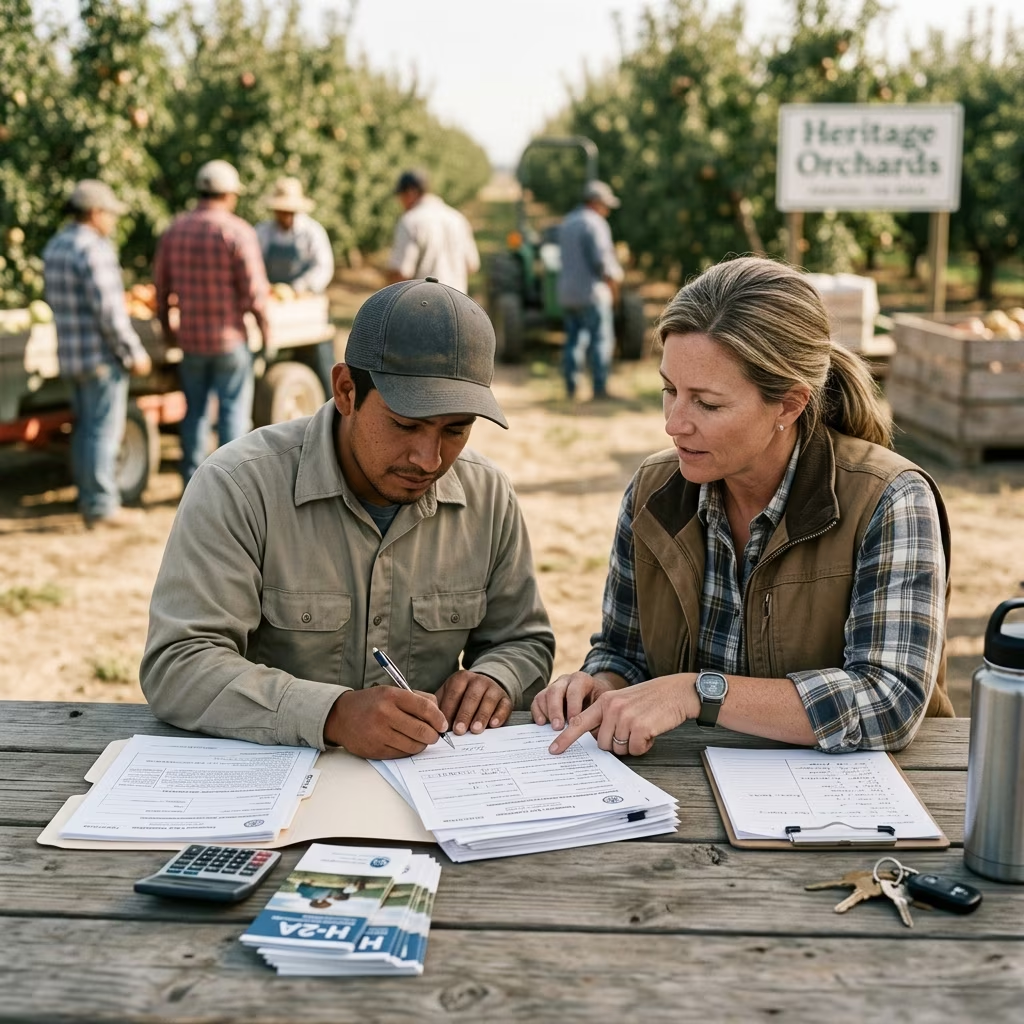
Employers who want to bring in foreign workers for seasonal or short-term jobs must follow a federal process that protects both U.S. workers and the incoming employee. In most cases, that process begins with temporary labor certification, a Department of Labor review that focuses on wages, recruitment, and the need for the job to be filled by a foreign national.
Temporary labor certification is not a single universal form. The exact filing path depends on the visa category, the type of work, and whether the job is agricultural or non-agricultural. For employers, the process can be time-sensitive and highly technical, but the core goal is consistent: show that the role is temporary, pay the required wage, and document an honest effort to recruit qualified U.S. workers first.
What temporary labor certification actually does
Temporary labor certification is a government determination that a U.S. employer may hire a nonimmigrant worker for a temporary need. It is most closely associated with the H-2A program for agricultural workers and the H-2B program for non-agricultural workers. The certification is generally required before the employer can move on to the immigration petition stage with U.S. Citizenship and Immigration Services.
The certification process gives the Department of Labor a chance to review the employer’s wage offer, working conditions, and recruitment efforts. In practice, the agency is asking whether the job opportunity is real, whether it is temporary, and whether available U.S. workers were given a fair chance to apply.
Which visa category uses certification
Not every temporary worker visa uses the same labor-market screening process. H-2A and H-2B cases depend on temporary labor certification, while H-1B cases use a different filing called a Labor Condition Application. That difference matters because employers often assume all temporary work visas follow the same procedure, when in fact the requirements are distinct.
The H-2A program is designed for temporary agricultural labor, such as harvesting, planting, and farm-related seasonal work. The H-2B program is for temporary non-agricultural jobs, such as hospitality, landscaping, maintenance, or other seasonal positions. Both programs involve federal recruitment rules and a wage review, but the forms and some obligations differ.
The main stages in the process
Although the paperwork differs between H-2A and H-2B, the overall path is similar. Employers generally move through three broad steps:
- Requesting the correct wage determination, when required
- Submitting the temporary employment certification application
- Completing the immigration petition after certification is approved
Each stage has deadlines and supporting documents. Missing a date or failing to document recruitment efforts can delay the case or lead to denial.
Wage rules are central to the filing
A core purpose of the certification process is to ensure that foreign labor does not undercut the wages and working conditions of U.S. workers. Employers must agree to pay at least the required prevailing wage for the occupation and location. That wage is meant to reflect the local market rate for the job, rather than a figure chosen solely by the employer.
For H-2B cases, the employer generally begins with an Application for Prevailing Wage Determination so the Department of Labor can identify the proper wage level before the main certification filing. In H-2A matters, the wage rules are handled through the agricultural program’s own process, so a separate prevailing wage request is not treated the same way as in H-2B cases.
In either category, the wage obligation is not just a technicality. It is part of the employer’s promise that hiring foreign workers will not depress standards in the local labor market.
Recruitment is not optional
Before the government approves the certification, the employer must show real recruitment efforts for U.S. workers. This generally means advertising the position, accepting applications, and evaluating qualified domestic applicants in good faith. The exact recruitment steps depend on the program, but the principle is the same: the employer must make a genuine effort to fill the job locally before turning to foreign labor.
Documentation is essential. Employers should retain evidence of where job orders were placed, what the advertisements said, when they ran, how applicants were contacted, and why any U.S. applicants were not hired. A strong paper trail can make the difference between an approved case and a stalled one.
Recruitment is also closely tied to the job description. If the employer advertises a role too narrowly, or changes the duties later, the Department of Labor may question whether the labor market test was fair and accurate.
What the application usually asks for
The temporary employment certification application is more than a form number. It is a package of disclosures about the employer, the job opportunity, wages, working conditions, and recruitment history. The application typically asks for the business’s identity, worksite location, dates of need, job duties, minimum requirements, and details about how the employer tried to hire U.S. workers.
For H-2B filings, the application package generally includes an attestation section in which the employer makes specific promises to the government. Those promises typically cover topics such as:
- There are not enough available, willing, and qualified U.S. workers
- The job is not open because of a strike or lockout
- The employer will follow applicable labor and employment laws
- The employer will continue the required recruitment effort for U.S. workers
H-2A filings contain similar commitments, although the forms and appendices are designed for agricultural work. In both programs, the declarations matter because they are legal promises, not just administrative checkboxes.
How H-2A and H-2B differ in practice
It is useful to compare the two programs side by side because the underlying logic is similar even though the mechanics differ. Agricultural employers using H-2A and non-agricultural employers using H-2B both need temporary labor certification, but the forms, wage steps, and recruitment structure are not identical.
| Feature | H-2A | H-2B |
|---|---|---|
| Type of work | Temporary agricultural labor | Temporary non-agricultural labor |
| Wage step | Handled through the agricultural certification process | Often begins with a prevailing wage determination request |
| Recruitment | Required and closely supervised | Required and documented through job order and advertisements |
| Purpose | Seasonal farm and agricultural labor shortages | Seasonal or short-term non-farm labor shortages |
Deadlines matter more than many employers expect
Temporary labor certification works on a calendar, not on a flexible business schedule. Employers are expected to file early enough for the Department of Labor to review the application, issue notices, and allow time for recruitment. In H-2B cases, employers commonly need to work backward from the date of need to avoid missing the filing window. In H-2A cases, the timeline also runs several weeks before the work begins.
Because these programs are time-sensitive, employers should prepare supporting information before filing rather than after. A delayed wage request, incomplete job order, or missing recruitment report can push the case beyond the intended start date and create staffing shortages.
Common mistakes that cause delays
Many certification problems come from preventable errors. Some employers underestimate how detailed the government review can be. Others make changes mid-process without realizing those changes affect eligibility.
- Submitting an incomplete wage request or missing attachments
- Advertising job terms that do not match the final filing
- Failing to document recruitment efforts clearly
- Using job duties that are too vague or inconsistent
- Missing filing deadlines for the certification or later petition
- Overlooking attestations about layoffs, strikes, or compliance obligations
A careful review before filing can reduce these risks. Employers should treat the certification packet as a coordinated compliance project rather than a simple HR form.
What happens after certification is granted
Approval from the Department of Labor is not the final step. Once the employer receives temporary labor certification, it must usually file a petition with USCIS, commonly Form I-129 for H-2 workers. The certification supports the petition by showing that the Department of Labor has already reviewed the labor-market portion of the case.
After USCIS approves the petition, the foreign worker may apply for a visa at a consulate abroad if one is needed, or seek admission at the border in certain situations. The labor certification therefore serves as the foundation for the immigration process, but it does not itself authorize work.
Why compliance continues after approval
Getting the certification approved does not end the employer’s duties. The promises made in the application continue to matter throughout the worker’s employment. Employers must pay the promised wage, maintain proper records, and follow all applicable labor rules. If the employer changes the job, the schedule, or the wage structure in a material way, the original certification may no longer fit the actual employment relationship.
That is why many employers treat temporary labor certification as an ongoing compliance obligation. The government is not only checking the application at the front end; it is also relying on the employer’s truthfulness and consistency throughout the life of the temporary job.
When legal guidance is especially useful
Some employers can manage a straightforward case internally, but many benefit from legal help. Counsel can identify the proper visa category, prepare the recruitment strategy, organize the supporting evidence, and help avoid filing errors that lead to delay. This is especially important when the job is unusual, the timeline is tight, or the business has past compliance issues.
Legal guidance can also be useful when the employer has multiple worksites, needs a large seasonal workforce, or is unsure whether the position fits H-2A or H-2B requirements. Because the programs have different forms and different obligations, choosing the wrong path can create expensive setbacks.
Questions employers ask most often
Is temporary labor certification the same as a visa?
No. Certification is a Department of Labor step that usually comes before the immigration petition. The visa or work authorization process happens later and typically involves USCIS and, if needed, a consulate.
Do all foreign-worker cases require the same filing?
No. H-2A, H-2B, and H-1B cases follow different rules. H-1B uses a Labor Condition Application, while H-2A and H-2B use temporary labor certification procedures.
Can an employer skip recruitment if no one is available?
No. Recruitment is part of the required showing. The employer must document efforts to find U.S. workers and explain why the position still needs a foreign worker.
How long does the process take?
The timeline varies by program, worksite, filing completeness, and agency workload. Employers should plan well in advance because both wage review and recruitment can take time before the immigration petition can even be filed.
What records should employers keep?
Employers should keep copies of wage requests, job orders, advertisements, recruitment reports, applicant communications, certifications, and all supporting declarations. Those records can be important if the government later questions the filing.
References
- H-2B Temporary Non-Agricultural Workers — U.S. Citizenship and Immigration Services. 2025-07-01. https://www.uscis.gov/working-in-the-united-states/temporary-workers/h-2b-temporary-non-agricultural-workers
- H-2B Temporary Non-agricultural Program — U.S. Department of Labor, Employment and Training Administration. 2025-07-01. https://www.dol.gov/agencies/eta/foreign-labor/programs/h-2b
- H-2A Temporary Certification for Agricultural Workers — U.S. Department of Labor, FLAG System. 2025-07-01. http://flag.dol.gov/programs/H-2A
- How To Get Temporary Labor Certification for Foreign Workers — Super Lawyers. 2025-07-01. https://www.superlawyers.com/resources/immigration/ohio/how-to-get-temporary-labor-certification-for-foreign-workers/