
How Email Collection Scams Drain Law Firms
A practical look at why collection-email fraud fools attorneys and how firms can reduce the risk.
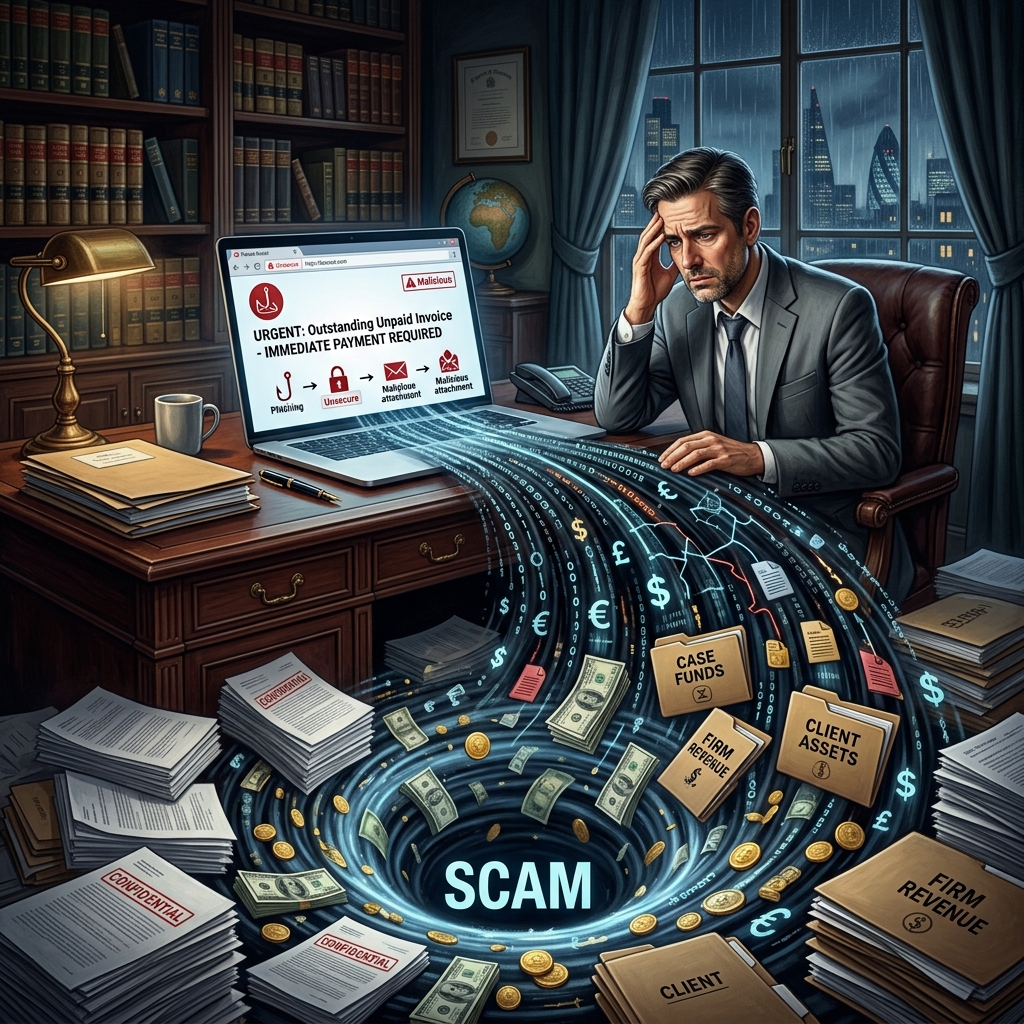
Law firms are increasingly being targeted by email-based collection scams that promise easy fees but hide counterfeit payments and overseas money transfers. These schemes work because they imitate a familiar part of legal practice: recovering money for clients.
The danger is not limited to a single bad check or one deceptive message. The fraud often unfolds in stages, beginning with a polished request for help, followed by a fake payment instrument, and ending with a demand that the lawyer move funds quickly before the bank detects the problem.
Why this scam is so effective
Collection-related fraud succeeds because it borrows the appearance of legitimate legal work. A prospective “client” claims to need assistance recovering a debt, collecting a settlement, or managing a commercial payment dispute. The pitch may include a fee for the lawyer and a simple instruction: receive funds in the United States, keep a portion, and send the rest elsewhere.
That structure looks routine enough to lower suspicion. It also plays to the realities of legal practice, where lawyers often handle incoming funds, trust accounts, and short deadlines. The scammer depends on a busy office moving quickly and assuming the payment has cleared.
- It imitates ordinary collection or settlement work.
- It creates a sense of urgency around payment handling.
- It uses counterfeit checks or money orders that may appear authentic at first.
- It relies on the gap between provisional credit and true bank finality.
How the scheme usually unfolds
The scam commonly begins with an email from a company, supposed business owner, or foreign contact seeking help collecting money. The message may sound professional and may include explanations about an unpaid invoice, settlement proceeds, or funds being held in another country.
After the lawyer shows interest, the fraudster sends a check or money order for the amount supposedly owed. In many cases, the document is counterfeit or otherwise invalid even if it appears convincing on first inspection. The lawyer is then urged to forward part of the money to another account, often overseas, and keep a fee for the firm.
The critical vulnerability is timing. Banks can make deposits temporarily available before fully verifying them, especially with larger or more complex items. If the lawyer disburses funds before the deposit is truly final, the firm may be left covering the loss when the payment fails.
| Stage | What the scammer does | Why it works |
|---|---|---|
| Initial contact | Sends a professional-looking collection request by email | Appears similar to ordinary client intake |
| Payment step | Provides a check or money order | May look legitimate long enough to create confidence |
| Disbursement step | Requests quick transfer of funds to another account | Uses urgency to outrun bank verification |
| Loss event | The deposit is reversed after funds are sent out | The firm absorbs the shortfall |
Why law firms are attractive targets
Law firms are especially appealing to fraudsters because they are trusted intermediaries. A lawyer can move money, communicate with banks, and give an air of legitimacy to a transaction. That trust is exactly what criminals want to exploit.
There is also a behavioral element. Lawyers are trained to respond to client needs, resolve disputes, and move matters efficiently. A scammer who frames the request as a simple collection matter can exploit that professional instinct. The result is a transaction that looks businesslike from the outside but is built on deception from the start.
Some versions of the fraud also resemble broader wire and payment scams that target legal professionals. Bar associations have warned that attorneys face increasing phishing, trust account, and transfer fraud risks, especially when a request involves money, urgency, and an unfamiliar sender.
Warning signs that deserve immediate scrutiny
Not every unsolicited legal inquiry is fraudulent, but several patterns should trigger skepticism. A request that arrives only by email, involves a foreign party, promises a substantial fee for limited work, or asks for fast movement of funds should be examined carefully.
- The “client” is reachable only by email.
- The other side is based outside the United States.
- The matter involves a large payment and a quick turnaround.
- Instructions change at the last minute by email.
- The sender pressures the firm to transfer money before confirmation.
Law firms should also be cautious when the sender’s identity cannot be independently verified. Fraud often depends on a false name, a spoofed email address, or a copied company identity that looks real until checked against a trustworthy source.
Simple controls that reduce risk
The best protection is not always advanced software. In many cases, the most effective defense is a disciplined verification process. One recommended approach is to confirm wire instructions verbally using a trusted phone number already in the firm’s records rather than a number included in an email.
Firms can also add anti-fraud language to engagement letters and email signatures. Clear warnings that wire instructions must be independently confirmed make it harder for a scammer to succeed through a single deceptive message.
- Verify payment instructions using a known phone number or established contact method.
- Train all staff members, not just lawyers, to spot suspicious payment requests.
- Require a second person to review unusual disbursements or settlement transfers.
- Hold incoming deposits until the bank confirms that funds have fully cleared.
- Review email security settings and account access regularly.
Why “available” is not the same as “safe”
One of the most important lessons in these cases is the difference between money that is merely available and money that has actually cleared. A bank may temporarily credit an account before the sending bank has completed the transfer process. That provisional access can create a false sense of security.
For law firms, that distinction matters. If funds are disbursed based on provisional availability rather than final settlement, the firm may later learn that the deposit was counterfeit or reversed. At that point, the lawyer may have already sent money to the scammer’s chosen destination.
This is why caution is particularly important when a transaction involves large sums, foreign accounts, or an unfamiliar party. The combination of those factors raises the stakes and increases the odds that the initial deposit is part of a fraud attempt.
How staff training helps stop losses
Fraud prevention cannot rest on a single attorney. Receptionists, paralegals, accounting staff, and assistants often see the first signs of a suspicious request. Regular training helps them recognize the hallmarks of scam emails before the matter reaches the trust account stage.
Training should cover common manipulation techniques, including urgency, authority, and secrecy. Staff should know that an email asking for a new payment destination, a different wire account, or an outside-of-normal procedure deserves verification before any action is taken.
Firms should also practice what to do when something looks wrong. A clear internal escalation path can prevent hesitation and ensure that suspicious matters are reviewed quickly by the right person.
What to do if a suspicious payment request arrives
When a suspicious collection email comes in, the safest response is to slow down and verify every detail independently. That means contacting the alleged sender through a source the firm already trusts, such as a known office number or an established directory listing.
If the message claims to come from a company or lawyer, verify the contact information through authoritative records rather than the email itself. If the payment is supposed to involve another attorney, confirming that the attorney is real and licensed through bar records adds an important safeguard.
- Pause any disbursement until the payment is fully verified.
- Check sender identity using independent contact information.
- Review the deposit instrument for inconsistencies or irregularities.
- Escalate unusual matters to a supervising attorney or fraud-response lead.
- Document the verification steps taken before moving any money.
Frequently asked questions
Why do scammers target lawyers instead of the general public?
Lawyers are trusted to receive, hold, and transfer money. That role gives scams a professional cover and makes the fraud seem more believable.
Can a deposited check still be fake even if the bank shows the money?
Yes. A bank may make funds temporarily available before the payment is truly final. If the item is counterfeit or later rejected, the deposit can be reversed.
What is the safest way to verify wire instructions?
Call a known, trusted number from the firm’s own records or another reliable source, not the number included in the email that sent the instructions.
Are these scams always cross-border?
No. Many involve foreign accounts or overseas parties, but the common feature is the request to move money quickly after a deceptive payment is received.
Should firms rely on insurance to cover the loss?
No. Prevention is the better defense. Guidance from bar associations emphasizes training, verification, and internal controls rather than assuming insurance will solve the problem.
The broader lesson for legal practices
Email collection scams are not sophisticated because they use cutting-edge technology alone. They are effective because they blend ordinary legal business, rushed decision-making, and counterfeit financial documents into one convincing package. The solution is equally practical: slow down, verify independently, and build firmwide habits that make fraud harder to execute.
For law firms, the real cost is not only the immediate financial loss. A successful scam can disrupt client trust, create operational headaches, and expose weaknesses in internal controls. The better question is not whether a firm can afford to spend time on verification, but whether it can afford not to.
References
- Lawyers Have Lost $70M and Counting to Email Collection Scam — FindLaw. 2026-07-10. https://www.findlaw.com/legalblogs/strategist/lawyers-have-lost-70m-and-counting-to-email-collection-scam/
- How to Stop This $475000 Email Scam from Happening to Your Law Firm — Illinois State Bar Association, 2Civility. 2025-??-??. https://www.2civility.org/stop-this-email-scam-from-happening-at-your-law-firm/
- Beware: Sophisticated Email Scams Targeting Lawyers — Utah State Bar. 2025-??-??. https://www.utahbar.org/beware-sophisticated-email-scams-targeting-lawyers/
- Scams targeting lawyers and trust accounts — Wisconsin Courts, Office of Lawyer Regulation. 2024-??-??. https://www.wicourts.gov/courts/offices/docs/olrscams.pdf
- Fraud Alert: New and Old Scams Targeting Attorneys — State Bar of California. 2025-??-??. https://www.calbar.ca.gov/legal-professionals/fraud-alert-scams-impacting-attorneys
Similar Articles








Read full bio of medha deb


