
How Educational Gag Orders Threaten America’s Classrooms
Classroom censorship is rising, but students are fighting back.
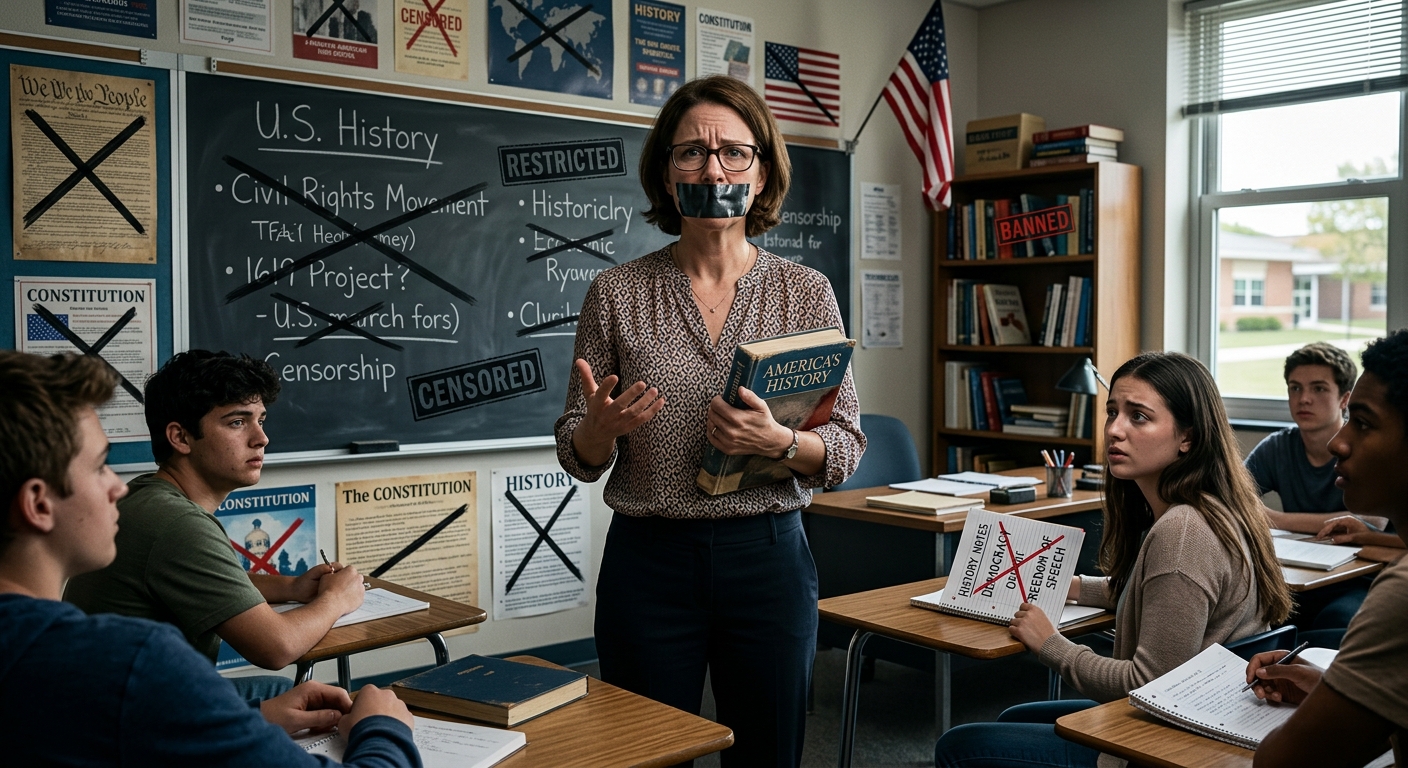
In classrooms across the United States, an aggressive battle is being waged over the fundamental purpose of public education. It is not merely a debate over teaching methodologies or standardized testing; rather, it is a coordinated campaign to control what information, history, and ideas students are permitted to encounter. “Educational gag orders”—a term used to describe state laws, policies, and local directives aimed at restricting classroom discussions on topics like race, gender, and sexuality—have swept through statehouses and school board meetings with unprecedented momentum. Behind the legislative rhetoric of “parental rights” lies a chilling reality: a systematic effort to censor marginalized voices and sanitize American history. As curricula are stripped of nuance and school library shelves are emptied of diverse perspectives, the most profoundly affected stakeholders—the students themselves—are raising the alarm. The narrative surrounding classroom censorship often centers on adult politicians and administrators, yet it is the students who sit in these censored classrooms every day. Their perspectives are crucial to understanding the true cost of these policies.
The Modern Architecture of Classroom Censorship
The mechanisms of classroom censorship have evolved drastically over the last few decades. Historically, attempts to ban a book or alter a lesson plan originated from an individual parent expressing concern over a specific piece of material. Today, however, educational censorship is largely characterized by highly organized, well-funded political campaigns that leverage state legislation to enact sweeping bans. This modern architecture of censorship does not target single controversial paragraphs; it targets entire subjects, identities, and historical truths.
Recent data paints a stark picture of this escalating trend. According to the American Library Association (ALA), 2025 saw a record-breaking 5,668 books banned or censored in public and school libraries, representing an unprecedented surge in challenges . Notably, the ALA found that 92 percent of these challenges were initiated by pressure groups, political decision-makers, or government officials, compared to a mere 2.7 percent originating from individual parents . This statistical reality dismantles the widely publicized argument that these movements are “grassroots” parental efforts. Instead, they are top-down political strategies designed to suppress narratives that challenge a specific ideological worldview.
State legislatures have been equally aggressive. By passing vaguely worded laws that prohibit the teaching of “divisive concepts,” lawmakers have created a pervasive atmosphere of fear among educators. Teachers, unsure of where the legal lines are drawn, often engage in self-censorship, preemptively removing books or skipping historical events to avoid professional retaliation, public shaming, or even termination.
Legal Framework: The First Amendment in Schools
To understand the gravity of educational gag orders, one must examine the legal and constitutional foundation of students’ rights in public schools. The intersection of the First Amendment and public education has long been a complex area of jurisprudence, balancing the authority of school boards to set curricula with the constitutional rights of students to learn and express themselves.
The landmark 1982 Supreme Court case, Board of Education v. Pico, serves as a crucial legal anchor in the fight against library censorship. In a plurality decision, the Court ruled that local school boards may not remove books from school library shelves simply because they disagree with the ideas contained within those books . The ruling famously declared that the First Amendment protects the right to receive information and ideas, noting that school libraries are environments specifically dedicated to voluntary inquiry.
However, the modern censorship movement frequently attempts to bypass the spirit of Pico by focusing its efforts on mandatory curricula rather than voluntary library reading, or by framing the removal of LGBTQ+ and racial materials as an issue of “educational suitability” rather than ideological disagreement. Proponents of gag orders argue that the state—and by extension, the local school board—has absolute authority to dictate the bounds of classroom instruction. Yet, civil rights advocates and legal scholars argue that when these curricular decisions are explicitly motivated by racial animus or a desire to silence political viewpoints, they cross the line into unconstitutional viewpoint discrimination.
Erasure by Legislation: Target Demographics
A critical analysis of the books being removed and the lessons being banned reveals a clear pattern: the censorship disproportionately targets historically marginalized communities. The vast majority of challenged materials center on LGBTQ+ characters, explore the history of civil rights, or are authored by people of color.
For LGBTQ+ students, the erasure is immediate and devastating. Laws broadly referred to as “Don’t Say Gay” bills prohibit instruction or even classroom discussion regarding sexual orientation and gender identity. In practice, this means an educator could be penalized for displaying a photograph of their same-sex spouse or for validating a student’s chosen pronouns. When school libraries remove memoirs of queer youth or coming-of-age novels featuring gay protagonists, the implicit message sent to LGBTQ+ students is that their identities are inherently taboo, shameful, or dangerous.
Similarly, educational gag orders targeting discussions of systemic racism deny students of color the opportunity to see their ancestors’ struggles and triumphs reflected in the curriculum. Sanitizing history to remove the uncomfortable realities of slavery, segregation, and institutionalized inequality does not protect students; it alienates those who live with the legacy of these historical injustices. The psychological toll of this erasure is immense. When students are told that their identities or histories are inappropriate for academic settings, it fosters a hostile educational environment and significantly undermines their sense of belonging and self-worth.
The High School Perspective: Students Strike Back
Despite the formidable political machinery driving educational gag orders, a powerful counter-movement has emerged from within the very classrooms being targeted. High school students across the nation are refusing to be passive recipients of a redacted education. Recognizing that their intellectual development and future civic participation are at stake, young people are organizing and demanding their right to learn.
Student activism against classroom censorship takes many forms. Across various states, students have staged large-scale walkouts to protest anti-LGBTQ+ legislation and curriculum bans. They are showing up at contentious school board meetings, taking to the podium during public comment periods to eloquently defend their teachers and their right to read diverse literature. Furthermore, students are forming independent, extracurricular reading groups and “banned book clubs,” creating safe spaces outside the formal curriculum to discuss the very texts their schools have attempted to suppress.
This youth-led resistance highlights a profound irony in the censorship movement. By attempting to shield students from complex ideas, lawmakers have inadvertently catalyzed a generation of politically engaged, critical thinkers. These students are experiencing a real-time lesson in civics and constitutional law. They understand that their education is a tool for empowerment, and they are fiercely guarding it against those who seek to blunt its edge.
Educational Deficits: The Price of a Sanitized Syllabus
The consequences of educational gag orders extend beyond the immediate emotional and psychological harm inflicted on marginalized students; they threaten the academic integrity of the entire educational system. A robust education requires grappling with complex, uncomfortable, and multifaceted truths. When curricula are reduced to a series of uncontroversial, state-approved facts, the development of critical thinking skills is severely stunted.
In a globalized and deeply interconnected world, students must be prepared to navigate diverse perspectives and complex social dynamics. An education that avoids the realities of race, gender, and inequality leaves students ill-equipped to participate meaningfully in a democratic society or to succeed in higher education and the modern workforce. The chilling effect is already permeating beyond the K-12 level. According to a 2026 report by PEN America, the web of control has expanded so drastically that more than half of all students at U.S. colleges and universities now study in a state with at least one law or policy restricting what can be taught . This indicates a pipeline of censorship, where the intellectual deficits fostered in high school are compounded by restrictions at the university level.
If students are not taught how to analyze differing viewpoints or confront historical injustices, they are left vulnerable to misinformation and lacking the empathy required for civic engagement. The price of a sanitized syllabus is a generation of citizens unprepared for the complexities of the real world.
Moving Forward: Community Action and Academic Freedom
The fight against educational gag orders requires active participation from the entire community. While student activists are leading the charge on the ground, they need the support of adult allies and legal organizations to effect lasting change. Here are several ways communities can protect academic freedom:
- Engage in Local Elections: School board elections are the primary battlegrounds for educational policy. Voting for candidates committed to inclusive education is a critical first step.
- Attend Board Meetings: Citizens must show up to actively support educators and administrators who are facing immense pressure from censorship advocacy groups.
- Support Legal Advocacy: Organizations dedicated to civil liberties rely on community support to challenge vaguely worded gag orders in court and defend First Amendment rights.
- Empower Student Voices: Provide resources, safe spaces, and platforms for students organizing banned book clubs and peaceful protests.
Frequently Asked Questions (FAQ)
What exactly is an educational gag order?
An educational gag order is a legislative mandate or state policy that restricts teachers and school districts from discussing specific topics in the classroom. Most commonly, these orders target subjects related to race, racism, sexual orientation, gender identity, and American history.
Why are so many books being banned right now?
The current surge in book bans is driven largely by organized political pressure groups rather than individual parental complaints. These groups use coordinated lists of targeted books—mostly featuring LGBTQ+ characters or authors of color—to pressure local school boards and libraries into removing the materials.
Don’t parents have a right to control what their children learn?
Parents have the right to direct the upbringing of their own children, and they can often request alternative assignments. However, courts have consistently held that a parent’s right to control their own child’s education does not give them the right to dictate the broader curriculum or remove library books for all other students in a public school district.
How does the First Amendment protect students in public schools?
The First Amendment protects students’ rights to free expression and their right to receive information. While school boards have broad discretion over curricula, the Supreme Court ruled in Board of Education v. Pico that they cannot remove library books simply because they disagree with the political or social ideas expressed in those texts.
Conclusion
The ongoing wave of educational censorship represents a profound threat to the foundational ideals of American public education. By weaponizing legislation to silence marginalized voices and sanitize history, proponents of gag orders are compromising the intellectual growth of millions of students. However, the resilient pushback from high schoolers themselves provides a beacon of hope. Their refusal to accept a diminished education underscores a powerful truth: curiosity cannot be legislated out of existence. Protecting the classroom as a marketplace of ideas is essential not only for the holistic development of individual students but for the preservation of a vibrant, informed, and empathetic democracy. We cannot let classroom censorship win, because to do so would be to forfeit the future.
References
- Censorship by the Numbers: Banned Books Data — American Library Association. 2026-04-20. https://www.ala.org/advocacy/bbooks/banned-books-data
- BOARD OF EDUCATION v. PICO, 457 U.S. 853 (1982) — FindLaw / Supreme Court of the United States. 1982-06-25. https://caselaw.findlaw.com/court/us-supreme-court/457/853.html
- PEN America Warns of Expanding Web of Control as Politicians Escalate Campaign to Censor U.S. Colleges and Universities — PEN America. 2026-01-15. https://pen.org/press-release/pen-america-warns-of-expanding-web-of-control-as-politicians-escalate-campaign-to-censor-u-s-colleges-and-universities/
Similar Articles








Read full bio of Sneha Tete


