
How California’s Data Privacy Laws Affect You Everywhere
Understanding California’s privacy rules, your data rights, and why businesses worldwide must now treat personal information more carefully.
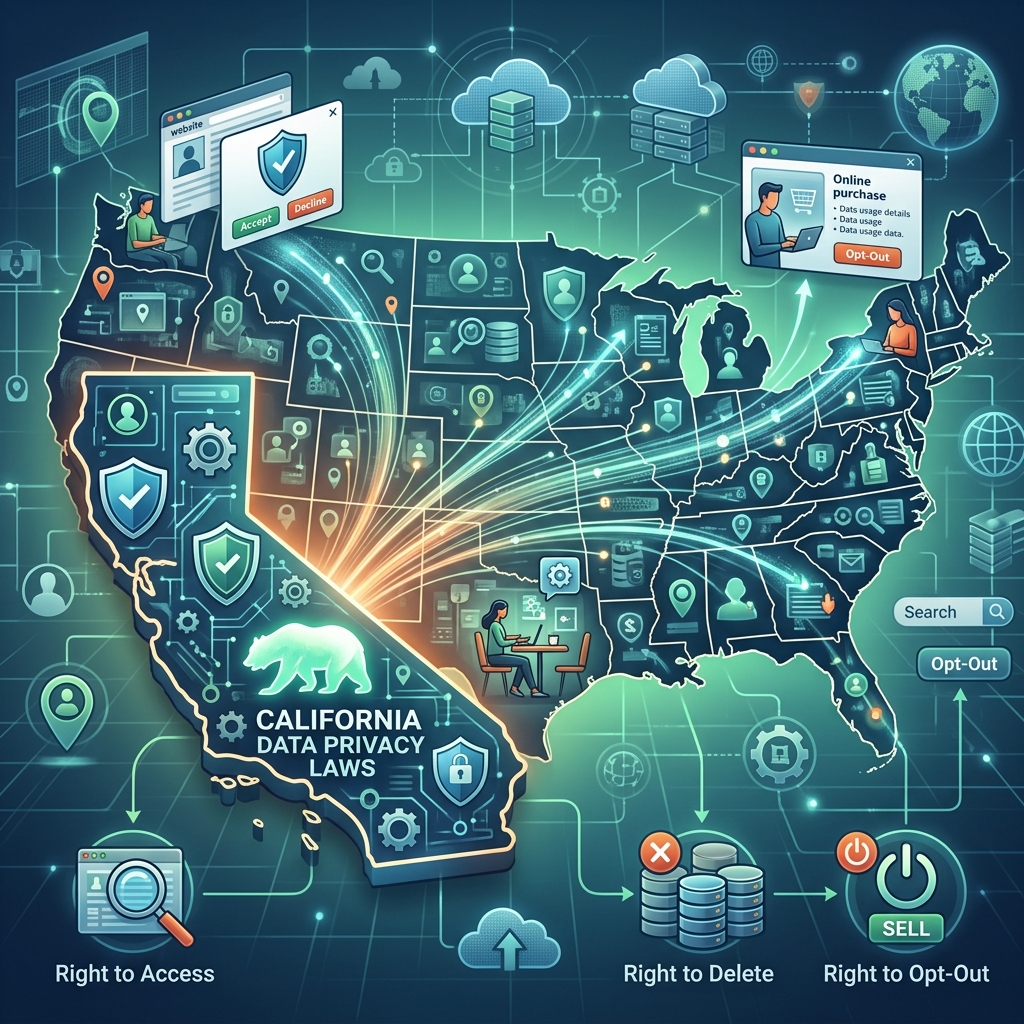
California has adopted some of the strongest data privacy laws in the United States, led by the California Consumer Privacy Act (CCPA) and its expansion, the California Privacy Rights Act (CPRA). These laws give residents powerful rights over how businesses collect, use, and share their personal information, and they also reshape how companies across the country handle data.
Even if you never set foot in California, these rules can still influence how your data is treated. Many businesses choose to adopt California’s standards nationwide to simplify compliance and maintain consumer trust.
From CCPA to CPRA: The Core Privacy Framework
The California Consumer Privacy Act (CCPA) took effect on January 1, 2020 and created a baseline set of privacy rights for California residents. In 2020, voters approved Proposition 24, the California Privacy Rights Act (CPRA)
What These Laws Aim to Do
Together, CCPA and CPRA are designed to:
- Increase transparency around how personal information is collected and used.
- Give individuals meaningful choices about data sharing and sale.
- Impose security and governance obligations on businesses that handle large amounts of personal data.
- Create enforcement mechanisms and penalties for violations and inadequate security practices.
Key Consumer Rights Under CCPA and CPRA
For California residents, the laws grant several central rights over personal information collected by businesses.
- Right to know what personal information a business collects, uses, sells, or shares.
- Right to delete personal information collected from them, subject to certain exceptions.
- Right to opt out of the sale or sharing of personal information, including through online signals like the Global Privacy Control (GPC).
- Right to non-discrimination when they exercise privacy rights (for example, a business generally cannot charge higher prices solely for opting out).
- Right to correct inaccurate personal information that a business holds (added by CPRA).
- Right to limit the use and disclosure of sensitive personal information, such as precise geolocation, financial account numbers, or genetic data (added by CPRA).
Which Businesses Must Comply?
California’s privacy laws do not apply to every organization. Instead, they focus on for-profit entities that meet specific thresholds and collect personal information from California residents.
Core Applicability Criteria
Under the CCPA framework, a business is covered when it collects personal information from California residents and meets at least one of the following criteria:
- Gross annual revenue above $25 million.
- Buys, receives, sells, or shares personal information of more than 50,000 California residents.
- Derives at least 50% of its annual revenue from selling personal information of California residents.
CPRA adjusts and expands these concepts, including updating thresholds for the number of consumers whose data is processed and adding obligations around sensitive personal information and targeted advertising.
Implications for Organizations Outside California
A business does not need to be physically located in California for these laws to apply. If an organization interacts with California residents online, ships products to them, or otherwise collects their data while meeting the statutory thresholds, California privacy rules likely apply.
Many companies that serve national or global markets choose to implement a single privacy program based on California standards. This strategy simplifies compliance and avoids creating different rights for customers depending on their state.
What Counts as “Personal Information”?
CCPA and CPRA have a broad definition of personal information. It includes any information that identifies, relates to, describes, or could reasonably be linked with a particular consumer or household.
Common Examples
- Names, addresses, phone numbers, email addresses.
- Account usernames and associated credentials.
- Government identifiers such as Social Security numbers.
- Online identifiers like cookies, IP addresses, and device IDs.
- Location data that can pinpoint where someone is or has been.
- Purchase history and browsing activity on websites or apps.
Sensitive Personal Information Under CPRA
CPRA introduces the concept of sensitive personal information, which receives extra protections. Examples include precise geolocation, financial account numbers, racial or ethnic origin, and genetic data. Individuals can instruct businesses to restrict use of this sensitive data to limited purposes, such as providing requested services.
How These Laws Affect You If You Live Outside California
Even if you are not a California resident, you may experience indirect benefits and changes because of these laws. Businesses often redesign their privacy practices and user experiences for all customers, not just Californians.
Practical Ways You May See Changes
- More detailed privacy notices explaining what data is collected and why, influenced by California’s notice-at-collection requirements.
- New “Do Not Sell” or “Do Not Share” links on websites, allowing users to opt out of data sales or targeted advertising.
- Tools to access or delete your data, even if the company technically only has to offer those options to California residents.
- Greater focus on cybersecurity, because inadequate security can lead to penalties and lawsuits when data breaches occur.
- Consistency in privacy practices across U.S. customers, reducing confusion about who has which rights.
Why Businesses Extend California Rights More Broadly
Organizations may voluntarily extend CCPA/CPRA-style rights to all users for several reasons:
- Operating one unified privacy program is simpler than managing different rules by state.
- Providing robust privacy protections builds trust and brand reputation.
- Other states are adopting similar laws, so national alignment anticipates future regulation.
Obligations and Risks for Businesses
For covered businesses, compliance is not optional. California’s laws create concrete obligations and significant consequences for non-compliance.
Core Compliance Duties
- Provide required notices at or before data collection, explaining categories of information and purposes of use.
- Maintain procedures to respond to access, deletion, correction, and opt-out requests within mandated timeframes.
- Implement reasonable security measures to protect personal data from unauthorized access or breaches.
- Review contracts with service providers to ensure they meet privacy requirements and do not misuse data.
- Limit use of sensitive personal information according to consumer instructions and regulatory guidance.
Penalties and Enforcement Risks
Organizations that violate California’s privacy laws face both regulatory and civil exposure.
- Regulators can impose fines of up to $7,500 per intentional violation and $2,500 per unintentional violation under CCPA.
- Consumers may pursue legal actions if a business fails to implement reasonable security and a breach compromises their personal information.
- CPRA empowers a dedicated enforcement agency, increasing oversight and scrutiny of compliance programs.
Comparison Table: CCPA vs. CPRA (High-Level)
| Feature | CCPA | CPRA (Amendment) |
|---|---|---|
| Effective date | January 1, 2020 | Key additions effective January 1, 2023 |
| Core rights | Know, delete, opt out, non-discrimination | Adds right to correct and limit use of sensitive data |
| Sensitive personal information | Not separately defined. | Defined with special limitations and protections. |
| Enforcement structure | Primarily through the Attorney General. | Creates the California Privacy Protection Agency for dedicated enforcement. |
| Scope of businesses | Revenue and data volume thresholds. | Refines thresholds and expands coverage for high-volume processors. |
New and Emerging California Privacy Developments
Beyond CCPA and CPRA, California continues to update and refine its privacy landscape with additional laws that address specific technologies and practices.
Examples of Recent Initiatives
- Opt-out preference signals: A law commonly referred to as the “Opt Me Out” Act requires browsers to include functionality that allows consumers to send an opt-out preference signal, making it easier to communicate do-not-sell or do-not-share choices automatically.
- Social media account deletion rules: Certain large platforms must offer a clear, prominent way for users to request account deletion, improving control over online profiles.
- Data broker transparency: Updates to data broker registration requirements demand more detailed disclosures about what categories of data are collected and how they are used.
These newer laws build on the foundation of CCPA and CPRA, and they further signal California’s role as a leading jurisdiction on digital privacy.
Practical Tips for Individuals
Whether you live in California or elsewhere, you can take proactive steps to protect your data and take advantage of the tools businesses now provide.
Steps You Can Take Today
- Review privacy notices on the websites and apps you use regularly.
- Look for links such as “Privacy,” “Your Privacy Choices,” or “Do Not Sell or Share My Personal Information.”
- Submit access requests to see what information a business holds about you, where allowed.
- Use deletion tools to remove old accounts or data that you no longer need online.
- Enable browser-based signals like Global Privacy Control (GPC) if supported, to automatically convey your opt-out preferences.
Practical Tips for Businesses
Organizations that touch California residents’ data need a structured approach to privacy compliance. Even smaller companies outside California can benefit from aligning with these standards.
Foundations of a Strong Privacy Program
- Assess applicability: Determine whether your business meets revenue or data thresholds tied to California residents.
- Map data flows: Document what personal information you collect, how it is processed, and where it is stored or shared.
- Update policies: Revise privacy policies and internal procedures to reflect CCPA/CPRA rights and obligations.
- Train staff: Educate customer-facing and technical teams about handling rights requests and protecting personal data.
- Monitor legal updates: Track new California laws and related guidance from regulators and courts.
FAQs: California Data Privacy Laws and You
Do California privacy laws apply to me if I’m not a resident?
CCPA and CPRA rights formally apply to California residents. However, many businesses extend similar controls and tools—such as data access or deletion—to all users. You may benefit from these changes even if you live in another state.
Can a business charge me for exercising my privacy rights?
California law includes a right to non-discrimination, which prohibits businesses from treating residents unfairly just because they exercise privacy rights, such as opting out of the sale or sharing of their data. There may be differences in pricing or service tiers in some circumstances, but they must comply with detailed statutory rules.
Is targeted advertising considered a “sale” of personal information?
Under CPRA, sharing personal information for certain types of cross-context behavioral advertising can fall under rules similar to sale or sharing of data, meaning consumers must be able to opt out of that activity.
How do I submit a privacy request to a business?
Businesses subject to CCPA/CPRA typically provide designated methods for requests, such as web forms, toll-free numbers, or email addresses described in their privacy policies. Look for sections titled “Your Privacy Rights” or similar language.
What happens if a company suffers a data breach?
If a business fails to implement reasonable security measures and a breach exposes consumers’ personal information, California law allows affected individuals to seek statutory damages in certain circumstances. Regulators may also investigate and impose penalties, especially where systemic security failures are involved.
References
- California Consumer Privacy Act (CCPA) — California Office of the Attorney General. 2023-01-01. https://oag.ca.gov/privacy/ccpa
- What Is the California Consumer Privacy Act (CCPA)? — Palo Alto Networks. 2023-06-01. https://www.paloaltonetworks.com/cyberpedia/ccpa
- California Consumer Privacy Act (CCPA) — Electronic Privacy Information Center (EPIC). 2022-09-01. https://epic.org/california-consumer-privacy-act-ccpa/
- California Privacy Rights Act (CPRA): Compliance Guide — Kiteworks. 2024-03-01. https://www.kiteworks.com/risk-compliance-glossary/california-privacy-rights-act/
- Why California’s New Data Privacy Law Matters — CivicPlus. 2023-07-01. https://www.civicplus.com/blog/wa/california-privacy-laws/
- California Enacts New Privacy Laws — Inside Privacy (Covington & Burling LLP). 2023-10-09. https://www.insideprivacy.com/state-privacy/california-enacts-new-privacy-laws/
- Effects of and Responses to the GDPR and CCPA — UC Berkeley Center for Long-Term Cybersecurity. 2021-04-01. https://cltc.berkeley.edu/publication/privacy-legislation-on-the-ground/
Similar Articles








Read full bio of medha deb


