
Understanding Homeowner Liability for Invitees, Licensees, and Trespassers
A practical guide to how homeowner liability changes with invitees, licensees, trespassers, and the level of care owed to each type of visitor.
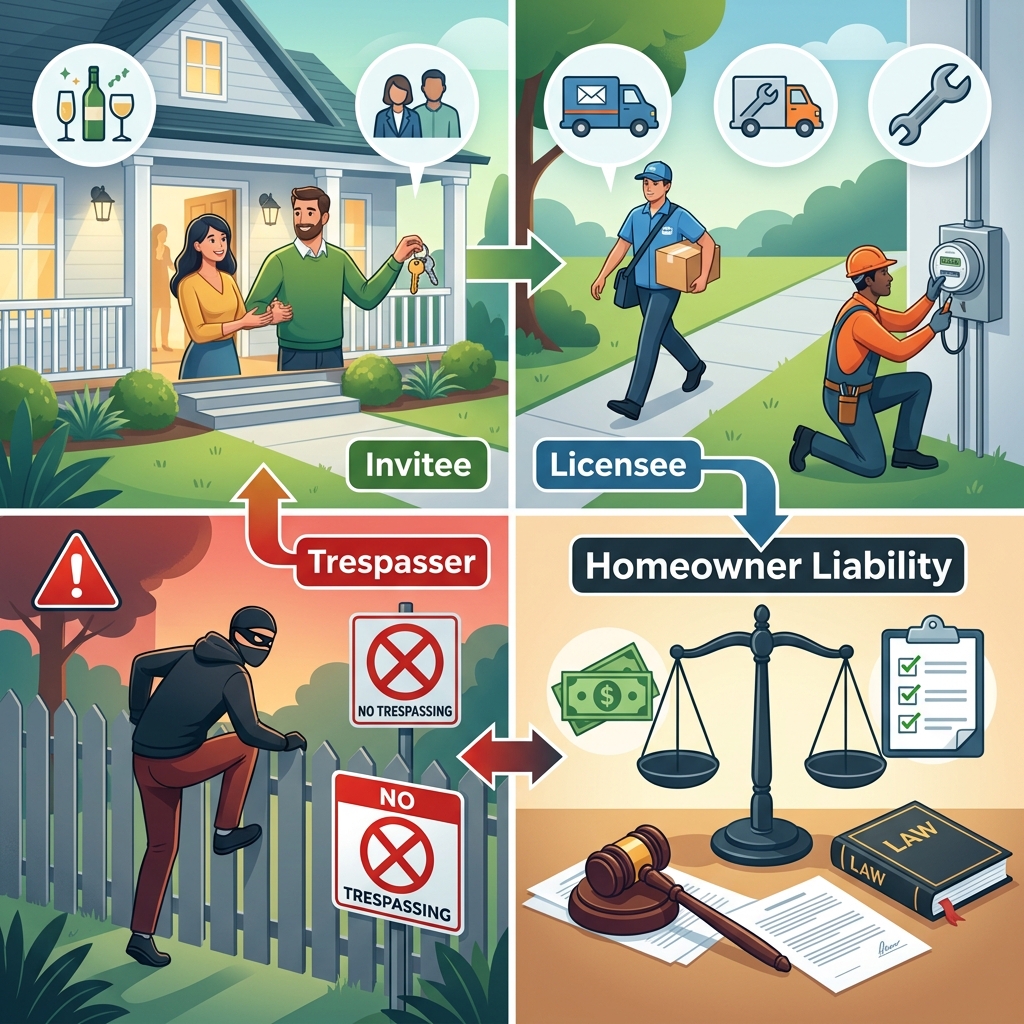
Homeowners are not automatically responsible for every injury that occurs on their property. Instead, liability usually depends on who was injured, why they were on the property, and what the homeowner did (or failed to do) to prevent harm. These questions form the core of premises liability law, which governs when property owners must pay for injuries suffered by visitors.
This article explains how the law categorizes visitors as invitees, licensees, and trespassers, and how a homeowner’s duty of care changes with each category. It also offers practical examples, risk management tips, and answers to common questions.
Premises Liability Basics for Homeowners
Premises liability refers to a property owner’s legal responsibility for injuries caused by unsafe conditions on their land or in their buildings. The law does not require homeowners to guarantee absolute safety, but it does expect a reasonable level of care, tailored to the type of visitor and the circumstances.
Courts often focus on whether the homeowner:
- Knew or should reasonably have known about a dangerous condition.
- Recognized that the condition created an unreasonable risk of harm.
- Took reasonable steps to fix the problem or warn visitors.
- Failed to act, and that failure directly caused the injury.
These elements tie into the broader concept of negligence: a failure to use reasonable care under the circumstances, leading to harm.
Visitor Status: Why It Matters So Much
In most states, a person who steps onto someone else’s property is classified into one of three main categories:
- Invitee – on the property for a purpose that benefits the owner, often business-related or public.
- Licensee – on the property with permission for social, personal, or other non-business reasons.
- Trespasser – on the property without consent or legal privilege.
This classification matters because the degree of care the homeowner owes each type of visitor is different. Invitees receive the highest level of protection, licensees receive a moderate level, and trespassers receive the lowest.
Invitees: Highest Duty of Care
An invitee is someone on the property because the owner has expressly or implicitly invited them for a purpose that benefits the owner or serves a public function. In the residential context, invitees may include contractors, delivery personnel, or people attending a paid event or home-based business activity.
What Makes Someone an Invitee?
- They enter for business or commercial reasons, such as performing paid work or making deliveries.
- They attend an open house, sale, or similar event that benefits the owner financially.
- They are members of the public invited onto property used for a public purpose.
Legal Duties Owed to Invitees
Homeowners owe invitees the highest duty of care under premises liability law. This typically includes:
- Inspecting the property regularly to identify hazards that might cause harm.
- Fixing dangerous conditions within a reasonable time or blocking access to them.
- Warning invitees of concealed or hidden dangers that might not be obvious.
Courts often apply a three-part test to determine whether a homeowner is liable for invitee injuries:
| Element | Meaning |
|---|---|
| Knowledge | The owner knew, or should have discovered with reasonable care, the dangerous condition. |
| Expectation | The owner should expect invitees will not spot the danger or will fail to protect themselves. |
| Protection | The owner did not exercise reasonable care to protect invitees against that danger. |
Examples of Invitee-Related Risks
- A contractor falls through a weakened porch floor the homeowner knew about but did not repair or warn about.
- A delivery driver slips on icy steps when the homeowner failed to treat the ice after noticing it earlier that day.
In these situations, courts may find the homeowner liable if reasonable maintenance or warnings could have prevented the injury.
Licensees: Social Guests and Non-Business Visitors
A licensee is a person allowed on the property for their own purposes, not primarily to benefit the owner financially. Most social guests fall into this category: friends, relatives, neighbors dropping by for a visit, or someone using the property for a lawful, non-commercial reason with the owner’s consent.
Who Is a Licensee?
Typical licensees include:
- Friends invited for dinner or a backyard gathering.
- Family members visiting overnight.
- Neighbors invited to use the yard, pool, or driveway.
Duties Owed to Licensees
Homeowners owe licensees a moderate duty of care, which is less demanding than what is owed to invitees. This usually includes:
- Warning licensees of known hidden dangers that the owner is aware of but the guest is unlikely to discover easily.
- Refraining from willful or wanton conduct that places the guest in unreasonable danger.
Unlike the duty owed to invitees, homeowners typically are not required to inspect the property specifically for licensees or to discover unknown dangers before social guests arrive.
When Can Licensees Recover for Injuries?
To hold a homeowner liable, a licensee often must show:
- The owner knew about the hazard or had reason to know it existed.
- The owner did not warn the guest about the hazard.
- The guest was unaware of the dangerous condition and could not reasonably have discovered it.
For example, if a homeowner knows that a deck railing is loose but says nothing to a visiting friend, and the friend leans on the rail and falls, a court may treat this as a breach of the duty owed to licensees.
Trespassers: Minimal Duty, Important Limits
A trespasser is someone who enters or remains on the property without the owner’s consent or legal right. Trespassers receive the lowest level of legal protection, but homeowners are not free to endanger them deliberately.
Definition of a Trespasser
- They come onto the property without permission.
- They remain after permission has clearly been revoked.
- They have no legal privilege (such as emergency responders acting within their duties).
Duties Owed to Adult Trespassers
For adult trespassers, the homeowner’s duty of care is typically limited to avoiding willful, wanton, or reckless misconduct. That means:
- The owner generally has no duty to inspect or make the premises safe for trespassers.
- The owner must not set traps or intentionally create hazards designed to injure trespassers.
- In some jurisdictions, recklessly ignoring highly dangerous conditions when trespassers are known or anticipated may also lead to liability.
Many courts allow trespassers to recover damages only when the owner engages in extreme misconduct, such as deliberately causing harm or acting with a conscious disregard of a known, serious risk.
Child Trespassers and Attractive Hazards
The law often treats child trespassers differently, recognizing that young children may not fully understand risks. Many states apply a doctrine often referred to as the “attractive nuisance” or related principles, under which owners may have a duty to protect children from hazards that are likely to attract them.
Courts commonly consider whether:
- The hazard is likely to attract children (e.g., a swimming pool, abandoned vehicle, or construction site).
- The child, due to age, cannot appreciate the danger or protect themselves from it.
- The owner could reasonably foresee that children may trespass to access the hazard.
- The owner failed to exercise reasonable care to remove or guard against the danger.
In such cases, even if the child is technically a trespasser, the homeowner may be liable for injuries when safety measures—like fencing a pool—would have reasonably reduced the risk.
Comparing Duties: Invitees, Licensees, and Trespassers
The table below summarizes the typical differences in duties owed under premises liability law.
| Visitor Type | Purpose | Duty of Care | Key Obligations |
|---|---|---|---|
| Invitee | Business or public benefit to owner | Highest | Inspect property; fix hazards; warn of hidden dangers; maintain reasonable safety. |
| Licensee | Social or personal visit with permission | Moderate | Warn of known hidden dangers; avoid willful or reckless exposure to harm; no broad duty to inspect. |
| Adult Trespasser | On property without consent | Minimal | Avoid willful, wanton, or reckless harm; no general duty to make premises safe. |
| Child Trespasser | On property without consent, often drawn by a hazard | Varies (often higher than adult trespasser) | In many states, reasonable steps to protect children from attractive hazards; foreseeability and child’s ability to appreciate danger are crucial. |
How Courts Evaluate Premises Liability Claims
Although rules vary by state, courts often rely on negligence principles when deciding whether a homeowner is responsible for a visitor’s injuries. A successful premises liability claim generally requires proof of:
- Duty – The homeowner owed the visitor a legal duty of care based on their status.
- Breach – The homeowner failed to meet that duty, such as by not fixing a known hazard or failing to warn of it.
- Causation – The breach directly caused the injury; the dangerous condition and the owner’s failure to act must be linked to the harm.
- Damages – The visitor suffered actual, compensable harm (medical bills, lost wages, pain and suffering, etc.).
Even if a dangerous condition exists, a homeowner may avoid liability if the visitor knew about the risk, voluntarily accepted it, or behaved in a way that significantly contributed to the injury.
Practical Risk-Reduction Tips for Homeowners
Homeowners can reduce liability exposure through a combination of reasonable maintenance, clear communication, and attention to known risks.
General Safety Measures
- Conduct periodic walkthroughs of your home and yard to check for hazards like loose railings, uneven steps, and inadequate lighting.
- Repair or cordon off dangerous areas promptly once you become aware of them.
- Use visible signs or verbal warnings when you cannot immediately fix a known hazard.
- Ensure walkways, stairs, and entry points are kept clear of debris, ice, and other slipping or tripping risks.
Protecting Invitees and Licensees
- Notify contractors and delivery personnel of any structural issues or potential safety concerns.
- Tell social guests about non-obvious risks, such as weak steps, loose tiles, or low-hanging obstacles.
- If hosting events, consider lighting, crowd flow, and access to potentially hazardous areas like basements or balconies.
Addressing Trespasser Risks
- Avoid creating traps or intentionally dangerous conditions aimed at deterring trespassers.
- Secure attractive hazards—such as pools, trampolines, or construction zones—especially where children may be present.
- Use fencing, locked gates, and clear “No Trespassing” notices where appropriate.
Frequently Asked Questions (FAQs)
1. Does a homeowner always owe the same duty of care to every visitor?
No. The duty of care depends heavily on whether the visitor is classified as an invitee, licensee, or trespasser, and sometimes whether the visitor is an adult or a child. Invitees receive the highest level of protection, licensees receive moderate protection, and trespassers receive minimal protection subject to important limits on willful and reckless conduct.
2. Are social guests treated the same as delivery drivers or contractors?
Usually not. Social guests are generally treated as licensees, while delivery drivers and contractors are commonly considered invitees because they are on the property for reasons that benefit the homeowner or relate to business. The homeowner typically owes invitees a more demanding duty, including active inspection and hazard correction, compared to the duty owed to licensees.
3. Can trespassers sue a homeowner for injuries?
In many jurisdictions, adult trespassers can recover damages only if the homeowner engages in willful, wanton, or reckless misconduct. There is usually no obligation to make the premises safe for trespassers or to inspect the property for their benefit. However, special rules often apply to child trespassers, particularly where attractive hazards like pools are involved, and in those situations liability can arise if reasonable precautions are not taken.
4. What should someone do if they are injured on another person’s property?
Legal guidance typically emphasizes several immediate steps:
- Seek medical care promptly to address injuries and create a documented record.
- Report the incident to the property owner or manager so that basic facts are recorded.
- Gather evidence, such as photographs of the scene, witness names, and any relevant communications.
- Consult a lawyer experienced in premises liability to evaluate visitor status, duty of care, and potential claims.
5. Do premises liability rules vary by state?
Yes. While the basic categories of invitee, licensee, and trespasser are widely recognized, specific duties, definitions, and exceptions can differ from state to state. Some jurisdictions have modified traditional categories through statutes or court decisions. For precise analysis of a particular incident, local law and recent cases must be consulted.
References
- Homeowner Liability: Invitees, Licensees, and Trespassers — FindLaw. 2023-11-21. https://www.findlaw.com/realestate/owning-a-home/homeowner-liability-invitees-licensees-and-trespassers.html
- Trespassers v. Licensees v. Invitees in Premises Liability Cases — Cordisco & Saile LLC. 2022-05-04. https://www.cordiscosaile.com/blog/trespassers-v-licensees-v-invitees-in-premises-liability-cases/
- Liability Based on Status as Invitee, Licensee, or Trespasser — ChurchLawAndTax.com. 2019-07-15. https://www.churchlawandtax.com/pastor-church-law/church-property/premises-liability/liability-based-on-status-as-invitee-licensee-or-trespasser/
- In Premises Liability Cases, What Duty of Care Is Owed to Invitees, Licensees, and Trespassers Under Washington State Law? — GS Jones Law Group. 2021-03-10. https://www.gsjoneslaw.com/blog/in-premises-liability-cases-what-duty-of-care-is-owed-to-invitees-licensees-and-trespassers-under-washington-state-law/
- Guest and Invitee Rights — Premises Liability Laws in Massachusetts — Boston Injury Lawyer Blog (Colonna & Doyle). 2023-02-02. https://www.bostoninjurylawyerblog.com/guest-and-invitee-rights-premises-liability-laws-in-massachusetts/
- The Difference Between Invitees, Licensees, and Trespassers — Conboy Injury Law. 2020-09-18. https://conboyinjurylaw.com/blog/the-difference-between-invitees-licensees-and-trespassers/
Similar Articles








Read full bio of Sneha Tete


