The Myth of the Simple Path
Generations of citizens have been educated on the legislative process through simplified, animated explanations. The narrative taught in grade school usually follows a straightforward, linear path: a piece of legislation is introduced, debated in a committee, voted on by the full chamber, passed to the opposite chamber for an identical review, and finally sent to the executive branch to be signed into law. While this idealistic version provides a foundational understanding of government, it entirely glosses over the most critical, contentious, and secretive steps of modern lawmaking. The reality of the legislative process is far more complex, operating through procedures that are rarely taught and deeply misunderstood.
When a bill passes the House of Representatives and a similar, but not identical, version passes the Senate, the legislative journey hits a massive roadblock. The United States Constitution mandates that both chambers must pass the exact same text—down to the final comma—before any bill can become a law. Reconciling these competing versions is where the true power of the legislative branch is concentrated, and it is a process that operates largely out of the public eye. Understanding this hidden machinery is essential for anyone who cares about how our laws are actually written.
The Bicameral Bottleneck: Why Bills Rarely Match
The framers of the Constitution intentionally designed a bicameral legislature to foster friction. The House of Representatives, with its 435 members, operates on majoritarian rules. If the majority party is unified, it can draft, debate, and pass legislation with rapid efficiency. The House is designed to react quickly to the passions of the public. Conversely, the Senate, comprising 100 members, was designed to be a deliberative body. It operates under complex procedural rules, most notably the legislative filibuster, which effectively requires a 60-vote supermajority to advance major pieces of legislation.
Because of this high supermajority threshold, the Senate must often heavily amend House-passed bills to secure the necessary bipartisan consensus. As a result of these structural differences, it is exceedingly rare for the two chambers to pass identical legislation on the first attempt. By the time a major legislative package survives both chambers, the two versions can differ by hundreds of pages, reflecting totally different policy priorities, funding levels, and regulatory frameworks. This bicameral bottleneck necessitates a formal reconciliation process to merge the divergent texts into a single, unified document.
The Mechanics of the Conference Committee
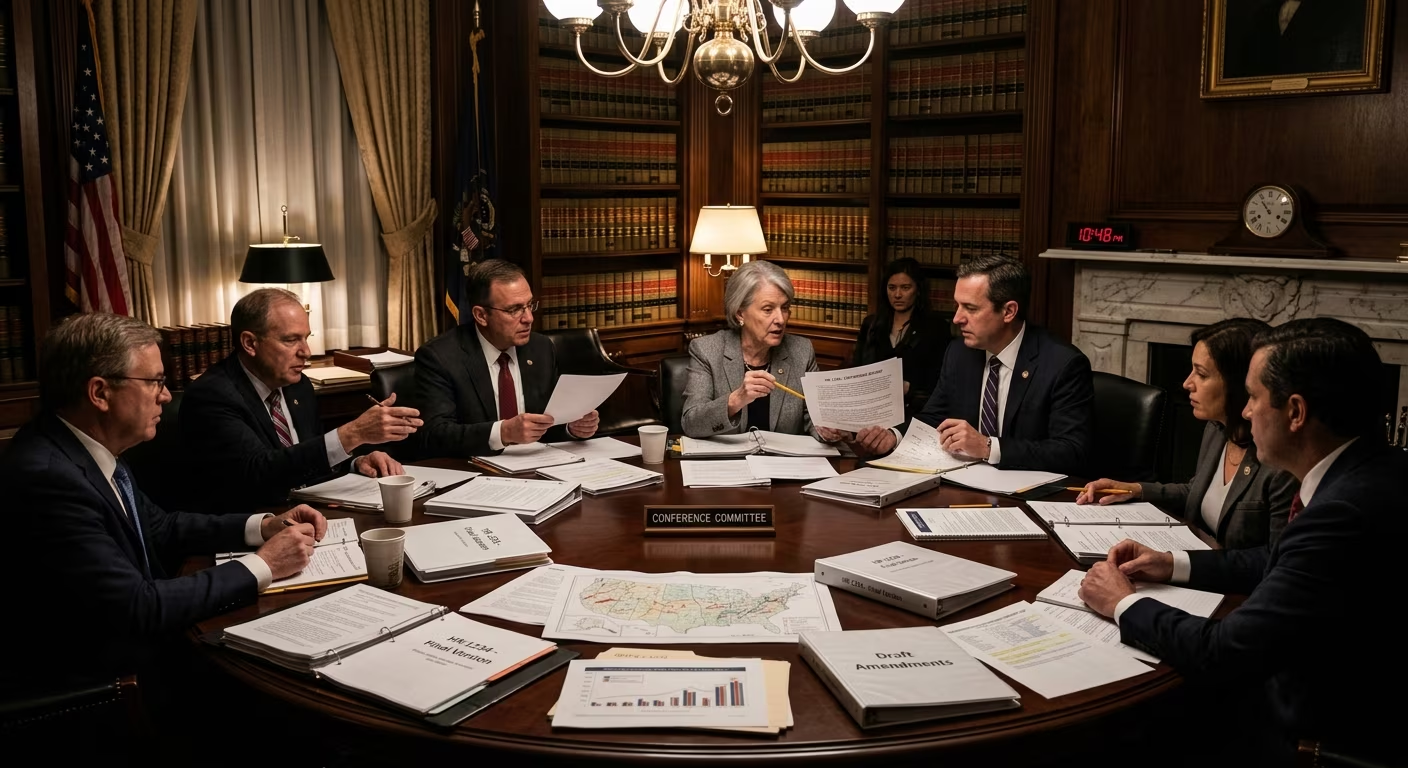
Historically, the primary mechanism for resolving these deep legislative disagreements was the conference committee. A conference committee is a temporary, ad hoc panel composed of members from both the House and the Senate, officially referred to as “conferees” or “managers.” These committees are convened with one singular purpose: to iron out the differences between the House and Senate versions of a specific bill.
The operational mechanics of these committees reveal how power is wielded on Capitol Hill:
- Appointment of Conferees: The leadership in both chambers selects the conferees. They are typically senior members drawn from the standing committees that originally drafted the legislation, ensuring that subject-matter experts are at the negotiating table.
- The Scope of Differences: Under formal rules, conferees are strictly limited to negotiating the “scope of differences.” This means they are only permitted to address the specific provisions where the House and Senate versions conflict. They are theoretically prohibited from rewriting sections that both chambers have already agreed upon or from inserting entirely new, unrelated legislation.
- The Final Report: Once a majority of the House delegation and a majority of the Senate delegation agree on a compromise, they produce a “Conference Report.” This document contains the finalized legislative text.
- The Joint Explanatory Statement: Accompanying the report is a joint explanatory statement, which serves as a vital piece of legislative history, detailing how disagreements were resolved and explaining the intent behind the new language.
Crucially, once a conference report is presented to the House and Senate floors for a final vote, it is highly privileged. It cannot be amended. Lawmakers face a stark, take-it-or-leave-it choice: vote to pass the compromised package in its entirety, or vote it down and risk killing the legislation completely.
The Modern Alternative: Amendment Exchange
While conference committees were once the standard operating procedure for Congress, their usage has plummeted in recent decades. Today, congressional leadership often prefers a highly centralized, streamlined alternative known formally as “amendment exchange,” and informally as “ping-ponging.”
Ping-ponging occurs when the two chambers bypass the creation of a formal conference committee entirely. Instead, the leadership in one chamber takes the other chamber’s passed bill, amends it, and sends it back. The receiving chamber then amends that amendment and returns it. The legislation effectively bounces back and forth across the Capitol rotunda until both sides agree on identical text.
This shift away from formal committees fundamentally changes the dynamics of lawmaking. In a traditional conference committee, rank-and-file conferees hold significant negotiating leverage. In an amendment exchange, negotiations are yanked out of the committee process and handled directly by the Speaker of the House and the Senate Majority Leader. Setting up a conference committee in the Senate can require multiple debatable motions, opening the floor to time-consuming filibusters. Ping-ponging allows leadership to bypass these procedural landmines. Most troublingly, amendment exchanges allow party leaders to negotiate final details behind closed doors, without the public meetings and formal documentation that conference committees require.
Must-Pass Vehicles: The Ultimate Trojan Horses
The secrecy inherent in these end-stage negotiations becomes particularly problematic when dealing with “must-pass” legislation. These are mammoth legislative vehicles that carry catastrophic economic or security consequences if they fail, such as omnibus appropriations bills that prevent government shutdowns, or the National Defense Authorization Act (NDAA) which authorizes funding for the military.
Because these bills are practically guaranteed to receive a final affirmative vote, they become irresistible targets for controversial policy riders. During the frantic final days of negotiation—whether in a rare conference committee or a high-stakes ping-pong exchange—lawmakers often succeed in “air-dropping” completely new, un-debated provisions into the final text.
Imagine a scenario where neither chamber’s original bill contained language authorizing expanded digital surveillance. In a transparent system, adding such a measure would require public hearings and dedicated floor debate. But in the secretive final hours of finalizing a must-pass bill, leadership can slip the provision into the final report. When the 2,000-page document is presented to rank-and-file members hours before a midnight deadline, they are trapped. They cannot strip out the surveillance provision without voting against the entire federal budget.
The Hidden Impact on Civil Liberties
To truly understand the danger of opaque legislative mechanisms like ping-ponging and conference committee air-drops, one must look at their historical impact on civil liberties. When the regular legislative process is bypassed, the fundamental rights of citizens are often the first casualty. Open debate in congressional committees allows advocacy groups, legal scholars, and the public to analyze proposed laws for constitutional violations. It provides a vital opportunity to sound the alarm if a bill infringes upon privacy, freedom of speech, or due process.
However, when provisions are secretly negotiated and inserted into must-pass omnibus bills at the eleventh hour, this critical layer of public defense is stripped away. For example, extensive expansions of federal surveillance powers, immigration restrictions, or new mandatory minimum sentencing guidelines have frequently bypassed standard judiciary committee markups. Instead, they are tucked deeply into the annexes of defense authorizations or homeland security funding bills.
Lawmakers are forced into an impossible position: vote to pass a bill that funds critical infrastructure, or vote against it to protect civil liberties and risk being blamed for a catastrophic government shutdown. This coercive environment is toxic to civil rights. It allows controversial, rights-infringing policies to become the law of the land without ever surviving the rigorous, public scrutiny that the democratic process was designed to facilitate. Protecting civil liberties, therefore, is not merely about electing the right officials; it is about demanding procedural integrity and forcing the lawmaking process out of the shadows.
Comparing the Paths to Reconciliation
To better grasp how these two distinct mechanisms operate, it is helpful to compare their structural differences. While both aim to reconcile bicameral differences, their approach to transparency, speed, and power distribution could not be more distinct.
| Feature | Conference Committee | Amendment Exchange (Ping-Pong) |
|---|---|---|
| Transparency | Requires public meetings and a formal Joint Explanatory Statement detailing changes. | Highly secretive; negotiations occur behind closed doors with no formal public record of changes. |
| Power Dynamics | Empowers rank-and-file committee members who serve as official conferees. | Consolidates power almost entirely in the hands of the House Speaker and Senate Majority Leader. |
| Speed | Slow; requires formal appointment votes, potential filibusters on motions, and scheduled meetings. | Fast; bypasses many procedural hurdles and debatable motions in the Senate. |
| Scope Rules | Strict rules technically prohibit introducing entirely new matters (though “air-dropping” still occurs). | Few formal restrictions on what leadership can attach as an amendment between the houses. |
Restoring Democratic Accountability
This widespread shift toward centralized, closed-door negotiations represents a significant degradation of democratic accountability. When the defining details of our nation’s laws are hammered out in private by a handful of leaders rather than in open committee markups, public scrutiny is entirely bypassed. This lack of transparency disproportionately empowers well-connected special interests. Lobbyists who understand the intricacies of the amendment exchange process can work directly with leadership to insert favorable language at the eleventh hour. Meanwhile, the public, the press, and even the vast majority of elected representatives are kept completely in the dark until the final text is published.
Reforming this broken system requires institutional courage and a demand for procedural transparency. Advocates emphasize that lawmakers must strictly enforce rules prohibiting “air-dropping” and guarantee a mandatory 72-hour review period for all finalized legislation before a final vote occurs.
Conclusion
The linear journey of a bill becoming a law is a comforting myth that fails to capture the true dynamics of Capitol Hill. The real crucible of lawmaking happens at the very end of the process, in the quiet rooms where bicameral differences are reconciled. Whether through the formal mechanism of the conference committee or the high-stakes volleying of amendment exchanges, these final negotiations dictate the rules that govern our society. By demystifying these obscure procedures, citizens can better hold their representatives accountable and demand a process that values transparency over political expediency.
Frequently Asked Questions (FAQs)
1. What is a congressional conferee?
A conferee, also known as a manager, is a member of the House or Senate appointed to serve on a temporary conference committee. Their role is to negotiate a compromise between competing versions of a specific piece of legislation.
2. Can a conference report be amended on the floor?
No. Once a conference committee finalizes its report, it is highly privileged. When it is brought to the House or Senate floor for a final vote, it is subject to an up-or-down vote only. No further amendments are permitted.
3. What is a Joint Explanatory Statement?
A Joint Explanatory Statement is a formal document produced alongside a conference report. It details exactly how the conferees resolved the differences between the House and Senate bills, serving as a critical piece of legislative history.
4. How does “ping-ponging” differ from a conference committee?
Ping-ponging, or amendment exchange, bypasses the creation of a formal committee. Instead, leadership in one chamber amends the other’s bill and sends it back. This method is faster and centralizes power within party leadership, but it severely limits transparency.
5. Why are “must-pass” bills controversial?
Must-pass bills, like omnibus spending packages or the NDAA, are controversial because failure to pass them results in severe consequences, such as a government shutdown. This makes them prime targets for leadership to attach unpopular or un-debated policy riders, knowing lawmakers will be forced to vote for the overall package.
References
- Considering Legislation on the House Floor: Common Practices in Brief — Congressional Research Service. 2025-01-06. https://crsreports.congress.gov/product/pdf/R/R47314
- Resolving Legislative Differences in Congress: Conference Committees and Amendments Between the Houses — Congressional Research Service. 2023-11-14. https://crsreports.congress.gov/product/pdf/98/98-696
- Frequently Asked Questions about Committees — United States Senate. 2024-05-10. https://www.senate.gov/committees/committee_faq.htm