
The Hidden Costs of Digital Classrooms: Surveillance and Accessibility
How invasive remote learning technologies and a lack of accessibility are driving a student-led movement for educational equity.
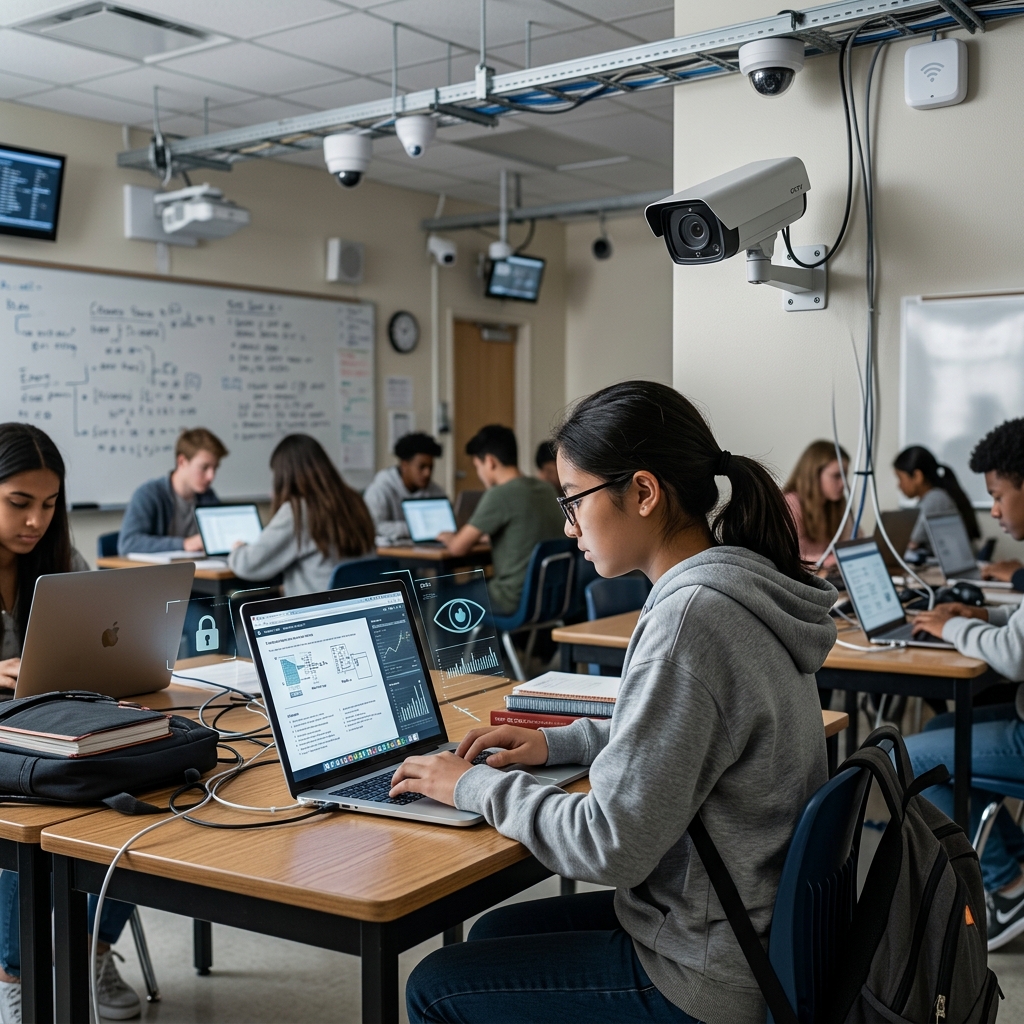
The mass integration of remote learning technologies into mainstream education was initially heralded as a triumph of modern connectivity. When classrooms across the globe were abruptly forced to close their physical doors, digital infrastructure provided an essential lifeline. It allowed academic instruction to continue amidst unprecedented disruption, seemingly bridging the gap between isolated students and their educators. However, as the dust settled on this rapid transition, a more troubling narrative began to emerge beneath the surface of virtual schooling. The widespread adoption of virtual learning platforms brought with it a profound reliance on educational technology (ed-tech) that often prioritized administrative control over student well-being and pedagogical integrity.
At the center of this ongoing controversy are dual crises that have catalyzed widespread student pushback: the aggressive invasion of personal privacy through digital surveillance, and the systemic marginalization of students with disabilities. While these digital tools allowed academic calendars to proceed, they also exposed and exacerbated deep-seated systemic inequities. The home environment, once considered a private sanctuary, was suddenly transformed into a heavily monitored extension of the classroom. Concurrently, the nuanced, individualized accommodations required by special education mandates were frequently found to be incompatible with rigid, one-size-fits-all software systems. As the fear of falling behind mounts among vulnerable student populations, a new civil rights battlefront has opened. Students, educators, and advocates are now demanding a fundamental restructuring of remote learning paradigms—one that respects legal privacy boundaries and guarantees equitable access for all learners.
The Expanding Footprint of Digital Surveillance
Remote learning fundamentally altered the student experience by introducing corporate surveillance into the daily educational routine. At the heart of this profound shift is the dramatic expansion of e-proctoring software. Before the widespread pivot to online education, these surveillance tools were a niche product, utilized primarily for specialized online certification courses or massive open online courses (MOOCs). Today, they have become a staple of K-12 and higher education assessments across the country. The sudden explosion of automated proctoring systems fundamentally altered the trust dynamic between students and educators, replacing a traditional presumption of academic integrity with an algorithmic presumption of guilt.
The Intrusive Mechanics of E-Proctoring
E-proctoring platforms operate by seizing substantial control of a student’s personal hardware and monitoring their physical environment in real-time. These applications typically require users to install software that locks down the computer’s browser, preventing the student from opening other tabs, utilizing keyboard shortcuts, or accessing secondary applications. But the surveillance extends far beyond the confines of the digital screen. Utilizing the computer’s webcams and microphones, these programs track eye movements, log ambient noise levels, analyze keystroke rhythms, and use facial recognition algorithms to detect what the software deems “suspicious” behavior.
The software acts as an automated judge, flagging anomalies—such as a student looking away from the screen for too long to think, a sudden shadow crossing the room, or a family member speaking in the background. These flags send alerts to instructors, often pausing or terminating the high-stakes exam in the process. Furthermore, many platforms require highly invasive “room scans.” Before an exam can even begin, a student must physically pick up their laptop or external webcam and pan it around their bedroom or living space to visually prove they are alone and do not have illicit materials. This practice forces students to expose their private living conditions, financial circumstances, and family dynamics to instructors and third-party corporate servers, erasing the boundary between public schooling and private home life. The psychological toll of being intensely watched by an opaque algorithmic system induces severe test anxiety, fundamentally altering a student’s ability to demonstrate their actual academic proficiency.
FERPA and the Blurring of Private Boundaries
The mandatory adoption of these surveillance tools has sparked intense legal and ethical debates regarding student data privacy and the overreach of educational institutions. Public schools and universities in the United States are legally bound by the Family Educational Rights and Privacy Act (FERPA), a federal law enacted to protect the privacy of student education records and personally identifiable information (PII). However, the rapid procurement of third-party ed-tech applications during times of crisis often outpaced thorough legal review by school boards and university administrators. When institutions mandate the use of platforms that collect intimate biometric data, video recordings of private bedrooms, and continuous audio logs, they tread into legally precarious territory.
According to guidelines provided by the U.S. Department of Education’s Privacy Technical Assistance Center, schools must carefully evaluate the terms of service of online educational services to ensure they handle data in a safe, secure, and legally compliant manner. Yet, many e-proctoring companies retain the right to store student video feeds and biometric profiles on their proprietary, cloud-based servers for extended periods. Students are essentially forced into a corner regarding consent; refusing to agree to these overarching terms of service generally means failing a class, receiving a zero on a final exam, or being denied access to crucial educational materials altogether. This coercive dynamic effectively strips students of their digital agency and makes the forfeiture of fundamental civil liberties a mandatory prerequisite for receiving an education.
The Overlooked Crisis: Students with Disabilities
Beyond the severe privacy invasions affecting the general student body, the pivot to highly monitored online education has created an acute and ongoing crisis for students with disabilities. For many disabled learners, the physical classroom provided a highly structured environment where Individualized Education Programs (IEPs) and Section 504 plans could be actively managed, monitored, and adjusted by trained special education professionals. The abrupt transition to remote learning often stripped these students of their essential accommodations, leaving them to navigate rigid digital platforms that were simply not designed with accessibility in mind.
The Institute of Education Sciences explicitly emphasizes that even in remote and virtual settings, schools are legally obligated under federal law to provide a Free Appropriate Public Education (FAPE). However, reviews of the educational impacts of remote learning consistently reveal that this legal obligation was frequently unmet. Students with visual impairments struggled immensely with learning management systems that were fundamentally incompatible with standard screen readers. Students who are deaf or hard of hearing found themselves trying to follow live virtual lectures that lacked accurate, real-time closed captioning or sign language interpretation. Additionally, the heavy reliance on text-dense interfaces, flashing graphics, and complex navigation menus created insurmountable barriers for students with cognitive, developmental, or specific learning disabilities.
Systemic Accessibility Barriers in Ed-Tech
The technical infrastructure of many remote learning platforms routinely failed to adhere to the internationally recognized Web Content Accessibility Guidelines (WCAG). This widespread lack of compliance meant that basic, critical accessibility features—such as high color-contrast alternatives, keyboard-only navigation for those with limited motor skills, and integrated text-to-speech functionality—were either entirely absent or too bug-ridden to use effectively. When the fundamental, daily tools of learning are structurally inaccessible, students with disabilities are forced to fall behind their peers. This dynamic not only exacerbates long-standing educational inequities but acts as a direct violation of federal civil rights mandates designed to protect vulnerable learners.
When Algorithms Punish Neurodivergence
The intersection of automated surveillance technology and disability represents one of the most egregious systemic failures of the modern remote learning ecosystem. E-proctoring algorithms are fundamentally trained on datasets that assume a specific, neurotypical baseline of human behavior. Consequently, these automated systems routinely pathologize and penalize the natural behaviors of neurodivergent students and those with physical disabilities, creating a digital environment fraught with ableism.
For a student with Attention Deficit Hyperactivity Disorder (ADHD), looking away from the screen to process complex information or shifting in their seat to manage sensory input is a standard, necessary coping mechanism. But to a rigid e-proctoring algorithm, these actions are immediately flagged as signs of academic dishonesty. A student with Tourette syndrome experiencing uncontrollable motor tics may trigger constant, anxiety-inducing alerts for irregular movement, potentially locking them out of their exam. Autistic students who rely on stimming behaviors—such as rocking, tapping, or hand-flapping—to maintain their focus find themselves repeatedly penalized by facial recognition software that demands absolute stillness and unbroken, unblinking eye contact with a webcam for hours at a time.
Moreover, facial recognition algorithms utilized by these platforms have well-documented racial and technical biases. They frequently fail to recognize the faces of students of color unless the students shine exceptionally bright lights directly onto their faces. This technical requirement can easily trigger severe sensory overload or debilitating migraines in students with sensory processing disorders. In these instances, the technology not only fails to accommodate the student’s needs but actively weaponizes their disability against them.
Student Pushback: A Demand for Digital Equity
Students are not accepting these oppressive conditions passively. Across the country, a highly robust, student-led movement has emerged to push back against the unchecked use of invasive remote learning technologies. Through massive online petitions, highly organized boycotts, and formal legal complaints submitted to university administrations, students are demanding an immediate halt to the use of e-proctoring software. They argue persuasively that an educational system built on a foundation of surveillance, suspicion, and systemic ableism is fundamentally incompatible with the higher goals of fostering independent, critical thought and academic growth.
This grassroots activism is beginning to yield tangible legislative and institutional changes. Several major universities have outright banned the use of algorithmic proctoring tools following immense pressure from student governing bodies and faculty senates. On a legislative level, lawmakers are finally beginning to recognize the absolute necessity of digital equity. For instance, legislation such as the Illinois mandate requiring that all third-party online curriculum services used in K-12 schools be completely WCAG 2.1 compliant demonstrates a vital, proactive step toward ensuring that educational tools meet the needs of all families they serve. These victories highlight the immense power of collective student action in shaping the future of educational technology policy.
Building a More Inclusive Pedagogical Future
The solution to these multifaceted problems lies not in refining surveillance algorithms to be slightly less biased, but in reimagining the core pedagogical approach to remote learning entirely. When educators rely heavily on high-stakes, strictly timed exams that necessitate e-proctoring, they inadvertently prioritize administrative policing over actual student learning. The shift toward “authentic assessment” provides a highly viable, equitable alternative that respects both privacy and diverse learning needs. Authentic assessments evaluate a student’s ability to apply knowledge to realistic, real-world scenarios rather than simply demanding the memorization and regurgitation of facts under extreme psychological pressure.
By utilizing open-book exams, collaborative multimedia projects, peer reviews, and asynchronous problem-solving tasks, educators can completely eliminate the need for invasive monitoring software. These formats are inherently more flexible and vastly more accessible for students with disabilities, as they allow learners to engage with the academic material at their own pace and in home environments that accommodate their specific sensory and physical requirements. Furthermore, project-based learning actively fosters critical thinking, complex problem solving, and creativity—vital skills that simply cannot be measured or quantified by a webcam tracking a student’s eye movements. Investing in pedagogical innovation rather than corporate surveillance tools is essential for building a resilient, equitable, and forward-thinking educational framework for the digital age.
Comparing Assessment Models: Privacy and Accessibility
| Assessment Model | Privacy Impact | Accessibility for Disabled Students | Pedagogical Value |
|---|---|---|---|
| Traditional In-Person Exams | Low. Administered in a public setting without home surveillance. | Moderate. IEPs can be managed by on-site staff, though physical barriers may remain. | Moderate. Tests recall but may not reflect real-world application of skills. |
| E-Proctored Remote Exams | Very High. Requires camera access, room scans, and algorithmic tracking of behavior. | Poor. High risk of algorithmic bias against neurodivergent tics and sensory needs. | Low. High anxiety environments reduce true demonstration of knowledge. |
| Authentic Remote Assessments | Very Low. No live surveillance required; focused on project submission. | Excellent. Allows students to work at their own pace using preferred assistive tech. | High. Encourages deep critical thinking, creativity, and practical application. |
Frequently Asked Questions (FAQs)
- What is FERPA and how does it apply to remote learning?
The Family Educational Rights and Privacy Act (FERPA) is a federal law protecting the privacy of student education records. In remote learning, FERPA applies to the data collected by ed-tech platforms. Schools must ensure that third-party vendors do not misuse personally identifiable information (PII) or biometric data collected during online sessions or exams. - How do e-proctoring tools violate disability rights?
Many e-proctoring tools rely on algorithms that interpret standard neurodivergent behaviors—such as lack of eye contact, physical tics, or the need to read aloud—as cheating. Furthermore, the interfaces often fail to support essential assistive technologies like screen readers, actively preventing students with disabilities from accessing the exam equally. - What are the Web Content Accessibility Guidelines (WCAG)?
WCAG is an internationally recognized set of standards designed to make web content more accessible to people with disabilities. In education, WCAG compliance ensures that digital learning platforms feature proper color contrast, keyboard navigability, text-to-speech options, and closed captioning. - How can students advocate for better privacy policies?
Students can advocate by forming coalitions, petitioning school boards, and collaborating with faculty senates to demand transparency in ed-tech contracts. Pushing for authentic, project-based assessments over surveillance-heavy exams is one of the most effective ways to protect digital privacy on campus.
References
- Online Proctoring Problems and How FERPA Can Promote Student Data Due Process — NDLScholarship. 2021. https://scholarship.law.nd.edu/
- Plan and deliver: Educating students with disabilities in remote settings — Institute of Education Sciences (IES). 2020-04-22. https://ies.ed.gov/
- Access and Inclusion of Students with Disabilities in Virtual Learning Environments: Implications for Post-Pandemic Teaching — ERIC. 2021. https://eric.ed.gov/
- Protecting Student Privacy While Using Online Educational Services — U.S. Department of Education. 2014-02-15. https://studentprivacy.ed.gov/
- Gov. Pritzker Celebrates Increasing Access to Online Learning for Students with Disabilities — Illinois.gov. 2021-09-02. https://www.illinois.gov/
Similar Articles








Read full bio of Sneha Tete


