
Hawaii Wage And Hour Laws: Employer Guide To Pay, Overtime Now
A practical guide to pay rules, overtime, breaks, and worker protections in Hawaii.
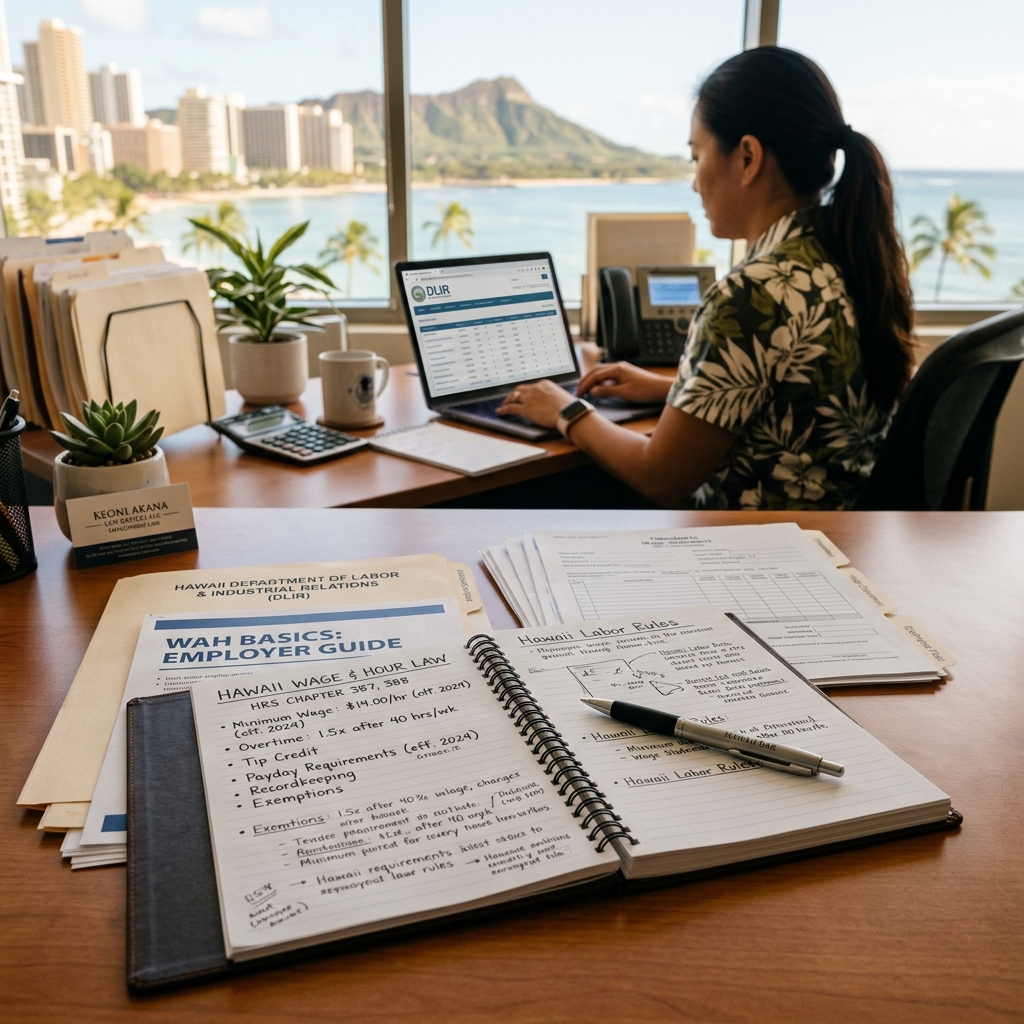
Hawaii wage and hour laws at a glance
Hawaii’s wage and hour rules set the baseline for how workers must be paid, when wages are due, and which employees are entitled to extra protections. The state’s current minimum wage is $16.00 per hour beginning January 1, 2026, with a scheduled increase to $18.00 per hour on January 1, 2028. Employers must also pay overtime at one and one-half times the regular rate for most hours worked over 40 in a workweek.
These rules are not just about hourly pay. Hawaii law also covers payday timing, wage statements, final paychecks, records, and certain rights for minors and nursing employees. In practice, that means an employer must manage payroll carefully and keep track of hours, deductions, and compensation details.
Minimum wage rules and future increases
Hawaii’s minimum wage is higher than the federal floor, and the state has adopted a stepped increase schedule. According to the state Wage Standards Division, the minimum wage rose to $14.00 per hour on January 1, 2024, then to $16.00 per hour on January 1, 2026, and will rise again to $18.00 per hour on January 1, 2028.
For employees, the practical point is simple: most nonexempt workers must receive at least the state minimum wage for every hour worked. For employers, the more important issue is compliance with the current rate, not the rate that applied last year. A payroll system that does not update automatically can create underpayment risk very quickly.
Some workers may be paid differently under specific legal exceptions, but those exceptions are narrow and should be reviewed carefully before being used.
Overtime pay and how it is calculated
Hawaii generally follows the familiar overtime model used in federal wage law. Nonexempt employees are entitled to overtime pay at 1.5 times their regular rate for hours worked beyond 40 in a single workweek.
That rule means overtime is based on the workweek, not on a daily total. If an employee works ten hours in one day but still totals fewer than 40 hours for the week, state law generally does not treat those extra hours as overtime. There is an important exception for certain state or county public works construction projects, where different overtime rules may apply.
To avoid mistakes, employers should identify the employee’s regular rate before calculating overtime. The regular rate may include more than just base hourly pay, depending on the compensation structure.
When wages must be paid
Hawaii requires employers to pay wages at least twice each month on paydays set in advance. The law is designed to prevent long delays between work performed and payment received.
Paydays generally must occur within seven days after the end of the pay period. In limited circumstances, the state may allow payment up to 15 days after the pay period ends. Monthly payroll is allowed only in specific situations, so most employers still use a semi-monthly or biweekly system to stay compliant.
Wages must be paid in cash, by check that can be cashed on demand at face value, or through direct deposit or payroll debit cards when those methods are used lawfully. Employers must also provide a written wage statement each payday that includes the hours worked, pay rate or rates, gross pay, deductions, and net earnings.
What must appear on a pay stub
Hawaii law requires detailed pay records, not just a final amount. Each payday, employees must receive a written record showing the total hours worked, the basis for the pay rate, gross compensation, itemized deductions, and net pay.
This documentation matters for both sides of the employment relationship. Workers can use it to confirm whether they were paid correctly, while employers rely on it to show that wages were calculated properly if a dispute arises.
A good payroll statement should be easy to read and should match timekeeping records. If an employee sees unexplained deductions or missing hours, the wage statement is usually the first place to look.
Final wages after a job ends
Hawaii law also addresses when a worker must receive their last paycheck. If an employee is discharged, the employer generally must pay final wages on the same day or by the next working day. If the employee resigns, the final paycheck is due by the next regular payday.
These timing rules are important because final-pay disputes are common. They can involve regular wages, unused leave if employer policy or contract requires payment, and any other compensation that has already been earned under company policy or law.
Employers should make sure termination procedures and payroll procedures line up. A delay caused by internal review does not usually extend the deadline automatically.
Breaks, meal periods, and rest time
For most adult employees, Hawaii law does not require a general meal or rest break. That is a notable difference from states that mandate breaks for all workers. In Hawaii, the main statutory break requirement applies to younger workers.
Specifically, employers must provide at least a 30-minute meal or rest break to 14- and 15-year-old minors who work five consecutive hours. Outside that child labor rule, break policies are often left to the employer or governed by workplace agreements.
Even when the law does not require a break, employers should still be clear in their policies about whether short breaks are paid or unpaid. Ambiguity can lead to disputes about whether employees were effectively allowed to take the break time they were promised.
Special protections for nursing employees
Hawaii law requires reasonable break time for employees who need to express breast milk for a nursing child, for up to one year after the child’s birth. The employer must also provide a private space that is not a restroom stall.
This is more than a scheduling preference. The workplace must include a location that offers privacy and is appropriate for the purpose, and employees must be informed of the protection. Employers that use shared workspaces or customer-facing areas should plan ahead so they can designate a compliant room or area.
Child labor and young workers
Hawaii imposes additional rules on minors to protect school-age employees and limit hazardous work. Minors may not work in hazardous occupations or in jobs connected with adult entertainment.
Young workers are also required to obtain a certificate of employment or age before working. For 14- and 15-year-olds, the law requires a 30-minute meal or rest period after five consecutive hours of work.
These requirements are especially relevant for retail, food service, agriculture, and seasonal employers that hire teens. Managers should verify age, work-hour limits, and job duties before assigning shifts.
Payroll records and employer documentation
Hawaii employers are expected to keep records that support each paycheck. Wage records typically include employee names, addresses, occupations, hours worked, wages paid, and similar information needed to confirm compliance.
Recordkeeping is not merely administrative. If a wage claim arises, the employer may need these records to show how pay was computed and whether all hours were paid. The absence of records can make disputes harder to defend.
Workers should also keep copies of pay stubs, schedules, and time records when possible. Those documents can be useful if the employee later needs to challenge unpaid wages or overtime errors.
Other pay issues workers often ask about
Hawaii’s wage rules do not require premium pay for holidays unless an employer promises it or a contract requires it. In other words, extra holiday pay is generally a matter of employer policy rather than statewide mandate.
When a salaried employee works fewer hours than expected because of absence or termination, the salary may be prorated for that pay period in some situations. That issue often comes up when a worker leaves midweek or misses part of a scheduled period.
Workers who report to work and are told immediately that no work is available are not automatically entitled to be paid for that appearance under Hawaii law. That can surprise employees, so employers should communicate scheduling expectations clearly.
How Hawaii law interacts with federal rules
Many employers must comply with both Hawaii law and the federal Fair Labor Standards Act. When both laws apply, the rule that gives workers the greater protection usually controls.
That means a Hawaii employer may need to look at state minimum wage, overtime, and payroll timing rules first, then check whether federal law adds any additional duties. For employers with multistate operations, this can be especially important because payroll systems often default to federal standards that are not always enough under state law.
Frequently asked questions
- Is Hawaii’s minimum wage changing again?
Yes. The state minimum wage is set to increase from $16.00 to $18.00 per hour on January 1, 2028.
- Does Hawaii require daily overtime?
No. Overtime is generally based on hours worked over 40 in a workweek, not on hours worked in a single day.
- Do adult workers have to get meal breaks?
Not under Hawaii’s general wage-and-hour rules. The break requirement specifically mentioned in the law applies to 14- and 15-year-old minors working five consecutive hours.
- How soon must I get my final paycheck?
If you are fired, final wages are generally due the same day or by the next working day. If you quit, the employer generally has until the next regular payday.
- Must employers provide pay stubs?
Yes. Hawaii requires a written record each payday showing hours worked, pay rate information, gross pay, deductions, and net earnings.
Why these rules matter in practice
Hawaii wage and hour law is built to ensure that employees are paid on time, at least at the state minimum wage, and with overtime when required. The law also creates structure around payroll records, child labor, and nursing accommodations so that workplace pay is more transparent and easier to enforce.
For employees, the most useful habit is to review every pay statement and compare it with actual hours worked. For employers, the safest approach is to maintain consistent payroll practices, update wage rates promptly, and document every pay decision carefully.
References
- Minimum Wage and Overtime — Hawaii Department of Labor and Industrial Relations, Wage Standards Division. 2024-01-02. https://labor.hawaii.gov/wsd/minimum-wage/
- Labor Laws Poster — Hawaii Department of Labor and Industrial Relations. 2024-01-02. https://labor.hawaii.gov/wp-content/uploads/2023/12/20240102-Labor-Laws-Poster.pdf
- Wage and Hour FAQs — Hawaii Department of Labor and Industrial Relations, Wage Standards Division. 2026-07-10. https://labor.hawaii.gov/wsd/wage-and-hour-faqs/
- Hawaii Employment Law Overview — Brightmine. 2026-07-10. https://www.brightmine.com/us/resources/hr-compliance/hawaii-employment-law/
- Hawaii Labor Laws: A Comprehensive Guide — myShyft. 2026-07-10. https://www.myshyft.com/state-labor-laws/hawaii/
Similar Articles








Read full bio of Sneha Tete




