Haunted Laws: Chilling Court Battles from the Halloween Season
Explore strange, spooky, and sometimes hilarious Halloween-related court cases that blur the line between legal logic and supernatural lore.
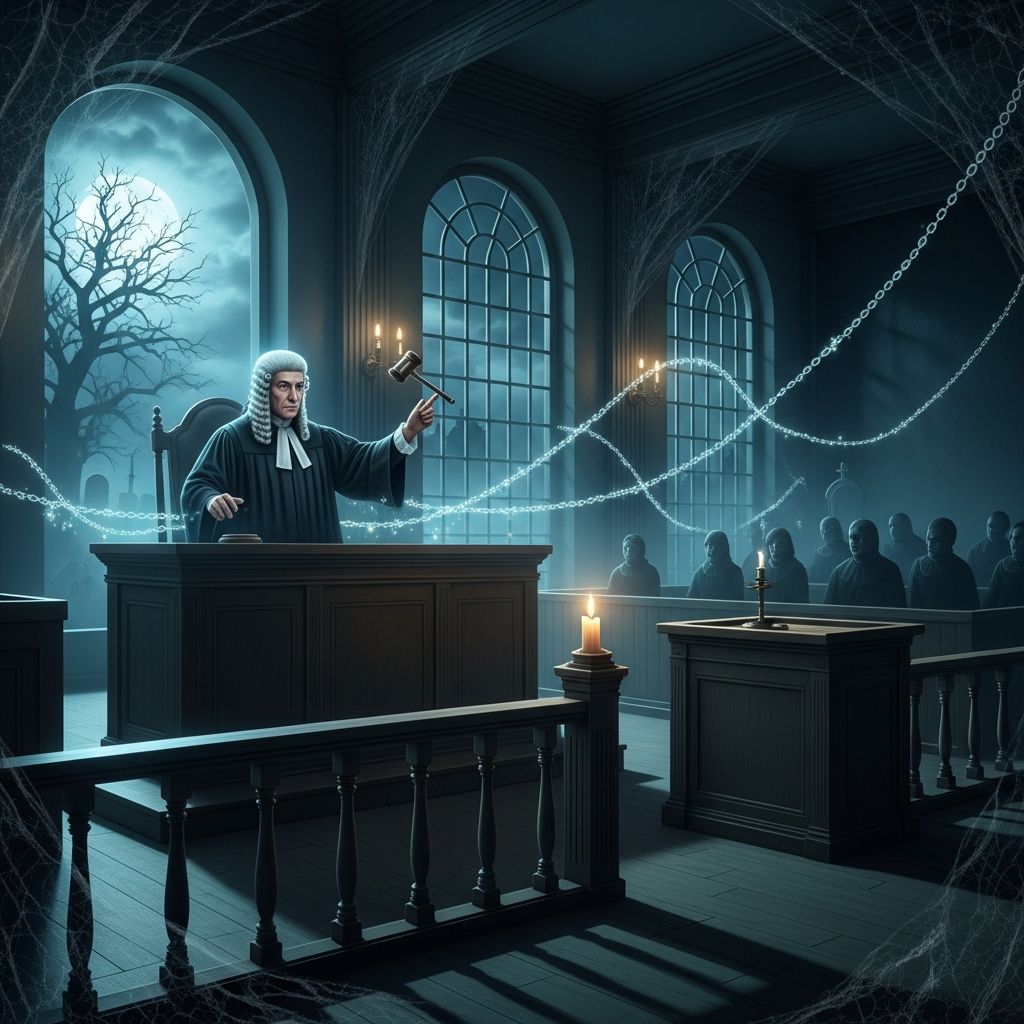
Every autumn, carved pumpkins and plastic skeletons appear on porches—but in courtrooms, Halloween shows up in a different way. Real people have gone to court over haunted houses, ghostly disclosures in real estate, burning costumes, and even over-the-top tombstones. These disputes show how ordinary legal principles can take on an eerie twist when fear, folklore, and festivities are involved.
This article explores a range of Halloween-adjacent cases and legal issues, inspired by real court decisions and news stories. Instead of retelling any single source, it offers a fresh, organized look at how the law handles ghosts, ghouls, and seasonal scares.
1. When the Afterlife Meets Real Estate
One of the most famous intersections between law and the supernatural involves real estate. Buyers sometimes ask a question that sounds more like folklore than law: Do I have a right to know if my new house is haunted?
Psychologically Stigmatized Properties
Some homes are not dangerous in a physical sense but have disturbing histories—murders, suicides, or rumors of hauntings. These are often called psychologically stigmatized properties.
- In many U.S. states, sellers must disclose known material defects like structural issues or environmental hazards, but not necessarily emotional or psychological stigmas.
- A few states require disclosure of deaths on the property within a certain time period, while others explicitly say such events are not material facts unless a buyer asks directly.
- Some courts have treated widely publicized hauntings or notorious events as facts that can affect market value, and thus may become relevant in litigation when a buyer feels misled.
The tension is clear: the law prefers objective, verifiable facts, whereas hauntings are rooted in belief, folklore, and reputation.
Practical Lessons for Buyers and Sellers
- Buyers should ask specific questions about prior events if they care about reputation, not just structural condition.
- Sellers are usually safest disclosing well-known stigmas that could lead to future disputes, even if not strictly required.
- Real estate agents often follow state statutes and professional guidelines to address stigmas without making claims about the supernatural.
2. Haunted Attractions and the Price of a Good Scare
Haunted houses, hayrides, and corn mazes try to terrify guests—but where is the line between a successful scare and a lawsuit? Courts have repeatedly been asked to decide whether an injury at a Halloween attraction is just an inherent risk of seeking fright.
Assumption of Risk in Haunted Venues
In many personal injury cases, judges apply the doctrine of assumption of risk: people who voluntarily participate in an inherently risky activity may be deemed to accept certain dangers.
- Visitors to haunted houses generally expect jump scares, loud noises, and dark, disorienting environments, so courts often say that being frightened is exactly what was purchased.
- When injuries result from a person running, slipping, or colliding in a moment of fear, some courts have ruled that this is a foreseeable consequence of a deliberately scary attraction, not necessarily negligence.
- However, operators can still be liable if they ignore basic safety—such as hidden hazards, structural defects, or clear violations of building and fire codes.
Safety Basics for Spooky Businesses
To reduce legal exposure, haunted attractions typically focus on:
- Maintaining clearly marked emergency exits and adequate crowd control.
- Training actors not to touch guests or chase them into unsafe areas.
- Managing lighting so the scene is scary but obvious hazards are still visible.
- Posting warnings about strobe lights, fog machines, and other effects that could affect certain visitors.
These precautions tie into general premises liability principles that apply year-round, not just in October.
3. Costumes, Fire, and Product Liability Nightmares
Homemade and store-bought costumes are iconic Halloween staples, but some lawsuits show what happens when festive outfits meet open flames or poor design.
Flammable Fabrics and Clothing Standards
Many fire-related costume cases stem from the way materials react to heat. In the United States, the Flammable Fabrics Act authorizes the Consumer Product Safety Commission (CPSC) to regulate the flammability of clothing and textiles, including children’s costumes.
- CPSC standards aim to ensure that children’s sleepwear and costumes resist rapid ignition and flame spread.
- Products that ignite too easily or burn too quickly can trigger recalls or lawsuits alleging design defects or failure to warn.
Some historic Halloween-related cases involved homemade costumes assembled from cotton batting or other highly flammable materials. When those costumes ignited—often from a match or cigarette—injured parties sued both the manufacturers of the materials and, at times, the retailers that sold them.
Key Legal Issues in Costume Fire Cases
| Legal Concept | How It Arises with Costumes |
|---|---|
| Design defect | Material selection or construction makes a costume unreasonably prone to catching fire. |
| Failure to warn | Lack of adequate labels about flammability, use near open flames, or necessary precautions. |
| Comparative negligence | Courts weigh the user’s own choices, such as using an open flame near obviously flammable material. |
Practical Safety Tips for Celebrants
- Choose costumes labeled as flame resistant or meeting relevant safety standards.
- Avoid open flames like candles and matches when costumes include loose fabric, tulle, or decorative batting.
- Substitute battery-powered lights for real candles in jack-o’-lanterns whenever possible.
4. Ghosts, Gimmicks, and Intellectual Property
Halloween is prime time for creative works—horror films, spooky logos, novelty costumes, and themed products. As a result, the holiday is fertile ground for intellectual property disputes, from copyrights in horror stories to trademarks in novelty outfits.
Copyright and the Horror Genre
Copyright law does not protect general ideas or stock elements, only the original expression of those ideas.
- Common horror setups—like a group of people trapped in a remote cabin, or a haunted mansion—are considered unprotectable plot premises.
- However, specific characters, dialogue, and detailed scenes can be protected if they show sufficient originality.
- Some courts have evaluated claims where one creator alleged that a film or book copied their haunted-cabin storyline, only to rule that only generic horror tropes were shared.
Trademarks and Costume Disputes
Trademarks protect distinctive brand identifiers such as names, logos, and product shapes used in commerce. Halloween has seen unusual disputes, including over the design of novelty costumes.
- Manufacturers have sued competitors for allegedly copying distinctive costume designs, arguing that shape, color, and overall appearance function as protected trade dress.
- Court decisions often examine whether the design is sufficiently distinctive, non-functional, and associated in consumers’ minds with a single source.
Ghosts in Logos and Public Domain Characters
Some IP disputes involve ghostly mascots or logos. When an older ghost character slips into the public domain because its copyright was not renewed, others may reuse or adapt it without permission.
- If a company fails to renew copyright on a character, older depictions can be freely used, though newer versions might still be protected.
- That can lead to arguments about how much of a ghost’s look is still protected versus how much belongs to the public.
5. Creepy Conduct, Criminal Law, and Urban Legends
Some of the most disturbing Halloween-related cases involve criminal law. While many holiday scares are harmless theatrics, a few real incidents have shaped public fears and policies.
Poisoned Candy and the Fear Factor
Urban legends about poisoned Halloween candy have circulated for decades. Criminological research and public health reviews have found that substantiated cases of strangers poisoning random trick-or-treaters are exceedingly rare.
- Scholars note that most documented incidents involve tampering by relatives or hoaxes rather than unknown neighbors.
- Despite the rarity, the fear persists, influencing parental behavior and community rules for trick-or-treating.
Criminal Responsibility and Supernatural Claims
In a few high-profile cases, defendants have tried to explain violent acts by invoking demonic possession or supernatural influence.
- Courts in the United States ground criminal responsibility in mental state, capacity, and evidence—not in spiritual explanations.
- While defense teams can introduce expert testimony on mental illness or delusions, judges do not accept supernatural forces as a legal excuse.
These cases highlight the tension between personal belief and legal standards of proof.
6. Seasonal Decorations, Public Spaces, and Neighbor Disputes
Elaborate Halloween yard displays can delight some neighbors and infuriate others. Disputes over decorations sometimes escalate into formal complaints or lawsuits.
Property Rules and Community Standards
- Homeowners’ associations (HOAs) may enforce bylaws on lawn displays, noise, and lighting, including seasonal décor.
- Local governments can regulate public safety issues—such as obstructed sidewalks, blocked sightlines at intersections, or excessive sound late at night.
- In rare situations, displays that mimic real crimes or emergencies can prompt calls to law enforcement and debates over taste versus speech rights.
Gravestones, Tombstones, and Cemetery Disputes
Even gravestones have sparked litigation, particularly when families request unconventional designs—such as sports-themed monuments or large, brightly colored structures.
- Churches and cemetery operators typically set design and size standards for markers, which may limit highly personalized or commercial imagery.
- When families challenge these restrictions, courts often balance contractual rights, religious or institutional autonomy, and the family’s interest in expressive memorials.
7. Insurance, Pumpkins, and Unexpected Claims
Insurance companies sometimes find themselves litigating over surprisingly mundane Halloween mishaps. Collapsing inflatable decorations, vandalized jack-o’-lanterns, or guests injured at parties may all spawn coverage disputes.
Typical Insurance Questions Around Halloween
- Homeowners’ policies may cover injuries to trick-or-treaters on a walkway, subject to policy limits and exclusions.
- Commercial policies are implicated when stores use large inflatables or displays that fall, leak, or cause property damage.
- Liability exclusions can come into play if an event is classified as commercial entertainment rather than a casual gathering.
8. How Courts Balance Fun and Responsibility
Across these varied cases, several recurring legal themes appear:
- Reasonable expectations: What risk did participants reasonably expect when they chose to attend a haunted house or wear a particular costume?
- Disclosure versus privacy: How much does a seller or organizer need to reveal about past events, hazards, or reputational issues?
- Free expression versus regulation: When Halloween crosses into parody, political speech, or shocking imagery, courts weigh First Amendment concerns against public safety and property rules.
- Evidence over superstition: Even in ghostly or demonic-sounding cases, judges and juries rely on tangible evidence, expert testimony, and statutory standards.
Frequently Asked Questions (FAQs)
Q1: Can I sue if I get hurt in a haunted house?
Possibly, but success is not guaranteed. Courts often find that visitors assume some risk of being frightened and may hold operators liable only if there were hidden hazards, poor maintenance, or violations of safety codes that went beyond normal scare tactics.
Q2: Does a seller have to tell me if a house is haunted or if someone died there?
It depends on the jurisdiction. Some states require disclosure of certain deaths within a set time period, while others explicitly say such facts are not material. Buyers concerned about stigmas should ask targeted questions and review state law or consult a real estate attorney.
Q3: Are Halloween costumes required to be flame resistant?
Children’s costumes must meet federal flammability standards enforced by the U.S. Consumer Product Safety Commission, but no garment is entirely fireproof. Consumers should still avoid open flames and look for labels indicating compliance with federal safety rules.
Q4: Can someone claim demonic possession as a legal defense?
Courts do not recognize supernatural forces as a legal excuse. Defendants may raise insanity or diminished capacity defenses based on medical evidence, but claims that a demon or ghost controlled their actions are treated as matters of belief, not law.
Q5: Are urban legends about strangers poisoning Halloween candy true?
Empirical research and crime reviews indicate that verified cases of strangers randomly poisoning trick-or-treaters are extremely rare, and most widely reported stories are hoaxes or involve someone known to the child.
References
- Real Estate Stigmatized Properties: Psychological Impact and Disclosure — National Association of REALTORS®. 2014-10-01. https://www.nar.realtor/sites/default/files/reports/2014/realtor-mag/realtor-mag-stigmatized-properties-2014-10-01.pdf
- Joel Best & Gerald T. Horiuchi, The Razor Blade in the Apple: The Social Construction of Urban Legends — Social Problems (Oxford University Press). 1985-06-01. https://doi.org/10.2307/800385
- Halloween Safety — U.S. Consumer Product Safety Commission. 2021-10-20. https://www.cpsc.gov/Safety-Education/Safety-Education-Centers/halloween
- Freedom of Speech — Legal Information Institute, Cornell Law School. 2024-01-15. https://www.law.cornell.edu/wex/freedom_of_speech
- 6 Bizarre Halloween-Related Lawsuits — Mental Floss. 2020-10-27. https://www.mentalfloss.com/article/629869/bizarre-halloween-lawsuits
- 13 Spooky Copyright Cases, Just in Time for Halloween — Copyright Lately. 2021-10-29. https://copyrightlately.com/13-spooky-copyright-cases-halloween/
Similar Articles







Read full bio of Sneha Tete