
Guns and Movie Theaters: How Firearm Rules Really Work
Understand how state gun laws and theater policies intersect when it comes to carrying firearms into movie theaters in the United States.
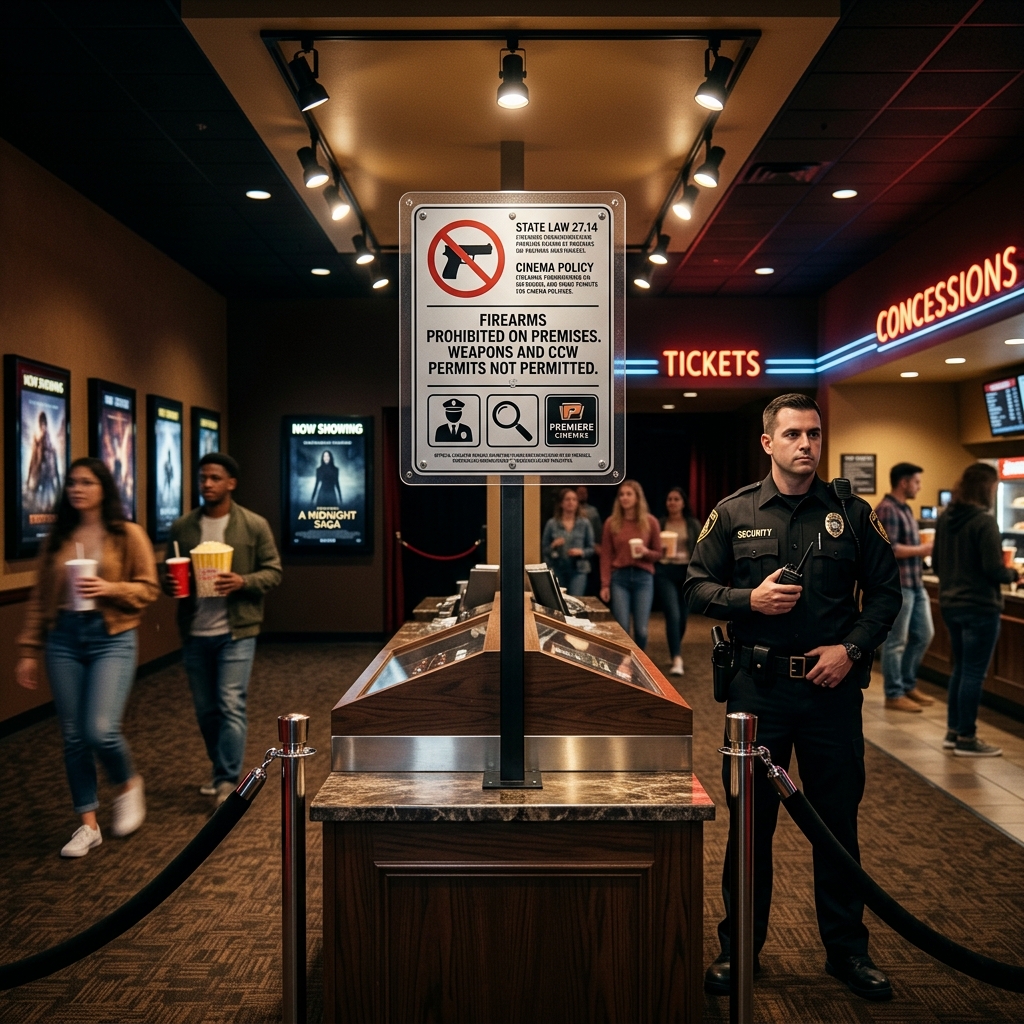
Whether firearms are allowed in a movie theater depends on a mix of state gun laws, local regulations, and the theater’s own private property policies, not on any single nationwide rule. Understanding how these layers fit together is crucial if you carry a firearm and plan to see a movie.
This article explains how movie theaters can regulate guns on their premises, how state concealed carry rules interact with those private policies, and what legal risks exist if you bring a firearm into a cinema that restricts weapons. It is for informational purposes only and is not legal advice.
1. No Single National Rule for Guns in Movie Theaters
In the United States, there is no federal statute that specifically addresses carrying firearms in movie theaters as a category of location. Instead, restrictions are primarily created by:
- State legislatures, which define where concealed firearms may or may not be carried.
- Local governments, which can sometimes add extra location-based rules.
- Private property owners, such as movie theater chains, who can set conditions for entry.
Because there is no single nationwide standard, what is permitted in one state can be illegal or prohibited by policy in another. Gun owners must therefore look at both statutory law and theater rules where they live.
2. How State Concealed Carry Laws Affect Movie Theaters
Every state now allows some form of concealed carry of handguns, either with or without a permit, but the conditions and location restrictions vary significantly. Many states use statutes that list places where firearms are forbidden even for otherwise lawful carriers.
2.1 Permit and Permitless Carry Frameworks
Concealed carry in the United States generally fits into one of these categories:
- Permitless (“constitutional”) carry – some states allow qualified adults to carry concealed without a permit.
- Shall-issue permits – most states issue permits to applicants who meet statutory criteria, such as background checks and training.
Even where permitless carry is allowed, states can still designate sensitive locations where firearms are not permitted. Movie theaters may or may not be included in such lists, depending on the state’s policy choices.
2.2 Statutory “No-Carry” Locations
Many state statutes identify specific places where concealed weapons are banned regardless of permits. A typical list may include:
- Court facilities and courtrooms
- Detention facilities such as jails and prisons
- Polling places during elections
- School buildings and certain campus areas
- Government meeting rooms and legislative hearings
- Portions of businesses primarily selling alcohol, such as bars
In some states, movie theaters are not explicitly listed. For example, Florida’s concealed carry statute identifies multiple prohibited locations but does not include movie theaters, which means lawful carriers may bring firearms into theaters unless another rule applies. Other states treat certain entertainment venues differently, and may include them in location restrictions or rely more heavily on private property rules.
3. Movie Theaters as Private Property
Movie theaters are usually privately owned businesses, and under general property law principles, owners and operators are allowed to set conditions for entry. This often includes restrictions on weapons even if state law would otherwise allow concealed carry.
3.1 Corporate Policies of Major Chains
Large national theater chains commonly adopt policies that prohibit weapons for ordinary patrons. For instance, one major chain’s public FAQ states that it does not permit “weapons of any kind” in its theaters. Typical private policies may include:
- Blanket bans on firearms, including lawfully carried civilian weapons.
- Restrictions on prop guns and costume weapons, particularly during themed screenings.
- Prohibited items that could make other guests feel unsafe or disrupt the movie-going experience.
These policies are enforceable as conditions of entry, even if they are not backed by state criminal statutes specifically about theaters. Patrons who do not comply can usually be asked to leave.
3.2 The Legal Role of “No Guns” Signs
How much legal force a “no firearms” sign carries depends almost entirely on state law:
- In some states, posted signs are given statutory weight, and ignoring them can itself be a criminal offense if the sign meets specific requirements (for example, size, placement, and wording).
- In other states, signs are primarily a way to express private policy. Violating the sign may not be a weapons offense but can lead to a trespass charge if you refuse to leave when asked.
Gun owners should check whether their state’s concealed carry law gives legal effect to posted prohibitions by private businesses. This determines whether entering a theater with a gun against posted rules is potentially a criminal act or only a basis for removal.
4. Guns in Movie Theaters: Law vs. Policy
In practice, whether you can legally carry a gun into a movie theater requires looking at two separate questions:
- Does state law allow concealed carry in that type of location?
- Does the theater’s private policy prohibit firearms?
These two layers can be summarized as follows:
| Scenario | State Law | Theater Policy | Practical Result |
|---|---|---|---|
| Lawful carry permitted, no posted ban | Allows concealed carry in theaters | No weapons policy or sign | Carrying may be lawful; ordinary trespass rules still apply. |
| Lawful carry permitted, private ban posted | Allows carry | Theater bans guns via policy and signage | Violating policy can lead to removal; may be a specific offense if state law enforces signs. |
| State designates theaters as gun-free | Statute forbids carry in designated entertainment venues | Policy may match or reinforce law | Carrying is illegal; possible criminal charges even without a sign. |
| Theater on larger restricted premises | Prohibits guns on certain government or institutional sites | Theater located within those grounds | Location-based restriction applies regardless of theater’s own policy. |
5. Examples of Location-Based Differences
Comparing different jurisdictions illustrates how rules can diverge:
- In one state, concealed carry law does not list theaters among prohibited places, meaning licensed carriers may be allowed to bring guns into cinemas unless the theater’s own policy says otherwise.
- In another state, certain entertainment or institutional locations—such as state institutions for mental health or specific festival grounds—are explicitly firearm-free, regardless of permits.
- Elsewhere, location restrictions may focus more on government facilities and schools, leaving ordinary commercial venues like theaters primarily governed by private property rules.
These examples show why relying on anecdotal information from other states can be misleading. Laws are state-specific and sometimes highly detailed.
6. Potential Criminal and Civil Consequences
Carrying a firearm into a theater where it is forbidden can lead to a range of consequences, depending on how the restriction is created:
6.1 Criminal Liability Under State Law
When a state statute specifically bans firearms in certain locations, entering those places armed can be a criminal offense. Possible outcomes include:
- Criminal charges for violating location restrictions, which may be misdemeanors or felonies depending on the statute.
- Revocation or suspension of a carry permit, if the person is a permit holder and state law ties violations to licensing consequences.
- Enhanced penalties if the violation occurs in sensitive areas such as schools or government buildings.
These consequences apply even if the theater itself is privately run, if it falls within a category of locations the legislature has designated as firearm-restricted.
6.2 Trespass and Policy-Based Enforcement
Where no statute bars firearms in theaters, but a theater’s policy prohibits them, legal consequences are usually based on property and trespass law:
- The theater may deny entry to anyone carrying a weapon contrary to its policy.
- If a person refuses to comply or leave, they may face a trespass charge under general criminal trespass statutes.
Respecting requests from theater staff to leave or disarm is often decisive in avoiding legal problems, even when the underlying carry is lawful under state law.
7. Practical Steps for Gun Owners Before Going to the Movies
Gun owners who want to stay within the law and avoid conflicts should take several practical steps before carrying into a theater.
7.1 Check State and Local Laws
- Review your state’s concealed carry statute and any published guidance from state agencies to find the list of prohibited locations.
- Look for local ordinances or administrative regulations that might add location-based restrictions, especially in cities or special districts.
- Confirm whether signage has legal force in your state and what requirements signs must meet.
7.2 Identify Theater Policies
- Check the theater’s website for any guest conduct or weapons policies in FAQ or terms of use sections.
- Observe signage at the entrance, including notices about weapons, bag checks, or other security measures.
- Contact the theater directly if policies are unclear, particularly if you intend to carry a firearm.
7.3 Consider Risk Management and Alternatives
- Weigh whether carrying into a crowded, dark venue aligns with your personal risk assessment and training.
- Consider alternative theaters with policies more consistent with your views on lawful carry if available.
- If carrying is not allowed, decide whether to attend without your firearm or choose a different activity.
8. Common Misunderstandings About Guns in Theaters
Several misconceptions frequently arise when discussing guns and movie theaters:
- “If I have a permit, I can carry anywhere.” In reality, permits come with detailed location restrictions, and many sensitive places remain off-limits.
- “Signs are always just suggestions.” In some states, ignoring properly posted signs is a statutory offense and can lead to criminal penalties.
- “Theaters can’t override state law.” Private businesses can impose stricter conditions than state law and remove patrons who refuse to comply.
- “There is a federal rule for theaters.” Federal law focuses on categories like schools, federal facilities, and certain parks, not ordinary commercial theaters.
9. FAQs: Guns and Movie Theaters
Q1: Is it ever clearly legal to carry a concealed firearm in a movie theater?
Yes, in some states, theaters are not listed among prohibited locations, and state law allows concealed carry generally. However, a theater’s private policy can still prohibit firearms on its property, so legality under state law does not guarantee acceptance by the theater.
Q2: Can a theater ask me to leave if they discover I am carrying legally?
Yes. As private property owners, theaters may set rules, including bans on weapons, and ask patrons to leave if they do not comply. Refusing to leave can lead to trespass issues even if your carry is otherwise lawful.
Q3: Do I face criminal charges just for walking into a theater with my concealed weapon?
It depends on the jurisdiction. If state law designates theaters or similar venues as firearm-free locations, entering with a gun can be a criminal offense. In states where theaters are not restricted and signs are not legally enforceable, the primary risk is trespass if you refuse to comply with staff directions.
Q4: How can I find out if my state treats private “no guns” signs as legally binding?
You should review your state’s firearms statutes and official guidance from relevant agencies, such as departments of justice or public safety. Many states spell out whether posted notices by private businesses have statutory force or merely express policy. Consulting a licensed attorney is advisable for interpretation.
Q5: Are there special rules if the theater is inside a government or institutional complex?
Yes. If a theater is located on property that is otherwise restricted—such as certain state institutions or specific government grounds—location-based firearm bans can apply regardless of theater policies. In those cases, carrying on the property may be illegal even if the theater itself does not post extra restrictions.
References
- Concealed carry in the United States — Various contributors; summary of U.S. concealed carry legal frameworks. 2023-06-01. https://en.wikipedia.org/wiki/Concealed_carry_in_the_United_States
- Licensed to carry: Movie theaters among Florida places where guns are allowed — Naples Daily News. 2012-07-27. https://archive.naplesnews.com/business/licensed-to-carry-movie-theaters-among-florida-places-where-guns-are-allowed-ep-388181706-330852871.html
- Can You Conceal Carry in a Movie Theater? A Comprehensive Guide — BattlBox. 2023-04-15. https://www.battlbox.com/blogs/outdoors/can-you-conceal-carry-in-a-movie-theater-a-comprehensive-guide
- Location Restriction Laws in Washington — Giffords Law Center to Prevent Gun Violence. 2023-10-01. https://giffords.org/lawcenter/state-laws/location-restrictions-in-washington/
- Theatre Info: Frequently Asked Questions — AMC Theatres. 2024-01-01. https://www.amctheatres.com/faqs/theatre-info
Similar Articles








Read full bio of Sneha Tete




