
Guide To Filing Divorce In California In 2026: 3 Options
Complete step-by-step instructions for initiating and completing divorce proceedings in California, including 2026 joint petition updates.
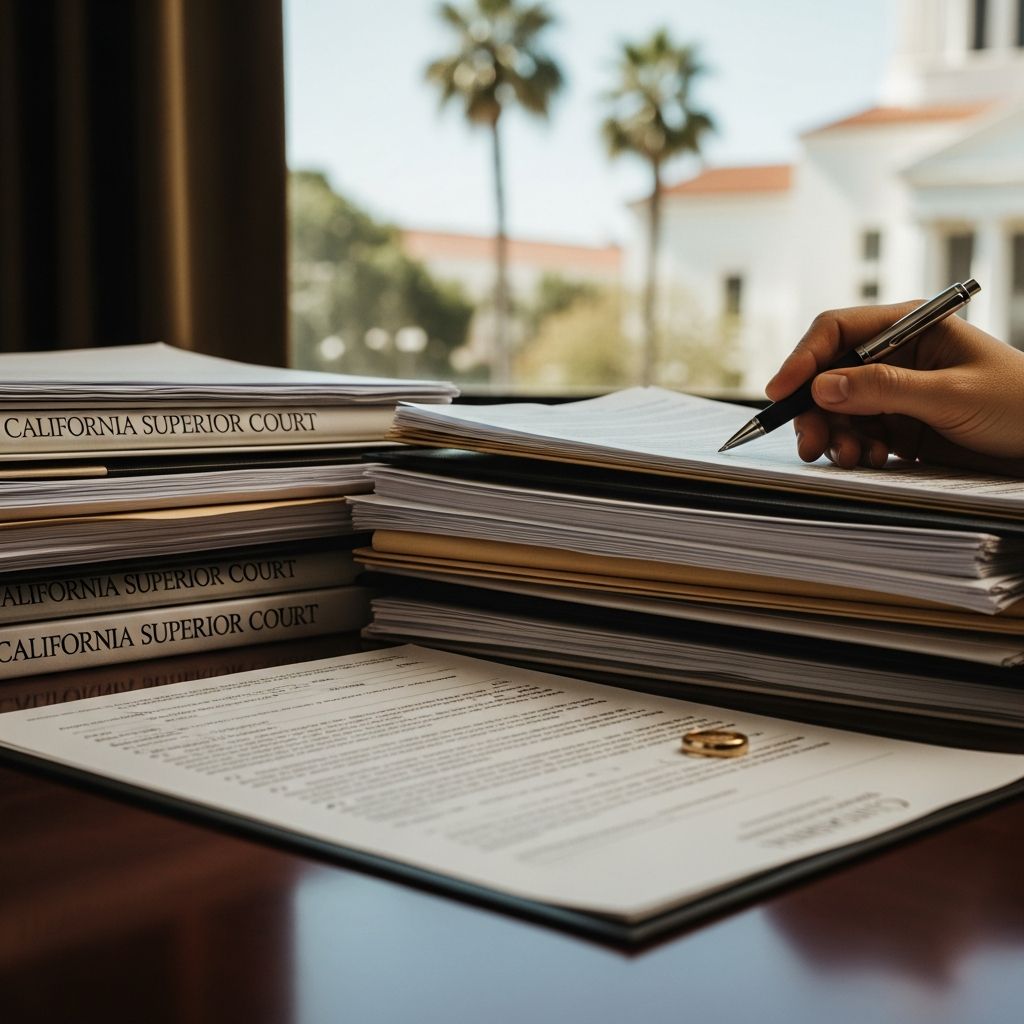
Divorce in California, legally termed dissolution of marriage, follows specific procedures governed by state family law. This guide outlines the entire process, from eligibility checks to final judgment, incorporating recent legislative changes like the 2026 joint petition option for cooperative couples.
Understanding Eligibility and Residency Requirements
To file for divorce in California, at least one spouse must meet strict residency criteria: residence in the state for six months and in the filing county for three months immediately preceding the petition. These rules ensure local courts have jurisdiction, particularly for child custody matters under the Uniform Child Custody Jurisdiction and Enforcement Act (UCCJEA).
California operates under a no-fault system, meaning irreconcilable differences suffice as grounds—no proof of wrongdoing is required. All dissolutions include a mandatory six-month waiting period from filing or service date, preventing rushed finalizations.
Choosing Your Divorce Pathway
California offers multiple routes based on agreement level and circumstances. Contested divorces involve disputes resolved by court or trial, while uncontested paths suit agreeing couples.
- Standard Dissolution: One spouse files independently; suitable for any case but lengthier if contested.
- Summary Dissolution: Limited to short marriages (under 5 years), no children, minimal assets/debts (<$52,000 separate property, community property under $52,000 excluding vehicles). Uses Joint Petition FL-182; no service needed.
- New Joint Petition (from Jan 1, 2026): Expanded uncontested option via Senate Bill 1427. Any couple agreeing on terms can file jointly using FL-700, bypassing service and initial fees duplication. Ideal for long marriages, families, or asset-heavy cases.
| Divorce Type | Eligibility | Key Forms | Service Required? |
|---|---|---|---|
| Standard | All couples | FL-100, FL-110 | Yes |
| Summary | Strict limits | FL-182 | No |
| Joint Petition (2026+) | Agreeing couples, no limits | FL-700, FL-710 | No |
Step-by-Step: Starting a Standard Divorce
Begin by completing the Petition—Marriage/Domestic Partnership (Form FL-100). Detail marriage date, children, property, support requests, and desired outcomes (legal separation or dissolution). Pair with Summons (FL-110), notifying spouse of proceedings and automatic temporary restraining orders (ATROs) that prohibit asset transfers, child relocation out-of-state, or insurance changes.
File at the Superior Court clerk’s office in your county, paying ~$435-$450 fee (waivable via FW-001 if low-income). Receive a case number and endorsed filed copies for service.
Serving Divorce Papers
A non-party adult (18+) must serve copies on the spouse within 60 days: personal delivery preferred, alternatives include mail or publication if evading. Spouse gets 30 days to respond via Form FL-120; non-response allows default request.
The Game-Changer: Joint Petition Process from 2026
Effective January 1, 2026, couples file as co-petitioners using:
- Joint Petition—Marriage/Domestic Partnership (FL-700): Outlines issues like custody, support, property.
- Summons—Joint Petition (FL-710).
- UCCJEA Declaration (FL-105) if minor children.
No service between spouses; ATROs activate upon filing, starting the six-month clock. Cannot seek temporary orders here—designed for self-managed agreements. If discord arises, revoke via FL-720 and convert to standard process.
Financial Transparency: Mandatory Disclosures
All divorces require preliminary (within 60 days of filing/response) and final declarations, exchangeable without court filing unless waived mutually via FL-144.
- Declaration of Disclosure (FL-140).
- Income & Expense Declaration (FL-150).
- Schedule of Assets & Debts (FL-142).
- Property Declaration (FL-160 if real estate).
These ensure equitable division of community property (acquired during marriage) vs. separate property. Failure to disclose accurately risks judgment invalidation.
Negotiating and Documenting Agreements
Reach written stipulations on child custody/visitation (best interest standard), support (guideline calculator), spousal support, property/debt split. Attach to Judgment form FL-180.
For uncontested finals:
- Appearance, Stipulations & Waivers (FL-130).
- Declaration for Default/Uncontested Dissolution (FL-170).
- Judgment (FL-180) with agreement.
Submit post-waiting period; court reviews for fairness, especially child-related terms.
Addressing Children and Support Issues
Custody prioritizes child’s health, safety, stability; joint preferred if feasible. Use parenting plans detailing schedules, holidays, decisions. Child support follows statewide formula based on income, custody time.
Spousal support considers marriage length, earning disparity, standard of living. Temporary orders available in standard cases via FL-300 Request for Order.
Court Hearings and Finalization
Uncontested cases rarely need hearings; submit packets for judge signature. Contested require case management conferences, settlement conferences, or trial. Post-judgment, bifurcations possible for status-only dissolution if property disputes linger.
Obtain certified copies of filed Judgment for name changes, retirement divisions, etc. Appeals rare but possible within strict timelines.
Costs, Fees, and Fee Waivers
Filing: $435-$450; response $435; other motions $60+. Add service ($50+), copies. Low-income qualify for waivers covering most fees.
Common Mistakes to Avoid
- Hiding assets—penalties include fines, attorney fees.
- Missing disclosure deadlines—delays finalization.
- Violating ATROs—contempt charges.
- Filing in wrong county—dismissal.
Alternatives to Court: Mediation and Collaboration
Mediation (court or private) fosters agreements; collaborative law uses team professionals for out-of-court resolution. Joint petition complements these for amicable pairs.
Frequently Asked Questions
Can I file for divorce online in California?
Some counties offer e-filing; check local Superior Court site. Forms downloadable from courts.ca.gov.
How long does a California divorce take?
Minimum 6 months; uncontested 6-8 months, contested 1+ years.
Do I need a lawyer for uncontested divorce?
Not required; self-represented common, but attorney advised for complexities.
What if my spouse won’t sign papers?
Proceed to default after 30 days; court decides unresolved issues.
Does the joint petition replace summary dissolution?
No, summary remains for qualifying simple cases; joint broader scope.
References
- California Divorce Process – Step By Step [2026 Updated] — Northern Family Law Mediation Group. 2026. https://www.nflmg.org/blog/california-divorce-process/
- California’s New “Joint Petition for Dissolution” Will Benefit Spouses In Collaborative Divorce Cases Starting January 1, 2026 — Collaborative Divorce California. 2025. https://collaborativedivorcecalifornia.com/californias-new-joint-petition-for-dissolution-will-benefit-spouses-in-collaborative-divorce-cases-starting-january-1-2026/
- Types of Uncontested Divorce in California — DivorceNet. 2026. https://www.divorcenet.com/resources/uncontested-divorce-california.html
- New Joint Petition for Divorce and Separation in California — Provinziano & Associates. 2025. https://provinziano.com/blog/joint-petition-for-divorce-and-separation-in-california/
- Joint petition for divorce or legal separation — California Courts Self Help Guide. 2026. https://selfhelp.courts.ca.gov/divorce/joint-dissolution
- Start a divorce case — California Courts Self Help Guide. 2026. https://selfhelp.courts.ca.gov/divorce/start-divorce
Similar Articles








Read full bio of Sneha Tete


