
Guide to Common Property Ownership Types
Learn how fee simple, co-ownership, community property, trusts, and business entities shape your rights and responsibilities in real estate.
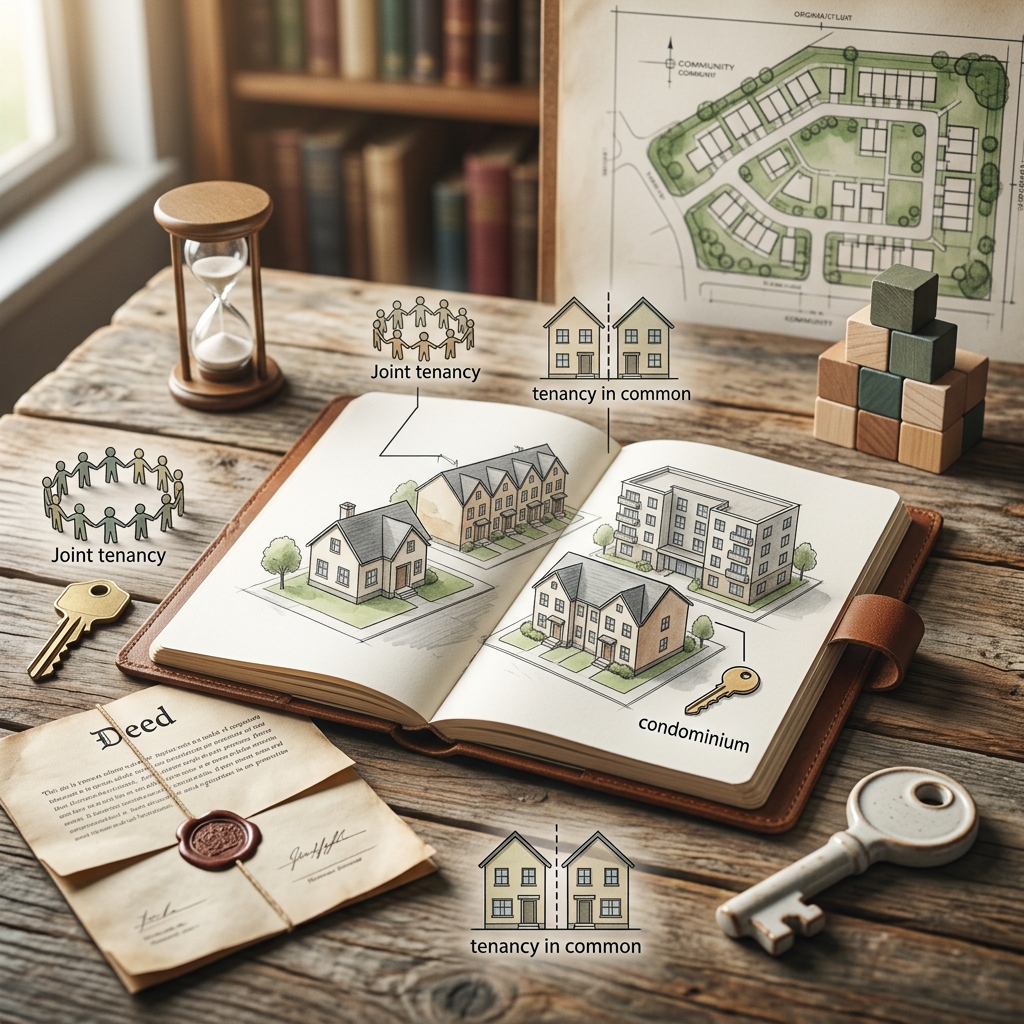
When you purchase real estate, you are not only buying land or a building—you are also choosing a legal form of ownership. That choice affects who controls the property, how it can be sold or transferred, what happens at death or divorce, and how creditors may reach it. Because those consequences are significant, it is important to understand the major ownership structures before you buy, sell, or transfer real estate.
This guide explains widely used property ownership types in clear, practical terms. It uses the law of real estate as a backdrop, but focuses on what buyers, co-owners, and families need to know when deciding how to hold title.
Why Property Ownership Form Matters
Two houses may look identical from the street, yet the legal rights attached to each can be very different. The way title is held can influence:
- Control – Who can make decisions about using, leasing, refinancing, or selling the property.
- Transfer on death – Whether an interest passes automatically to a survivor or must go through probate.
- Exposure to creditors – Whether a co-owner’s personal debts can lead to forced sale or liens.
- Tax treatment – How income, gains, and losses are reported and which deductions are available.
- Estate planning options – Whether the property can be easily aligned with your will or trust.span>
Choosing an ownership type is therefore part legal decision and part financial planning decision. In many cases, consulting an experienced real estate or estate planning attorney is advisable.
Overview of Major Ownership Categories
Most residential real estate is held under one of the following broad structures:
- Individual ownership (fee simple in one name)
- Co-ownership between two or more parties
- Ownership by a married couple under community property rules (in certain states)
- Title held by a trust for estate or asset management purposes
- Ownership by a business entity such as a partnership, LLC, or corporation
- Leasehold interests, where someone holds temporary rights under a lease rather than permanent ownership
| Ownership Type | Who Holds Title? | Survivorship Rights? | Common Uses |
|---|---|---|---|
| Fee Simple (sole ownership) | One individual or legal entity | No automatic survivorship | Primary homes, investment property for single owners |
| Joint Tenancy | Two or more co-owners | Yes, interest passes to surviving co-owners | Couples or relatives seeking automatic transfer at death |
| Tenancy in Common | Two or more co-owners | No survivorship; shares pass by will or intestacy | Unrelated investors, siblings, friends co-buying property |
| Community Property | Spouses in certain states | Often paired with survivorship options by statute | Marital property acquired during marriage |
| Trust Ownership | Trustee holds title for beneficiaries | Controlled by trust terms, not default law | Estate planning, incapacity planning, probate avoidance |
| Entity Ownership (LLC, corp.) | Business entity | Depends on entity and agreements | Rental property, group investments, liability management |
| Leasehold Estate | Owner keeps title; tenant has possessory rights | None; lease ends per contract | Rental housing, commercial leases |
Fee Simple: The Default Form of Complete Ownership
In many jurisdictions, the standard way an individual owns real property is known as fee simple ownership. In practical terms, this is what people typically imagine when they say they “own” a home.
Where a person holds property in fee simple in their own name, they generally have:
- The broadest legally recognized bundle of rights in the property
- Power to sell, gift, lease, or mortgage the property without consent from co-owners
- Responsibility for taxes, maintenance, and compliance with zoning or other legal restrictions
If a fee simple owner dies, their interest passes through their will or, if no will exists, according to state intestacy law and may require probate. For that reason, individual owners often combine fee simple title with estate planning tools such as wills, trusts, or transfer-on-death deeds where available.
Joint Ownership Between Multiple People
When more than one person acquires property together, the law treats that arrangement as joint ownership. Co-ownership can be structured in different ways, each with its own rules for survivorship, transfer, and creditor rights.
Joint Tenancy
Under joint tenancy, two or more people hold equal shares in the same property. A defining feature is the right of survivorship: when one joint tenant dies, their share automatically passes to the surviving joint tenants, rather than to their heirs or through their will.
Key characteristics include:
- Each co-owner has an equal share and equal right to use and enjoy the whole property.
- Transfers made by a joint tenant during life can change or sever the joint tenancy depending on state law.
- Because survivorship is automatic, inheritances from a deceased joint tenant may be limited.
Joint tenancy is often used by couples or close relatives who want to ensure that the property passes directly to the survivor without probate. However, it can complicate estate planning where more complex distribution is desired.
Tenancy in Common
In a tenancy in common, two or more people also own the same property, but their shares can be unequal and there is no right of survivorship.
Important features include:
- Each owner has a fractional interest, which may be equal or unequal (for example, 50% and 25% shares).
- Every tenant in common has the right to possess and use the entire property, regardless of share size.
- On death, a co-owner’s share passes according to their will or state law, potentially introducing new co-owners.
- An owner may transfer or sell their share independently, subject to any agreement among the co-owners.
Tenancy in common is common among friends, siblings, or unrelated investors purchasing property together because it allows flexible ownership percentages and individualized estate plans. Clear written agreements about expenses, use, and exit strategies are strongly recommended.
Community Property in Marital Relationships
In certain U.S. states, married couples are subject to community property regimes. Under these systems, most property acquired during marriage is deemed to belong equally to both spouses, regardless of whose name is on the title or who earned the income used to buy it.
Broadly, community property rules mean:
- Each spouse owns a one-half interest in property acquired during the marriage, with some exceptions for separate property.
- Disposition of community property at death or divorce is governed by state statutes.
- Creditors of one spouse may have claims on community assets, subject to local law.
Community property states vary in details, and some offer forms such as “community property with right of survivorship” to combine equal marital ownership with automatic transfer to the surviving spouse. Because tax and estate consequences can be complex, professional legal advice is strongly recommended in community property jurisdictions.
Holding Real Estate in a Trust
Real estate can be owned not just by individuals or entities but also by a trust. In this arrangement, title is placed in the name of a trustee, who manages the property for the benefit of one or more beneficiaries under written trust terms.
Typical steps to place property in a trust include:
- Creating a written trust agreement.
- Designating a trustee (which can be the original owner, another individual, or a professional fiduciary).
- Identifying beneficiaries who will enjoy the benefits of the trust property.
- Executing a deed that transfers the property into the trust’s name.
Advantages may include:
- Coordination with broader estate planning, including control over who receives the property and when.
- Potential avoidance of probate for the property at the original owner’s death.
- Management of property for those who are minors or unable to manage their own affairs.
Trusts come in many forms (revocable, irrevocable, testamentary, and more), each with distinct tax and legal consequences. It is important to ensure deeds and trust documents are properly prepared to achieve the intended results.
Business Entities as Property Owners
Instead of owning real estate personally, many investors and business owners hold property through a business entity such as a partnership, limited liability company (LLC), or corporation.
Common reasons for entity ownership include:
- Liability management – Separating personal assets from business risks associated with rental operations or development.
- Co-investment structure – Allowing multiple individuals to own interests in an entity that itself holds the property.
- Tax planning – Using entity taxation rules to allocate profits, losses, and deductions among owners.
Under this model, the entity appears as the owner on the deed, while individuals hold membership interests, partnership interests, or shares in the entity. Transfers, decision-making, and distributions are governed by operating agreements, partnership agreements, bylaws, or similar documents.
Leasehold Estates: Rights Without Title
Not everyone who occupies property is an owner. A leasehold estate arises where the owner grants a tenant the right to occupy and use the property for a defined period in exchange for rent.
Key aspects include:
- The landlord retains title while the tenant holds a temporary possessory right defined by the lease.
- At the end of the term, the tenant’s rights end and full possession returns to the owner.
- Tenants generally cannot sell or mortgage the property; their rights are limited to what is granted in the lease.
Leasehold interests are ubiquitous in residential rentals and commercial leases. In some markets, long-term leaseholds (lasting decades) may function similarly to ownership from the tenant’s perspective, but the underlying title remains with the fee owner.
Factors to Consider When Choosing an Ownership Type
There is no single “best” form of property ownership; the optimal structure depends on your goals, relationships, and risk profile. Some important considerations include:
- Number and relationship of owners – Are you buying alone, with a spouse, with family, or with unrelated investors?
- Desired survivorship arrangements – Do you want your interest to pass automatically to a co-owner or to be controlled by your will or trust?
- Estate planning objectives – Are you trying to avoid probate, provide for specific beneficiaries, or manage property for minors?
- Exposure to risk and creditors – Are you comfortable holding the property personally, or does an entity structure better protect your other assets?
- Tax implications – How will income, deductions, and future gains be treated under each ownership form?
Because these issues intersect with state law, tax rules, and personal circumstances, professional advice from attorneys and tax advisors is often beneficial before making a final decision.
Frequently Asked Questions About Property Ownership Types
Is fee simple ownership always the default?
Fee simple is commonly the default form of individual ownership in many jurisdictions, especially when a deed does not specify a more limited estate. However, defaults for co-ownership (such as tenancy in common) vary by state, so reviewing the deed language is essential.
What is the main difference between joint tenancy and tenancy in common?
The central difference is survivorship. In joint tenancy, a deceased owner’s share passes automatically to remaining co-owners. In tenancy in common, the share becomes part of the deceased’s estate and passes under their will or state law.
Do community property rules apply in every state?
No. Only certain states use community property systems for marital property, and each has its own statutes and nuances. Couples outside those jurisdictions typically rely on other co-ownership forms and marital property rules specific to their state.
Why would someone place their home in a trust?
Homeowners often use trusts to integrate real estate into a comprehensive estate plan, avoid probate, manage property during incapacity, or provide structured benefits for heirs. The specific advantages depend on the type of trust and local law.
When is it helpful to use an LLC or corporation to own property?
Entity ownership is commonly used for rental properties, joint investments, or projects involving higher liability risk. LLCs in particular can offer liability protection and flexible management arrangements when properly formed and maintained.
Does a tenant ever become an owner through a lease?
Ordinary leases do not give tenants ownership; they provide temporary possession and use rights defined by the lease agreement. Some contracts, such as lease-options, may grant the tenant a right to purchase in the future, but title changes only if a separate transfer of ownership occurs.
References
- Understanding Property Ownership Types — Super Lawyers. 2023-04-12. https://www.superlawyers.com/resources/real-estate/residential-real-estate-transactions/understanding-property-ownership-types/
- Property Law 101: Types of Ownership — Blueprint Title. 2021-08-10. https://blueprinttitle.com/property-law-101-types-of-ownership/
- Ownership and Titles: Chain of Title in Property Law — University of Pittsburgh School of Law (Online). 2020-11-19. https://online.law.pitt.edu/blog/understanding-ownership-and-title-in-property-law
- Four Types of Property Ownership and the Transfer of Title — West Coast Escrow. 2019-06-03. https://www.westcoastescrow.com/blog/four-types-of-property-ownership-and-the-transfer-of-title/
- 5 Ways to Own Your Home: Understanding Different Types of Property Ownership — SSB LLC. 2020-02-14. https://ssbllc.com/5-ways-to-own-your-home-understanding-different-types-of-property-ownership/
- Real Estate Ownership Types in PA — Carosella & Associates. 2022-01-21. https://carosella.com/blog/types-of-real-estate-ownership/
Similar Articles








Read full bio of Sneha Tete


