
The Commercial Data Loophole: How Government Agencies Bypass the Fourth Amendment
Discover how federal agencies bypass the Fourth Amendment by purchasing your smartphone location data from commercial brokers.
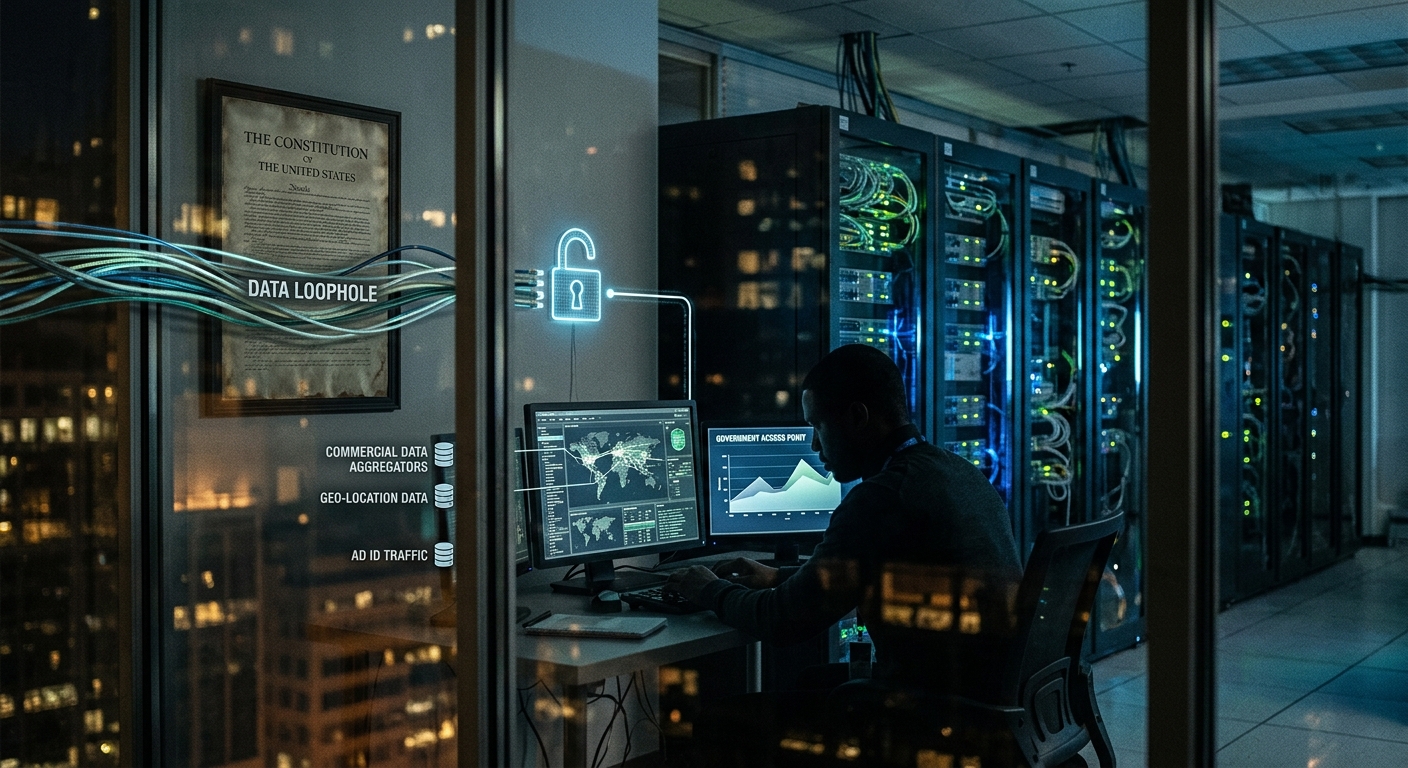
Every day, millions of Americans wake up, check their smartphones, and unknowingly broadcast their precise physical movements to a sprawling, unregulated ecosystem of commercial data brokers. For years, the public has operated under the assumption that the government must obtain a warrant to track a citizen’s physical location. However, a glaring legal loophole has allowed federal agencies to bypass the judicial system entirely. Instead of presenting probable cause to a judge, government agencies are simply pulling out their wallets and purchasing massive troves of location data on the open market.
This practice has fundamentally altered the landscape of digital privacy. By acquiring data from third-party aggregators, law enforcement and immigration enforcement agencies can construct detailed maps of our daily lives—where we sleep, where we work, where we worship, and who we associate with. This article explores the mechanics of location data brokering, the legal gray areas that enable warrantless government surveillance, and the ongoing legislative battles aiming to close this profound privacy loophole.
The Mechanics of Location Data Collection
To understand how the government acquires this information, one must first understand how the data is generated and harvested. The modern smartphone is essentially a highly sophisticated tracking beacon. While cellular networks constantly monitor the proximity of devices to cell towers to route calls and messages, a more granular level of tracking occurs within the apps installed on the device.
When consumers download weather apps, local news aggregators, or navigation tools, they are routinely prompted to grant location permissions. Often, the fine print in the terms of service permits the app developer to share or sell this data to third-party monetization partners. These partners, known as data brokers, specialize in aggregating billions of geographic data points from hundreds of millions of mobile devices. They compile this information into massive, searchable databases.
Data brokers collect “Mobile Advertising Identifiers” (MAIDs) alongside precise GPS coordinates and timestamps. While these companies frequently claim that their data is aggregated and anonymized, the sheer volume and precision of the information paint a highly detailed picture of an individual’s movements. The Federal Trade Commission (FTC) has increasingly scrutinized this industry. In recent enforcement actions, the FTC targeted companies like Venntel and Gravy Analytics for unlawfully tracking and selling sensitive location data, noting that such surreptitious surveillance undermines civil liberties. Despite these regulatory actions, the market for location data remains vast and highly lucrative.
The Legal Gray Area: Bypassing the Fourth Amendment
The Fourth Amendment of the United States Constitution protects citizens against unreasonable searches and seizures, stipulating that warrants must be issued based on probable cause. Historically, if the government wanted to track a suspect’s movements, they had to convince a judge to authorize the surveillance.
In 2018, the Supreme Court handed down a landmark ruling in Carpenter v. United States. The Court ruled that the government must obtain a warrant to access historical Cell-Site Location Information (CSLI) held by wireless carriers. Chief Justice John Roberts, writing for the majority, noted that cell phones are “almost a feature of human anatomy” and that tracking their location provides an intimate window into a person’s life, revealing their familial, political, professional, religious, and sexual associations. The Carpenter decision was hailed as a massive victory for digital privacy.
However, the ruling left a critical blind spot. The Carpenter case specifically addressed data obtained directly from telecommunications providers via compelled disclosure (subpoenas or court orders). It did not explicitly address what happens when the government acts not as a sovereign compelling information, but as a commercial consumer purchasing it on the open market. Federal agencies have leveraged this distinction to argue that voluntarily commercialized data falls outside the scope of Carpenter. By treating location data as a commercially available commodity, the government argues it is merely buying information that is already available to anyone willing to pay for it, thus circumventing the warrant requirement.
Federal Agencies on a Data Shopping Spree
The exploitation of this commercial data loophole is not a theoretical concern; it is a widespread, multi-million dollar practice across several federal agencies. Documents obtained through public records requests and congressional oversight have revealed that components of the Department of Homeland Security (DHS), specifically Customs and Border Protection (CBP) and Immigration and Customs Enforcement (ICE), have spent heavily on subscriptions to commercial location databases.
These databases provide agencies with access to a staggering volume of information. Agents can draw digital “geofences” around specific areas—such as border crossings, protest sites, or target neighborhoods—and identify every mobile device that entered or exited the zone during a specific timeframe. They can then track those individual devices backward or forward in time to determine where the user lives, works, and travels.
For immigration enforcement, this capability allows agents to track the movements of undocumented individuals without needing to establish probable cause for a physical search. While agencies defend these purchases as necessary tools for national security and border enforcement, privacy advocates argue that the unrestricted use of commercial databases turns ordinary citizens into subjects of continuous, warrantless surveillance. The sheer scale of the data acquired—billions of pings mapping the daily lives of millions of people—represents a profound expansion of government tracking capabilities without congressional authorization or judicial oversight.
The Illusion of Anonymity and Civil Liberty Threats
A primary defense offered by both data brokers and government agencies is that the purchased data is “anonymized.” They emphasize that the databases do not contain names, phone numbers, or social security numbers, but only alphanumeric device identifiers. However, privacy experts and technologists have repeatedly demonstrated that location data is inherently identifiable.
The concept of “pattern of life” analysis renders anonymity a myth. If a supposedly anonymous data point regularly spends the hours of midnight to 6:00 AM at a specific residential address, and 9:00 AM to 5:00 PM at a specific office building, it takes only a cursory public records search to identify the owner of the device. Furthermore, observing where a device travels can reveal highly sensitive personal information.
The civil liberty implications are severe. Warrantless access to commercial location data threatens to chill First Amendment rights. Individuals may be hesitant to attend political protests, union organizing meetings, or places of worship if they know their presence is being logged in a database accessible to federal agents. Moreover, tracking visits to medical facilities, such as reproductive health clinics or psychiatric offices, exposes deeply personal health information to government scrutiny without any suspicion of criminal wrongdoing. The FTC has specifically highlighted the danger of data brokers selling information regarding visits to health-related locations and places of worship, underscoring the severe risks to consumer privacy.
The Push for Legislative Guardrails
As public awareness of the commercial data loophole has grown, a bipartisan coalition of lawmakers has introduced legislation to rein in the practice. The most prominent effort is the Fourth Amendment Is Not For Sale Act. This proposed legislation seeks to close the loophole by expressly prohibiting law enforcement and intelligence agencies from purchasing personal data, including location information, from data brokers if that data would normally require a warrant or court order to obtain.
The Act aims to restore the spirit of the Carpenter decision by ensuring that the government cannot use its purchasing power to strip citizens of their constitutional protections. Under the proposed law, agencies would be forced to revert to the traditional judicial process: if they want to track an individual’s location, they must present probable cause to a judge and obtain a warrant, regardless of whether the data is held by a telecom giant or a commercial data broker.
While the legislation has garnered support from a diverse array of civil liberties organizations across the political spectrum, it faces opposition from law enforcement groups who argue that cutting off access to commercial data would hamper their ability to investigate crimes and secure the border. The ongoing debate highlights the urgent need to update privacy laws for the digital age.
How Consumers Can Protect Their Digital Footprint
While a permanent solution requires legislative action, consumers can take proactive steps to limit the amount of location data their devices broadcast to commercial brokers:
- Review App Permissions: Regularly audit the location permissions granted to applications on your smartphone. Limit access to “Only While Using the App” and disable precise location tracking for apps that do not strictly require it (e.g., weather apps can function on generalized ZIP code data rather than exact GPS coordinates).
- Reset Advertising Identifiers: Both iOS and Android allow users to reset their Mobile Advertising ID (MAID) or opt out of ad personalization entirely. Doing this regularly severs the link between your historical data and your current device profile.
- Turn Off Background Refresh: Prevent apps from collecting data when you are not actively using them by disabling background app refresh for non-essential applications.
- Use Privacy-Focused Alternatives: Whenever possible, utilize services and applications that prioritize user privacy and explicitly state they do not sell user data to third-party brokers.
Frequently Asked Questions (FAQs)
What is a data broker?
A data broker is a company that specializes in collecting personal information about consumers from various sources, aggregating it, and selling it to third parties. They gather data from public records, online tracking, app permissions, and purchasing histories, often without the consumer’s direct knowledge or consent.
What did the Carpenter v. United States decision do?
In 2018, the Supreme Court ruled in Carpenter v. United States that the government generally must obtain a warrant supported by probable cause to access a person’s historical cell-site location information (CSLI) from their wireless carrier. It recognized that people have a reasonable expectation of privacy in their physical movements.
Can the government track my phone without a warrant?
Due to the commercial data loophole, federal agencies can currently purchase precise smartphone location data from commercial data brokers without obtaining a warrant. While they cannot compel your cellular provider to hand over data without a court order, they can legally buy similar data on the open market.
Is “anonymized” location data truly anonymous?
No. While data brokers may strip names and phone numbers from the data, the location patterns themselves are highly identifiable. Analyzing where a device rests at night and travels during the day makes it relatively simple to determine the identity of the device owner.
References
- 16-402 Carpenter v. United States (06/22/2018) — Supreme Court of the United States. 2018-06-22. https://www.supremecourt.gov/opinions/17pdf/16-402_h315.pdf
- FTC Takes Action Against Gravy Analytics, Venntel for Unlawfully Selling Location Data Tracking Consumers to Sensitive Sites — Federal Trade Commission. 2024-12-03. https://www.ftc.gov/news-events/news/press-releases/2024/12/ftc-takes-action-against-gravy-analytics-venntel-unlawfully-selling-location-data-tracking
- S. 4082 – A bill to implement reforms relating to foreign intelligence surveillance authorities, and for other purposes. — Congress.gov. 2026-03-12. https://www.congress.gov/bill/118th-congress/senate-bill/4082
Similar Articles








Read full bio of medha deb


