
Getting ID, Birth Certificates, and Social Security in DC
Step-by-step guidance to help DC residents replace or obtain a photo ID, birth certificate, and Social Security card even without existing documents.
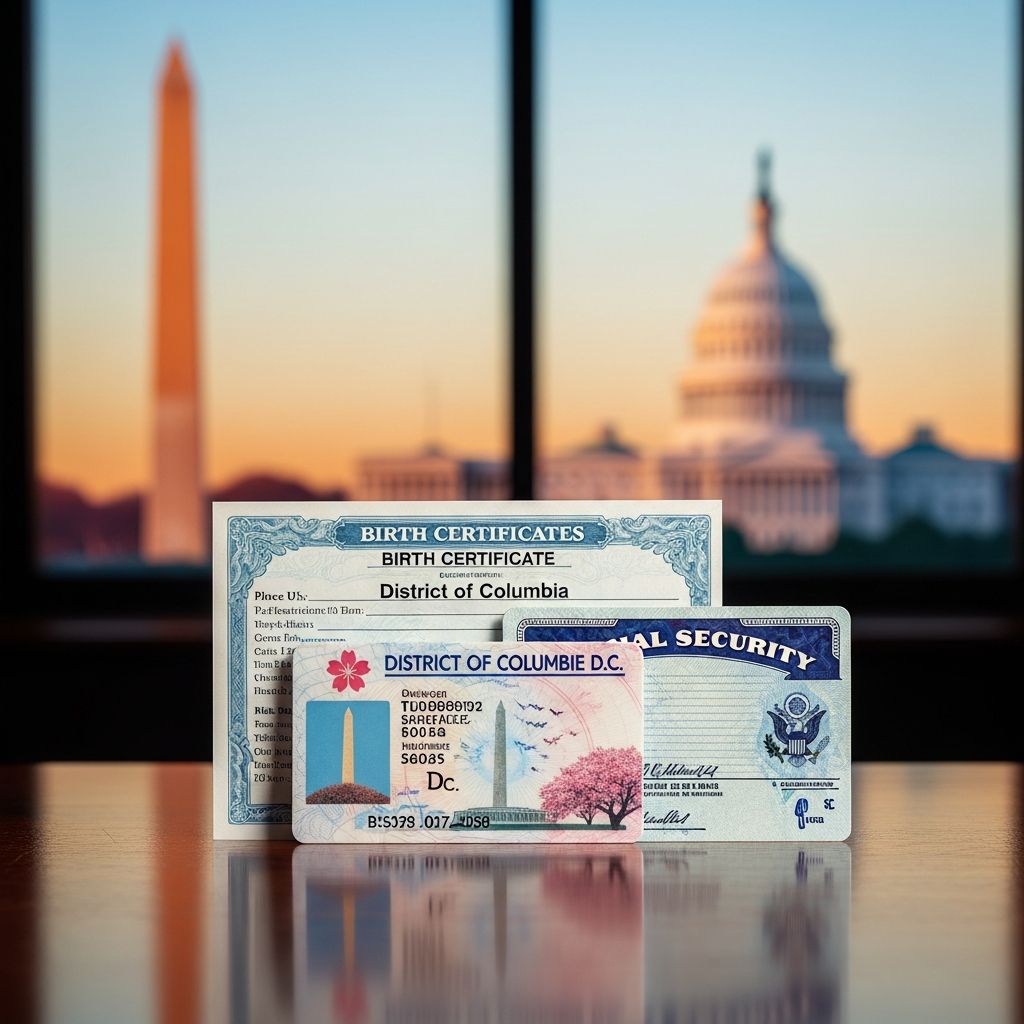
Having valid identification is essential for work, housing, benefits, school enrollment, voting, and many other parts of daily life. This guide explains how people connected to Washington, DC can obtain or replace a government photo ID, a certified birth certificate, and a Social Security card, with special attention to what to do if you have lost your documents or never had them.
1. Why These Documents Matter
Most agencies and employers in the United States require a combination of identity and citizenship documents. For many people, these include:
- A state-issued driver license or non-driver ID
- A certified birth certificate issued by a state or DC vital records office
- A Social Security card issued by the Social Security Administration (SSA)
Federal rules for completing a Form I-9 to prove identity and work authorization specifically list state IDs, U.S. birth certificates, and Social Security cards as common options.
2. Understanding the Basic Documents
Before looking at the step-by-step process, it helps to understand what each document is and who issues it.
2.1 Government Photo ID
A government photo ID is usually one of the following:
- Driver license issued by a state or DC
- Non-driver ID card issued by a state or DC
- Passport or passport card issued by the U.S. Department of State
In DC, the Department of Motor Vehicles (DC DMV) issues driver licenses and non-driver IDs. To qualify, you need to prove your identity, age, social security number (or in some cases ineligibility), and DC residency.
2.2 Certified Birth Certificate
A certified birth certificate is an official record created by the government where you were born. For births in the District of Columbia, the DC Health Vital Records Division keeps these records and issues certified copies.
A certified copy is printed on security paper with raised seals or other special features and is accepted for legal purposes such as passports, school, and benefits.
2.3 Social Security Card
The Social Security Administration (SSA) issues Social Security numbers and cards. The card itself is generally used as an identity and work authorization document, but the number is also needed for many purposes such as employment, filing taxes, and certain public benefits.
3. Getting or Replacing a DC Birth Certificate
If you were born in DC, you usually must get your birth certificate from DC Health’s Vital Records Division (DCVRD). If you were born in another state, you must request it from that state’s vital records office, which can be found through the Centers for Disease Control and Prevention (CDC) “Where to Write for Vital Records” directory.
3.1 Who Is Allowed to Request a DC Birth Certificate
To protect privacy, DC treats birth records as confidential and limits who can order a copy.
Generally, the following people may request a DC birth certificate:
- The person named on the certificate (must typically be at least 18)
- A parent named on the birth certificate
- Close family such as adult children, siblings, grandparents, or grandchildren with proof of relationship
- A legal guardian or custodian with a court order
- A legal representative (such as an attorney) with written authorization
- Certain government officials such as social workers or law enforcement with specific documentation
If you are not sure whether you qualify, contact DCVRD directly to confirm before paying any fees.
3.2 Ways to Order a DC Birth Certificate
DC offers several ways to obtain a certified birth certificate for births that occurred in the District.
| Method | How It Works | Typical Advantages | Things to Consider |
|---|---|---|---|
| Online / Phone (through remote provider) | Order electronically via DC’s approved remote ordering service (such as VitalChek). | Convenient, no travel, can pay by card. | Extra service fees; must upload or mail ID; mail delivery time. |
| By Mail | Mail a completed application, ID copy, and payment to the address listed by DCVRD. | Useful if you cannot visit in person and do not want to use online services. | Processing and mailing can take several weeks; risk of mail delays. |
| In-Person (walk-up or kiosk) | Visit a DC vital records service location and order at a kiosk or service window. | Fastest for many people; staff can review your paperwork on the spot. | Limited hours; you may need to wait in line and bring original ID documents. |
3.3 Identification Required for a DC Birth Certificate
To receive a birth certificate in DC, you must prove your identity. DCVRD separates IDs into primary and secondary lists.
Examples of acceptable primary photo ID (must usually be original, unexpired, and undamaged) include:
- State-issued driver license or non-driver ID card
- U.S. passport or passport card
- Permanent resident (green) card
- Employment authorization card
- U.S. military ID
- Government employee or law enforcement ID (with additional required documents)
If an electronic kiosk can confirm your identity, one primary ID may be enough. When automatic verification does not work, DCVRD may require a combination of up to three documents from primary and secondary lists, at least one of which must be primary.
Examples of secondary evidence used to support identity include:
- Recently dated pay stub or W-2 form
- School ID with transcript or report card
- Utility bill, lease, or tax return with your name and address
- Social Security card, voter registration card, or vehicle registration
- Court papers or Department of Corrections documents with photo
3.4 Fees and Processing Times
DC charges a fee for each certified copy of a birth certificate. The CDC’s directory lists the current base cost for DC birth records and the mailing address for written requests. Remote ordering services and card payments typically add service or processing fees.
Processing times can vary. In general:
- Mail orders can take several weeks from the date the office receives your request.
- Online and phone orders depend on verification and mail delivery.
- In-person orders may be completed the same day if documents are in order.
4. Getting a Government Photo ID When You Lack Documents
One of the hardest situations for many people is not having any current photo ID or Social Security card to start with. The process can feel circular: you need ID to get a birth certificate, but you also need a birth certificate to get ID.
While the precise requirements change over time and differ among states, here are common strategies that DC residents use to break this cycle, based on typical DMV and vital records practices.
4.1 Collect Alternative Proofs of Identity
If you lack a standard driver license or passport, gather as many alternative documents as you can. These might include:
- Old, expired driver license or school ID (even if no longer valid)
- Hospital records from birth or early medical records
- Immunization records, school enrollment forms, or report cards
- Benefits letters from Social Security, Medicaid, SNAP, or housing authorities
- Pay stubs, tax returns, or W-2 forms that show your name and part of your SSN
- Court records, probation or parole paperwork, or correctional ID
These types of records are often similar to items on the secondary ID list that DCVRD accepts and can make it easier to convince a vital records office to issue a certificate.
4.2 Use Family or Guardianship Documents
If you are unable to request your own birth certificate because of age or missing documents, a qualifying relative or guardian may be able to order it for you.
- Parents can use their own ID, along with proof that they are listed on the birth record.
- Legal guardians can show a court order naming them as guardian and their own photo ID.
- Adult children, grandparents, or siblings can sometimes apply with documents proving relationship, such as other birth certificates or court records.
4.3 Ask About Exceptions and Alternative Procedures
Vital records offices sometimes have procedures for people who do not have typical documents, especially in cases of homelessness, natural disasters, or domestic violence. While the details are not always publicized, it is worth asking DCVRD or legal aid groups about:
- Identity affidavits signed in front of a notary
- Letters from shelters, social workers, or case managers
- Use of correctional or probation records as primary or secondary ID
Because policies can change, always confirm current requirements with DCVRD or a reputable legal services organization.
5. Replacing a Social Security Card
Once you have some proof of identity—often your birth certificate or state ID—you can request a replacement Social Security card. The Social Security Administration allows free replacement of lost or stolen cards for U.S. citizens and certain noncitizens, subject to annual and lifetime limits.
5.1 Where and How to Apply
You can request a replacement Social Security card by:
- Using the my Social Security online portal in eligible states if you meet age, citizenship, and ID criteria
- Submitting a paper application by mail to your local SSA office
- Visiting an SSA office in person (often by appointment)
The application form (Form SS-5) asks for your full legal name, name at birth, Social Security number (if known), place of birth, date of birth, citizenship, and parents’ names, among other details. You must also provide original documents proving your identity, and in some cases your citizenship and age. SSA’s official instructions list which documents are acceptable.
5.2 Documents Commonly Needed for SSA
For U.S. citizens, SSA generally asks for:
- A U.S. birth certificate or U.S. passport to prove citizenship and age
- A state driver license, state non-driver ID, or U.S. passport as primary identity document
SSA may also accept other records in specific circumstances, such as employee ID, school ID, or health insurance card, but these are usually backups if you cannot get primary ID.
5.3 Protecting Your Number After Replacement
Replacing a card does not change your Social Security number. If your card was stolen or you suspect identity theft, you may also need to:
- Check your credit reports regularly
- Report fraud alerts to major credit bureaus
- Contact law enforcement if someone is using your information
The Federal Trade Commission provides step-by-step identity theft recovery guidance, which is especially important if your birth certificate or Social Security card has been misused.
6. Practical Order: Which Document to Get First?
The right order depends on what you already have. For many DC residents, this general sequence works best:
- Step 1: Obtain a certified birth certificate from the state or DC where you were born.
- Step 2: Use the birth certificate (plus any secondary records) to request a state ID or driver license.
- Step 3: Once you have a state ID, apply for or replace your Social Security card.
If you already have any one of these, you may be able to use it to obtain the others more easily.
7. Tips to Avoid Delays or Denials
Requests for identity documents are sometimes denied because paperwork is incomplete, signatures are missing, or fees are incorrect. To reduce the risk of delays:
- Use the most recent official application forms from DC Health and SSA websites.
- Read instructions carefully and answer every required question.
- Send only copies when allowed; never mail original IDs unless specifically required.
- Check that your name, date of birth, and parents’ information are spelled consistently across documents.
- Keep receipts, confirmation numbers, and copies of everything you submit.
8. Frequently Asked Questions (FAQs)
Q: I was born in DC but now live in another state. Do I still have to get my birth certificate from DC?
Yes. You must request your birth certificate from the jurisdiction where you were born. If your birth occurred in DC, DC Health’s Vital Records Division is the official source, even if you currently live elsewhere.
Q: Can I use an expired driver license as ID to get a DC birth certificate?
DC Health may accept a recently expired state driver license or ID as part of the combination of documents used to prove identity, especially when paired with other secondary records. However, requirements can change, so you should confirm current rules with DCVRD before applying.
Q: How long does it take to get a DC birth certificate by mail?
Processing times vary, but government guidance suggests that mail orders often take several weeks, including mailing time in both directions and time for the office to process the request.
Q: Is a photocopy of my birth certificate good enough for a driver license or passport application?
No. Most agencies, including DMV offices and the U.S. Department of State, require a certified copy of your birth certificate with security features, not a photocopy or scanned image.
Q: Do I have to pay a fee every time I request a copy of my birth certificate?
Generally yes. Vital records offices charge a set fee for each certified copy, and remote ordering services often add processing fees. Fee waivers are rare and usually limited to specific programs or circumstances.
References
- Birth Certificates — DC Health. 2024-05-01. https://dchealth.dc.gov/service/birth-certificates
- Vital Records — DC Health. 2024-06-10. https://dchealth.dc.gov/vital-records
- Where to Write for Vital Records: District of Columbia — Centers for Disease Control and Prevention (CDC). 2023-01-19. https://www.cdc.gov/nchs/w2w/dc.htm
- D.C. Vital Records — Order Certificates Online — VitalChek Network Inc. 2024-02-15. https://www.vitalchek.com/v/birth-certificates/district-of-columbia/dc-vital-records
- Social Security Number & Card — Social Security Administration. 2024-04-05. https://www.ssa.gov/number-card/
Similar Articles








Read full bio of Sneha Tete


