
Getting a Copy of a Death Certificate: Practical Guide
Learn who can request a death certificate, where to apply, what documents you need, and how many certified copies to order for legal and financial tasks.
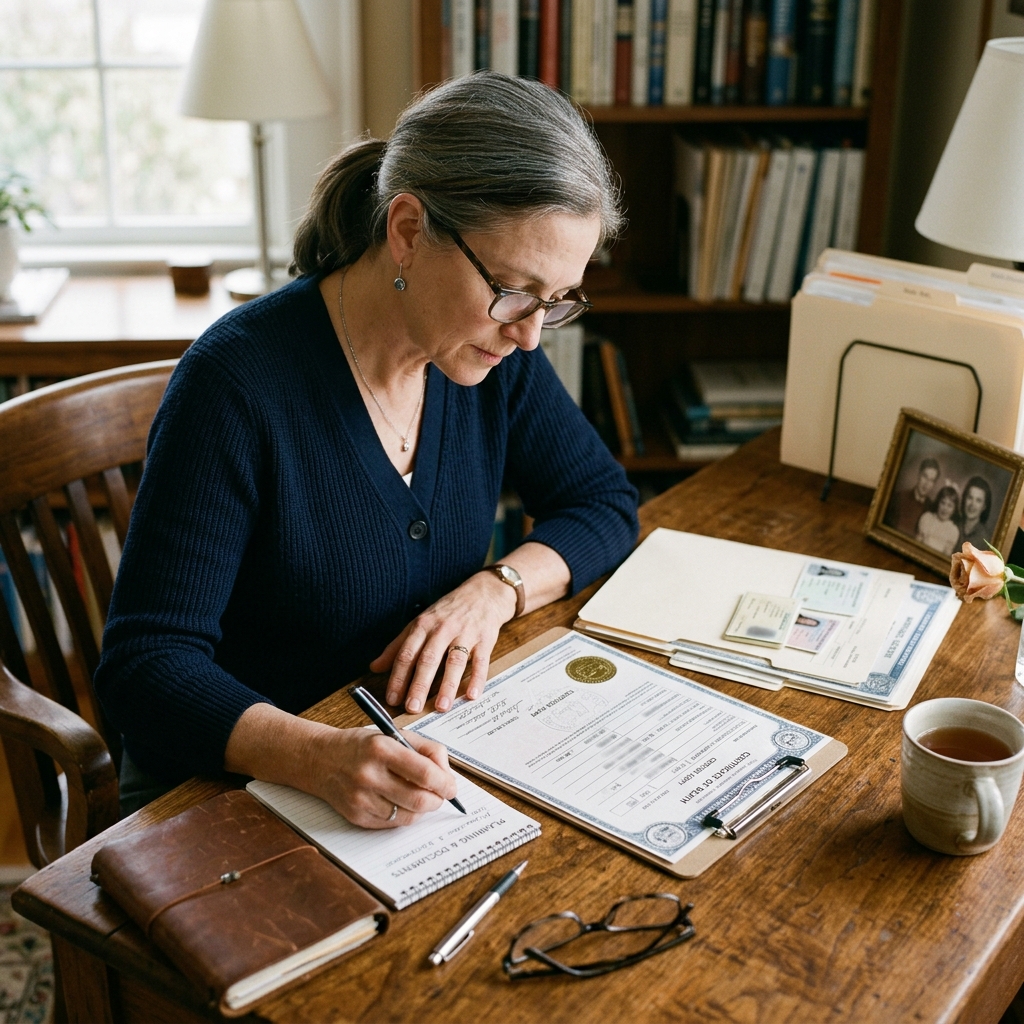
After someone dies, one of the first official documents families and executors need is a death certificate. This document serves as legal proof that a person has died and is required to settle many aspects of their financial, legal, and personal affairs.
This guide explains in clear, practical terms how to get a copy of a death certificate in the United States, who can request one, why you need it, and how to avoid common problems during the process.
Why a Death Certificate Matters
A death certificate is an official record issued by a government vital records office that confirms a person’s death, including key details such as the date, place, and cause of death. It is used as proof of death in many legal and administrative procedures.
Common situations where it is required
In most cases, you will need certified copies of the death certificate (not just photocopies) for important tasks, such as:
- Notifying and updating government agencies (for example, Social Security)
- Claiming life insurance or pension benefits
- Transferring or closing bank and investment accounts
- Changing title or ownership on real estate and vehicles
- Starting probate or estate administration in court
For less formal tasks, like canceling online subscriptions or memberships, a regular photocopy may be sufficient, but you should always check each organization’s requirements.
Certified copy vs. informational copy
Many states issue different types of copies:
- Certified copy – Printed on security paper, usually with a raised or embossed seal. This is accepted as legal proof of death for most official purposes.
- Informational copy – Often contains similar information but may be marked “informational only.” These copies are typically not valid for legal or financial transactions and may omit sensitive details like full Social Security numbers or cause of death, depending on state law.
If you are handling estate or financial matters, you will almost always need certified copies.
Who Is Allowed to Request a Death Certificate?
States restrict who can obtain a certified death certificate to protect the deceased person’s private information and prevent fraud. The exact rules differ from state to state, but there are common patterns.
Typical eligible requesters
In many U.S. jurisdictions, the following people can usually order a certified copy:
- Surviving spouse or registered domestic partner
- Child, stepchild, or grandchild of the deceased
- Parent, legal guardian, or grandparent
- Sibling of the deceased
- Legal representative, such as the executor or administrator of the estate, or an attorney acting on their behalf
- Funeral director or funeral home responsible for final arrangements (usually shortly after the death)
- Anyone with a valid court order authorizing access
Some states also allow other categories, such as people who can demonstrate a direct financial interest or a documented need. If you are not a close family member, you may need to supply additional proof, such as letters of administration, a court order, or a notarized authorization from an eligible relative.
When death certificates become public records
In many states, death certificates are not permanently restricted. After a certain number of years—often 25 years or more—they may become public records that anyone can request. The waiting period varies by state, so check with the relevant vital records office to find out when restrictions no longer apply.
Where to Request a Death Certificate
Death certificates are issued by government vital records offices, usually at the state or local (county/city) level. You must request the record from the jurisdiction where the death occurred, not where the person lived or is buried.
| Option | Who runs it | Advantages | Potential drawbacks |
|---|---|---|---|
| State vital records office | State department of health or vital records agency | Centralized records; mail and online options in many states | Processing times can be longer; fees vary |
| County or city vital records / clerk | Local health department or county clerk | Often faster for recent deaths; in-person service | May not hold older records; limited service hours |
| Funeral home | Licensed funeral director | Very convenient immediately after death; they file initial certificate and can order copies for you | Best only for the initial batch; changes later may require dealing with vital records directly |
| Authorized online vendors | Third-party companies contracted by states (for example, VitalChek) | Order from anywhere; track orders; credit card payment | Service fees in addition to government fees; still subject to state rules |
Using the state vital records office
The U.S. federal government provides a central directory that points you to each state’s vital records office. From there, you can learn:
- Available ordering methods (online, by mail, in person)
- Per-copy fees and any additional search costs
- Processing times and rush options
- Eligibility requirements and acceptable identification
States typically allow you to download or complete an application form online and then submit it either electronically or by mail.
Ordering at the county or city level
For many recent deaths, the local health department or county clerk where the death occurred holds the record and can often issue certificates more quickly than the state office. Local offices often offer:
- Walk-in service during business hours
- Mail‑in applications
- Access to authorized online ordering systems
In some states, county offices only handle deaths from a particular range of years (for example, from 2009 to the present), and older records are maintained centrally at the state office.
When the death occurred outside the United States
If a U.S. citizen dies abroad, the U.S. embassy or consulate generally works with the local authorities to obtain proof of death and issues a document called a Consular Report of Death Abroad (CRDA). This report can be used within the United States as proof of death for many legal and administrative purposes, similar to a domestic death certificate.
- At the time of issuance, families can usually obtain multiple certified copies of the CRDA at no cost, up to a certain limit.
- Additional copies can later be ordered from the U.S. Department of State if needed.
Information and Documents You Will Need
Although each jurisdiction has its own forms, most ask for similar information about both the deceased person and the applicant.
Details about the deceased
- Full legal name (including any prior names, if known)
- Date of death (or at least a range of years, though this may incur extra search fees)
- Place of death (city or county and state)
- Sex
- Approximate age or date of birth
- Last known address
- Social Security number, if requested (some forms ask for this to help locate the record)
Information about you as the requester
- Your full name, mailing address, and contact information
- Your relationship to the deceased (for example, spouse, child, attorney for the estate)
- Statement of the reason you need the certificate (estate administration, insurance, personal records, etc.)
- Number of certified copies requested
Identification and proof of eligibility
Most vital records offices require proof of identity and sometimes proof of your relationship or legal interest. Common requirements include:
- A photocopy or original of a government‑issued photo ID, such as a driver’s license, state ID card, passport, or military ID
- For mailed applications, a legible photocopy of your ID; do not send the original unless specifically instructed
- For some states, notarization of the application if you are requesting by mail or if you are not present in person
- If you are a legal representative, additional documents such as letters testamentary, letters of administration, or power of attorney
How Many Certified Copies Should You Order?
There is no universal rule for how many certified copies you will need, but you should plan ahead to avoid repeated applications and extra delays.
Factors to consider
Consider ordering more certified copies up front if the deceased person had:
- Multiple bank and investment accounts at different institutions
- Real estate in more than one county or state
- Retirement accounts, pensions, or life insurance policies
- Business interests or professional licenses
- Debts that will need formal settlement (such as mortgages or significant loans)
Financial and government institutions often take a copy and do not return it, so each one you send is effectively used up.
Typical ranges
Many estate planning professionals suggest ordering somewhere between 5 and 15 certified copies, depending on the complexity of the estate. For a simple estate with a single home and a few accounts, fewer copies may be sufficient. For larger or multi‑state estates, more may be necessary.
Application Methods and Processing Times
Most jurisdictions offer several ways to apply. Each has its own timing and cost implications.
In‑person requests
- Usually the fastest option if you live near the vital records office
- You complete the application, present ID, pay the fee, and may receive the certificate the same day or within a short period of time
- Useful when you need the document urgently and can visit during office hours
Mail‑in requests
- Common option if you live out of the area or cannot attend in person
- You mail the completed application, payment, and photocopy of ID to the specified address
- Processing times vary; state and local offices often advise allowing several weeks for standard mail requests
- Some offices offer expedited service if you use express mail or pay an additional rush fee
Online applications
- Many states allow online or electronic ordering either directly or through an authorized vendor such as VitalChek
- You enter your information, upload or provide ID details if required, and pay with a credit or debit card
- Certificates are then mailed to you; the online portion only replaces the application step
- Third‑party services usually charge separate processing fees in addition to government charges
Costs and Payment
Every state sets its own fees for death certificates. There is usually:
- A base fee for the first certified copy
- A reduced fee for additional copies ordered at the same time
- Possible extra fees for extended searches when you do not know the exact date or place of death
- Service or convenience fees for online vendors
Payment methods typically include checks, money orders, or credit/debit cards (especially for in‑person or online requests). Offices usually do not recommend sending cash through the mail.
Correcting or Updating a Death Certificate
Sometimes, families later discover mistakes on a death certificate, such as errors in the spelling of a name, marital status, or date of birth. Correcting these details usually requires:
- Filing a formal request for an amendment with the same vital records office that issued the record
- Providing documentary proof (for example, a birth certificate or marriage certificate)
- Paying an amendment or correction fee
If the cause or manner of death is disputed or needs to be changed, the process can be more complex and may involve medical examiners, doctors, or legal proceedings.
Common Challenges and How to Handle Them
If you are not an immediate family member
If state law does not list you as an eligible requester, you may still be able to obtain a copy by:
- Getting a written, notarized authorization from an eligible family member
- Providing documentation that you are the legal representative of the estate, such as court letters appointing you as executor or administrator
- Requesting a court order that directs the vital records office to release the certificate to you
When the death occurred a long time ago
Older records may be archived or transferred to state archives or historical divisions. For deaths more than several decades old, you might need to:
- Check whether the record has become a public document that anyone can request
- Search state archives or historical vital records offices
- Accept that only informational copies are available for very old records used for genealogical research
When you do not know the exact date of death
If you do not know the precise date, you can sometimes request a search for a range of years, though some offices charge additional fees per year searched. To narrow the range, consider:
- Checking obituaries, cemetery records, or funeral home records
- Contacting relatives, friends, or medical providers
- Reviewing past correspondence or documents mentioning the death
Frequently Asked Questions
Can I order a death certificate from a different state than where the person died?
No. You must request the record from the state or local jurisdiction where the death occurred. Ordering from another state is typically not allowed, though that state may help direct you to the correct office.
Do I always need a certified copy, or is a photocopy enough?
Government agencies, insurance companies, financial institutions, and courts usually require a certified copy. Photocopies might be acceptable for less formal tasks like canceling subscriptions, but you should confirm with each organization first.
How long does it take to receive a death certificate?
Processing times vary widely. In‑person requests may be completed the same day, while mail and online applications can take anywhere from a few days to several weeks, depending on demand, staffing, and whether you requested expedited service.
Can I track my online order?
Authorized online vendors and some state systems often provide tracking numbers or status updates once your order is submitted, allowing you to monitor when the certificate is processed and mailed.
Is a Consular Report of Death Abroad the same as a U.S. death certificate?
It is not identical, but it is treated as official proof of death in the United States for many legal and administrative purposes. The CRDA is issued by the U.S. Department of State when a U.S. citizen dies overseas and can be used to handle many of the same affairs you would manage with a domestic death certificate.
References
- How to get a certified copy of a death certificate — USA.gov. 2024-01-10. https://www.usa.gov/death-certificate
- How to Get a Death Certificate After a Loved One Dies — Pierro Law Group. 2022-06-15. https://www.pierrolaw.com/administration/how-to-get-a-death-certificate-after-a-loved-one-dies/
- How to Get Death Certificates After a Loved One’s Death — Goff Legal. 2023-05-01. https://gofflegal.com/trust-administration/how-to-get-death-certificates/
- Getting a Death Certificate — Legal Aid Services of Oklahoma. 2021-09-20. https://oklaw.org/resource/getting-a-death-certificate
- Death Certificates — Florida Department of Health. 2023-08-30. https://www.floridahealth.gov/certificates-records/death-certificates/
- Order Death Certificates Online — VitalChek. 2024-02-01. https://www.vitalchek.com/v/death-certificates
- Order a Death Certificate — Texas Department of State Health Services. 2024-03-15. https://ovra.txapps.texas.gov/ovra/order-death-certificate
Similar Articles








Read full bio of medha deb


