
General vs. Special Warranty Deeds Explained
Understand how general and special warranty deeds protect buyers and sellers, and learn which type of deed fits your next real estate transaction.
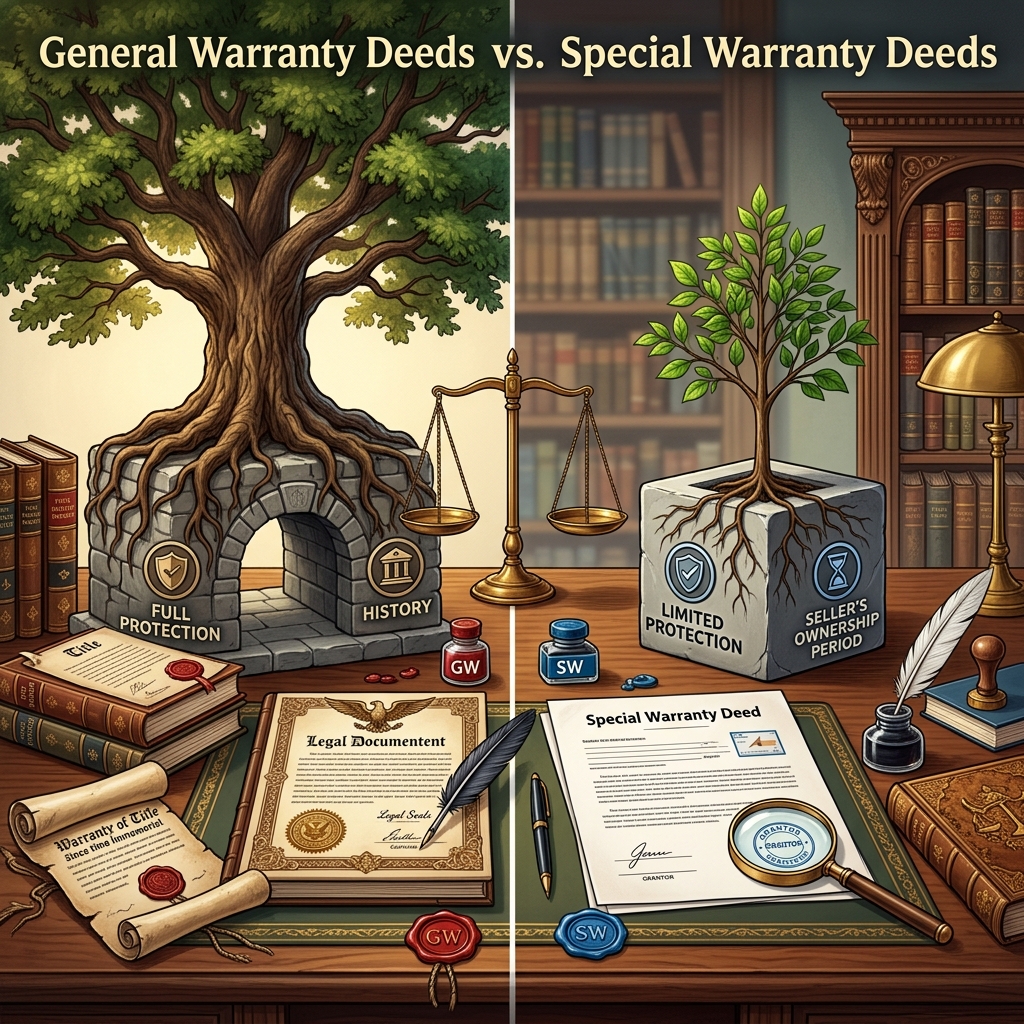
When real estate changes hands, the document that transfers ownership is called a deed. One of the most important decisions in a property transfer is whether to use a general warranty deed or a special (limited) warranty deed. The choice directly affects how much protection the buyer receives and how much long-term risk the seller accepts.
Both deed types do more than simply move title from seller to buyer. They also include warranties of title—promises about the status of ownership and liens on the property. The difference lies in how far back in time those promises extend.
What a Warranty Deed Is (and Why It Matters)
In any warranty deed, the seller (often called the grantor) conveys the property to the buyer (the grantee) and gives legal assurances about the title. These assurances typically include:
- Ownership — The seller states that they legally own the property and have the right to convey it.
- Freedom from undisclosed encumbrances — The property is promised to be free of undisclosed liens, mortgages, or other claims, except those specifically listed in the deed.
- Defense of title — The seller agrees to defend the buyer’s title against lawful claims covered by the deed’s warranties.
These warranties give buyers confidence that they are receiving clear title and that the seller will stand behind the transfer if a covered problem arises. At the same time, the warranties create potential long-term liability for the seller.
Core Difference: How Far the Warranties Reach Back in Time
The key distinction between a general warranty deed and a special (limited) warranty deed is the timeframe the seller’s promises cover.
| Feature | General Warranty Deed | Special (Limited) Warranty Deed |
|---|---|---|
| Scope of title protection | Entire history of the property, including all prior owners. | Only the period when the current seller owned the property. |
| Seller’s liability for old defects | Seller may be responsible for defects arising before their ownership. | Seller is not responsible for pre-existing title defects. |
| Protection level for buyer | Broadest protection and strongest warranties. | More limited protection; buyer accepts some historical risk. |
| Common use | Typical for residential sales using traditional financing. | Frequently used in commercial deals or where the seller will not guarantee full title history. |
General Warranty Deeds: Maximum Protection for Buyers
A general warranty deed provides the most comprehensive set of title warranties. In many states, it may also be referred to as a statutory warranty deed or simply a warranty deed.
Key Promises in a General Warranty Deed
Under a general warranty deed, the seller usually promises:
- The seller is the lawful owner with full power to convey the property.
- The property is transferred free and clear of undisclosed liens or encumbrances.
- No previous conveyances have occurred that would invalidate the buyer’s ownership.
- The seller will defend the buyer’s title against all lawful claims, even if those claims arise from events before the seller acquired the property.
Because these promises reach back through the entire chain of title, the seller effectively guarantees the integrity of the property’s ownership history “all the way back,” sometimes described as back to the sovereign or original grant of the land.
Why Buyers Prefer General Warranty Deeds
From a buyer’s perspective, a general warranty deed is usually the most favorable option because:
- It offers the broadest protection against unknown title problems, including old liens or claims.
- The seller must step in to defend the title if covered issues arise.
- It aligns well with lender requirements and title insurance, making financing smoother.
Buyers who are paying substantial amounts for property or who have limited appetite for risk often insist on general warranty deeds whenever practical.
Risk Considerations for Sellers
For sellers, general warranty deeds involve greater long-term exposure because they can be held responsible for defects that existed before they owned the property.
- Old liens or recording errors may surface after the sale.
- The seller might have to defend lawsuits or claims arising from earlier owners.
- Even with title insurance, disputes can be time-consuming and stressful.
Despite these risks, general warranty deeds remain the standard in many residential transactions, especially when sellers have owned the property for a long time and are confident in its title history.
Special (Limited) Warranty Deeds: Focused Protection, Limited Liability
A special warranty deed—sometimes called a limited warranty deed—offers a narrower set of title warranties. The seller promises only that they have not created defects in title during their period of ownership.
What a Special Warranty Deed Covers
Under a special warranty deed, the seller typically warrants:
- They own the property and have the right to convey it.
- No encumbrances or title problems arose because of their actions during their ownership period, except those disclosed in the deed.
- They will defend the title only against claims tied to their ownership, not against issues originating from prior owners.
Crucially, the seller does not guarantee that the title is free from defects that predate their ownership. If a title problem surfaces from an earlier era, responsibility generally falls on the buyer or on any title insurance policy, not on the seller.
Why Sellers Prefer Special Warranty Deeds
Sellers often favor special warranty deeds because they significantly limit their liability:
- The seller is only responsible for problems caused or allowed during their ownership.
- Unknown historical defects do not create direct legal exposure for the seller.
- The seller can complete the transaction without guaranteeing the full chain of title.
This narrower warranty structure is particularly attractive in transactions where the seller has not owned the property for long, has limited knowledge of its earlier history, or is acting as a fiduciary (such as an executor or trustee).
Impact on Buyers
From the buyer’s standpoint, a special warranty deed offers less reassurance about undiscovered historical issues. However, buyers may still accept a special warranty deed when:
- The property is subject to extensive title insurance coverage.
- The transaction is commercial and market norms favor limited warranties.
- The purchase price or risk profile makes the reduced warranty acceptable.
In many commercial deals, buyers rely heavily on title insurance and due diligence rather than on broad seller warranties.
Comparing Buyer and Seller Interests
General and special warranty deeds reflect a tension between buyer protection and seller risk. Understanding these interests can help both sides negotiate a fair agreement.
Buyer Priorities
- Maximum title security — Buyers want assurance that they are acquiring good, marketable title.
- Coverage for unknown problems — General warranty deeds protect against issues the buyer cannot reasonably discover before closing.
- Confidence for lenders — Strong warranties can make lenders more comfortable providing financing.
Seller Priorities
- Limiting long-term liability — Sellers typically want to avoid responsibility for events from previous owners.
- Closing the file — After transfer, sellers prefer not to be drawn into future disputes about old title defects.
- Market norms — In some property types or locations, special warranty deeds are standard and widely accepted.
Common Situations Where Each Deed Is Used
Although customs vary by state and by local practice, some general patterns have emerged regarding when each deed type is commonly used.
Typical Uses for General Warranty Deeds
- Owner-occupied residential sales with conventional financing, where buyers expect maximum protection.
- Transfers between unrelated parties buying and selling at fair market value.
- Transactions with long-term ownership where the seller has confidence in the title history.
Typical Uses for Special Warranty Deeds
- Commercial real estate transactions, where limited warranties are common and title insurance is heavily relied upon.
- Sales by fiduciaries such as executors, trustees, or entities that did not occupy or closely manage the property.
- Transfers from banks or institutions disposing of foreclosed or REO properties, where they refuse to guarantee prior history.
Local law may use different names for these deeds (such as statutory warranty deed for a general warranty deed in some jurisdictions), but the underlying concepts of full versus limited warranties remain similar.
Role of Title Searches and Title Insurance
Regardless of whether a general or special warranty deed is used, buyers should not rely solely on the deed’s language to protect their interests. A thorough title search and appropriate title insurance are essential parts of risk management.
- Title search — A title company or attorney reviews public records to identify liens, easements, mortgages, and other claims against the property.
- Title insurance — A policy that protects the insured (buyer and/or lender) against financial loss from certain covered title defects discovered after closing.
With a general warranty deed, title insurance supplements the seller’s broad warranties. With a special warranty deed, title insurance plays an even more critical role because it may be the primary protection against defects originating before the seller’s ownership.
How to Decide Which Deed Type Is Right for Your Transaction
Choosing between a general and special warranty deed depends on the nature of the property, bargaining power of the parties, local custom, and each side’s risk tolerance.
Questions Buyers Should Ask
- Is a general warranty deed standard practice for this type of property in this area?
- Will my lender or title insurer require a particular deed type?
- How comfortable am I relying on title insurance and my own due diligence instead of broad seller warranties?
- Is the seller willing to provide stronger guarantees in exchange for adjustments to price or other terms?
Questions Sellers Should Ask
- How long have I owned the property, and how well do I understand its title history?
- Am I prepared to accept potential liability for pre-existing defects if I give a general warranty deed?
- What is typical in similar transactions in my market, and will offering only a special warranty deed affect the property’s attractiveness?
- Should I obtain legal advice to understand the exact warranties my state’s deed language will impose?
Because deed terminology and statutory forms differ across states, consulting a licensed real estate attorney or experienced title company can help both parties select a deed that aligns with state law and their risk preferences.
Frequently Asked Questions (FAQs)
1. Are general warranty deeds always better than special warranty deeds?
For buyers, a general warranty deed usually offers better protection because the seller guarantees clear title for the property’s entire history. However, in some commercial transactions, a special warranty deed may be acceptable when combined with strong title insurance and due diligence.
2. Can a lender require a particular type of deed?
Yes. Many lenders financing residential property prefer or require general warranty (or statutory warranty) deeds because they offer broad title assurances and align well with underwriting standards. In commercial lending, deed requirements may vary, and lenders may accept special warranty deeds with appropriate title insurance.
3. Does a special warranty deed mean there is something wrong with the property?
Not necessarily. A special warranty deed primarily limits the seller’s responsibility to their ownership period. It does not automatically indicate known problems, but it does mean the buyer must pay closer attention to title searches and insurance to guard against older defects.
4. If I receive a special warranty deed, can I still get title insurance?
Yes. Title insurance is commonly available regardless of deed type, though the specific coverage and endorsements may differ. In fact, title insurance is especially important when a special warranty deed is used because the seller is not guaranteeing the entire chain of title.
5. Do all states use the same deed terminology?
No. Deed names and statutory forms differ by state, and some jurisdictions use terms such as “statutory warranty deed” to refer to a general warranty deed. Despite these differences, the core concepts of full versus limited warranties remain similar, so local legal advice is important.
6. Can the parties negotiate custom warranty language?
In many transactions, parties can negotiate deed language that expands or restricts warranties. However, any non-standard wording should be carefully drafted by a legal professional to ensure it complies with state law and clearly reflects the parties’ intentions.
References
- Difference Between a General Warranty Deed and a Special Warranty Deed — Rocket Lawyer. 2024-01-10. https://www.rocketlawyer.com/real-estate/home-ownership/buy-or-sell-property/legal-guide/difference-between-a-general-and-special-warranty-deed
- General Warranty Deed vs Special Warranty Deed — TexasPropertyDeeds.com. 2023-06-15. https://www.texaspropertydeeds.com/general-warranty-deed-vs-special-warranty-deed/
- Special vs. General Warranty Deed: Key Differences and Uses — Investopedia. 2023-11-29. https://www.investopedia.com/terms/s/special-warranty-deed.asp
- Texas General Warranty vs. Special Warranty Deeds — Silberman Law Firm. 2022-08-01. https://silblawfirm.com/real-estate-law/general-warranty-deeds-vs-special-warranty-deeds-in-texas/
- Exploring Property Ownership Transfers and Title Insurance — Land Title Guarantee Company. 2023-05-10. https://www.ltgc.com/resources/deeds-use/
- Statutory Warranty Deed vs. Special Warranty Deed in Florida — The Orlando Law Group. 2022-09-14. https://www.theorlandolawgroup.com/blog/statutory-warranty-deed-vs-special-warranty-deed-in-florida/
- Different Deeds Mean Different Things — Farm Office, Ohio State University. 2023-09-28. https://farmoffice.osu.edu/blog/thu-09282023-953pm/different-deeds-mean-different-things
Similar Articles








Read full bio of medha deb


