
Frozen Embryos And Divorce: 3 Legal Approaches Explained In 2025
How courts weigh contracts, consent, and reproductive rights in embryo disputes after divorce.
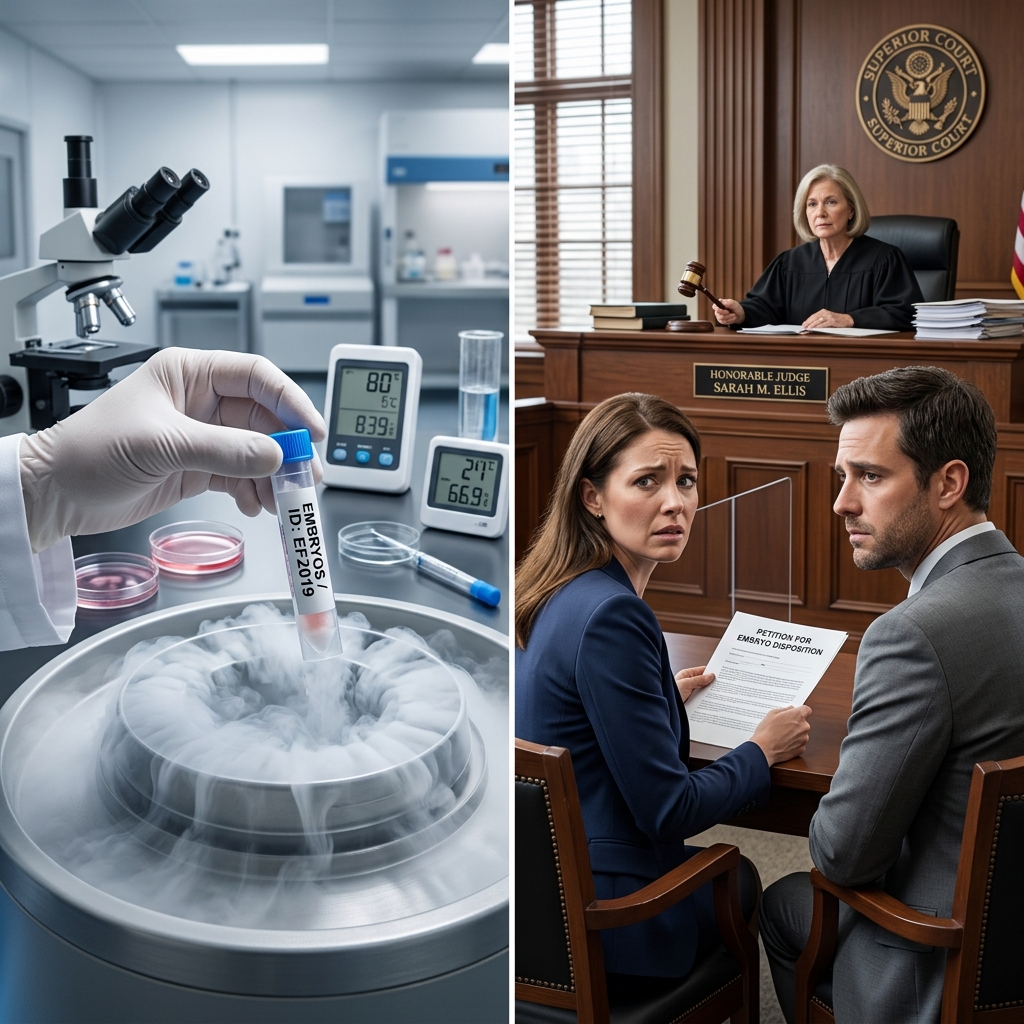
Frozen Embryos and Divorce: The Legal Problem
Frozen embryos create one of the most difficult questions in family law because they do not fit neatly into the usual categories of marriage, property, or parenthood. When a couple separates, the central issue is not simply who “gets” the embryos, but who has the legal power to decide whether they are stored, discarded, donated, or used to attempt a pregnancy.
Courts across the United States have approached these disputes in different ways. Some treat embryo agreements as binding contracts. Others weigh competing constitutional interests, especially the right to become a parent and the right not to become a parent. A smaller number of states have enacted statutes that direct judges to a specific rule. The result is that the outcome often depends on where the case is filed and what documents the couple signed before fertility treatment began.
Why These Cases Are So Hard
Embryo disputes are emotionally charged because they involve both biology and personal identity. One spouse may see the embryos as the only realistic path to having a genetically related child. The other may see forced use of the embryos as an unwanted step into parenthood, with lasting emotional, financial, and legal consequences.
This tension explains why courts rarely treat these cases like ordinary property disputes. A table, car, or bank account can usually be divided without affecting a person’s life in a deep and permanent way. Frozen embryos are different because their use can create a child, and that makes the legal stakes much higher.
- One partner may want to preserve a chance at genetic parenthood.
- The other may want the embryos destroyed, donated, or kept in storage.
- Both people may have signed fertility paperwork before the breakup.
- The state may have a statute or case law that favors one approach over another.
The Role of Embryo Agreements
In many cases, the first document a court looks at is the fertility clinic agreement signed before IVF treatment. Those forms often say what should happen if the couple divorces, separates, or dies. Common options include destruction, donation to research, donation to another recipient, or control by one spouse or by both spouses together.
Courts often enforce these agreements because they reflect the couple’s prior intent. If the language is clear, judges may conclude that the parties already decided the issue before emotions changed after the breakup. This contract-based approach is attractive because it gives fertility patients some predictability and reduces the need for courts to make moral judgments about embryo status.
Still, an agreement is not always the last word. Some courts refuse to enforce a provision if doing so would force one person into parenthood against their will. Others interpret the document narrowly, especially when the language does not clearly address divorce or does not specify what happens if one party changes their mind later.
Three Common Legal Approaches
Although state law varies, courts generally use one of three broad methods when deciding embryo disputes.
| Approach | Core idea | Likely result |
|---|---|---|
| Contract enforcement | The pre-IVF agreement controls. | The embryos are handled according to the signed paperwork. |
| Balancing of interests | The court weighs the right to procreate against the right not to procreate. | The stronger interest may prevail, often favoring the spouse who does not want to become a parent if the other has another path to parenthood. |
| Mutual consent | Both parties must agree before the embryos can be used or disposed of. | The embryos may remain in storage until the parties reach a new agreement. |
The contract approach is the most straightforward. The balancing approach is more flexible but less predictable. The mutual-consent rule is highly protective of both parties, yet it can leave embryos in indefinite storage if the former spouses cannot agree.
Reproductive Rights on Both Sides
Courts that apply a balancing test usually start with the idea that each person has a serious, legally recognized reproductive interest. One partner may argue that the embryos are the only meaningful way to have a biological child. The other may argue that being compelled to parent a genetic child, even indirectly, violates a profound personal right.
Judges often consider whether the person seeking use of the embryos has other ways to become a parent, such as additional IVF cycles, donor gametes, adoption, or a new relationship. They may also consider the burden imposed on the person who objects. That burden can include legal parenthood, child support exposure, emotional pressure, and the long-term consequences of having a child with an ex-partner.
Because these interests are deeply personal and often irreversible, courts frequently try to avoid a rule that would automatically favor one side in every case.
State Laws Can Change the Outcome
Some states have written embryo-disposition rules into their family law statutes. These laws can override or limit what a judge might otherwise do under general contract or property principles. For example, some states require enforceable embryo disposition agreements and place significant weight on the couple’s written instructions. Other states give priority to the spouse who wants to bring the embryos to birth, even if a prior contract says otherwise.
There are also states that use more unusual standards. Louisiana, for instance, uses a best-interest approach for disputes over an in vitro fertilized ovum. Arizona takes a different path by directing courts to award the embryo to the spouse who intends to develop it to birth, while limiting the other spouse’s parental obligations unless there is a separate written agreement.
Because these statutes differ so much, two people with nearly identical facts may receive different results depending on the state where the divorce is decided.
What Courts Often Refuse to Say
Even when courts are asked to decide embryo disputes, they often avoid saying that embryos are either ordinary marital property or fully equivalent to a child. Instead, they may describe embryos as something unique, partly because the legal consequences of use are unlike the consequences of dividing any other asset.
This middle position is one reason the law remains unsettled. If embryos were treated exactly like property, the case would be simpler but many people would object that such a rule ignores the potential for human life. If they were treated exactly like persons, that would raise separate problems, including questions about the legal rights of embryos and the limits of reproductive autonomy. Most courts have tried to stay between those poles.
What Happens to the Embryos After Divorce
Once a dispute is resolved, the embryos may be destroyed, remain in storage, be donated, or in some jurisdictions be used by the spouse who wants to proceed with implantation. The practical result often turns on the controlling document and the governing state law.
- Destruction may occur if the parties agreed to it or if no one can lawfully use the embryos.
- Continued storage may happen when the law requires mutual consent and no agreement exists.
- Donation to research may be allowed where state law and clinic policy permit it.
- Donation to another recipient may be available in some jurisdictions and clinic programs.
- Use by one spouse may be allowed in states that prioritize the intent to procreate.
These outcomes are not interchangeable. Each carries different legal, emotional, and ethical consequences, especially when a former spouse believes the embryos represent a last chance at a genetically related child.
How Couples Can Reduce Future Conflict
People considering IVF can lower the risk of later litigation by discussing embryo disposition before treatment begins. This conversation is often difficult, but it is far easier to resolve before a marriage breaks down. The most important step is reading the clinic agreement carefully and understanding whether the document gives one person sole control, requires joint consent, or sets out a default rule if the couple separates.
It is also wise to think about future changes. A person who feels certain today may feel differently after a divorce, after the birth of a child, or after a major life event. Clear language can help, but no document can erase every dispute. If the state law allows flexibility, couples may want to speak with a family law attorney before signing the fertility paperwork.
- Ask what happens if the relationship ends before implantation.
- Confirm whether both signatures are needed for future decisions.
- Review whether donation, destruction, or storage is the default outcome.
- Understand whether the agreement can be changed later.
- Learn how state law treats embryo disputes in your jurisdiction.
Why Prenuptial Agreements Usually Are Not Enough
A prenuptial agreement may address financial and property issues, but it usually is not the best place to decide embryo disposition. Courts may view embryo-related provisions differently from ordinary marital property clauses because reproductive decisions involve interests that go beyond money. A prenup also may not be detailed enough to cover the many possibilities that can arise in fertility treatment.
For that reason, fertility clinics usually require separate consent forms or disposition agreements. Those documents are more likely to be considered by a court because they are written specifically for the embryos and usually reflect the couple’s intent at the time of treatment.
Frequently Asked Questions
Are frozen embryos treated as property?
Sometimes, but not always. Some courts lean toward property rules, while others treat embryos as a unique category because they may lead to a pregnancy and child.
Can one spouse use the embryos after divorce without consent?
Usually not. In many states, the answer depends on the clinic agreement and local law. A number of courts require at least some level of consent from both parties, while others may enforce a prior contract or balance the parties’ interests.
What if the agreement says the embryos should be destroyed?
That provision may be enforced, especially in states that treat fertility agreements as binding. However, some courts may still examine whether enforcement would unfairly burden the spouse who wants to use the embryos.
Can embryos be donated after divorce?
Sometimes. Donation options depend on state law, clinic policy, and the wording of the couple’s signed documents. Some jurisdictions permit donation to research or to another recipient, while others are more restrictive.
Do all states follow the same rule?
No. State law varies widely. Some states emphasize contracts, some use balancing tests, and some have specific statutes that decide the issue in advance.
Why This Area of Law Will Keep Evolving
Embryo disputes sit at the intersection of reproductive medicine, family law, and constitutional rights. As fertility treatment becomes more common and more couples store embryos for future use, courts will continue to face cases where old consent forms collide with new personal realities. That tension is unlikely to disappear soon.
For now, the safest assumption is that the words signed before IVF may matter as much as, or more than, the feelings of either spouse after divorce. At the same time, because the law remains unsettled in many states, each case still turns on its own facts, the governing statute, and the specific language of the parties’ agreement.
References
- Who Gets Frozen Embryos in a Divorce? — DivorceNet. 2024. https://www.divorcenet.com/resources/who-gets-frozen-embryos-in-a-divorce.html
- Frozen Embryos and Divorce – CT — Needle | Cuda. 2024. https://www.needlecuda.com/frozen-embryos-and-divorce-ct/
- California Health and Safety Code § 125315 — California Legislative Information. 2024. https://leginfo.legislature.ca.gov/
- Florida Statutes § 742.17 — The Florida Senate. 2024. https://www.flsenate.gov/
- Arizona Revised Statutes § 25-318.03 — Arizona Legislature. 2024. https://www.azleg.gov/
- Louisiana Revised Statutes §§ 9:131 — Louisiana State Legislature. 2024. https://www.legis.la.gov/
Similar Articles








Read full bio of Sneha Tete


