
Frozen Embryos In Divorce: California Rights, Agreements Guide
How California law handles frozen embryo disputes when a marriage ends.
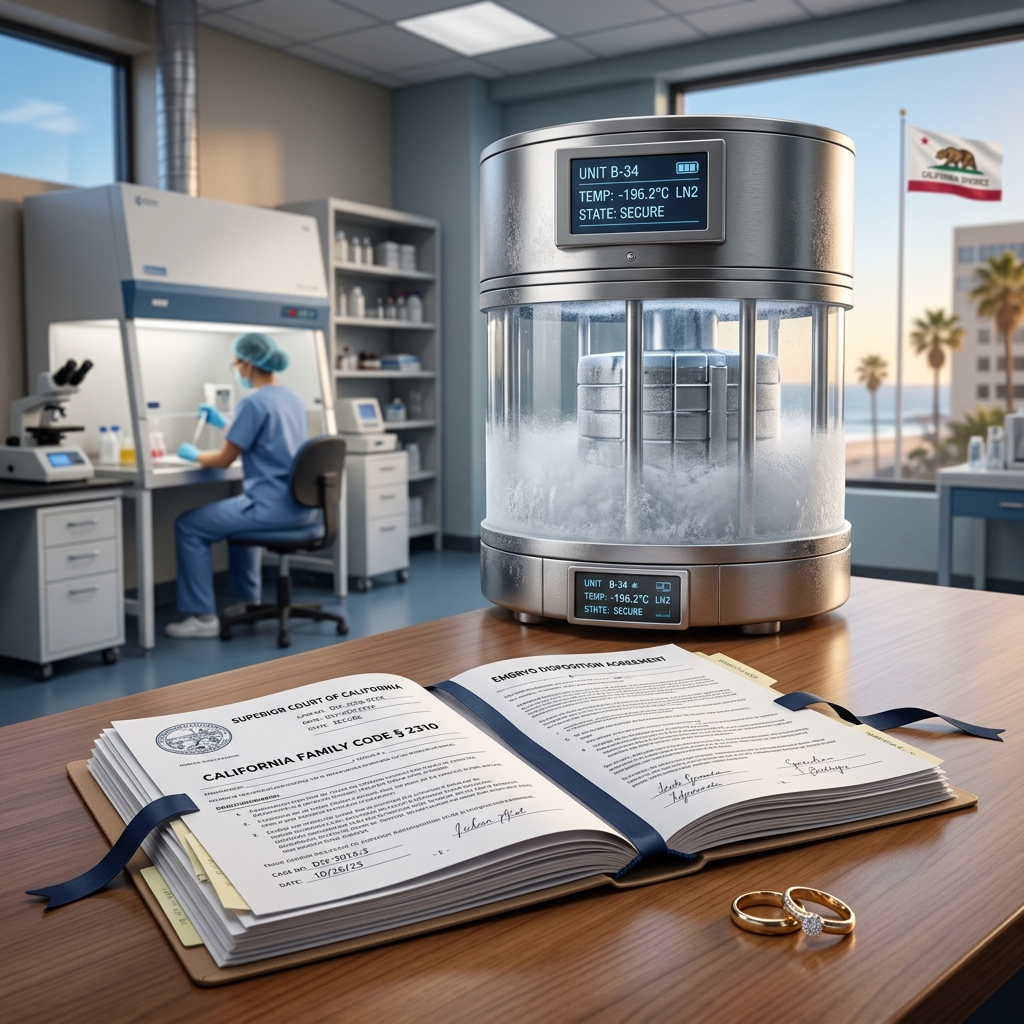
When a marriage ends, dividing homes, accounts, and parenting responsibilities is already difficult. Frozen embryos create an even more sensitive problem because they sit at the intersection of medicine, contract law, reproductive choice, and deeply personal beliefs about family. In California, courts generally do not treat embryo disputes like ordinary child custody cases. Instead, they usually begin with the agreement the couple signed before fertility treatment and ask whether that agreement controls the outcome.
That approach matters because embryos are not simply viewed as property in the usual sense, but they are also not treated as children for purposes of standard custody rules. The result is a legal area shaped by consent forms, constitutional concerns about procreation, and court decisions that try to respect both parties’ interests without forcing unwanted parenthood.
Why frozen embryos create a special legal problem
Frozen embryos are unlike most other marital assets. A bank account can be divided, and a car can be sold. An embryo, however, may represent the possibility of genetic parenthood, future family planning, and a child’s life. That is why disputes over embryos can become intense quickly.
California family law has developed around the idea that these disputes should not be resolved by assuming one spouse has an automatic right to use the embryos. Instead, courts consider what the couple agreed to before the embryos were created and how that agreement fits with public policy.
The central conflict is often simple to state and difficult to solve: one spouse may want the embryos preserved for future use, while the other may object to becoming a genetic parent after divorce. Courts must weigh the desire to avoid compelled parenthood against the desire to preserve a chance at biological parenthood.
Consent forms often matter more than emotions
In California, fertility clinics typically require patients to sign written embryo disposition agreements before treatment. These documents often explain what should happen if the couple separates, divorces, or disagrees later. Courts frequently treat those forms as binding contracts.
That contract-focused approach gives couples a roadmap before conflict arises. Common options in embryo agreements include:
- Allowing one spouse to use the embryos later
- Requiring destruction of the embryos after divorce or lack of consent
- Keeping the embryos frozen until both parties agree
- Donating the embryos to another recipient or for research
When the contract clearly addresses divorce, California courts often enforce it. The reasoning is that the parties had a chance to make a choice in advance, and the court should respect that choice unless it violates law or public policy.
This means a spouse who changes their mind after separation may still be bound by what they signed earlier. The emotional change does not automatically erase the legal effect of the agreement.
California courts are cautious about forced parenthood
One of the strongest principles in embryo litigation is that a person generally should not be forced into parenthood against their will. That idea has significant weight in California disputes. Even when one spouse strongly wants to use the embryos, courts often hesitate if doing so would create legal, biological, or practical parenthood for the other spouse without consent.
This concern helps explain why courts may enforce an agreement calling for destruction or continued storage rather than authorizing unilateral use. The law tends to protect the objecting spouse’s interest in avoiding parenthood, especially when that spouse never consented to the embryos being used after divorce.
At the same time, the law does not treat the issue as purely one-sided. Courts also recognize that a frozen embryo may be the only remaining chance for a person to have a genetically related child. The legal challenge is to resolve these competing interests in a principled way.
What happens when there is no clear agreement?
Not every embryo dispute is controlled by a detailed contract. Some agreements are vague, incomplete, or difficult to interpret. In those cases, courts may look beyond the document and consider the circumstances of the couple’s relationship, the reason they created the embryos, and the practical consequences of each possible outcome.
Different states use different approaches, and even within California the law has continued to develop through case-by-case decisions. Some courts give substantial weight to prior consent forms. Others consider balancing tests that examine the interests of both parties. The exact analysis can vary depending on the facts.
When the agreement is unclear, judges may ask questions such as:
- Did both spouses clearly express what should happen to the embryos in the event of divorce?
- Would granting use of the embryos create parenthood for the objecting spouse?
- Does either spouse have a stronger reproductive interest in using or preserving the embryos?
- Was the couple’s original intent documented in the clinic paperwork?
Even when a court uses a broader balancing approach, the absence of a clear agreement does not guarantee that the spouse seeking implantation will win. These cases remain highly fact-specific.
Why embryo disputes are not the same as child custody cases
It is tempting to think that a frozen embryo should be handled the same way as a child in a custody dispute. California law generally does not take that view. A child custody case focuses on the best interests of an existing child. Embryo cases raise a different question: whether embryos should be used at all, and if so, by whom.
That difference matters because an embryo is not treated as a child already born into the world. Courts therefore avoid applying ordinary parenting-time or legal custody frameworks. Instead, they focus on reproductive rights, consent, and contractual allocation.
This distinction also explains why a spouse cannot usually demand “custody” of embryos in the same way they would seek custody of a child. The legal system treats the embryo dispute as a separate category with its own rules and limits.
How California fits into the broader national picture
California is not alone in confronting frozen embryo disputes, but its approach is often described as contract-centered. Across the country, states have taken several different paths. Some rely on agreements. Others use balancing tests when the parties disagree. A few place greater emphasis on the intention to procreate, while still others may prioritize the objecting spouse’s right not to become a parent.
California’s framework is especially notable because the state requires fertility patients to sign agreements addressing embryo disposition before treatment. That requirement pushes couples to think ahead and reduces the chance that a future court will need to improvise a solution.
Still, advance planning does not eliminate all conflict. Disputes can arise when the agreement is incomplete, when the language is ambiguous, or when one spouse argues that the contract should not be enforced in the specific situation.
Practical issues couples should think about before IVF
Because these disputes are so difficult, the best time to address them is before treatment begins. Couples often focus on the medical side of in vitro fertilization and overlook the legal side. That can lead to major problems later.
Before creating embryos, partners should think carefully about what they want written into the consent paperwork. A clear agreement can prevent later uncertainty and can reduce the chance of a painful court battle.
Helpful planning points include:
- What should happen if the couple divorces?
- Should either spouse have unilateral control over future use?
- Is destruction, donation, or indefinite storage preferred?
- What happens if one spouse dies before the embryos are used?
- Should changes to the agreement require written consent from both parties?
These decisions are hard to make while the relationship is stable, but they become even harder once a separation has occurred. A carefully written agreement can spare both sides from uncertainty later.
How judges think about fairness in a deeply personal dispute
Although embryo cases are legal disputes, they are also deeply human. Judges know that the outcome may affect a person’s ability to have a biological child, their feelings about parenthood, and their future family life. At the same time, the court must avoid turning the case into a moral referendum on which spouse’s wishes are more sympathetic.
That is why courts often emphasize predictability and consent. If the parties already decided what should happen, the judge may treat that decision as the fairest answer, even if one person later regrets it. If there is no agreement, the court may look for the least disruptive solution that respects both parties’ rights.
In practice, that means a spouse asking to use the embryos may need more than an emotional argument. They may need a legal basis grounded in the contract, the facts surrounding the fertilization process, or state law.
Questions people often ask about frozen embryos in divorce
Below are some of the most common questions that come up when a couple separates and embryos remain in storage.
| Question | General answer in California |
|---|---|
| Are frozen embryos treated like children? | Usually no. California courts generally do not apply ordinary child custody rules. |
| Does the clinic agreement matter? | Yes. Courts often treat it as a controlling contract. |
| Can one spouse force implantation? | Usually not if the other spouse objects and the agreement does not support it. |
| What if the couple never discussed embryo disposition? | The court may apply broader legal analysis, but results are less predictable. |
| Can the embryos be donated? | Possibly, if the agreement allows it or both parties later consent. |
What this means for divorcing couples
For couples facing divorce, frozen embryos can become one of the most difficult unresolved issues. The law in California usually starts with the written agreement signed before IVF. That document often determines whether embryos may be used, destroyed, frozen indefinitely, or donated.
If the agreement is silent or unclear, the case may become more complicated and more expensive. Because these disputes touch on constitutional rights, contract principles, and reproductive choices, they are rarely resolved by simple rules. Courts must decide whether the embryo arrangement reflects the couple’s true intentions and whether enforcing it would improperly compel parenthood.
Anyone dealing with this issue should review clinic paperwork carefully and seek legal advice early. The law gives significant weight to advance consent, and once a divorce begins, changing the outcome can be very difficult.
References
- California Health and Safety Code § 125315 — California Legislative Information. 2024-01-01. https://leginfo.legislature.ca.gov/faces/codes_displaySection.xhtml?sectionNum=125315.&lawCode=HSC
- Findley v. Lee — California courts / published reporting. 2016-01-01. https://www.courtlistener.com/opinion/4343281/findley-v-lee/
- Vergara v. Loeb — California appellate record / unpublished decision discussed in legal reporting. 2020-01-01. https://www.courtlistener.com/opinion/4705940/vergara-v-loeb/
- Frozen Embryos and Embryo Disposition Agreements — American Bar Association. 2023-01-01. https://www.americanbar.org/groups/family_law/publications/family-advocate/2023/summer/frozen-embryos-and-embryo-disposition-agreements/
- Assisted Reproductive Technology: Ethics and Policy — Stanford Encyclopedia of Philosophy. 2024-01-01. https://plato.stanford.edu/entries/parenthood/
Similar Articles








Read full bio of medha deb


