
Balancing Free Speech and Public Health in a Pandemic
How to safely exercise First Amendment rights during a public health emergency.
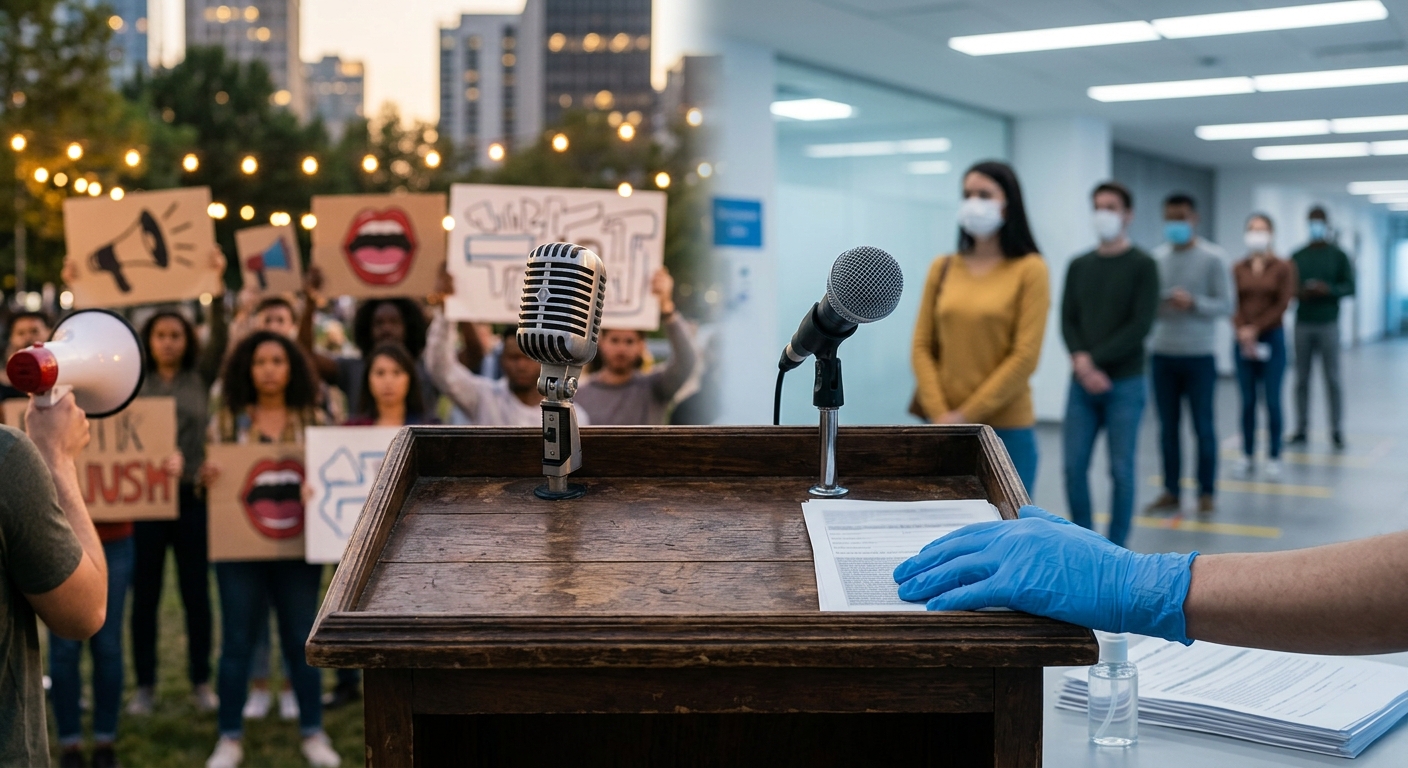
The fundamental right to peaceful assembly stands as a foundational pillar of democratic societies. It acts as the primary vehicle for social change, political dissent, and communal solidarity. Throughout history, the physical mobilization of citizens has spurred the most critical advancements in civil rights and systemic reform. However, when the world is thrust into a severe public health crisis—such as a fast-spreading viral pandemic—the bedrock principles of constitutional freedom often collide with the urgent necessity of communal safety. This intersection poses a profound challenge: how does a society uphold the unalienable right to speak truth to power while simultaneously mitigating the spread of a deadly pathogen?
The tension between civil liberties and public health mandates is not merely a modern anomaly but a recurring theme in constitutional law. Navigating this precarious balance requires a deep understanding of legal frameworks, epidemiological science, and strategic community organizing. This article explores the legal boundaries of state police powers, the rigorous judicial scrutiny applied to First Amendment restrictions, and the practical, science-backed strategies that allow citizens to exercise their right to assemble without compromising the well-being of their communities.
The Legal Bedrock: State Police Powers vs. Constitutional Rights
To comprehend the legal parameters of protesting during a pandemic, one must first examine historical jurisprudence regarding state powers during health emergencies. The defining legal precedent in the United States is the landmark 1905 Supreme Court case Jacobson v. Massachusetts. In this ruling, the Court established that states possess inherent “police powers” to enforce public health mandates—in that specific case, compulsory smallpox vaccinations—to protect the collective welfare from a deadly disease. The Court famously noted that the liberty secured by the Constitution does not import an absolute right in each person to be wholly freed from restraint at all times.
However, while this precedent granted states broad authority to curb disease outbreaks, it explicitly warned that these powers are not infinite. Public health mandates cannot arbitrarily, unreasonably, or oppressively violate fundamental constitutional rights. During the COVID-19 pandemic, this century-old precedent was frequently invoked by governments to justify lockdowns, curfews, and gathering restrictions. Yet, it was also heavily scrutinized by modern legal scholars and federal judges. A comprehensive study by Stanford University researchers analyzed over 1,000 lawsuits challenging recent public health mitigation efforts, revealing that courts increasingly constrained public health powers when they perceived agency overreach or disparate treatment of constitutionally protected activities. The underlying legal principle remains clear: emergency public health powers must be wielded with precision and equity, not as a blunt instrument to suppress political dissent.
Judicial Scrutiny and the First Amendment in Crises
The First Amendment fiercely protects the right of the people peaceably to assemble and petition the government for a redress of grievances. Despite this, First Amendment protections are not absolute; governments are permitted to impose “time, place, and manner” restrictions. To survive judicial review, these restrictions must be content-neutral (meaning they do not target the specific message of the protest), narrowly tailored to serve a significant governmental interest, and leave open ample alternative channels for communication.
In a public health emergency, curbing the spread of a highly transmissible pathogen is indisputably recognized by the courts as a compelling governmental interest. The legal friction almost always arises when defining what constitutes “narrowly tailored.” Broad, blanket bans on all outdoor assemblies have routinely faced intense judicial pushback. Courts analyze whether the government’s restrictions are the least restrictive means necessary to achieve the health objective. For instance, imposing a strict numerical limit on a massive, several-acre public park while allowing hundreds of shoppers inside a poorly ventilated big-box store represents a legal and logical discrepancy that courts are likely to strike down. The application of public health laws must be equitable. Consequently, total prohibitions on protests during a pandemic are frequently deemed unconstitutional, provided that organizers and protesters comply with the same reasonable health protocols applied across other sectors of public life.
Public Health Perspectives: The Epidemiology of Mass Gatherings
From a strictly epidemiological standpoint, any large congregation of individuals presents a risk for viral transmission, particularly for airborne or aerosolized pathogens. The Centers for Disease Control and Prevention (CDC) continuously monitors and updates guidelines regarding mass gatherings. The CDC categorizes political protests as “spontaneous mass gatherings,” which pose unique biological risks because they often lack the structured crowd control, sanitation infrastructure, and entry screening typical of planned, ticketed events.
Unlike an outdoor amphitheater concert where seating is assigned and distanced, protests inherently involve fluid movement and close-contact activities like chanting, singing, and shouting. These vocal behaviors are scientifically known to exponentially increase the expulsion of respiratory droplets and aerosols, projecting them significantly farther than normal conversational speech. However, the risk profile of these events is heavily dependent on the environmental setting. Epidemiological data collected during the massive outdoor assemblies of 2020 demonstrated that outdoor environments, when coupled with high rates of mask compliance among attendees, substantially mitigated the anticipated spikes in localized viral transmission. Constant airflow and ultraviolet exposure in outdoor settings disperse and dilute aerosolized particles rapidly, proving that complete suppression of outdoor protests is scientifically unnecessary if harm-reduction strategies are effectively deployed.
Assessing the Risk Profile of Protest Activities
To better understand the epidemiological impact of different assembly methods, public health experts generally categorize activism into varying levels of risk. Recognizing these tiers allows organizers to make informed decisions based on current community transmission rates.
| Risk Level | Protest Activity | Recommended Mitigation Strategy |
|---|---|---|
| High | Indoor unmasked gatherings; densely packed outdoor crowds shouting | Avoid entirely during peak pandemic surges; pivot to digital alternatives or relocate outdoors with strict spacing. |
| Medium | Outdoor marching in close proximity; vocal chanting | Mandate high-filtration masks (N95/KN95); enforce physical distancing through podding; utilize electronic amplification instead of shouting. |
| Low | Outdoor car caravans; distanced banner drops; digital activism | Ensure participants stay within their household vehicles; use shared digital platforms for coordinated action. |
Harm Reduction: Best Practices for Organizing and Attending
For activists and community organizers, operating during a pandemic necessitates the adoption of a rigorous harm-reduction framework. This approach acknowledges the inherent risks of physical gathering but seeks to minimize them through practical, science-backed interventions. It is entirely possible to mount a powerful, highly visible protest while simultaneously safeguarding community health. Organizers should integrate the following critical strategies into their event planning:
- Embrace Expansive Outdoor Venues: Organizers should prioritize wide, open outdoor spaces such as large municipal parks, expansive plazas, or wide boulevards. Narrow streets or partially enclosed courtyards trap air and increase exposure risk. Constant, unimpeded outdoor ventilation is the strongest environmental defense against aerosol transmission.
- Mandate and Distribute High-Quality Masks: Even if local government mandates have been temporarily lifted, protest organizers should set an internal community standard of wearing high-filtration masks. Establishing mutual aid distribution stations at the perimeter of the assembly ensures that every participant has access to vital protective equipment.
- Implement Podding and Physical Distancing: Protesters should be encouraged to attend and march within small, pre-existing “pods” or household groups. Maintaining a buffer zone of at least six feet between different pods reduces localized crowding. Utilizing visual markers, such as chalk grids on the pavement or physical ropes held by marshals, can help crowds intuitively understand and maintain safe spacing.
- Amplify with Technology, Not Voices: Because vigorous shouting projects respiratory aerosols over long distances, organizers should rely on electronic amplification. Megaphones, portable PA systems, and noisemakers like drums and bells can generate the necessary disruptive energy without the biological risk of vocal expulsion.
The Compounding Risks of Law Enforcement Tactics
A critical, often overlooked intersection of public health and constitutional rights involves the tactics utilized by law enforcement for crowd control. The deployment of riot control agents, commonly referred to as “tear gas” (such as CS or CN chemical compounds), poses severe and compounding hazards during a respiratory pandemic. According to the CDC’s chemical emergency guidelines, riot control agents cause acute irritation to the eyes, mouth, throat, and lungs, prompting intense coughing, choking sensations, and excessive tearing.
In the context of a highly contagious respiratory virus, the use of these chemical agents is epidemiologically disastrous. It forces exposed individuals to violently and involuntarily expel respiratory droplets, potentially spreading a virus to dozens of nearby people. Furthermore, the intense physical distress causes individuals to instinctively remove their masks to gasp for air or flush their faces with water, immediately stripping them of their primary viral defense. Because these chemical irritants induce acute respiratory inflammation, they also make the lungs significantly more susceptible to subsequent severe infections. Human rights advocates and public health experts strongly condemn the use of chemical irritants on crowds during health crises, arguing that such tactics unnecessarily escalate a localized gathering into a potential superspreader event, thereby endangering broader public safety.
Alternative Avenues of Dissent
There are moments during a severe pandemic when public health indicators reach critical thresholds—such as hospital intensive care units reaching maximum capacity or the emergence of a highly virulent variant. In these extreme scenarios, large physical gatherings, even with meticulous precautions, may become temporarily untenable. In these moments, the First Amendment requirement that alternative channels of communication remain open becomes paramount, and activists must pivot to innovative forms of assembly.
Activists have successfully expanded the traditional definition of “assembly.” Car caravans have emerged as a highly effective, zero-contact method of protest. By forming slow-moving convoys draped in painted banners and utilizing coordinated honking, protesters can disrupt normal traffic operations, command intense media attention, and safely convey their collective message without ever leaving the isolated environment of their vehicles. Similarly, distributed digital activism has evolved far beyond simple email petitions. Coordinated phone-banking, decentralized virtual town halls, and algorithmic disruption represent powerful exercises of free speech that carry zero epidemiological risk while still applying immense political pressure.
Conclusion
The intersection of the First Amendment and public health is not, and should not be viewed as, a zero-sum game. The preservation of human life and the preservation of civil liberty are dual, interconnected imperatives of a functional, thriving democracy. By understanding the constitutional boundaries of government emergency powers, applying rigorous and equitable judicial scrutiny to health mandates, and adopting meticulous epidemiological harm-reduction strategies, society can weather a public health crisis without silencing the vital voices of dissent. Exercising the right to protest safely during a pandemic demands extraordinary preparation, communal discipline, and tactical innovation. Ultimately, it ensures that both the biological health of the community and the foundational health of its democratic institutions remain robust and fiercely protected.
Frequently Asked Questions (FAQs)
- Can the government completely ban protests during a pandemic?
No. While the government can impose reasonable, content-neutral time, place, and manner restrictions (such as crowd size limits that align equitably with restrictions on other public activities), blanket bans on constitutional rights are subject to strict judicial scrutiny. If a city allows outdoor dining or commercial shopping, it generally cannot constitutionally forbid outdoor peaceful protests. - What are “police powers” in a public health context?
Derived from the 10th Amendment and famously affirmed in the 1905 Supreme Court case Jacobson v. Massachusetts, police powers allow state governments to enact laws and emergency mandates to protect the health, safety, and welfare of the general public. This includes the authority to issue quarantine orders and mandate vaccinations, though these powers are always constrained by fundamental constitutional rights. - Are outdoor protests scientifically safe during a respiratory pandemic?
From an epidemiological perspective, outdoor environments significantly reduce the risk of viral transmission compared to indoor spaces, due to rapid air dilution and ultraviolet light. When combined with universal high-filtration masking and physical distancing, public health experts generally consider outdoor protests to be a highly manageable risk. - Why is tear gas considered a major public health risk during a pandemic?
Riot control agents act as severe respiratory irritants. They cause violent coughing and gasping, which drastically increases the expulsion of viral droplets into the air. They also force individuals to remove their protective masks and can cause pulmonary inflammation, leaving individuals much more vulnerable to severe respiratory infections.
References
- Balancing Religious Freedoms and Public Health Protections During the COVID-19 Pandemic — Berkley Center for Religion, Peace and World Affairs. 2020-06-03. https://berkleycenter.georgetown.edu/responses/balancing-religious-freedoms-and-public-health-protections-during-the-covid-19-pandemic
- US Court Rulings Constrain Public Health Powers During COVID-19 Pandemic — Stanford University, Freeman Spogli Institute for International Studies. 2024-05-22. https://fsi.stanford.edu/news/us-court-rulings-constrain-public-health-powers-during-covid-19-pandemic
- Mass Gatherings | Yellow Book — Centers for Disease Control and Prevention (CDC). 2024-05-01. https://wwwnc.cdc.gov/travel/yellowbook/2024/itineraries/mass-gatherings
- Riot Control Agents | Chemical Emergencies — Centers for Disease Control and Prevention (CDC). 2024-04-04. https://www.cdc.gov/chemicalemergencies/fact-sheets/riot-control-agents-tear-gas.html
Similar Articles








Read full bio of medha deb


