
Free Money Tax Schemes: How Scammers Target Seniors and Churchgoers
A detailed guide to understanding and avoiding fake “free money” tax refund schemes aimed at seniors and faith communities.
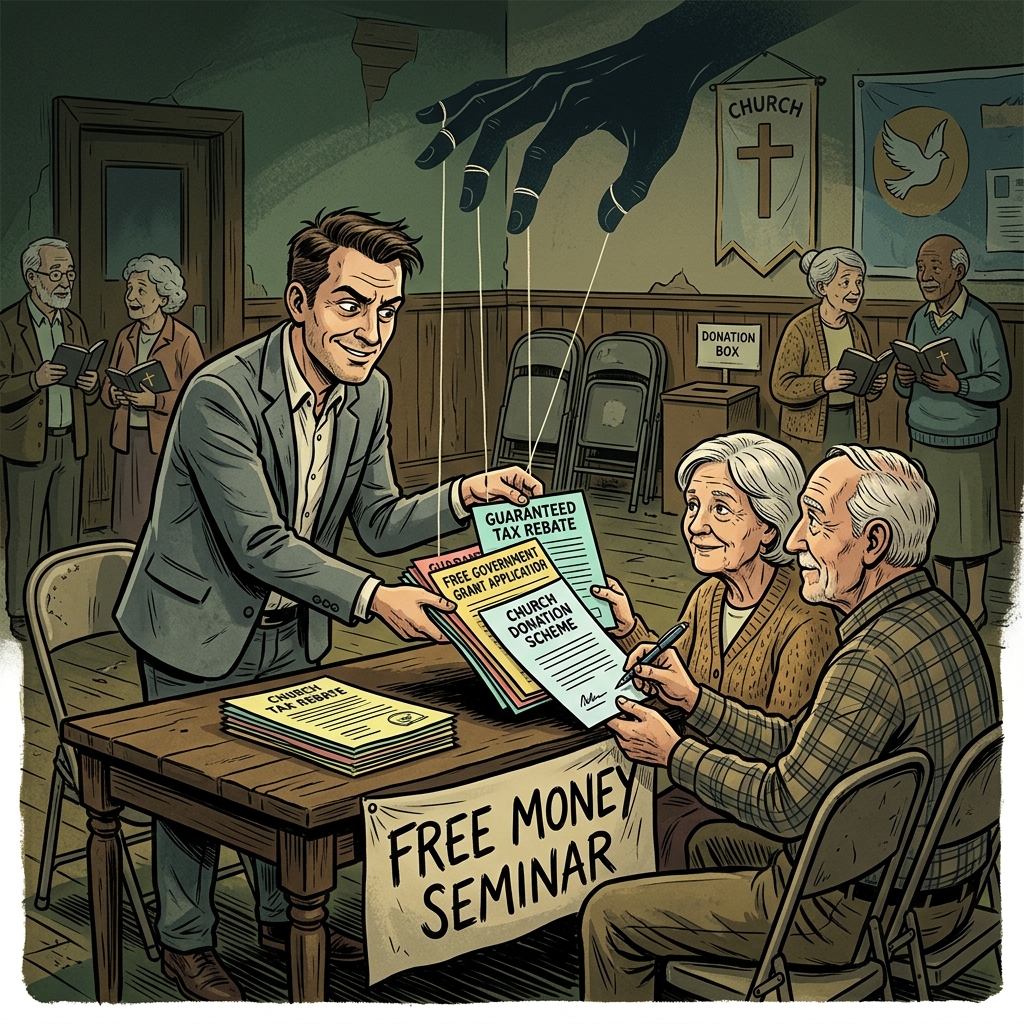
Across the United States, scammers are promoting bogus tax refund opportunities, often disguised as “free government money”, to vulnerable communities such as seniors and churchgoers. These schemes misuse the tax system, fabricate eligibility for credits and refunds, and leave victims facing audits, tax bills, and even penalties. Understanding how these schemes work is the first step toward avoiding them.
Why Seniors and Churchgoers Are Attractive Targets
Fraudsters do not choose victims at random. In many cases, they deliberately focus on older adults and faith-based communities for several reasons.[10]
- Trust in community leaders: Churchgoers may trust anyone invited to speak at religious gatherings, especially if someone appears endorsed by the pastor or a respected member.
- Limited tax knowledge: Seniors and low-income taxpayers may be less familiar with complex tax credits and refund rules, making it easier for scammers to confuse or deceive them.
- Financial vulnerability: Older adults living on fixed incomes can be highly motivated by promises of unexpected funds or larger refunds.
- Social isolation: Some seniors have limited access to independent advice, which reduces the chance that a friend or family member will spot the scam early.
Faith communities are especially attractive because scammers can reach many potential victims at once by presenting workshops or seminars that appear helpful and legitimate.
How the “Free Money” Tax Scam Typically Works
Although details vary, many of these schemes follow a recognizable pattern. Scammers position themselves as experts who can unlock hidden tax benefits, then charge fees or collect personal information to file dubious returns on behalf of their victims.
Common Tactics Used by Scammers
- Promotional seminars: Scammers arrange presentations in churches, community centers, or senior living facilities, claiming they know special programs for low-income or elderly taxpayers.
- Group sign-ups: After a seminar, victims are encouraged to sign up immediately and provide sensitive data such as Social Security numbers and bank details.
- Promised large refunds: The scammer promises substantial refunds or benefits, sometimes tied to fabricated eligibility for tax credits or government programs.
- High “processing fees”: Victims are charged up-front fees or are told that a portion of the refund will be kept by the preparer as a commission.
- False returns and credits: The scammer files tax returns that claim illegitimate or exaggerated credits, deductions, or refunds, often without the taxpayer fully understanding what is being submitted.
In many cases, the scammer disappears once the IRS detects the problem and rejects or later audits the return, leaving victims to deal with the consequences alone.
Warning Signs of Tax Scams Targeting Seniors and Congregations
The IRS and other agencies have identified several red flags that can help you recognize fraudulent tax schemes before you become a victim.[10]
| Red Flag | What It Usually Means |
|---|---|
| Promises of big refunds or “free money” | Scammers may be fabricating eligibility or filing false returns to obtain a large refund. |
| Pressure to sign documents immediately | Fraudsters want victims to act quickly, without time to seek independent advice. |
| Requests for cash-only payment or large fees | Legitimate preparers typically accept standard payment methods and provide receipts. |
| Preparers who refuse to sign returns | Paid preparers must sign and include their Preparer Tax Identification Number (PTIN). |
| Demands or threats | Scammers may impersonate the IRS and threaten arrest or penalties to force compliance.[10] |
| Unsolicited calls, texts, or emails claiming to be IRS | The IRS generally initiates contact by mail, not calls or emails. |
Any scheme that emphasizes speed, secrecy, or unusually large benefits should prompt skepticism, especially when aimed at older adults or church members.
IRS Guidance: How the Real IRS Contacts Taxpayers
Understanding how the IRS operates makes it easier to spot impostors. According to the IRS:
- Initial contact is usually by mail: The IRS generally starts by sending an official letter through the postal service when there is an issue with a tax return or an outstanding balance.
- The IRS will not demand immediate payment by phone: The agency will not call unexpectedly to demand payment or threaten law enforcement actions.
- No payment via gift cards or wire transfers: Legitimate tax payments are made through approved methods such as checks, electronic transfers, or official IRS online portals.
- Right to question or appeal: Taxpayers have the right to challenge or appeal an IRS decision, and the IRS informs them of these rights rather than insisting on instant payment.
If a contact does not match these practices, it is likely fraudulent and should be treated with caution.
Consequences for Victims of “Free Money” Tax Schemes
While scammers profit, victims may face serious consequences when false returns or fraudulent credits are filed in their name.
- Tax bills and penalties: When the IRS discovers that a return includes inaccurate credits or deductions, it may disallow them and issue a notice demanding repayment, plus interest and penalties.
- Audits and reviews: Victims can be selected for audits, requiring them to produce documentation and explanations for information that they may not understand because the preparer fabricated it.
- Identity theft risks: Scammers often collect Social Security numbers, dates of birth, and banking details, which can later be misused for other forms of fraud.[10]
- Loss of legitimate benefits: Misreported income or fraudulent claims can affect eligibility for means-tested benefits and create additional administrative problems.
Although some victims may ultimately prove they were misled, the process can be stressful, time-consuming, and financially harmful.
Steps to Protect Yourself and Your Community
Prevention is far easier than repairing the damage after a scam succeeds. Seniors, caregivers, and faith leaders can take practical steps to reduce risk.[10]
Practical Protection Tips
- Verify the preparer: Use trusted tax professionals, and check whether the preparer has a valid PTIN and appropriate credentials. Avoid anyone who refuses to sign returns or provide a physical business address.
- Never sign blank forms: Insist on reviewing the entire tax return before signing. Ask questions about each credit or deduction claimed on your behalf.
- Guard your personal information: Do not share Social Security numbers, bank account details, or identity documents with strangers or unverified organizations.
- Be skeptical of unsolicited offers: Treat unexpected calls, emails, letters, or social media messages promising tax refunds or government benefits with caution.
- Consult a trusted advisor: Before participating in any program promising “free money,” talk to a family member, legal aid office, or independent tax professional.
Faith communities can also help by inviting only recognized nonprofits, certified counselors, or reputable tax assistance programs to speak about tax issues.
Where and How to Report Suspected Tax Scams
Reporting scams helps protect others and may assist law enforcement in stopping repeat offenders. Several official resources are available.[10]
- IRS Impersonation and Tax Scams: The Treasury Inspector General for Tax Administration (TIGTA) provides an IRS impersonation scam reporting form and telephone hotline for reporting fake IRS contacts.
- Federal Trade Commission (FTC): Individuals can report fraud and phone scams using the FTC’s online complaint assistant, helping authorities track nationwide patterns.
- National Elder Fraud Hotline: The U.S. Department of Justice maintains a dedicated hotline for elder fraud victims, providing support and guidance.[10]
- Local law enforcement: Police departments often encourage residents to report impostor scams and may issue public alerts warning others.[10]
- Financial institutions: Banks can help monitor accounts for suspicious activity and support efforts to limit further financial loss.
When reporting, provide as much detail as possible: names used by the scammer, contact information, dates and amounts of any payments, and copies of letters or emails.
Role of Caregivers, Families, and Community Leaders
Protecting seniors and congregations from tax scams is a shared responsibility. Caregivers and family members can assist by staying informed and proactively discussing fraud risks.
- Regular conversations: Talk openly with older relatives about common scams, emphasizing that it is safe to ask for help if something seems suspicious.
- Reviewing documents: Offer to read tax-related letters, emails, or promotional materials with them before they respond or sign anything.
- Planning for capacity issues: Consider legal tools such as financial powers of attorney to ensure trusted individuals can help manage tax and financial matters if cognitive decline occurs.
- Community education: Pastors, deacons, and other leaders can organize fraud awareness sessions and share official guidance from the IRS and justice authorities.
By making fraud awareness part of regular community life, churches and senior organizations can greatly reduce the likelihood that scammers will succeed.
Frequently Asked Questions (FAQs)
1. Is it ever possible to get “free money” from the IRS?
No legitimate IRS program offers random “free money.” Refunds and credits are based on the law and require accurate eligibility and documentation. Any scheme emphasizing easy cash without clear rules is suspect.
2. How can I verify if a tax preparer is legitimate?
Ask for their Preparer Tax Identification Number (PTIN) and professional credentials. Check independent reviews, confirm that they will sign your return, and avoid preparers who base their fee solely on the size of your refund.
3. What should I do if I already gave my Social Security number to a scammer?
Contact the IRS, monitor your tax transcripts, and consider placing fraud alerts or credit freezes with major credit bureaus. Report the incident to the FTC and the National Elder Fraud Hotline for additional guidance.[10]
4. Does the IRS ever call people by phone?
In some limited circumstances, IRS employees may call, but usually only after prior written communication. Unexpected calls demanding payment or threatening arrest should be considered scams and reported.
5. I attended a seminar at church that offered large refunds for seniors. How do I know if it was legitimate?
Request written information about the program, verify the organization’s status, and consult an independent tax professional. If the seminar emphasized secrecy, rapid sign-ups, or unusually large benefits, treat it as a potential scam and report concerns.
References
- IRS warns elderly, low-income churchgoers of tax scam — ABC7 Los Angeles. 2012-03-06. https://abc7.com/archive/8570943/
- IR-2024-164: IRS warns against scams targeting seniors — Internal Revenue Service. 2024-06-10. https://content.govdelivery.com/accounts/USIRS/bulletins/3a240b2
- Recognize tax scams and fraud — Internal Revenue Service. 2024-03-20. https://www.irs.gov/help/tax-scams/recognize-tax-scams-and-fraud
- Elder Justice Initiative: Senior Scam Alert — U.S. Department of Justice. 2023-11-15. https://www.justice.gov/elderjustice/senior-scam-alert
- IR-2024-164: IRS warns against scams targeting seniors — Internal Revenue Service (National Elder Fraud Hotline details). 2024-06-10. https://content.govdelivery.com/accounts/USIRS/bulletins/3a240b2
- How to Spot, and Prevent, the Tax Scams That Target Elders — McAfee. 2023-02-14. https://www.mcafee.com/learn/how-to-spot-and-prevent-the-tax-scams-that-target-elders/
- Ways to Prevent Potential Tax Scams for Seniors — Senior Helpers. 2023-04-11. https://www.seniorhelpers.com/ct/danbury/resources/news-and-blog/2023-04-11/
Similar Articles








Read full bio of Sneha Tete




