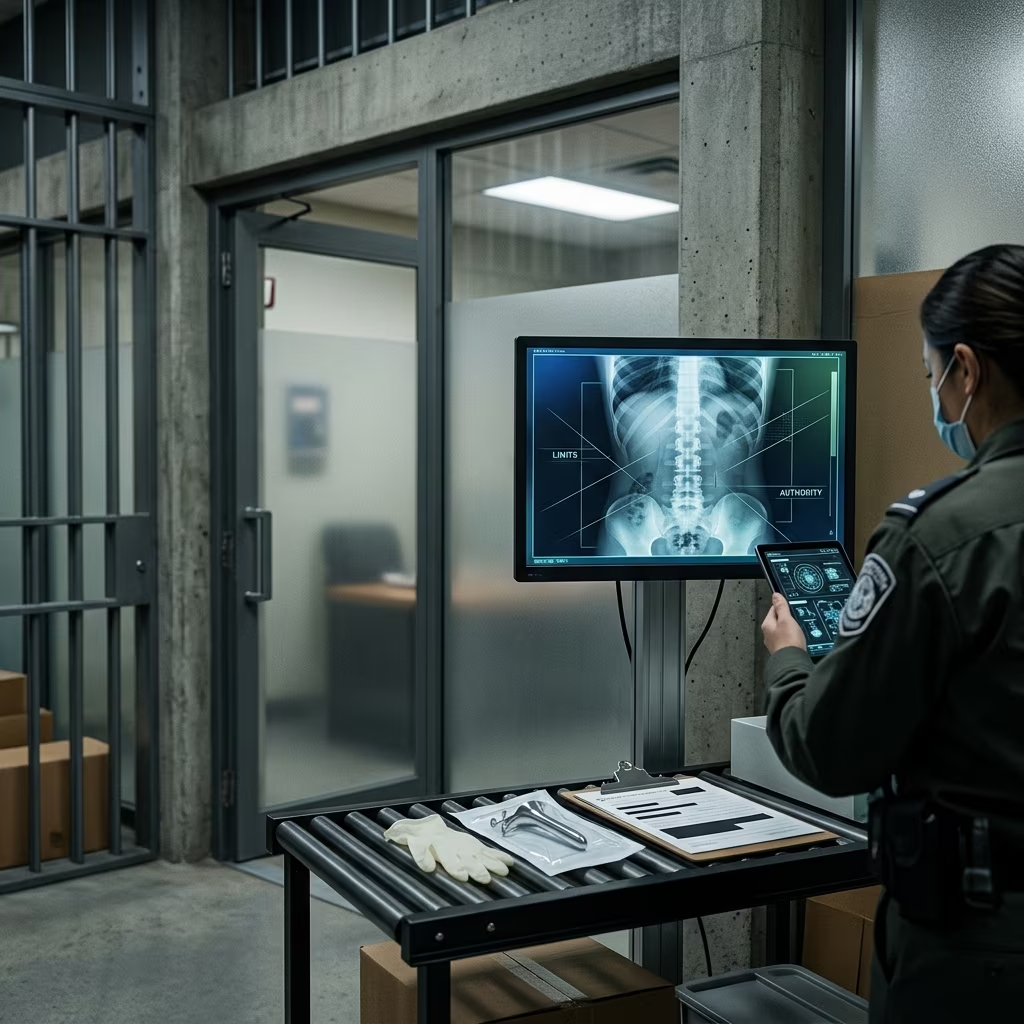
The use of x‑ray technology and anal cavity searches raises serious questions about how far the government may intrude into the human body in the name of law enforcement. Courts have repeatedly turned to the Fourth Amendment, which protects against unreasonable searches and seizures, to decide when such highly invasive procedures are lawful.
This article explains how courts analyze these searches, why an x‑ray of a suspect’s anal cavity has been upheld as constitutional in some cases, and what factors determine whether a particular search is considered reasonable under the Fourth Amendment.
Understanding the Fourth Amendment Framework
The Fourth Amendment prohibits unreasonable searches and seizures, rather than banning all searches outright. When judges review body cavity or x‑ray searches, they apply a balancing test that weighs the government’s need against the individual’s privacy and bodily integrity.
- Core protection: Freedom from unreasonable governmental intrusion into the body and private areas.
- Key question: Is the search reasonable given all the circumstances?
- Tool used by courts: A balancing test that considers scope, manner, justification, and location of the search.
In practice, this means that courts do not automatically forbid body cavity searches; instead, they assess whether particular searches are justified and conducted in an appropriate way.
What Counts as a Body Cavity Search?
Many cases and statutes define body cavity searches broadly to include any inspection of internal cavities such as the anus, vagina, or genitals for evidence or contraband.
| Type of Search | Description | Intrusiveness Level |
|---|---|---|
| Strip search | Removal of clothing with visual inspection of naked body, but no penetration. | High, but less than internal probes. |
| Visual cavity search | Visual inspection of anal or genital area, sometimes requiring bodily movements. | Very high, often considered degrading. |
| Manual cavity search | Physical probing of internal cavities, sometimes with instruments. | Extreme; described as a major dignitary intrusion. |
| X‑ray cavity search | Use of diagnostic imaging to view possible contraband inside the body. | Significant, but often argued to be less physically intrusive. |
Courts recognize that these procedures implicate core privacy interests and dignity, particularly when the search involves internal penetration or exposure of intimate areas.
The Role of Warrants, Probable Cause, and Clear Justification
One central issue in x‑ray and anal cavity search cases is whether law enforcement had lawful authority to conduct the search—usually through a warrant, probable cause, or an emergency circumstance.
- Warrant requirement: Many courts and state laws require a warrant specifically authorizing body cavity searches, issued by a judge based on probable cause.
- Probable cause: Officers must have a reasonable, evidence‑based belief that contraband is concealed in a body cavity, not merely somewhere on the person.
- Urgent circumstances: In rare situations, imminent destruction of evidence or serious safety threats may justify a search without a warrant.
Law review analyses of body cavity searches emphasize several questions: Was there a lawful arrest? Was there probable cause to search the person? Was there a particularized indication that evidence would be found in a cavity, rather than on the surface of the body?
If these prerequisites are not met, courts are more likely to find a Fourth Amendment violation, especially when the search is physically invasive or degrading.
How Courts Assess Reasonableness in X‑Ray Anal Cavity Searches
In deciding whether an x‑ray of a suspect’s anal cavity violates the Fourth Amendment, courts look at several specific factors. A key case in the First Circuit upheld such an x‑ray search, concluding that it “passed muster” under the Fourth Amendment after balancing privacy against law enforcement needs.
Core Factors in the Reasonableness Analysis
- Medical risk and intrusiveness: A diagnostic x‑ray is generally considered brisk, painless, and safe when performed correctly, which weighs in favor of reasonableness compared to manual probing.
- Quality of the warrant: A valid, unchallenged warrant specifically authorizing an anal cavity search reinforces the legitimacy of using an x‑ray to carry out that search.
- Probable cause to suspect internal concealment: Courts look for evidence that officers reasonably believed the suspect stored drugs or contraband internally, such as prior behavior or reliable tips.
- Least intrusive means: If no less invasive method is available to verify suspicions—such as a simple pat‑down or visual inspection—an x‑ray may be deemed the least intrusive effective option.
- Professional medical involvement: Conducting the x‑ray in a medical setting by trained staff is significant; courts often require that invasive body searches be performed by licensed medical professionals.
In the First Circuit case that inspired the FindLaw analysis, the court emphasized that the x‑ray was safe, correctly performed, supported by probable cause, and the least intrusive way to confirm suspicions about internal drug concealment.
Effect of a Negative Physical Search
Defendants sometimes argue that once a physical search is negative—no contraband is found on the person—officers lose justification for more invasive procedures. The First Circuit rejected this argument in the x‑ray case, reasoning that a negative external search does not rule out the possibility that evidence is hidden inside the body.
From the court’s perspective, internal concealment remains a plausible explanation for missing contraband, so the x‑ray can still be supported by the original probable cause.
Scope of the Warrant and Incidental Findings
Another complication arises when an x‑ray authorized for a particular cavity captures images of additional internal areas. In the First Circuit case, the warrant focused on the anal cavity, but the x‑ray also showed the suspect’s abdomen and stomach.
The court held that viewing the stomach was incidental to the legitimate anal cavity search and did not require separate probable cause, even though the image exceeded the literal scope of the warrant.
- Incidental observation: When a lawful search naturally reveals information beyond its target, courts often regard the extra information as a permissible byproduct.
- No independent warrant: If the additional viewing happens unavoidably as part of executing a valid warrant, officers may lawfully use the results without seeking a new warrant.
This reasoning closely parallels principles from other search contexts—such as digital searches or plain‑view doctrine—where incidental discovery of evidence is allowed when the initial search itself is proper.
Privacy Claims Under State Law and Civil Rights Statutes
Suspects subjected to x‑ray cavity searches often pursue civil rights claims under 42 U.S.C. § 1983 and state privacy laws. In the Massachusetts case that the First Circuit considered, the plaintiff argued both federal constitutional and state privacy violations.
Massachusetts, for example, protects against “unreasonable” invasions of privacy under its statutes. The court concluded that a search performed in accordance with constitutional requirements and executed reasonably does not constitute an actionable invasion of privacy under state law.
- Federal claim (§ 1983): Requires showing a violation of a federal right, typically the Fourth Amendment, by state actors.
- State privacy statutes: Often hinge on whether the intrusion is “unreasonable” given the facts and the existence of a valid warrant.
- Medical provider liability: Courts may hold that hospital staff are not liable when they perform lawful procedures under a valid warrant and share results with police.
In the case described by Massachusetts Lawyers Weekly and other summaries, both the city and the hospital ultimately prevailed because the court found the search constitutional and reasonable.
Contrasting Cases: When Body Cavity Searches Cross the Line
Not all body cavity searches survive Fourth Amendment scrutiny. Other federal appellate decisions have found searches unconstitutional when the degree of intrusion and coercion far outweighs any legitimate governmental interest.
Example of an Unconstitutional Anal Probe
The American Civil Liberties Union reported on a Sixth Circuit case involving a man stopped for expired tags, suspected of having marijuana.
- He was strip‑searched, sedated intravenously, intubated, and subjected to an anal probe.
- The court described the search as “one of the greatest dignitary intrusions” that can result from a medical procedure.
- The forced procedures violated his Fourth Amendment rights, and the court refused to allow the government to use the drugs found through the search.
This decision illustrates that even when contraband is ultimately found, courts may exclude evidence and rule in favor of the defendant if the manner of the search is excessively invasive and not sufficiently justified by the circumstances.
Factors That Push a Search Beyond Constitutional Limits
Courts have identified several red flags that can render a body cavity search unconstitutional:
- Lack of medical oversight: Searches performed by untrained officers, rather than licensed medical personnel, raise serious concerns.
- Absence of a warrant or probable cause: Intrusive searches without clear legal authority often violate the Fourth Amendment.
- Humiliating, degrading conditions: Searches carried out in public, unsanitary, or unnecessarily painful ways can be deemed unreasonable.
- Excessive force or sedation: Coercive tactics, including sedation and invasive medical procedures, heighten the dignitary intrusion.
These cases provide an important counterpoint to decisions upholding x‑ray searches, showing that constitutional tolerance for bodily intrusion has clear limits.
Differences Between Prisoners, Arrestees, and Visitors
Courts treat body cavity searches differently depending on whether the person is an ordinary suspect, a prisoner, or a prison visitor. Prisoners typically have reduced privacy rights, while visitors retain stronger protections.
- Prisoners: Have limited Fourth Amendment rights but can challenge searches that go far beyond what is necessary for institutional security.
- Pretrial detainees and arrestees: Enjoy more privacy than convicted prisoners but may still be subject to visual strip or cavity searches when balanced against security needs.
- Prison visitors: Retain comparatively strong rights against unreasonable strip and body cavity searches, and courts are more skeptical about intrusive searches absent compelling justification.
Legal manuals and academic work note that while prisons may adopt policies allowing certain kinds of visual inspections, courts remain wary of degrading searches that exceed legitimate safety concerns.
Practical Guidance: When X‑Ray or Anal Cavity Searches May Be Lawful
Drawing from cases and commentary, several practical principles emerge regarding when x‑ray or anal cavity searches are more likely to be upheld.
- The search is authorized by a specific warrant issued on probable cause.
- There is a clear indication that contraband is hidden in a body cavity, not just on the person’s exterior.
- Medical personnel perform the x‑ray or procedure in a professional, hygienic setting.
- The method used is the least intrusive effective way to achieve the legitimate law enforcement objective.
- The manner of execution does not involve unnecessary humiliation, pain, or coercion.
When these criteria are met, courts have shown a willingness to uphold x‑ray cavity searches, even while acknowledging their impact on privacy and dignity.
Frequently Asked Questions (FAQs)
Are body cavity searches automatically unconstitutional?
No. Courts do not treat body cavity searches as per se unconstitutional. Instead, they apply a reasonableness standard, examining the scope, manner, justification, and setting of each search.
Can police order an x‑ray without a warrant?
In many jurisdictions, a warrant based on probable cause is strongly preferred and sometimes required for x‑ray or anal cavity searches. Only in truly urgent situations—where evidence may be destroyed and no time exists to obtain a warrant—might a warrantless search be upheld.
Does a negative pat‑down or external search prevent an internal x‑ray search?
Not necessarily. Courts have ruled that an external search coming up empty does not eliminate the possibility that contraband is internally concealed, so probable cause may still justify an x‑ray cavity search.
Who is allowed to perform body cavity or x‑ray searches?
Most guidance and case law emphasize that such searches should be performed by licensed medical professionals, such as doctors or nurses, in an appropriate clinical setting.
What happens if a cavity search is found unconstitutional?
If a court finds that a body cavity search violates the Fourth Amendment, evidence obtained from the search may be suppressed, meaning it cannot be used in criminal proceedings. The individual may also pursue civil rights claims for damages.
References
- Civil rights – X‑rays – Fourth Amendment — Massachusetts Lawyers Weekly. 2011-10-19. https://masslawyersweekly.com/2011/10/19/civil-rights-x-rays-fourth-amendment/
- X‑Ray Anal Cavity Search Doesn’t Violate Fourth Amendment Rights — FindLaw Legal Blogs, First Circuit. 2011-10-20. https://www.findlaw.com/legalblogs/first-circuit/x-ray-anal-cavity-search-doesnt-violated-fourth-amendment-rights/
- Body Cavity Searches — University of Tennessee County Technical Assistance Service. 2014-06-01 (approx.). https://www.ctas.tennessee.edu/eli/body-cavity-searches
- Anal Probe for a Traffic Stop? — American Civil Liberties Union. 2013-09-20. https://www.aclu.org/news/national-security/anal-probe-traffic-stop
- Visual Body Cavity Searches Incident to Arrest — University of Miami Law Review. 1990-01-01. https://repository.law.miami.edu/cgi/viewcontent.cgi?article=1607&context=umlr
- Jailhouse Lawyer’s Manual, Chapter on Searches — Columbia Human Rights Law Review. 2010-01-01. https://jlm.law.columbia.edu/files/2017/05/37.-Ch.-25.pdf
- Bare Analysis: Prison Visitor Strip and Body‑Cavity Searches — Minnesota Law Review. 1990-01-01. https://scholarship.law.umn.edu/cgi/viewcontent.cgi?article=1181&context=minnlrev