
Foreign Divorce In New York: What To Know And 5 Practical Steps
Understand when New York recognizes an overseas divorce and what proof courts may expect.
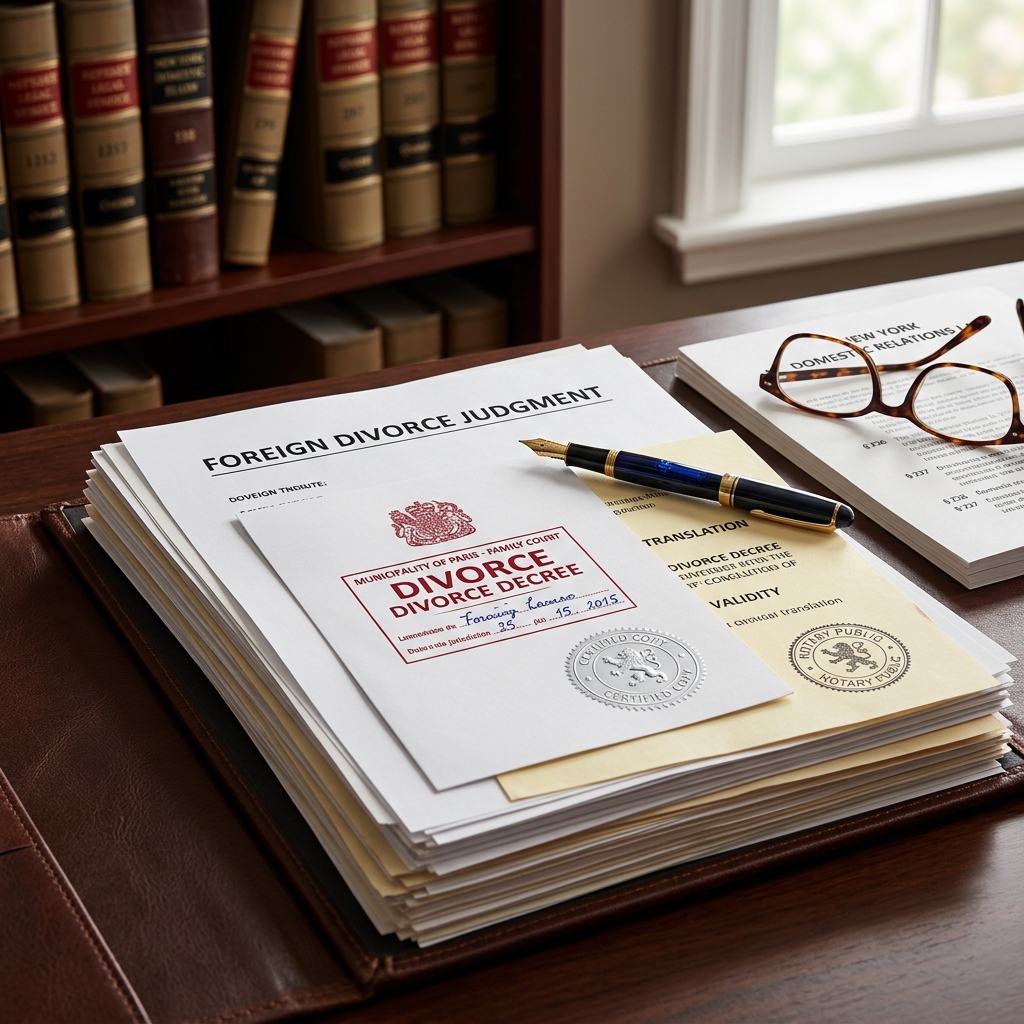
New York does not automatically reject a divorce issued in another country. In many cases, the state recognizes an overseas divorce if the foreign court had proper authority, the spouses received fair notice, and the process did not violate New York public policy.18
That general rule matters because married couples often live, work, or separate across borders. When one spouse obtains a divorce abroad, the key question in New York is usually not whether the foreign court used the same rules as a New York court, but whether the foreign judgment is sufficiently reliable to be respected here.18
How New York Approaches Foreign Divorces
New York generally recognizes foreign divorce decrees as a matter of comity, meaning the state gives respectful effect to a judgment from another country when basic fairness and jurisdictional standards are satisfied.18 Comity is not identical to automatic enforcement. Instead, it is a discretionary recognition doctrine that asks whether the foreign judgment should be treated as valid in New York.
The practical result is that a divorce granted abroad may be accepted in New York even if the foreign country is not the domicile of either spouse, so long as the circumstances show a real connection to the proceeding and adequate notice to both parties.1
By contrast, New York is wary of divorces that appear designed to evade ordinary court process, especially so-called mail-order divorces in which neither party meaningfully appears before the court or participates in a way that gives the proceeding legitimacy.1
What Usually Makes a Foreign Divorce Recognizable
For a foreign divorce to be recognized, several elements typically matter. The exact facts vary, but New York sources consistently emphasize jurisdiction, notice, and participation.128
- Adequate notice: both spouses should know about the divorce proceeding and have an opportunity to respond.18
- Some physical presence: at least one spouse should have a real presence in the foreign country connected to the divorce process.1
- Submission or appearance by the other spouse: the responding spouse should either appear in the foreign case or otherwise agree to the foreign court’s authority.12
- No conflict with New York public policy: the foreign judgment cannot rest on a procedure New York views as fundamentally unfair, such as an ex parte arrangement with no meaningful participation by either spouse.18
These requirements do not mean every foreign divorce must look like a New York divorce. They do mean that the proceeding must be recognizable as a real adjudication, not simply a paper transaction.12
Jurisdiction: Why the Foreign Court’s Authority Matters
Jurisdiction is one of the most important parts of the analysis. A New York court will want to know whether the foreign tribunal had a legitimate basis to dissolve the marriage.28
Different foreign systems use different rules, but the broader New York inquiry is whether the foreign court had enough connection to the spouses and the dispute to justify granting the divorce. That often involves questions such as whether one spouse lived in the foreign country, whether both spouses were present there, or whether the respondent formally submitted to the court’s power.12
If the only connection to the foreign country was a brief or artificial trip made solely to secure a divorce, recognition may be harder to obtain. New York courts look for a substantive relationship between the proceeding and the foreign forum, not just a temporary stopover used to manufacture a decree.18
| Issue | Why it matters in New York |
|---|---|
| Foreign court jurisdiction | Shows the court had authority to dissolve the marriage.2 |
| Notice to both spouses | Supports due process and fairness.18 |
| Appearance or consent | Helps show the respondent accepted or participated in the proceeding.12 |
| Public policy | Prevents recognition of fundamentally unfair divorces.18 |
Why Notice and Participation Are So Important
Due process concerns are central to recognition in New York. If a spouse had no meaningful notice of the foreign proceeding, or if the case moved forward without any chance to be heard, a New York court may refuse to recognize the judgment.18
Participation can take different forms. A spouse might appear in person abroad, file a response, sign a written consent, or otherwise submit to the foreign court’s authority. What matters is that the record shows more than a one-sided or secret process.12
This is one reason ex parte or “one-spouse-only” divorces can be difficult to defend later. If the respondent never had real notice or opportunity to object, the foreign decree may not carry enough procedural reliability for New York recognition.18
Documents That Help Prove the Divorce Is Valid
If you need New York to accept a foreign divorce, paperwork matters. The most useful records are the ones that establish the existence of the decree, the identity of the parties, and the nature of the foreign proceeding.128
- Certified copy of the divorce decree or judgment from the foreign court.18
- Authenticated or apostilled records when required for use in the United States.8
- Certified English translation if the original decree is in another language.18
- Proof of notice or appearance showing the respondent knew about and participated in the case.12
These documents do not guarantee recognition by themselves, but they usually make it easier to show that the foreign judgment deserves respect in New York. If the record is incomplete, a court may have trouble assessing jurisdiction or due process.18
Do You Need to Register a Foreign Divorce in New York?
In many situations, no separate “registration” is required just for the divorce to be recognized. Recognition usually depends on whether the foreign decree satisfies New York’s legal standards, not on whether it has been entered into a local registry.38
However, a court filing may be useful if you want New York to address issues that depend on the prior divorce, such as later disputes over property, support, custody, or enforcement of obligations from the foreign judgment.23
That distinction is important: recognition of the divorce is one thing, while enforcement of its terms is another. A foreign decree may end a marriage but still leave questions about whether New York should enforce specific financial or custodial terms.23
When New York May Refuse Recognition
New York may decline to recognize a foreign divorce when the facts suggest the judgment is unreliable, unfair, or inconsistent with the state’s public policy.18
- The spouses received no meaningful notice.18
- Neither spouse had a real presence in the foreign country connected to the proceeding.1
- The respondent never appeared and never consented in any recognizable way.12
- The divorce appears to be a paper-only or mail-order arrangement.1
- The surrounding facts raise concerns about coercion or lack of fairness.38
Refusal of recognition can have serious consequences. A person who believed they were divorced abroad may discover that New York still treats them as married, which can affect remarriage, taxes, inheritance, property rights, and family court matters.28
Common Situations Where Legal Review Is Worth Considering
Some people have no trouble relying on a foreign divorce, but others should get the facts reviewed before moving forward. A careful review is especially useful if the divorce will affect a new marriage, a property dispute, or a request to enforce or modify support orders in New York.23
Legal review is also smart when the paperwork is incomplete, the decree is in another language, or the facts suggest one spouse may challenge the divorce later. In those situations, the question is not only whether the divorce was granted abroad, but whether New York will honor it when the issue becomes important.12
Practical Steps if You Have a Foreign Divorce
If you already have an overseas divorce and want to understand its effect in New York, the following steps can help organize the issue before a dispute arises.28
- Collect the certified decree, translations, and any authentication papers.18
- Review whether one or both spouses had a real connection to the foreign country.12
- Check whether the responding spouse received notice and had a chance to participate.18
- Consider whether any New York issue still needs attention, such as property division or custody enforcement.23
- Speak with a New York family law attorney if the divorce may be questioned later.23
This sequence is useful because it separates the document problem from the legal problem. Sometimes the decree exists and is easy to prove, but the underlying facts still leave recognition uncertain.12
Frequently Asked Questions
Will New York always accept a divorce from another country?
No. New York often recognizes foreign divorces, but only when the foreign court had proper authority, the spouses had notice, and the judgment does not violate New York public policy.18
Does a foreign divorce have to come from the country where both spouses lived?
Not always. New York sources indicate that recognition can still be possible even when the foreign country was not the domicile of either spouse, so long as the proceeding meets the relevant fairness and jurisdiction requirements.1
Is a mail-order divorce likely to be recognized?
Usually not if it lacks real participation, notice, or a meaningful court appearance. New York treats that type of arrangement as inconsistent with public policy.1
Do I need an English translation of the decree?
Yes, if the decree is in another language, an English translation is usually needed so a New York court can review it.18
Can a foreign divorce affect property or support issues in New York?
Yes. Once recognized, a foreign divorce judgment may support later claims involving financial relief, property distribution, or related family law issues.2
Why This Issue Matters Before Remarriage or Litigation
People often discover foreign-divorce issues only when they try to remarry or when a former spouse raises a challenge. At that point, the validity of the prior decree becomes more than a technical question; it can affect marital status and the legal foundation for later claims.27
For that reason, anyone depending on an overseas divorce in New York should make sure the foreign judgment is documented clearly and that the surrounding facts show a legitimate proceeding. The earlier the issue is reviewed, the easier it is to correct problems before they become expensive disputes.23
References
- Validity of Foreign Divorces under New York Law — DivorceNet. n.d. https://www.divorcenet.com/states/new_york/divorce_overseas_validity_of_foreign_divorce_ny
- Recognition of Foreign Divorce Decrees in New York — Neuyac. n.d. https://neuyac.com/post-18-foreign-divorce-recognition
- How to validate and/or register in NY an overseas divorce? — Avvo. n.d. https://www.avvo.com/legal-answers/how-to-validate-and-or-register-in-ny-an-overseas–4856041.html
- Divorce — U.S. Department of State, Travel.State.Gov. n.d. https://travel.state.gov/en/international-travel/living-abroad/divorce.html
- Recognition of Foreign Divorce Decrees — University of Chicago Law Review. n.d. https://chicagounbound.uchicago.edu/cgi/viewcontent.cgi?article=3463&context=uclrev
- Enforcement of a Foreign Divorce Decree in New York — Cornell Law School, Legal Scholarship Repository. n.d. https://scholarship.law.cornell.edu/cgi/viewcontent.cgi?article=1234&context=clr
Similar Articles








Read full bio of Sneha Tete


