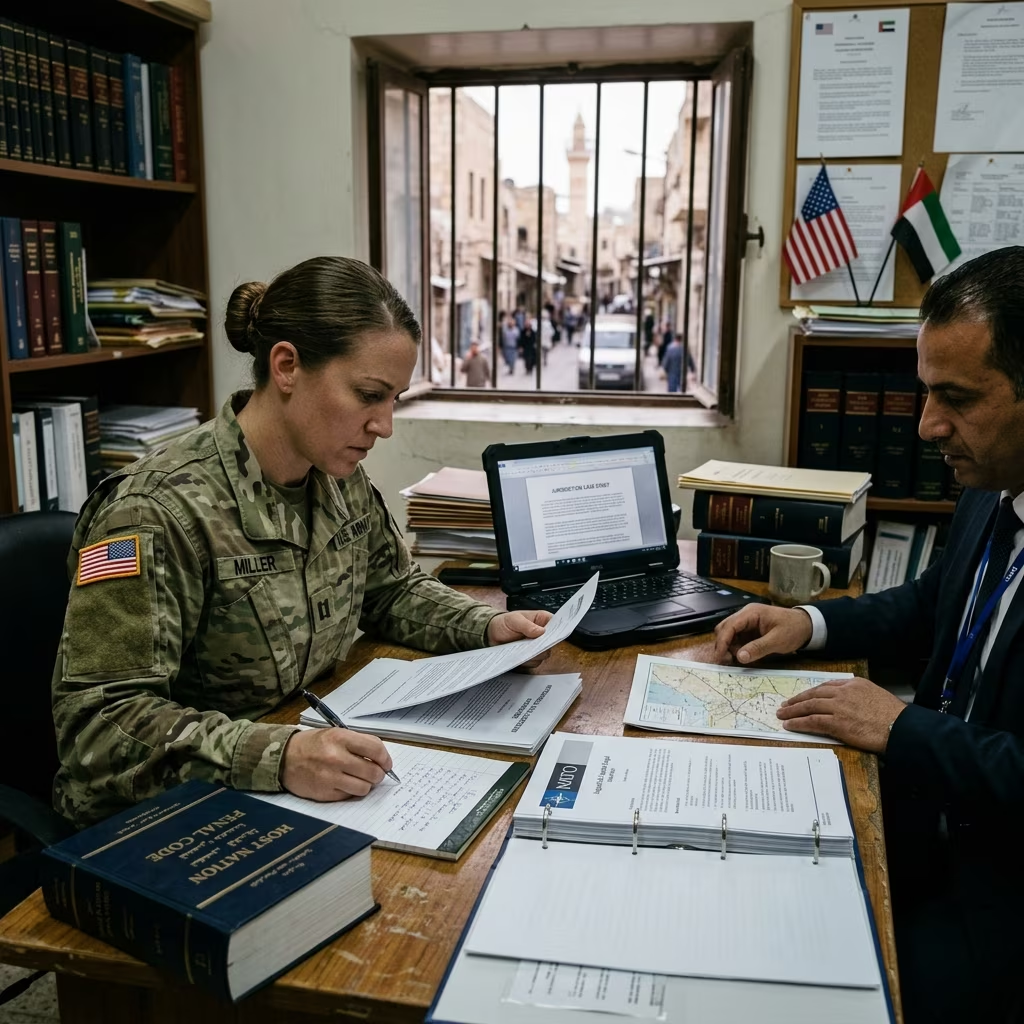
Thousands of military personnel live, work, and travel outside their home country every year. While they may wear the uniform and remain subject to their own military justice system, they are also physically present in another sovereign state. That reality raises complex questions: whose criminal laws apply, who can arrest and prosecute, and what rights and protections do service members have when accused of a crime overseas?
This guide explains how foreign criminal laws interact with military justice when troops are stationed abroad, focusing on the concept of concurrent jurisdiction, the role of Status of Forces Agreements (SOFAs), and practical considerations for service members and families living in host nations.
Core Principle: Host-Nation Sovereignty and Local Criminal Law
International law starts from a straightforward premise: a country has the inherent right to enforce its criminal laws within its own territory. When foreign military forces are present with the host nation’s consent, the host nation does not automatically lose that authority.
In broad terms:
- Members of a visiting armed force are presumed subject to local criminal law when they are in the host nation’s territory.
- Local authorities generally have the power to investigate, arrest, and prosecute for offenses that violate host-nation law, especially for off-base and off-duty conduct.
- Any limitations on that power typically arise from treaties or status of forces arrangements negotiated between the sending and host states.
Without a specific agreement, the default under customary international law tends to favor local jurisdiction, particularly for crimes that affect host-nation residents or property.
Concurrent Jurisdiction: When Two Legal Systems Overlap
In practice, criminal jurisdiction over military personnel abroad is often concurrent. Both the host nation and the sending nation may have lawful authority to prosecute the same conduct. This overlap is usually managed by formal agreements and practical arrangements.
Key points about concurrent jurisdiction:
- Sending state jurisdiction comes from national law and military codes (such as a uniform code of military justice) that apply to service members worldwide.
- Host-nation jurisdiction arises from territorial sovereignty and local penal codes.
- SOFAs typically specify which state has the primary right to exercise jurisdiction in particular categories of cases.
Rather than a simple rule, jurisdiction is structured so that some offenses are primarily handled by the military authorities of the sending state, while others fall primarily to host-nation courts.
Illustrative Jurisdiction Allocation
| Type of Offense | Typical Primary Jurisdiction | Rationale |
|---|---|---|
| Offense against sending state security or purely military interests | Sending state | Protects national security and internal discipline; often not criminalized the same way in host law. |
| Crimes against host-nation citizens or property off duty | Host nation | Direct impact on local community; territorial sovereignty is prioritized. |
| Offenses between members of the same visiting force | Sending state | Primarily an internal disciplinary matter within the foreign force. |
| Mixed cases affecting both local residents and military interests | Depends on SOFA terms | Often resolved through consultation and diplomatic negotiation. |
The Role of Status of Forces Agreements (SOFAs)
Status of Forces Agreements are international agreements defining the legal status of armed forces when they operate in another state’s territory. They are central to determining who prosecutes alleged crimes involving military personnel abroad.
Typical SOFA features include:
- Rules on criminal jurisdiction and how to allocate primary responsibility between host and sending states.
- Procedures for arrest, detention, and transfer of custody between military and local authorities.
- Guarantees regarding minimum standards of criminal procedure for service members tried in host-nation courts, such as fair treatment, access to counsel, and timely trial.
- Provisions addressing official duty activities and whether they receive some form of immunity or special handling.
SOFAs vary significantly by country and context. A long-term base in a stable allied country may have detailed and balanced jurisdiction rules, while arrangements in conflict zones or ad hoc deployments can be narrower or more flexible.
Official Duty vs. Off-Duty Conduct
One of the most important distinctions in foreign criminal jurisdiction is whether the alleged offense occurred in the course of official duty or during off-duty personal activity.
Official-Duty Conduct
Many agreements give the sending state priority for acts or omissions carried out while performing official duties, recognizing that such conduct often implicates operational decisions and chain-of-command responsibility.
In these cases:
- The sending state’s military authorities usually take the lead on any criminal or disciplinary proceedings.
- Local authorities may be limited or may choose to defer, particularly if the conduct is not clearly criminal under host-nation law.
- Internal mechanisms, such as court-martial or administrative sanctions, are commonly used to address wrongdoing.
Off-Duty Conduct
When a service member is off duty and engaged in personal activities—such as driving, socializing, or shopping—the presumption shifts toward host-nation jurisdiction.
For off-duty conduct:
- Local criminal laws generally apply, and local law enforcement may investigate and arrest.
- Common offenses include traffic violations, assaults, property damage, and other non-military crimes.
- The sending state retains the ability to pursue military charges based on the same conduct when it violates military law or regulations, but the timing and coordination depend on the applicable SOFA.
Rights and Protections in Host-Nation Criminal Proceedings
When service members face criminal charges in foreign courts, their rights are primarily determined by the host nation’s legal system. However, SOFAs and diplomatic practice often seek to ensure minimum protective standards consistent with international human rights norms.
Common safeguards include:
- Grounds for arrest: There must be some lawful basis under host-nation law for arrest, and arbitrary detention should be prohibited.
- Timely information on charges: Accused personnel are informed reasonably promptly of the specific accusations against them.
- Access to legal counsel: SOFAs frequently provide that service members can consult lawyers, including defense counsel provided or arranged by the sending state.
- Opportunity to communicate: The accused may contact military authorities, consular officers, or designated representatives after arrest.
- Fair treatment and humane conditions: Agreements and human rights obligations aim to protect against abuse or degrading treatment while in custody.
These safeguards do not replace host-nation law, but they help align local procedures with expectations of due process and fairness for foreign service members.
Military Dependents and Civilian Personnel Overseas
The legal position of civilians accompanying the armed forces—such as dependents, contractors, and civilian employees—can differ significantly from that of uniformed personnel.
According to official oversight reports, the United States has limited criminal jurisdiction over many civilian personnel and dependents abroad, leaving them primarily under foreign criminal law. While some may be covered by special statutes or agreements, many rely entirely on host-nation courts for criminal matters.
Key considerations:
- Civilians usually do not fall under military justice codes in the same comprehensive way active-duty members do.
- Host nations may exercise jurisdiction over civilians for local offenses, regardless of any connection to the visiting force.
- Support from the sending state—such as legal assistance or consular services—can be more limited and depends on national policy.
Practical Implications for Service Members Stationed Abroad
For those living and serving overseas, understanding how foreign criminal laws apply is an important part of personal and professional risk management. Some practical implications include:
- Local law awareness: Service members are expected to learn and respect host-nation criminal laws, including traffic rules, alcohol regulations, and public order offenses.
- Conduct off base: Actions off base are usually subject to host-nation law, even if the individual remains under military discipline.
- Command guidance: Commands often issue local policy guidance, briefings, and training on legal risks and SOFA provisions.
- Double exposure: Serious misconduct may lead to both local criminal prosecution and military disciplinary action, particularly when the behavior violates both systems.
- Legal support: Military legal offices and defense counsel can advise on foreign criminal exposure and coordinate with local counsel when necessary.
Working With Legal Counsel
Anyone facing potential criminal investigation or charges abroad should seek qualified legal assistance. For service members, this often involves a combination of military defense counsel and, where needed, local attorneys licensed in the host nation.
Reasons to consult counsel early include:
- Understanding which jurisdiction is likely to take the case under the applicable SOFA.
- Assessing possible penalties under both host-nation law and military codes.
- Protecting procedural rights, including the right to remain silent where applicable and the right to counsel.
- Coordinating with command and diplomatic channels to ensure all available protections under international agreements are invoked.
Frequently Asked Questions
Do foreign criminal laws apply to me when I leave the base?
Yes. When you are off base and within the host nation’s territory, you are generally subject to that country’s criminal laws, just like any other person there. SOFAs may adjust who prosecutes certain offenses, but they rarely exempt personnel from obeying local law.
Can I be prosecuted by both the host nation and my own military?
It is possible. Many situations involve concurrent jurisdiction, and the same conduct can violate both host-nation law and military codes. SOFAs typically identify which state has the primary right to proceed, but subsequent military disciplinary action may still occur.
What happens if I commit an offense while performing official duties?
When conduct arises from official duties, the sending state’s military authorities often have primary jurisdiction under many status of forces arrangements. However, specific outcomes depend on the applicable SOFA and whether host-nation law also treats the conduct as a crime.
Are my dependents covered by the same legal protections?
Not necessarily. Many dependents and civilian personnel accompanying the armed forces overseas are primarily subject to host-nation criminal jurisdiction, and the sending state may have little or no direct criminal authority over them. They may still receive consular or other support, but the legal framework is different.
How can I find out what the SOFA says for my host country?
SOFA terms are usually available through official government or military channels. Installation legal offices, staff judge advocates, and official publications can explain how the agreement allocates criminal jurisdiction and what rights and obligations apply to personnel in a particular country.
References
- Jurisdiction of Foreign Courts Over Crimes Committed Abroad by American Servicemen — South Carolina Law Review. 1960-01-01. https://scholarcommons.sc.edu/cgi/viewcontent.cgi?article=1554&context=sclr
- Some Criminal Offenses Committed Overseas by DOD Civilians Are Not Being Prosecuted — U.S. Government Accountability Office. 1979-05-31. https://www.gao.gov/products/fpcd-79-45
- International Law and Criminal Jurisdiction Over Visiting Armed Forces — California Western International Law Journal. 1986-01-01. https://scholarlycommons.law.cwsl.edu/cgi/viewcontent.cgi?article=1668&context=cwilj
- The International Law of the Armed Forces Abroad — U.S. Naval War College International Law Studies. 1992-01-01. https://digital-commons.usnwc.edu/cgi/viewcontent.cgi?article=1815&context=ils
- Status of Forces: Criminal Jurisdiction over Military Personnel Abroad — T.M.C. Asser Press / Springer. 2015-01-01. https://link.springer.com/book/10.1007/978-94-6265-057-2
- The Status of Armed Forces in Public International Law — Edward Elgar Publishing. 2024-01-01. https://www.elgaronline.com/edcollchap/book/9781035331086/chapter11.xml
- Criminal Jurisdiction over American Armed Forces Abroad — American Journal of International Law (JSTOR). 1956-01-01. https://www.jstor.org/stable/1337512