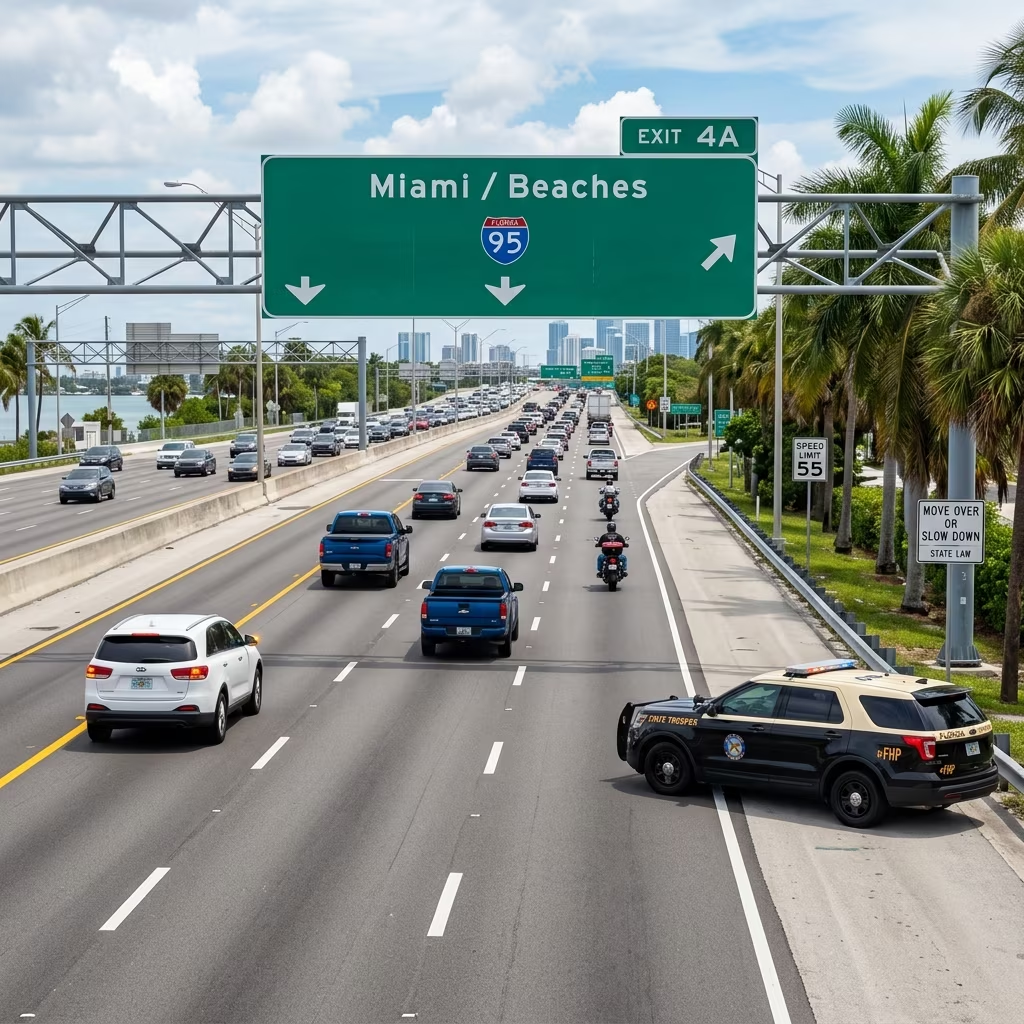
Florida traffic law combines statewide rules, local enforcement practices, and safety requirements that every driver should understand. The state’s traffic code is designed to create consistent rules on public roads, but the details matter: a minor mistake can lead to a citation, points on a license, higher insurance costs, or even a suspension. For drivers, the best protection is knowing what the law expects before a warning turns into a penalty.
How Florida organizes its traffic rules
Florida law is built around a uniform set of traffic rules intended to apply throughout the state. That matters because drivers move between counties, cities, and highways that may look different but are governed by the same basic legal framework. In practice, this means the same core duties apply whether you are commuting in a city, driving through a school zone, or traveling on an interstate.
State law also gives agencies and officers authority to enforce traffic safety on public roadways, including roads used by cars, motorcycles, bicycles, and other vehicles. The result is a legal system that focuses not only on moving traffic efficiently, but also on preventing crashes and protecting vulnerable road users.
The rules that shape everyday driving
Most traffic cases begin with ordinary driving behavior. Florida drivers are expected to obey posted signs, follow lane markings, yield when required, and operate at speeds that are safe for the conditions. Some violations are straightforward, such as running a red light or speeding. Others involve judgment, such as driving too fast for rain, congestion, or poor visibility.
Common duties on Florida roads include:
- Obeying posted speed limits and adjusting speed for conditions.
- Stopping completely at required signals and stop signs.
- Using turn signals when changing lanes or turning.
- Keeping to the correct lane and passing safely.
- Yielding to emergency vehicles and pedestrians when the law requires it.
These rules may sound basic, but they are the foundation for most enforcement actions. Many traffic citations are issued not because a driver intended to break the law, but because they failed to notice a sign, misjudged distance, or made a decision that created a safety risk.
Speed limits and when they change
Florida’s speed laws are not limited to a single statewide number. Speed limits depend on the type of road, the surrounding area, and the signs posted at the location. Typical default limits are commonly understood to be lower in neighborhoods and school zones and higher on rural interstates and limited-access highways when conditions allow. Posted signs always control when they differ from the default.
Speeding is especially important because it is one of the fastest ways to trigger a citation and create a license-point problem. A driver who moves from a mild speeding ticket to repeated violations can accumulate enough points to face suspension. Florida’s point system can lead to suspension after 12 points within 12 months, with longer suspension consequences for 18 points in 18 months or 24 points in 36 months.
In recent years, Florida has also treated extreme speeding more seriously. Under a 2025 law, some high-speed conduct can be charged as a criminal offense rather than a routine traffic citation when the driving is especially dangerous. That means aggressive speeding is no longer only a matter of paying a fine; it can also lead to mandatory court involvement, possible jail time, and lasting consequences for a driver’s record.
| Driving behavior | Typical consequence | Why it matters |
|---|---|---|
| Minor speeding | Citation and points | Can raise insurance rates and move a driver toward suspension |
| Repeated violations | Higher point totals, possible suspension | Shows a pattern of unsafe driving |
| Extreme speeding | Potential criminal charge | May carry jail, fines, and court requirements |
Point penalties and license suspension
Florida uses a point system to track traffic violations. Each eligible offense adds a set number of points to a driver’s record. The more serious the violation, the higher the point value. Once a driver crosses the state’s suspension threshold, the Department of Highway Safety and Motor Vehicles may suspend the license even if the underlying tickets were handled individually.
The key lesson is that traffic penalties can accumulate quickly. A driver may treat one ticket as a temporary inconvenience, but multiple citations within a short period can produce a much larger legal problem. That is one reason many drivers pay close attention to whether a citation includes points, whether traffic school is available, and whether a lawyer could help reduce the impact.
Florida’s suspension structure also means timing matters. Two tickets issued months apart may create a different outcome than the same violations spread over a longer period. Drivers who already have points on their record should be especially careful about new violations because an additional citation may push them over a threshold.
Alcohol, drugs, and serious traffic offenses
Not all traffic cases are treated alike. Some conduct is so dangerous that it creates immediate and severe consequences. DUI is one of the clearest examples. A drunk-driving offense can trigger an automatic license suspension for six months or longer, depending on the facts and the driver’s history. Unlike many routine citations, DUI allegations can involve administrative penalties, criminal charges, and court proceedings.
Other serious offenses can also lead to suspension, revocation, or criminal exposure. Florida law makes a clear distinction between ordinary moving violations and conduct that threatens public safety. That distinction is important because the legal response becomes much more severe when an offense suggests impaired judgment, reckless behavior, or deliberate disregard for others on the road.
Right-of-way, signals, and intersection behavior
Many crashes happen at intersections, driveways, and merging points where several drivers must make decisions at the same time. Florida drivers are expected to understand who should go first, when to yield, and how to handle traffic lights and stop signs. A right-of-way rule is not a suggestion; it is a legal duty tied directly to crash prevention.
Drivers turning right on red may be allowed to proceed after a complete stop if there is no sign prohibiting the turn, but the driver must still yield to pedestrians and cross traffic. At four-way stops, the order of arrival and the position of vehicles often determine who moves first. In ambiguous situations, the safest choice is to wait until the intersection is clearly clear.
Other intersection rules also matter. Drivers must not block intersections, and they should avoid entering an area unless there is room to fully clear it. Hesitation is usually safer than forcing a move that may leave a vehicle stranded in traffic.
Lanes, passing, and sharing the road
On multi-lane roads, lane discipline is part of lawful driving. Florida law expects drivers to stay in the proper lane and pass safely rather than weaving through traffic. On roads with multiple lanes, drivers generally travel in the right lane and pass on the left. This helps traffic flow predictably and lowers the risk of side-swipe collisions.
The duty to share the road also applies to bicycles. Florida treats a bicycle as a vehicle for legal purposes, and the person operating the bicycle is treated as a driver. That means bicyclists have road rights, but they also have traffic obligations. Motorists should avoid crowding cyclists or assuming they can ignore bicycle traffic just because it moves differently from cars.
Safe passing requires enough space, awareness of blind spots, and patience. A rushed lane change can create dangerous contact, especially on busy roads, in rain, or near exits. Drivers should use mirrors, signals, and direct observation before moving laterally.
Seat belts, child restraints, and occupant safety
Traffic law is not only about where and how fast you drive. It also governs how people inside the vehicle are protected. Seat belt use is a standard requirement for drivers and passengers, and child-restraint rules are even stricter. Florida’s visitor guidance also notes that young children must be restrained in an appropriate child car seat.
These rules matter for two reasons. First, they reduce injury risk in a crash. Second, failure to use safety restraints can become an enforcement issue and may affect liability questions later if a collision occurs. Even when no citation is issued, improper restraint use can make an accident much more dangerous than it needed to be.
What drivers should do when emergency vehicles approach
When a siren or flashing emergency lights appear behind you, Florida law expects an immediate and careful response. Drivers should yield, move out of the way when possible, and stop until the emergency vehicle has passed. On many roads, that means pulling toward the curb or edge of the roadway and leaving the lane clear.
This rule protects police officers, firefighters, ambulance crews, and the people they are trying to reach. Failing to yield to an emergency vehicle can cause delays and create a serious hazard. The safest response is to check mirrors early, signal intentions, and make a predictable move without sudden braking or swerving.
Traffic stops and practical conduct
A traffic stop is not the same as a courtroom, but it can affect what happens later. Drivers should remain calm, keep hands visible, and follow lawful instructions from the officer. If asked, the driver should be ready to provide a license, registration, and proof of insurance. Arguments at the roadside rarely help and can make the situation worse.
If a driver believes a citation was issued unfairly, the better place to challenge it is in court or through the proper administrative process. The stop itself is usually the worst time to debate legal details, because the immediate goal is safety and compliance.
How Florida traffic law connects to insurance and civil claims
Traffic laws also matter after a crash. A citation can influence insurance decisions and may become evidence in a civil claim. Florida uses a modified comparative negligence approach in many injury disputes, which means fault can reduce recovery if a person shares blame for the accident. In practical terms, a driver’s traffic conduct may affect more than a fine or point total; it can also affect the value of a claim and the outcome of a lawsuit.
That is why documentation matters. Police reports, photos, witness statements, and medical records can all become important after a crash. Even a seemingly routine traffic violation can have long-term consequences when property damage or bodily injury is involved.
Frequently asked questions
How many points can cause a suspension in Florida?
Florida can suspend a license after 12 points within 12 months, with additional penalties for 18 points in 18 months or 24 points in 36 months.
Can speeding become a criminal offense in Florida?
Yes. Florida’s newer law on dangerous excessive speeding can turn some extreme speeding behavior into a criminal charge rather than a simple citation.
Do bicyclists have to follow traffic laws?
Yes. Florida recognizes a bicycle as a vehicle, and the rider is treated as a driver for traffic-law purposes.
What should I do if an emergency vehicle is approaching?
Yield right-of-way, move safely toward the curb or edge of the road if possible, and remain stopped until the vehicle has passed.
Why do traffic tickets matter if I just pay the fine?
Because some tickets add points to your record, and those points can lead to license suspension, higher insurance costs, and more serious consequences if you keep receiving violations.
References
- Florida Traffic Laws — FindLaw. 2026-07-09. https://www.findlaw.com/state/florida-law/florida-traffic-laws.html
- Florida Statutes, Chapter 316: State Uniform Traffic Control — The Florida Senate / Online Sunshine. 2026-07-09. https://www.leg.state.fl.us/statutes/index.cfm?App_mode=Display_Statute&URL=0300-0399/0316/0316.html
- Florida Driving Laws: A Comprehensive Guide (2026 Update) — Porcaro Law. 2026-07-09. https://porcarolaw.com/florida-driving-laws-a-comprehensive-guide/
- Driving Safety — Florida Highway Safety and Motor Vehicles. 2026-07-09. https://www.flhsmv.gov/safety-center/driving-safety/
- Tips for Visitors on Driving in Florida — VISIT FLORIDA. 2026-07-09. https://www.visitflorida.com/travel-ideas/articles/visitor-services-driving-in-florida-tips-for-visitors-and-vacationers/
- Florida Drivers Handbook Online — State of Florida. 2026-07-09. https://www.stateofflorida.com/drivers-handbook/