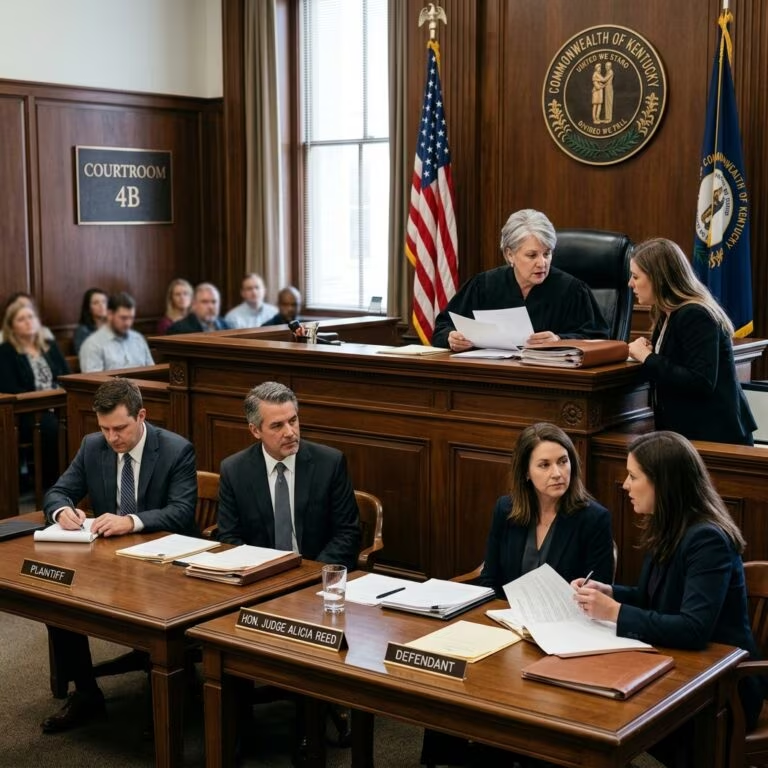
Changing your name legally in Florida involves specific court procedures designed to ensure the request is legitimate and serves the public interest. This comprehensive guide outlines eligibility criteria, step-by-step processes for adults and minors, special considerations during divorce, required documentation, potential costs, and essential updates after approval. Florida courts handle name changes under strict statutes to prevent fraud while accommodating valid personal reasons.
Understanding Legal Eligibility for Name Changes
To qualify for a name change in Florida, petitioners must meet foundational requirements that verify residency, intent, and legal standing. Courts exercise discretion, approving requests only when they align with state law and do not harm others.
- Residency Mandate: You must be a bona fide resident domiciled in the county where you file the petition.
- Age Requirement: Adults must be 18 years or older; minors require parental or guardian involvement.
- Civil Rights Status: No suspended civil rights, or they must be fully restored.
- Prohibited Purposes: Requests cannot aim to defraud, evade debts, infringe trademarks, use offensive language, or create confusion (e.g., names with numbers or excessive punctuation).
Courts also assess if the change benefits the public interest. For instance, incarcerated individuals or those with pending criminal cases typically face denials.
Step-by-Step Process for Adult Name Changes
Adults seeking a new name file a standalone petition unless restoring a prior name, which simplifies the process by waiving fingerprints.
- Prepare the Petition: Complete Form 12.982(a) or equivalent, detailing current name, proposed name, birth details, residences since birth, and reasons for change. Verify the document under oath.
- Gather Fingerprints: Submit fingerprints for state and federal criminal history checks via an approved vendor, unless restoring a former name.
- File in Circuit Court: Submit to the Circuit Court in your county of residence. Expect a filing fee around $400, varying by location.
- Publish Notice: Advertise intent in a local newspaper for four weeks, unless waived (e.g., for safety reasons).
- Attend Hearing: Appear before a judge who reviews compliance, background, and merits. Hearings occur soon after filing if uncontested.
- Receive Judgment: If approved, obtain the certified Final Judgment of Name Change.
The entire adult process often spans 6-12 weeks, depending on court backlog and publication timing.
Name Changes for Minors: Parental Roles and Protections
Altering a minor’s name (under 18) prioritizes the child’s best interests, requiring involvement from all legal custodians.
- Filing Party: A parent, guardian, or court-appointed guardian ad litem files Form 12.982(c).
- Consent Requirement: All parents with rights must consent via Form 12.982(d). Without consent, serve notice; non-residents may get publication notice.
- Court Scrutiny: Judges evaluate if the change serves the minor’s welfare, considering stability and family dynamics.
- Family-Wide Petitions: Use Form 12.982(f) for multiple minors under one household.
Fingerprinting applies to adults involved, excluding restorations. Non-consenting parents can object at the hearing, potentially complicating approval.
Incorporating Name Changes in Divorce Proceedings
Florida divorces offer a streamlined path for restoring former names, avoiding separate petitions.
| Aspect | Divorce Restoration | Standalone Petition |
|---|---|---|
| Purpose | Restore prior legal name (maiden, previous marriage) | Any new name |
| Statute | F.S. 61.052 | F.S. 68.07 |
| Requirements | Request in petition; no fingerprints/publication | Fingerprints, publication, hearing |
| Spouse Consent | Not needed | N/A |
| Timeline/Cost | Included in divorce; minimal extra | 6-12 weeks; ~$400+ |
Include the restoration request in your divorce petition or motion. Courts liberally approve former name returns without spouse objection rights. For entirely new names post-divorce, pursue F.S. 68.07 separately.
Costs and Fees Breakdown
Budget for these typical expenses:
- Filing Fee: $395-$425 in Circuit Court.
- Fingerprinting/Background Check: $50-$80.
- Publication: $100-$300, based on newspaper and name length.
- Copies/Certifications: $10-$20 per document.
- Attorney (Optional): $500-$2,000 for assistance.
Total for adults: $600-$1,000; minors/divorce restorations cost less without publication.
Post-Approval: Updating Official Records
With your certified judgment, promptly notify key agencies to avoid discrepancies.
- Social Security Administration (SSA): Apply for a corrected card (free, Form SS-5; mail or in-person).
- Driver’s License/ID: Visit DMV within 30 days with judgment, birth certificate, proof of address ($25-$30 fee).
- Passport: Submit Form DS-5504 or DS-82 with court order.
- Bank/Financial Accounts: Provide certified copy for updates.
- Professional Licenses: Contact issuing boards (e.g., nursing, law).
- Voter Registration: Update via county supervisor or FLVS.gov.
Prioritize SSA and DMV first, as many entities require these updated IDs. Delays can impact employment, travel, and benefits.
Frequently Asked Questions
Can I change my name for free in Florida?
No, court filing fees apply (~$400), plus fingerprints and publication. Divorce restorations incur no extra court costs.
How long does a Florida name change take?
Adults: 6-12 weeks; minors longer if contested; divorce: same as dissolution timeline.
Do I need a lawyer for a name change?
Not required for uncontested cases, but recommended for complexities like non-consent or unique names.
Can felons change their names?
Yes, if civil rights restored; fingerprints reveal history for judicial review.
What names are not allowed?
Offensive, fraudulent, confusing, or rights-infringing names (e.g., celebrities, slurs).
Potential Challenges and Tips for Success
Common hurdles include incomplete petitions, background issues, or publication errors. Tips: Double-check forms, use court self-help centers, track deadlines, and consult Florida Courts’ website for county-specific rules. For safety concerns (e.g., domestic violence), request publication waivers.
Staying informed on 2026 updates ensures compliance, as statutes evolve.
References
- Florida Name Change Requirements — Florida Name Change Law. Accessed 2026. https://www.floridanamechangelaw.com/requirements
- Name Change Divorce Florida: Complete 2026 Guide — Florida Divorce Law. 2026-01-01. https://www.floridadivorce.law/blog/florida-divorce-name-change-process
- Florida Statutes Section 68.07 — Florida Legislature. 2026. https://www.leg.state.fl.us/statutes/index.cfm?App_mode=Display_Statute&URL=0000-0099/0068/Sections/0068.07.html
- Navigating the Name Changing Process in Florida — T. Bogle Law. 2025-06-01. https://www.tboglelaw.com/blog/2025/june/navigating-the-name-changing-process-in-florida/
- Name Change — Florida Law Help. Accessed 2026. https://www.floridalawhelp.org/families-children/name-change