
Florida Guardianship Procedures Explained
A clear overview of how Florida guardianship cases begin, move through court, and change over time.
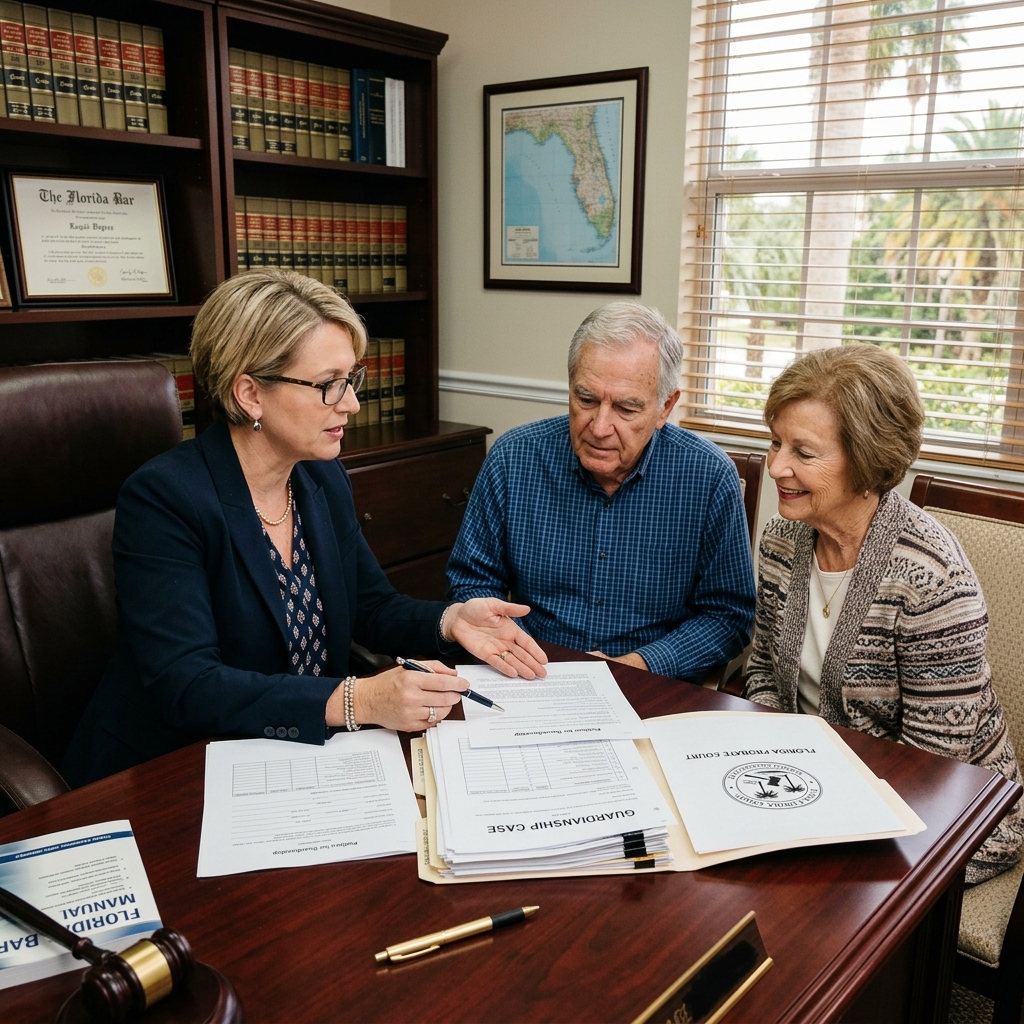
Understanding Florida Guardianship
Florida guardianship is a court process used when a person cannot manage some or all of their personal, medical, or financial affairs. In that situation, the court may appoint a guardian to act for the person and protect their interests. Guardianship is not automatic; it is a formal legal proceeding with required notices, filings, evaluations, and hearings. Under Florida practice, the process is shaped by state statutes, probate rules, local court procedures, and judicial decisions.
The system is designed to balance protection with personal rights. Before a court takes away decision-making authority, it must determine whether the person truly lacks capacity and whether a less restrictive option would work. That focus on preservation of rights is one of the central features of Florida guardianship law.
When a Guardianship Case May Be Needed
A guardianship case can arise in several settings. For adults, the issue often begins when illness, injury, disability, or advanced age leaves someone unable to handle day-to-day decisions. For minors, a guardianship may be needed when a child receives property, money, or a settlement that must be managed by an adult.
- An adult may need protection if there is evidence of impaired decision-making and no other arrangement is adequate.
- A minor may need a guardian of property when funds or assets exceed the amount the court allows to be managed informally.
- A guardianship may also be considered when parents are unavailable, deceased, or unable to care for a child’s needs.
Florida law also recognizes that some people voluntarily seek guardianship over their own property even though they remain mentally competent, usually because age or physical infirmity prevents them from handling assets effectively.
The Main Legal Path in an Adult Guardianship
For an adult guardianship, the court typically starts with a petition to determine incapacity. That filing asks the court to decide whether the alleged incapacitated person can manage the relevant aspects of life independently. Once the petition is filed, the court appoints an attorney to represent the person whose capacity is being questioned, and an examining committee is usually assigned to evaluate the person and report to the court.
After the evaluations are completed, the court schedules a hearing. The judge reviews the medical or professional reports, hears arguments, and decides whether incapacity has been proven. If the court finds that the person lacks capacity, it then considers the narrowest guardianship arrangement that will meet the person’s needs.
This sequence matters because Florida does not treat guardianship as a routine administrative filing. It is a rights-based judicial process, and the court must make findings before anyone can be stripped of authority to decide important personal or financial matters.
How the Court Decides What Type of Guardianship Is Appropriate
Not every guardianship is the same. Florida courts may tailor the order to the person’s actual limitations. In some cases, the guardian handles only property. In others, the guardian handles only personal decisions. In more serious situations, the court may grant broader authority. The goal is to use the least restrictive arrangement that still protects the individual.
| Type of arrangement | Typical purpose |
|---|---|
| Guardianship of the person | Addresses living arrangements, medical care, and personal welfare decisions. |
| Guardianship of the property | Manages income, assets, expenses, and financial transactions. |
| Limited guardianship | Gives the guardian authority only over specific rights the court removes. |
| Plenary guardianship | Transfers broad decision-making authority when the person cannot manage most needs independently. |
The court’s role is not simply to appoint someone and end the matter. It must identify which rights should remain with the person and which should be transferred to the guardian.
Guardian Advocate and Other Protective Options
Florida also uses related legal tools that may avoid a full incapacity proceeding. One important example is guardian advocacy, a process often used for individuals with developmental disabilities. In that setting, the court appoints a guardian without the same incapacity finding that is required in a standard adult guardianship proceeding.
Another option is preneed planning. A capable adult may express in writing who should serve as guardian if incapacity is later found, and that declaration must be signed and witnessed according to the statutory requirements. This kind of advance planning can help the court follow the person’s stated preference later, so long as the nominated guardian is qualified.
These alternatives show that Florida law does not rely on one single model. Instead, it provides different pathways for different circumstances, with varying levels of court involvement and personal autonomy.
Who Can Serve as a Guardian
Florida law allows qualified adults to serve as guardians, and family members are often considered first in practice. A guardian may also be a professional or an institution if the court finds that person or entity suitable. The essential point is that the proposed guardian must be legally qualified and able to act in the ward’s best interests.
Professional guardians in Florida must satisfy registration requirements, including training, testing, background screening, a bond, and formal registration with the state office that oversees public and professional guardians. Those requirements exist to improve accountability and reduce the risk of abuse or mismanagement.
- Professional guardians must complete the required course.
- They must pass the competency examination.
- They must undergo fingerprinting and background screening.
- They must obtain the required bond and register with the state office.
What Happens After Appointment
Once appointed, the guardian does not act informally or on instinct alone. Before exercising authority, the guardian must take an oath to faithfully perform the duties of the office. In many cases, the guardian must also post a bond, which helps protect the ward’s property from losses caused by mismanagement.
The guardian then begins carrying out court-approved responsibilities. Depending on the scope of the order, those duties may include managing bills, applying for benefits, arranging care, making medical decisions, securing housing, or supervising assets. In property cases, recordkeeping is especially important because the court expects financial transparency.
Guardians act under continuing court supervision. They are not free to ignore reporting duties or spend funds however they wish. The court may require periodic reports, accountings, and other updates to ensure that the guardianship continues to serve its intended protective function.
Rights That May Remain with the Ward
Even when a guardian is appointed, the ward may retain some rights if the court does not remove them. Florida guardianship is not always an all-or-nothing transfer of authority. The exact rights retained depend on the court order and the findings made in the case.
In practice, a guardianship order may leave a person with the ability to participate in some choices while shifting only certain responsibilities to the guardian. This approach is meant to respect the person’s autonomy to the extent possible while still addressing real vulnerability.
Limits on What a Guardian Can Do
A guardian’s authority is broad only to the extent the court permits it. Some decisions require special legal authorization, and others may not be made unless the law expressly allows them. Florida law places boundaries on decisions involving confinement, experimental procedures, marriage-related actions, sterilization, abortion, and other highly personal matters.
Those limits reflect a core idea: guardianship should protect, not erase, individual dignity. The court may give a guardian authority to handle necessary matters, but it remains cautious about decisions that involve deep bodily, family, or liberty interests.
How Guardianship Can End or Change
Guardianship is not always permanent. If the person’s condition improves, if a less restrictive solution becomes available, or if the guardian is no longer appropriate, the court can revisit the arrangement. In some cases, the ward or another interested person may ask the court to modify or terminate the guardianship.
This flexibility is important because capacity can change over time. Recovery from illness, improved support systems, or newly available planning tools may reduce the need for ongoing judicial control. Florida’s structure allows the court to respond to those changes rather than locking a person into unnecessary oversight.
Practical Steps Families Often Face
Families considering guardianship often encounter both legal and administrative tasks at once. They may need to gather medical records, identify appropriate petition forms, arrange for examinations, prepare for hearings, and decide whether a family member or professional should serve as guardian. Because the process is highly procedural, mistakes in filing or service can delay the case.
- Confirm whether the issue is adult incapacity, minor property, or another kind of protective proceeding.
- Collect documents showing why court intervention may be needed.
- File the appropriate petition with the probate court.
- Cooperate with examination and hearing requirements.
- Prepare for post-appointment duties if a guardian is named.
Local rules matter as well. Florida probate procedures operate alongside statewide statutes, so county practices can affect filing, scheduling, and documentation. That means the exact steps may vary slightly depending on the courthouse handling the case.
Frequently Asked Questions
What is the first step in an adult guardianship case? The process usually begins with a petition to determine incapacity, followed by appointment of counsel and evaluation by an examining committee.
Does a guardian automatically control every part of a person’s life? No. Florida courts may grant only limited authority, and the ward may retain rights that the court does not remove.
Can a minor have a guardian? Yes. A guardianship may be needed when a minor has property, receives a settlement, or lacks a parent who can manage the child’s affairs.
Is a professional guardian different from a family guardian? Yes. Professional guardians must meet state registration and training requirements, while family guardians are usually appointed based on suitability and the needs of the case.
Can guardianship be avoided? Sometimes. Depending on the facts, advance planning, limited orders, or other less restrictive alternatives may reduce or eliminate the need for a full guardianship proceeding.
Why the Procedure Matters
Florida guardianship procedure is detailed because the stakes are high. The court is deciding whether one person will gain legal power over another person’s life, health, or property. That is why the law requires notice, proof, medical or professional evaluation, and judicial oversight.
For families, the process can feel slow, but the structure protects against unnecessary interference and helps ensure that any appointment is truly justified. For the person under review, that structure is a safeguard against losing rights without meaningful proof. For the court, it is the mechanism that turns a difficult family situation into a legally supervised plan.
References
- Florida Guardianship Law and Information — University of Miami, Bioethics Program. 2004. https://bioethics.miami.edu/_assets/pdf/education/guardianship-and-ethics/guardianship-and-elder-law-bibliography/florida-guardianship-law-and-information.pdf
- Types of Guardianship — Disability Rights Florida. n.d. https://disabilityrightsflorida.org/disability-topics/disability_topic_info/types_of_guardianship
- Office of Public & Professional Guardians — Florida Department of Elder Affairs. n.d. https://elderaffairs.org/programs-and-services/office-of-public-professional-guardians-oppg/
- Guardianships — Polk County Clerk, Florida. n.d. https://www.polkclerkfl.gov/170/Guardianships
- How To – Guardianship — YouTube. n.d. https://www.youtube.com/watch?v=iC1GCKZulFM
- Guardianship — Twentieth Judicial Circuit Court of Florida. n.d. https://www.ca.cjis20.org/Programs/Civil-Case-Management/guardianship.aspx
- What Is Guardianship? — Florida State Guardianship Association. n.d. https://www.floridaguardians.com/about-guardianship/what-is-guardianship/
Similar Articles








Read full bio of medha deb


