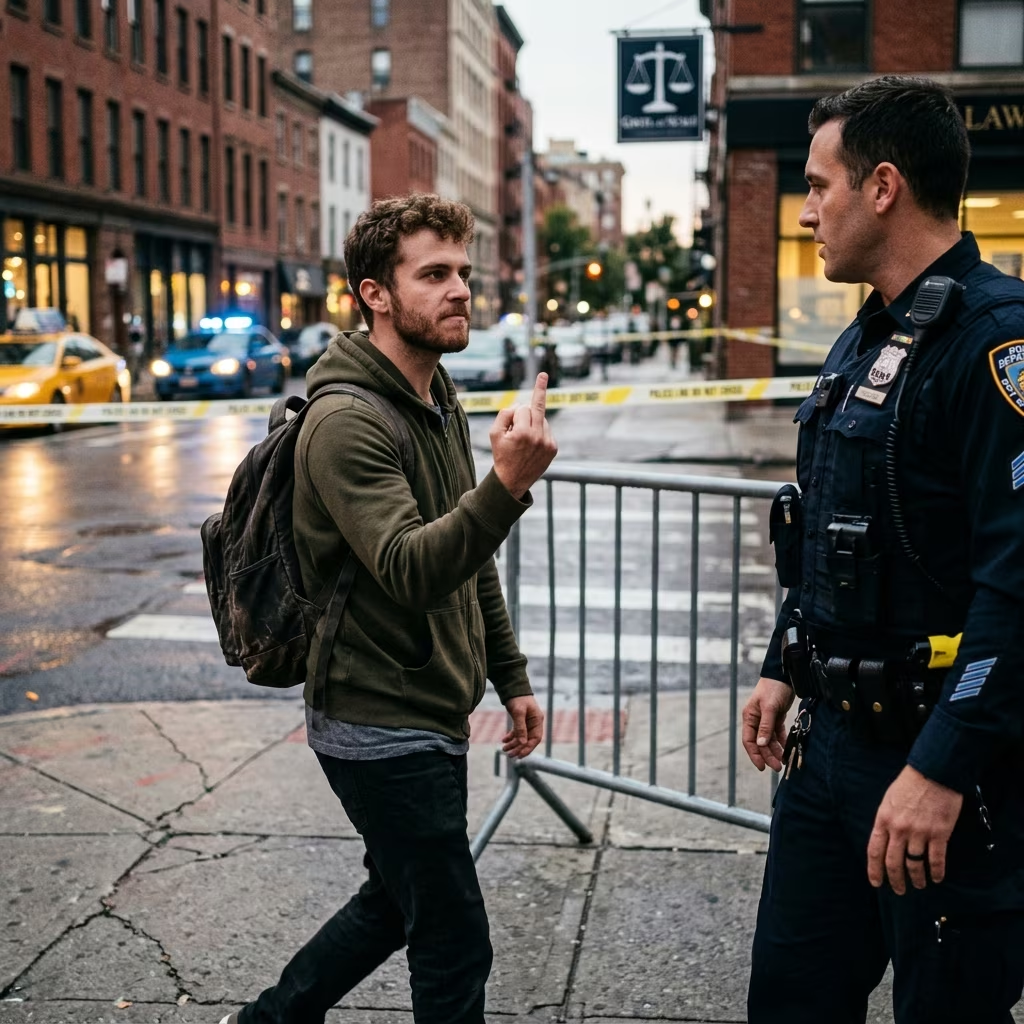
The raised middle finger is one of the most recognizable rude gestures in modern culture. When it is directed at law enforcement, it raises a practical question: can a police officer legally stop, arrest, or punish you simply for flipping them off? In recent years, federal courts have answered that question with increasing clarity, emphasizing that offensive expression aimed at government officials is generally protected by the First Amendment.
This article explains how U.S. courts treat the middle‑finger gesture, why it is usually considered protected speech, and what limits still exist. It focuses on traffic stops and street encounters, drawing from federal appellate decisions and core constitutional principles.
Symbolic Insults as Constitutional Speech
The First Amendment prohibits government from abridging freedom of speech; over time, courts have interpreted “speech” to include not only spoken or written words but also symbolic expression—conduct that is intended to convey a message and is likely to be understood.
Courts have repeatedly held that gestures such as the middle‑finger salute qualify as expressive conduct. The gesture typically communicates anger, contempt, or criticism toward its target, and observers immediately recognize its meaning. Accordingly, when directed at a police officer, it is treated as a form of expression covered by the First Amendment’s protections.
- Protected expression: The gesture communicates a clear message of disapproval or insult.
- Government target: Police are agents of the state, so insulting them is often a form of political or governmental criticism.
- Content neutrality: The government may not punish expression simply because it is offensive or disrespectful.
These principles are central to several appellate rulings that address whether police may stop or sanction individuals solely because of the middle‑finger gesture.
Traffic Stops, Seizures, and Constitutional Limits
Any traffic stop is considered a seizure under the Fourth Amendment, which means it must be justified by at least reasonable suspicion that a law has been violated. Reasonable suspicion requires specific, articulable facts pointing to an infraction or impending criminal activity, not merely a hunch or personal offense.
Federal courts have been clear on a key point: flipping off a police officer, by itself, does not supply reasonable suspicion or probable cause for a traffic stop when no other infraction is present. Judges have described the gesture as crude, rude, and inconsistent with good manners, but nonetheless noncriminal in nature.
If an officer initiates or extends a stop solely because someone raised their middle finger, that stop typically constitutes an unreasonable seizure under the Fourth Amendment and may also infringe the person’s First Amendment rights.
Key elements for a lawful stop
- Observed violation: Speeding, running a light, equipment problems, or other traffic infractions.
- Reasonable suspicion: Specific facts suggesting criminal activity, such as erratic driving that appears impaired.
- Continuity of purpose: The stop must relate to the identified violation, not become a vehicle to punish protected speech.
When a stop is prolonged or repeated purely because of an insulting gesture, courts have found the officer exceeded the lawful scope of their authority and engaged in constitutional retaliation.
Retaliation for Speech: When a Second Stop Crosses the Line
One prominent federal case involved a driver who, after receiving a citation, made the middle‑finger gesture toward the officer as she drove away. The officer responded by pulling her over again, issuing a harsher violation, and effectively punishing her insult.
The U.S. Court of Appeals for the Sixth Circuit held that the driver’s gesture was clearly protected by the First Amendment, and that the second stop constituted an unconstitutional act of retaliation.
| Legal Element | Court’s Reasoning |
|---|---|
| Protected activity | Raising the middle finger was expressive conduct firmly within First Amendment protection. |
| Adverse action | The second, unwarranted stop was a significant government action likely to deter future expression. |
| Causal link | The officer initiated the second stop explicitly because of the insult, not because of a new violation. |
| Lack of legal basis | No new probable cause or reasonable suspicion existed; the driver had committed no additional infraction. |
In the court’s view, any reasonable officer should know that punishing someone with a new seizure solely for a rude gesture violates clearly established constitutional law.
Insults, Disorderly Conduct, and When the Line Is Crossed
Although courts have repeatedly confirmed that a solitary middle‑finger gesture toward police is generally protected, surrounding behavior can transform a simple insult into activity that violates criminal statutes, especially those governing disorderly conduct or obstruction.
Many states define disorderly conduct broadly, covering acts that cause substantial inconvenience, alarm, or risk to the public. Yelling aggressively in a crowded area, refusing lawful instructions in a volatile situation, or inciting others toward violence can fall within these statutes.
Behaviors that may turn a protected gesture into criminal conduct
- Escalating confrontation: Threatening language, physical aggression, or attempts to provoke a brawl alongside the gesture.
- Obstruction of officers: Physically blocking an investigation, interfering with an arrest, or refusing commands that relate to immediate safety.
- Public disturbance: Sustained shouting, disruptive behavior in a crowded space, or actions that create genuine alarm.
In such situations, the gesture itself is usually not what triggers charges. Instead, it is part of a larger pattern of conduct that the law treats as disruptive or dangerous. Courts draw a distinction between offensive expression, which is protected, and conduct that crosses into threats, violence, or obstruction, which is not.
Professional Standards for Police: Expected Tolerance for Criticism
Federal courts have noted that police officers, as trained professionals, are expected to tolerate verbal abuse and offensive gestures without resorting to retaliatory action. Judges have emphasized that officers may personally dislike rude behavior, but that their legal authority does not extend to punishing citizens merely for disrespect.
This expectation is rooted in two ideas:
- Role as public officials: Police represent government power and are frequently the target of criticism, both polite and impolite.
- Risk of abuse: Allowing officers to detain or arrest people for insults would invite arbitrary enforcement and chill legitimate speech.
Accordingly, appellate rulings underscore that “fits of rudeness” may violate social norms but do not, by themselves, furnish legal grounds for a seizure or arrest.
Practical Risks Despite Legal Protection
Even when the law is clear, real‑world encounters can be messy. People who insult police officers may still experience short‑term consequences, such as being detained, questioned, or even arrested under broad statutes, only for charges to later be dropped or dismissed.
From a practical standpoint, individuals should understand the gap that sometimes exists between constitutional doctrine and day‑to‑day policing. While courts eventually vindicate free‑speech rights, that process can be time‑consuming, stressful, and expensive.
Real‑world considerations
- Temporary detention: Officers may, rightly or wrongly, interpret behavior as suspicious, leading to questioning or brief stops.
- Arrest followed by dismissal: Charges based only on protected expression may not survive judicial scrutiny, but the arrest itself can still be disruptive.
- Possible civil litigation: Those who experience retaliatory stops sometimes pursue civil rights lawsuits seeking damages and injunctions.
Understanding both the legal protection and the practical risks helps citizens make informed decisions during tense encounters.
Comparing Different Legal Contexts
Although the principles described above apply broadly, specific outcomes can depend on context, including whether the encounter involves a vehicle, a public event, or an ongoing investigation. The table below outlines how the same gesture may be treated in three common scenarios.
| Scenario | Typical Legal View | Key Risks |
|---|---|---|
| During a routine traffic stop | Protected speech; cannot alone justify a stop or second stop. | Officer may improperly extend the encounter, potentially leading to a rights dispute. |
| On a crowded street during a heated argument | Gesture itself protected, but may be evidence within a disorderly conduct case if broader disturbance exists. | Risk of charges if conduct includes shouting, threats, or interference with police duties. |
| Near an active police investigation | Insult protected, yet obstruction laws apply if the person physically or verbally disrupts the investigation. | Possible obstruction or interference charges if commands are ignored in a safety‑critical situation. |
Guidelines for Citizens: Exercising Rights Wisely
Knowing that the middle‑finger gesture is generally protected does not mean it is always wise to use it. Citizens who want to assert their rights while minimizing risk may consider several practical approaches.
Best practices during encounters with police
- Stay calm and clear: If you disagree with an officer, calmly state that you do not consent to further questioning or searches, rather than escalating the interaction.
- Avoid physical interference: Do not block, touch, or attempt to hinder officers, even while expressing criticism.
- Document when possible: In many jurisdictions, you may lawfully record police in public, which can be more useful than a gesture if rights are violated.
- Seek legal advice after the fact: If you believe a stop or arrest was retaliatory, consult a qualified attorney about potential remedies.
These strategies recognize that citizens have robust speech rights but that the safest way to contest police behavior is often through documentation and legal channels.
Frequently Asked Questions
Is flipping off a police officer always legal?
No. The gesture is generally protected as free speech when it stands alone, but it can be part of a broader incident that includes disorderly conduct, threats, or obstruction. In those cases, the criminal charge typically focuses on the disruptive conduct, not the gesture itself.
Can a police officer pull me over just because I raised my middle finger?
Federal appellate courts have held that a traffic stop based solely on the middle‑finger gesture lacks reasonable suspicion and violates the Fourth Amendment. Officers must identify an actual traffic or criminal violation to justify a stop.
What if the officer adds extra charges after I insult them?
If added charges are not supported by evidence of a real offense and appear to be retaliation for protected speech, they may be vulnerable to challenge in court. In some cases, individuals have successfully sued for violations of their constitutional rights.
Does it matter that the gesture is very offensive?
From a constitutional perspective, it does not. The First Amendment protects a wide range of expression, including speech and gestures that many people find offensive or disrespectful. Courts repeatedly emphasize that the government cannot punish expression just because it violates good manners.
Could I be charged with disorderly conduct for the gesture alone?
Courts are skeptical of using disorderly conduct statutes to criminalize a single gesture. Many decisions note that officers are expected to endure insults without viewing them as a breach of the peace. However, if the gesture occurs alongside disruptive or threatening behavior, disorderly conduct charges may be more likely.
References
- Cruise-Gulyas v. Minard summary — Free Speech Center, Middle Tennessee State University. 2019-03-20. https://firstamendment.mtsu.edu/post/court-rules-first-amendment-protects-motorist-who-gave-the-middle-finger-to-police-officer/
- Flipping Off Cops Is Free Speech, Sixth Circuit Rules — Courthouse News Service. 2019-03-14. https://www.courthousenews.com/flipping-off-cops-is-free-speech-sixth-circuit-rules/
- Flipping the Bird to Cops – Not a Basis for the Cop to Stop You — North Star Criminal Defense. 2019-03-18. https://www.northstarcriminaldefense.com/flipping-the-bird-to-cops-stop/
- Is It Illegal to Flip Off a Cop? — Suhre & Associates, LLC. 2022-09-01. https://www.suhrelaw.com/blog/is-it-illegal-to-flip-off-a-cop/
- Is It Illegal to Flip Off a Police Officer in Illinois? — W. Scott Hanken, Attorney at Law. 2023-05-15. https://www.linkedin.com/posts/wscotthanken_is-it-illegal-to-flip-off-a-police-officer-activity-7352460437688373248