
Flag Burning: Is It Legal In The U.S.? 2 Key Rulings Explained
Understanding when burning the American flag is protected political expression and when it can still lead to criminal liability.
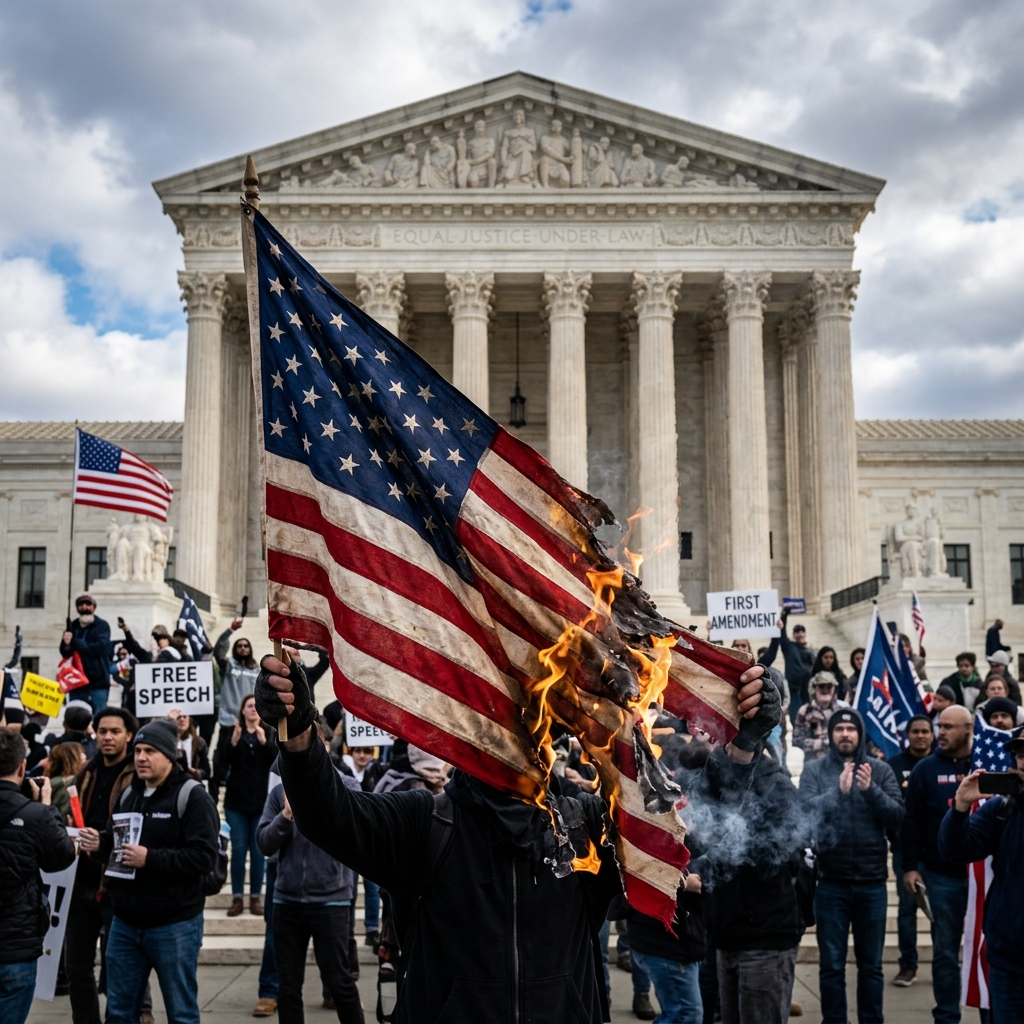
Burning the American flag is one of the most emotionally charged forms of political protest in the United States. At the same time, it is also one of the clearest examples of how the First Amendment protects unpopular and offensive expression. Understanding when flag burning is constitutionally protected and when it can still lead to criminal charges requires looking at both Supreme Court decisions and existing federal and state laws.
Flag Burning in the United States: Is It Legal?
Under current constitutional doctrine, burning a privately owned U.S. flag as political protest is generally lawful because it is considered symbolic speech, a form of expressive conduct protected by the First Amendment. The Supreme Court has twice held that broad, blanket bans on flag desecration—whether federal or state—violate free speech rights.
However, this does not mean that all flag burning is immune from prosecution. Conduct that accompanies or results from flag burning can still violate content-neutral laws, such as:
- Fire safety regulations (for example, rules against open flames in certain areas)
- Destruction of property laws when the flag is not owned by the protester
- Disorderly conduct or riot statutes when the burning is part of violent or threatening behavior
Courts distinguish between punishing the message conveyed by burning the flag (which is unconstitutional) and punishing independent harms like property damage or endangering public safety (which may be constitutional).
How Flag Burning Became Protected Symbolic Speech
The legal status of flag burning changed dramatically in the late twentieth century. Before that, both Congress and many states had criminal statutes punishing flag desecration. The turning point came when protesters challenged these laws on First Amendment grounds.
Texas v. Johnson (1989)
In Texas v. Johnson, the Supreme Court considered the case of Gregory Lee Johnson, who burned an American flag during a political demonstration at the 1984 Republican National Convention in Dallas. He was convicted under a Texas law that prohibited desecrating a “venerated object” if the act was likely to offend others.
The Court reversed his conviction, holding that:
- Flag burning in this context was political expression, meant to convey opposition to government policies.
- The Texas statute punished Johnson because of the content of his message, not merely because he used fire or caused a safety hazard.
- The government “may not prohibit the expression of an idea simply because society finds the idea itself offensive or disagreeable.”
By a 5–4 vote, the Court concluded that flag burning is a form of symbolic speech protected by the First Amendment and that states cannot impose blanket bans on such desecration.
United States v. Eichman (1990)
After Texas v. Johnson, Congress responded by passing the Flag Protection Act of 1989, which made it a federal offense to knowingly mutilate, deface, or burn the U.S. flag. This law attempted to frame the prohibition as “content-neutral” by avoiding references to offense or disrespect, but in practice it still targeted expressive flag burning.
In United States v. Eichman, the Supreme Court invalidated the Flag Protection Act, concluding that the federal statute suffered from the same constitutional defect as the Texas law. The Court emphasized that the government’s interest was tied to preserving the flag’s symbolic value—an inherently viewpoint-related objective.
After Eichman, broad criminal bans on flag desecration at both the federal and state levels became unenforceable because they conflict with the First Amendment.
| Case | Year | Issue | Result |
|---|---|---|---|
| Texas v. Johnson | 1989 | State prosecution for political flag burning | Flag burning is protected symbolic speech; state ban unconstitutional. |
| United States v. Eichman | 1990 | Federal Flag Protection Act | Federal ban on flag desecration violates First Amendment. |
Federal Flag Desecration Statute and Its Limits
Despite these decisions, Congress has not removed the federal flag desecration provision from the U.S. Code. 18 U.S.C. § 700 states that anyone who knowingly defiles, burns, or tramples upon a U.S. flag can be fined or imprisoned for up to one year. The statute also clarifies that properly disposing of a worn or soiled flag—often done by burning it respectfully—is not prohibited.
In practice, however, § 700 is unenforceable when applied to expressive, political flag burning because such enforcement would conflict with Texas v. Johnson and Eichman. Courts must interpret and apply the statute in a way that does not infringe constitutional rights, which effectively prevents prosecutions based solely on the symbolic destruction of a privately owned flag.
That said, federal authorities may still rely on other statutes when flag burning is part of conduct that involves:
- Threats or targeted harassment
- Violent acts or property damage
- Hate crimes or civil rights violations
In those situations, the underlying crimes—not the expressive act of burning the flag itself—form the basis for prosecution.
State and Local Laws: Content-Neutral Restrictions
Many states once had flag desecration laws modeled on earlier federal language. After the Supreme Court decisions, those laws remain on the books in some jurisdictions but are unenforceable to the extent they directly target expressive flag burning.
However, state and local governments can still enforce content-neutral rules that incidentally affect flag burning. Examples include:
- Open burning restrictions and environmental regulations
- Public safety rules governing the use of fire in crowded or sensitive areas
- Neutral regulations on demonstrations, such as permit requirements or time-place-manner limits, applied equally regardless of the protest’s message
If a person burns a flag in violation of such a neutral regulation, authorities may prosecute the underlying offense without focusing on the expressive symbolism. Courts look closely at whether the law is genuinely neutral and whether it leaves open ample alternative channels for expression.
Modern Federal Policy on Prosecuting Flag Burning
Debate over flag burning has periodically resurfaced in federal politics. For example, a 2025 executive order titled “Prosecuting Burning of the American Flag” directed federal officials to prioritize enforcement of existing laws where flag desecration causes harm unrelated to expression, such as violence, property damage, or civil rights violations.
The order did not create a new nationwide ban on flag burning or override Supreme Court precedent. Instead, it instructed the Attorney General to:
- Use existing criminal and civil statutes to prosecute acts of flag desecration that involve independent harms, like violent crimes or hate crimes
- Refer matters to state and local authorities if state laws such as open burning rules or disorderly conduct provisions may apply
- Consider litigation to clarify the scope of First Amendment exceptions in situations involving incitement or “fighting words”
This approach illustrates the distinction between protected expression and unprotected conduct. Flag burning that is likely to incite imminent violence or that is part of a targeted, threatening act may fall outside First Amendment protection, even though symbolic protest itself is protected.
When Flag Burning Can Still Lead to Criminal Charges
Although flag burning as political expression is generally shielded by the First Amendment, there are situations in which a person may still face criminal liability. Key risk areas include:
Burning Someone Else’s Flag
The right to express a political message does not include the right to destroy other people’s property. If a protester burns a flag owned by a government entity, a business, or another individual, they may be charged under:
- Criminal mischief or vandalism statutes
- Destruction of government property laws
- Burglary or trespass statutes, depending on how the flag was obtained
In these cases, the prosecution is based on property damage, not the protester’s viewpoint.
Violation of Fire Safety or Environmental Rules
Igniting a flag in a crowded space, near flammable materials, or in violation of open burning restrictions can lead to charges for:
- Reckless endangerment
- Violation of fire codes or environmental regulations
- Creating a public hazard
These rules apply equally to any use of fire, whether or not a protest message is involved, and are generally considered legitimate content-neutral regulations.
Incitement, Threats, and Hate Crimes
Flag burning may also intersect with categories of speech and conduct that are not protected by the First Amendment, such as incitement to imminent lawless action or true threats. For example:
- Using a burning flag to intimidate a specific individual or group could be treated as a threat.
- Burning a flag in conjunction with violent acts or targeted harassment may support hate crime charges, depending on the circumstances and applicable law.
Courts evaluate these situations on a case-by-case basis, focusing on whether the conduct goes beyond mere political expression and into the realm of unprotected speech or criminal behavior.
Symbolism, Patriotism, and Free Speech Principles
The cases on flag burning highlight a core principle of U.S. free speech law: the First Amendment protects expression even when it is deeply offensive to many people. The Supreme Court has explained that allowing government to silence expression because it is unpopular would undermine the entire purpose of free speech protections.
For many, the American flag is a powerful symbol of national unity and sacrifice. For others, burning the flag is intended to represent dissent or protest against perceived injustice. The Court’s decisions reflect the view that the strength of the symbol does not justify punishing those who express criticism by altering or destroying it.
At the same time, the law still protects public safety and property rights. Protesters who choose to burn a flag must do so in a way that does not harm others or violate neutral regulations.
Practical Considerations for Protesters and Organizers
Anyone considering flag burning as a form of protest should be mindful of both constitutional protections and practical legal risks. Some prudent steps include:
- Use a flag you own to avoid property damage or theft issues.
- Follow local fire codes and conduct burns in a safe, controlled environment.
- Coordinate with event organizers and local authorities when planning large demonstrations, especially if open flames are involved.
- Avoid targeted intimidation or threats against specific individuals or groups.
- Document the peaceful nature of the protest to clarify intent if questions later arise.
Consulting with an attorney or civil rights organization can provide more detailed guidance tailored to specific circumstances, particularly in jurisdictions with complex public safety ordinances.
Frequently Asked Questions (FAQs)
Is it a federal crime to burn the American flag?
Federal law still contains a flag desecration statute, 18 U.S.C. § 700, which nominally criminalizes burning or defiling the U.S. flag. However, the Supreme Court has held that prosecuting someone solely for burning a flag as political expression violates the First Amendment. As a result, expressive flag burning by the owner of the flag is generally not prosecuted under this statute.
Can states pass their own flag burning bans?
States technically can enact laws, but they cannot enforce statutes that directly prohibit expressive flag burning, because such bans conflict with Texas v. Johnson and Eichman. States may, however, enforce content-neutral laws (for example, fire safety regulations) that incidentally apply to flag burning.
Is respectfully burning a worn flag treated differently under the law?
Yes. Federal law explicitly states that properly disposing of a worn or soiled flag—commonly done by respectful burning ceremonies—is not prohibited. This type of burning is usually supported by organizations such as veterans’ groups and is not treated as desecration.
What if flag burning leads to violence or riots?
If burning a flag is part of conduct intended to incite imminent violence, or if it is closely tied to criminal acts such as assault, vandalism, or riots, authorities may prosecute those underlying crimes. The critical legal distinction is between punishing the protest message itself and punishing independent unlawful conduct.
Where can I learn more about the law on flag burning?
Reliable sources include educational materials from the federal judiciary and analyses from reputable legal publications and academic institutions. These resources explain key cases, current statutes, and ongoing debates about the scope of the First Amendment.
References
- First Amendment: Free Speech and Flag Burning — Administrative Office of the U.S. Courts. 2017-01-01. https://www.uscourts.gov/sites/default/files/free-speech-flag-burning_1.pdf
- When the Supreme Court Ruled to Allow American Flag Burning — National Constitution Center. 2019-06-21. https://constitutioncenter.org/blog/when-the-supreme-court-ruled-to-allow-american-flag-burning
- 18 U.S. Code § 700 – Desecration of the Flag of the United States — Legal Information Institute, Cornell Law School. 2024-01-01. https://www.law.cornell.edu/uscode/text/18/700
- Prosecuting Burning of the American Flag — The White House. 2025-08-25. https://www.whitehouse.gov/presidential-actions/prosecuting-burning-of-the-american-flag/
- The Supreme Court and Flag Burning: An Explainer — SCOTUSblog. 2025-08-26. https://www.scotusblog.com/2025/08/the-supreme-court-and-flag-burning-an-explainer/
Similar Articles








Read full bio of Sneha Tete




