
Fixed-Rate vs. Adjustable-Rate Mortgages Explained
Understand how fixed-rate and adjustable-rate mortgages work so you can choose the loan that best fits your budget and long-term plans.
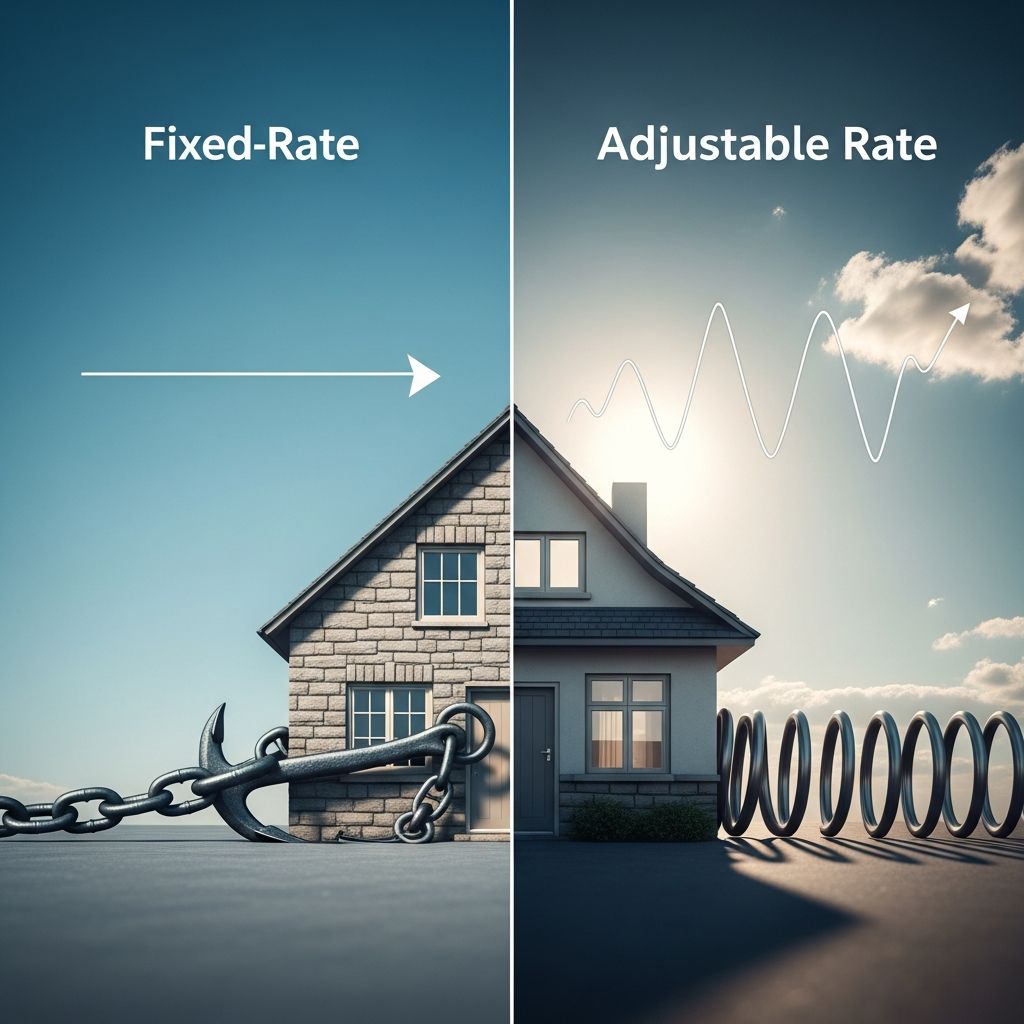
When you apply for a home loan, one of the most important choices you will make is whether to take a fixed-rate mortgage or an adjustable-rate mortgage (ARM). This decision affects how stable your payment will be, how much interest you might pay over time, and how much risk you are taking on if interest rates change in the future.
This guide walks through how each type of mortgage works, compares the pros and cons, and gives you practical ways to decide which may fit your financial situation and future plans.
What Is a Fixed-Rate Mortgage?
A fixed-rate mortgage is a home loan where the interest rate stays the same for the entire life of the loan. That means the principal-and-interest portion of your monthly payment is predictable month after month.
Fixed-rate loans are commonly offered with terms such as:
- 30-year fixed
- 20-year fixed
- 15-year fixed
- 10-year fixed (or other custom terms, depending on lender)
Because the rate does not change, fixed-rate mortgages are often described as providing long-term payment stability and protection from rising interest rates.
How a Fixed-Rate Mortgage Works
With a fixed-rate mortgage:
- Your interest rate is set when you close on the loan and does not adjust later.
- Your monthly principal-and-interest payment remains constant as long as you keep the same loan.
- You gradually pay down the loan balance (principal) over the term, with more of your payment going to interest in the early years and more to principal in later years.
Even though the principal-and-interest part of the payment is fixed, your total monthly out-of-pocket cost can still change if items like property taxes or homeowners insurance go up or down.
Advantages of a Fixed-Rate Mortgage
- Predictable payments: Easier to budget because the principal-and-interest payment does not change.
- Protection from rate increases: If market interest rates rise, your rate and payment stay the same.
- Simple to understand: Fewer moving parts than an adjustable-rate loan, which can be helpful for first-time buyers.
- Good for long-term owners: If you plan to stay in the home for many years, a fixed rate can provide ongoing stability.
Drawbacks of a Fixed-Rate Mortgage
- Higher initial rate: Compared with many ARMs, the starting interest rate on a fixed loan is often higher, especially when rates are low.
- Less benefit from falling rates: If market rates drop, your payment will not decrease unless you refinance, which usually involves fees and qualifying again.
- Potentially higher total interest: Over the first few years, a fixed-rate mortgage can cost more in interest than an ARM with a lower introductory rate, especially if you move or refinance early.
What Is an Adjustable-Rate Mortgage (ARM)?
An adjustable-rate mortgage, or ARM, is a home loan where the interest rate can change over time. ARMs usually begin with a fixed-rate introductory period followed by periodic rate adjustments based on a market index.
Common ARM structures include:
- 3/6, 5/6, 7/6, or 10/6 ARMs (fixed for 3, 5, 7, or 10 years, then adjust every 6 months)
- 5/1, 7/1, or 10/1 ARMs (fixed for 5, 7, or 10 years, then adjust once a year)
How an ARM Works
ARMs have three key parts after the introductory period:
- Index: A published interest rate that reflects market conditions, such as a Treasury index or the Secured Overnight Financing Rate (SOFR).
- Margin: A fixed percentage set by the lender that is added to the index to determine your new rate.
- Caps: Limits on how much your rate or payment can increase per adjustment and over the life of the loan.
After the introductory fixed period ends, your new rate is usually calculated as:
New ARM rate = index value + lender margin (subject to caps)
Adjustments happen at the interval stated in the loan’s name (for example, every 1 year for a 5/1 ARM, or every 6 months for a 5/6 ARM).
Advantages of an ARM
- Lower initial rate: ARMs usually start with a lower interest rate and lower payment than comparable fixed-rate loans.
- Short-term savings: If you sell the home or refinance before the first adjustment, you may pay less interest overall than with a fixed-rate mortgage.
- Potential benefit from falling rates: If market rates decline, your rate and payment may go down at adjustment dates, subject to the loan terms.
Drawbacks of an ARM
- Payment uncertainty: Once the fixed period ends, your rate and payment can increase, sometimes significantly, depending on the index and caps.
- More complex terms: You must understand indexes, margins, caps, and adjustment schedules to fully know your risk.
- Stress during rising-rate periods: In a rising-rate environment, adjustments can push payments higher, which may strain your budget if income does not keep pace.
Side-by-Side Comparison: Fixed vs. ARM
| Feature | Fixed-Rate Mortgage | Adjustable-Rate Mortgage (ARM) |
|---|---|---|
| Interest rate behavior | Stays the same for the entire loan term | Fixed for an introductory period, then adjusts at set intervals |
| Monthly principal-and-interest payment | Stable and predictable | Stable during intro period; can rise or fall afterward |
| Initial rate level | Usually higher than an ARM’s starting rate | Usually lower than comparable fixed-rate loans |
| Risk of payment shock | Low (rate does not adjust) | Moderate to high, depending on rate caps and market changes |
| Best suited for | Borrowers wanting long-term stability and planning to keep the home or loan for many years | Borrowers expecting to move, sell, or refinance before major adjustments, or who can handle potential increases |
How Rate Caps and Floors Limit ARM Changes
To prevent extreme jumps, most ARMs include rate caps and sometimes floors:
- Initial adjustment cap: Maximum the rate can increase (or decrease) at the first adjustment after the fixed period.
- Periodic adjustment cap: Maximum change allowed at each subsequent adjustment.
- Lifetime cap: Maximum total increase allowed over the life of the loan, typically a few percentage points above the initial rate.
- Rate floor: A minimum rate below which your interest rate cannot fall, even if the index goes very low.
These caps and floors are crucial for understanding your worst-case and best-case payment scenarios.
When a Fixed-Rate Mortgage May Be a Better Fit
A fixed-rate mortgage may suit you if:
- You value stability: You prefer knowing exactly what your principal-and-interest payment will be every month.
- You plan to stay long-term: You expect to keep the home or the loan for 10 years or more.
- Your budget is tight: A future payment increase would be hard to manage, and you want to avoid that risk.
- Rates are relatively low: Locking in a low fixed rate can be attractive when current market rates are favorable.
When an ARM May Be Worth Considering
An adjustable-rate mortgage can make sense in certain circumstances, especially if you understand and accept the tradeoffs.
Consider an ARM if:
- You expect to move or sell soon: If you plan to move before the fixed period ends, you may benefit from the lower initial rate without ever facing an adjustment.
- You anticipate higher future income: You are early in your career and reasonably expect your earnings to grow before any possible payment increases.
- You can handle risk: You have financial flexibility, such as savings or a low debt load, to absorb higher payments if rates rise.
- You expect rates to stay stable or decline: If the market outlook suggests flat or falling rates, future adjustments may not be severe, though this is never guaranteed.
Key Questions to Ask Before You Choose
Before committing to a fixed-rate or ARM loan, ask your lender the following:
- For fixed-rate loans:
- What is the interest rate and annual percentage rate (APR)?
- What are the total closing costs?
- How long will it take to break even if I pay points to lower the rate?
- For ARMs:
- How long is the initial fixed-rate period?
- What index is used, and where can I see its historical levels?
- What is the margin added to the index?
- What are the initial, periodic, and lifetime caps and any floor?
- What is the highest possible rate and estimated payment under the lifetime cap?
Having clear answers helps you compare loans and understand both the short-term cost and long-term risk.
Practical Tips for Comparing Offers
- Compare APR, not just rate: APR reflects both the interest rate and some of the fees, giving a more complete picture of cost.
- Model your time horizon: Estimate how long you are likely to keep the loan. Then compare total interest paid under each option over that time, not just the first year’s payments.
- Stress-test your budget: If considering an ARM, run scenarios where the rate hits the periodic and lifetime caps. Ask whether your budget could realistically cover those payments.
- Consider your risk comfort: Some borrowers prefer certainty even at a slightly higher cost; others are comfortable trading stability for a lower initial rate.
- Ask about refinancing options: While refinancing is not guaranteed, understanding the lender’s policies and typical closing costs can help you plan.
Frequently Asked Questions (FAQs)
Q: Do ARMs always end up more expensive than fixed-rate mortgages?
A: Not necessarily. In some cases, especially if you sell or refinance before the adjustment period or if rates stay low, an ARM can cost less than a fixed-rate loan. However, because rates can rise in the future, ARMs carry more uncertainty and potential for higher long-term costs.
Q: Can my total mortgage payment change with a fixed-rate loan?
A: Yes. Even though your principal-and-interest payment is fixed, your total monthly payment can rise or fall if your property taxes, homeowners insurance, or mortgage insurance premiums change. The core loan payment, however, does not change with a fixed-rate mortgage.
Q: What does something like “5/6 ARM” or “7/1 ARM” mean?
A: The first number refers to the length of the initial fixed-rate period in years, and the second number tells you how often the rate adjusts afterward. For example, in a 5/1 ARM, the rate is fixed for five years, then adjusts every one year. In a 5/6 ARM, the rate is fixed for five years, then can change every six months.
Q: How can I know how high my ARM payment might go?
A: Ask your lender to show you a payment example based on the loan’s lifetime rate cap. They should be able to estimate the maximum interest rate allowed under the contract and what your monthly payment would look like if that cap were reached.
Q: Is it easy to switch from an ARM to a fixed-rate mortgage later?
A: You can often switch by refinancing into a new fixed-rate loan, but it is not automatic. You must qualify based on your credit, income, and property value at that time, and you will usually pay closing costs again. There is no guarantee that rates will be lower when you want to refinance.
References
- Fixed-rate vs. adjustable-rate mortgage: What’s the difference? — Bankrate. 2024-03-15. https://www.bankrate.com/mortgages/arm-vs-fixed-rate/
- Fixed Rate vs. Adjustable Rate Mortgage: What’s Best for You — AllSouth Federal Credit Union. 2023-06-08. https://blog.allsouth.org/fixed-rate-vs-adjustable-rate-mortgage-whats-best-for-you
- Adjustable-rate mortgage (ARM) vs Fixed-rate mortgage — U.S. Bank. 2024-01-12. https://www.usbank.com/home-loans/mortgage/arm-vs-fixed.html
- ARM vs. Fixed-Rate Mortgage: Which Is Better? — NerdWallet. 2023-09-05. https://www.nerdwallet.com/mortgages/learn/arm-vs-fixed-rate-mortgage
- Adjustable-Rate vs. Fixed-Rate Mortgages — Canal Bank. 2022-10-20. https://gocanalbank.com/adjustable-rate-vs-fixed-rate-mortgages/
- Fixed and Adjustable-Rate Mortgage Differences — Vermont Federal Credit Union. 2023-04-18. https://www.vermontfederal.org/blog/fixed-vs.-adjustable-rate-mortgage
- Fixed vs. Adjustable-Rate Mortgage (ARM): What’s the Difference? — Rocket Mortgage. 2024-02-09. https://www.rocketmortgage.com/learn/arm-vs-fixed
Similar Articles








Read full bio of Sneha Tete


