How First-Degree Murder Sentences Are Set
First-degree murder is treated as the most serious homicide offense in many criminal justice systems because it typically involves an intentional killing with planning or another legally defined aggravating circumstance. The punishment can range from a very long prison term to life imprisonment without parole, and in some jurisdictions it can also include the death penalty.
Sentencing is not uniform across the United States. States define first-degree murder differently, and the available penalties depend on the statute, the facts proved at trial, the defendant’s age, and whether the jurisdiction permits capital punishment.
What Makes a Killing First-Degree Murder
In many jurisdictions, prosecutors must prove more than a death caused by the defendant. The charge often requires proof of intent and premeditation, meaning the killing was planned or carried out after reflection rather than in a sudden impulse.
Some states also classify certain deaths as first-degree murder even when the defendant did not personally kill the victim in the most direct sense. For example, felony murder rules can elevate a killing that occurs during the commission of another serious felony into first-degree murder under state law.
- Intent usually means the defendant meant to cause death or knew death was highly likely.
- Premeditation refers to advance thought or planning, even if the planning period was brief.
- Felony murder may apply when a death occurs during a qualifying violent felony.
- Special victim or motive factors can also raise a homicide to first-degree murder in some states.
Why Penalties Differ So Much by State
There is no single national sentence for first-degree murder in state courts. One state may impose life without parole, another may set a minimum number of years before parole eligibility, and another may allow the death penalty in limited cases.
These differences exist because criminal law is largely governed by state statutes. As a result, the same basic conduct can lead to very different outcomes depending on where the case is prosecuted.
| Jurisdiction example | Possible sentence |
|---|---|
| District of Columbia | Not less than 30 years and up to life without release |
| Michigan | Life imprisonment without eligibility for parole |
| Federal law | Death or life imprisonment |
| New York | Life imprisonment, with a lengthy minimum term in some cases |
These examples show how widely sentencing ranges can vary, even though all of them involve the gravest category of homicide.
When the Death Penalty Becomes an Option
In jurisdictions that still allow capital punishment, a first-degree murder conviction may expose the defendant to a separate sentencing process focused on whether death is an appropriate punishment.
That phase usually requires the court or jury to consider aggravating and mitigating factors. Aggravating factors are circumstances that make the crime more serious, while mitigating factors are circumstances that may justify a lesser punishment.
- Aggravating factors may include the victim’s status, the cruelty of the killing, or the presence of multiple victims.
- Mitigating factors may include youth, abuse history, or diminished mental capacity, depending on the jurisdiction.
- Separate sentencing proceedings are common when the death penalty is sought.
Not every state permits capital punishment, and some that do have effectively paused executions for legal or practical reasons. Where death is unavailable, the harshest sentence is usually life imprisonment or life without parole.
Life Imprisonment and Parole Rules
For defendants who do not receive a death sentence, life imprisonment is the most common outcome. But “life” does not always mean the same thing from one state to another.
Some systems impose life without the possibility of parole. Others allow parole eligibility only after a long minimum term, such as 20, 25, or 30 years. In certain places, a judge may also impose a term of years that is effectively a life sentence because of its length.
Parole eligibility matters because it determines whether a defendant can ever seek release. A sentence labeled “life” may still permit a future parole hearing, while “life without parole” means the person remains incarcerated for the rest of life unless the sentence is later changed through extraordinary legal action.
Aggravating Circumstances That Increase Exposure
Many first-degree murder statutes focus on especially serious circumstances that justify the harshest punishment. These factors can influence both the charge and the sentence.
- The victim was a police officer, firefighter, or other protected public servant acting in an official capacity.
- The killing was committed to silence a witness or retaliate against a witness.
- The murder was carried out for financial gain.
- The victim was killed during another serious felony such as kidnapping, arson, or rape.
- The death involved extreme brutality or cruelty.
These factors do not automatically guarantee the maximum sentence in every state, but they often expand the prosecution’s options and increase the likelihood of a severe penalty.
Special Considerations for Younger Defendants
Age can significantly affect sentencing. Some laws restrict the use of life without parole or capital punishment for defendants who were under 18 at the time of the offense.
That rule reflects the broader legal principle that juvenile defendants may be treated differently from adults in sentencing, even for the most serious crimes. In some jurisdictions, a defendant’s youth may also be considered a mitigating factor during sentencing.
How Judges and Juries Approach Sentencing
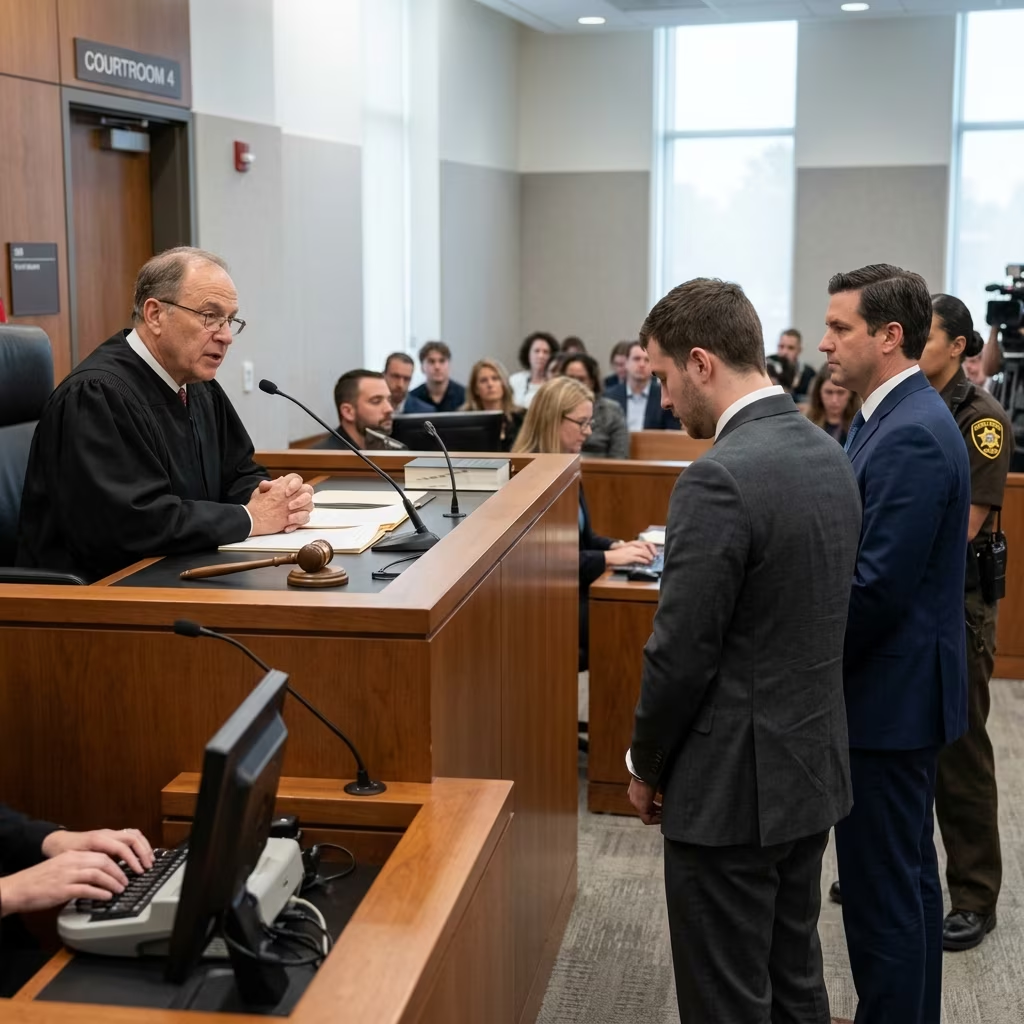
First-degree murder sentencing can involve several stages. The trial establishes guilt, and if the prosecution seeks the harshest punishment, a separate penalty phase may follow.
During that phase, the decision-maker reviews the facts surrounding the crime and the defendant’s background. The central question is often whether the aggravating factors outweigh the mitigating ones.
- Prosecutors present evidence supporting the most severe sentence.
- Defense attorneys present mitigating facts and challenge the prosecution’s narrative.
- Juries or judges evaluate whether the sentence should be death, life without parole, or a term of years.
Because the stakes are so high, sentencing in a first-degree murder case is often one of the most legally complex parts of the prosecution.
Examples of State-Level Sentencing Approaches
A look at selected jurisdictions illustrates the diversity of sentencing outcomes. In the District of Columbia, first-degree murder carries a sentence of at least 30 years and can reach life without release. Michigan law provides life imprisonment without parole eligibility. New York’s first-degree murder statute uses a class A-I felony framework that can result in life imprisonment and, in some situations, a very long minimum term before parole review.
Illinois also demonstrates how sentencing can be shaped by related aggravating rules, especially where felony murder or special victim circumstances are involved. Federal homicide law is similarly severe, allowing either death or life imprisonment for first-degree murder.
Common Legal Defenses and Sentence Reductions
Not every first-degree murder charge ends in conviction, and not every conviction results in the harshest available punishment. Defendants may argue that the prosecution failed to prove premeditation, intent, or the specific facts needed for an enhanced charge.
In some cases, the defense may seek a reduction to a lesser homicide offense by challenging the evidence of planning or disputing whether the killing occurred during a qualifying felony. At sentencing, mitigation evidence may also reduce punishment even when guilt is not in dispute.
- Arguments may focus on lack of planning or sudden provocation.
- Evidence may challenge the prosecution’s theory of the defendant’s role in the death.
- Mitigation may include mental health evidence, trauma history, or youth.
Frequently Asked Questions
Is first-degree murder always punishable by death? No. The death penalty is available only in jurisdictions that allow capital punishment and only when the prosecution pursues it.
Does first-degree murder always mean life without parole? No. Some states use life without parole, while others allow parole eligibility after a long minimum term or set a fixed sentence range.
Can someone be convicted even if they did not personally kill the victim? Yes. Under felony murder rules and similar doctrines, a person may be convicted if a death occurs during a qualifying felony.
Do juveniles face the same sentences as adults? Not always. Some statutes limit life without release for defendants who were under 18 at the time of the offense.
Why do federal and state penalties differ? Federal and state systems use different statutes, and each jurisdiction decides which punishments are available for homicide offenses.
References
- First-Degree Murder Laws — Justia Criminal Law Center. 2026-07-09. https://www.justia.com/criminal/offenses/homicide/first-degree-murder/
- First Degree Murder – Cook County Criminal Defense Lawyer — Chicago Area Criminal Lawyers. 2026-07-09. https://www.chicagoareacriminallawyers.com/practice-areas/violent-crimes/first-degree-murder/
- Penalty for murder in first and second degrees — District of Columbia Council Code. 2026-07-09. https://code.dccouncil.gov/us/dc/council/code/sections/22-2104
- First Degree Murder Law in Illinois — SR Hunter Law. 2026-07-09. https://www.srhunterlaw.com/Criminal-Code-of-1961-Article-9-First-Degree-Murder
- MCL – Section 750.316 — Michigan Legislature. 2026-07-09. https://www.legislature.mi.gov/Laws/MCL?objectName=mcl-750-316
- NY Penal Law § 125.27: Murder in the first degree — Criminal Lawyer. 2026-07-09. https://criminaldefense.1800nynylaw.com/new-york-penal-code/new-york-penal-law-125-27-murder-in-the-first-degree/
- Federal Homicide: From Murder to Manslaughter — Library of Congress, Congressional Research Service. 2026-07-09. https://www.congress.gov/crs-product/IF13161
- Felony Murder — Restore Justice Foundation. 2026-07-09. https://restorejustice.org/issues/sentencing/felony-murder/