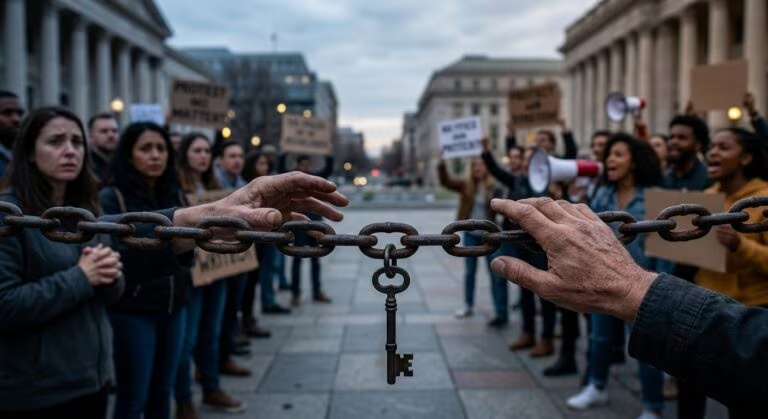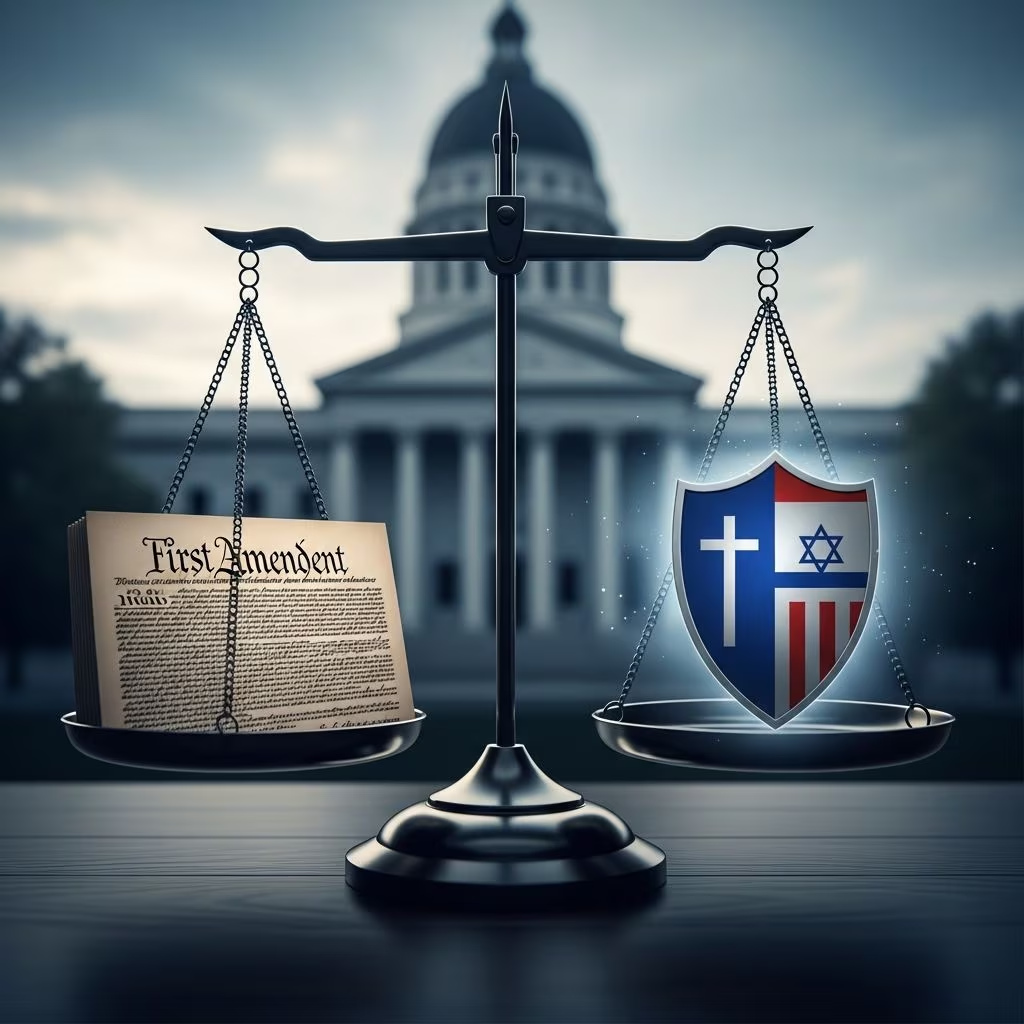
The First Amendment Defense Act (FADA) represents a significant legislative effort to safeguard religious and moral convictions regarding marriage in the face of expanding civil rights protections for same-sex couples. Introduced in response to the 2015 Supreme Court decision in Obergefell v. Hodges, which legalized same-sex marriage nationwide, FADA seeks to prevent the federal government from penalizing individuals, businesses, and organizations that adhere to traditional views on marriage.
Historical Context and Legislative Origins
The push for FADA emerged directly from the cultural and legal shifts following Obergefell v. Hodges, where the Supreme Court ruled 5-4 that the Fourteenth Amendment guarantees the right to same-sex marriage. This decision prompted concerns among religious groups that their sincerely held beliefs—defining marriage as between one man and one woman and reserving sexual relations for such unions—could lead to government sanctions.
On June 17, 2015, Senator Mike Lee (R-Utah) and Representative Raúl Labrador (R-Idaho) introduced FADA simultaneously in the Senate (S. 1598) and House (H.R. 2802). The House bill garnered 172 cosponsors, while the Senate version had 34, reflecting strong Republican support but no advancement through committees. A reintroduction occurred in 2018 by Senator Lee with 21 cosponsors, yet it stalled amid partisan divides. State-level variants, such as in Georgia, aimed to protect public employees like Kentucky clerk Kim Davis, who refused to issue same-sex marriage licenses.
Core Provisions of FADA
At its heart, FADA prohibits the federal government from any “discriminatory action” against persons who believe or act according to the conviction that marriage is or should be the union of one man and one woman, or that sexual relations are properly reserved for such a marriage. This broad language covers:
- Denial or revocation of tax-exempt status for nonprofits.
- Exclusion from federal grants, contracts, loans, or employment.
- Refusal of tax-deductible charitable contributions.
- Denial of accreditation if based on these beliefs.
- Any other federal penalties tied to these convictions.
Protections extend to individuals, for-profit and nonprofit organizations, regardless of religious affiliation, emphasizing moral convictions alongside faith-based ones. For instance, a business owner could decline services conflicting with these views without losing federal benefits.
| Protected Action | Federal Prohibition |
|---|---|
| Tax-exempt status | Cannot deny or revoke based on beliefs |
| Federal contracts/grants | Cannot exclude eligible entities |
| Employment | Cannot discriminate against qualified persons |
| Accreditation | Must deem accredited if otherwise qualified |
This table summarizes key safeguards, ensuring federal neutrality toward traditional marriage views.
Supporters’ Rationale: Defending Conscience Rights
Advocates, including the U.S. Conference of Catholic Bishops, argue FADA is essential to counter growing intolerance post-Obergefell. They highlight cases where individuals faced job loss, fines, or license revocations for refusing to participate in same-sex weddings, such as bakers or florists. FADA would preempt federal discrimination, protecting faith communities, business owners, and employees alike.
Proponents frame it as consistent with the First Amendment and Religious Freedom Restoration Act (RFRA), which already requires the government to justify burdens on religious exercise with compelling interests and least restrictive means. FADA codifies this for marriage-related beliefs, preventing proactive penalties. House Oversight Committee hearings emphasized its role in upholding conscience without threats from government.
Critics’ Concerns: Risks to Civil Rights and Equality
Opponents, like Third Way, contend FADA privileges one religious view—opposition to same-sex marriage—over others, violating First Amendment neutrality. It could enable refusals of service in taxpayer-funded programs, such as prenatal care to unmarried women or hospital visits for non-traditional couples.
- Allows federal employees to abandon duties without prior notice or accommodation.
- Permits religious tests for services in government-funded entities.
- Broadly applies to any extramarital sexual relations, potentially discriminating against heterosexuals too.
Critics argue existing laws like RFRA suffice, and FADA’s scope might render it unconstitutional by undermining antidiscrimination efforts. Groups like the Public Rights/Private Conscience Project decried its 2018 reintroduction as deceptive.
Impact on Businesses, Employees, and Nonprofits
For businesses, FADA could shield owners from federal contract losses if they decline same-sex wedding services. Nonprofits might retain tax status despite policies aligning with traditional marriage. Employees, including federal workers, gain protection from termination for moral objections.
However, it wouldn’t override state laws or private lawsuits, limiting scope to federal actions. In states without similar protections, it could harmonize policies. Real-world examples include county clerks refusing licenses, underscoring the need felt by some.
Current Status and Future Prospects
As of 2026, FADA remains unpassed, with no active bills in the 119th Congress per Congress.gov records. Periodic reintroductions reflect ongoing debates, potentially gaining traction in GOP-controlled chambers. Its future hinges on Supreme Court shifts and cultural attitudes toward religious liberty versus LGBTQ+ rights.
Recent rulings like Fulton v. City of Philadelphia (2021) bolster religious exemptions, possibly reducing FADA’s urgency, but advocates push for statutory clarity.
Broader Implications for Religious Freedom
FADA spotlights tensions between free exercise and equal protection. Supporters see it as vital for pluralism, allowing diverse views in a secular state. Critics fear it erodes nondiscrimination, prioritizing conscience over access.
Comparisons to RFRA highlight overlaps: both demand strict scrutiny for religious burdens. Yet FADA’s specificity to marriage beliefs raises establishment clause questions.
Frequently Asked Questions (FAQs)
What exactly does FADA protect?
FADA protects against federal discriminatory actions for beliefs that marriage is between one man and one woman or sexual relations are reserved for such marriage.
Who qualifies for protection under FADA?
Individuals, for-profit/nonprofit organizations, religious or secular, acting on these convictions.
Has FADA been passed into law?
No, despite introductions in 2015 and 2018, it has not advanced beyond sponsorship.
Does FADA affect state laws?
No, it applies only to federal government actions.
Could FADA allow discrimination against gay couples?
Critics argue yes, in federal programs; supporters say it prevents government overreach.
Balancing Rights in a Diverse Society
Navigating religious liberty and equality requires nuanced policy. FADA embodies this debate, proposing shields without private litigation immunity. As society evolves, such measures test democracy’s commitment to both freedom and fairness.
References
- Understanding the First Amendment Defense Act — John S. Flaherty, P.C. 2016. https://www.johnsflaherty.com/blog/understanding-the-first-amendment-defense-act
- First Amendment Defense Act — Wikipedia. 2023-11-21. https://en.wikipedia.org/wiki/First_Amendment_Defense_Act
- Backgrounder: First Amendment Defense Act — United States Conference of Catholic Bishops. 2015. https://www.usccb.org/resources/Backgrounder-FADA.pdf
- Understanding the First Amendment Defense Act — Third Way. 2015. https://www.thirdway.org/memo/understanding-the-first-amendment-defense-act
- Religious Liberty and H.R. 2802, the First Amendment Defense Act (FADA) — House Committee on Oversight and Accountability. 2015. https://oversight.house.gov/hearing/religious-liberty-and-h-r-2802-the-first-amendment-defense-act-fada/
- H.R.2802 – 114th Congress (2015-2016): First Amendment Defense Act — Congress.gov. 2015-06-17. https://www.congress.gov/bill/114th-congress/house-bill/2802