
First Aid Training Rules for Restaurants
Understand when restaurants must train staff in first aid, what laws apply, and how smart planning protects both employees and customers.
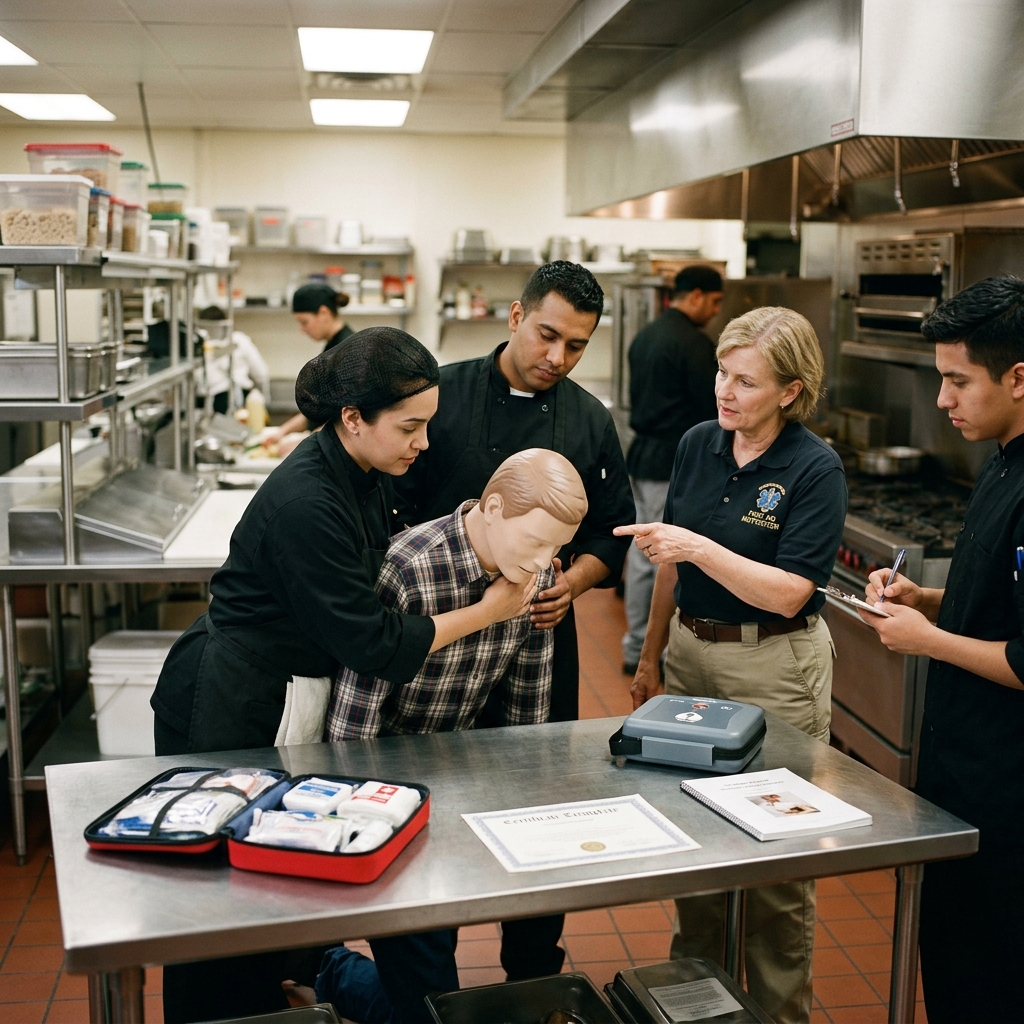
Restaurants operate in fast-paced, high-risk environments where sharp tools, hot surfaces, crowded dining rooms, and food allergens can turn routine service into a medical emergency within seconds. Understanding when the law requires first aid training, what regulators expect, and how to build a practical safety program is essential for any hospitality business owner or manager.
This article explains the legal framework around first aid in restaurants, clarifies when employee training is mandatory, and offers practical strategies to protect both staff and guests while staying compliant with workplace safety rules.
Why First Aid Matters in Food Service Operations
Even the best-run restaurant cannot eliminate every accident or illness. Fryer splashes, knife cuts, slips on wet floors, allergic reactions, and sudden cardiac events are all realistic scenarios. First aid is the bridge between the moment an incident occurs and the arrival of professional medical help.
In practice, effective first aid in restaurants serves three core purposes:
- Protecting employee health by offering immediate care for workplace injuries and illness.
- Reducing the severity of incidents, which can prevent minor issues from becoming life-threatening emergencies.
- Limiting legal exposure by demonstrating that the business took reasonable steps to provide a safe workplace.
Regulators and safety organizations emphasize that prompt first aid treatment is a basic duty of employers in hazardous environments, including food service workplaces.
Core Legal Framework: OSHA and Workplace First Aid
In the United States, the baseline legal rules on workplace first aid come from the Occupational Safety and Health Administration (OSHA). While OSHA does not issue restaurant-specific first aid regulations, its general standards apply to most workplaces, including food service operations.
OSHA’s General First Aid Rule
The key OSHA regulation is 29 CFR 1910.151(b), which addresses first aid arrangements at worksites. Under this rule:
- If there is no infirmary, clinic, or hospital in near proximity to the workplace, the employer must ensure that a person or persons are adequately trained to render first aid.
- Adequate first aid supplies must be readily available at the worksite.
OSHA has interpreted “near proximity” to mean that emergency medical services are reasonably accessible in terms of time and distance. In practice, this means some restaurants may rely on nearby emergency care, while others, especially in remote areas, must have trained first aid providers on site.
Training vs. Reliance on Outside Medical Services
OSHA guidance makes clear that an employer must ensure prompt first aid treatment, either by:
- Having at least one trained and certified first aid provider available during working hours, or
- Ensuring that a hospital or emergency service is reasonably accessible and can provide timely care.
For many urban restaurants, quick access to emergency medical services may satisfy OSHA’s proximity requirement, but this does not remove the need for basic readiness, including appropriate first aid supplies. In more isolated locations, OSHA expects employers to arrange on-site first aid training for designated staff members.
Bloodborne Pathogens and Designated First Aiders
Another important OSHA rule involves bloodborne pathogens. If an employee is trained in first aid and is formally identified as responsible for providing medical assistance as part of their job, that employee is covered by OSHA’s bloodborne pathogens standard (29 CFR 1910.1030).
Under this standard, employers must:
- Provide bloodborne pathogens training to staff who may be exposed to blood or other potentially infectious materials while performing first aid duties.
- Offer appropriate personal protective equipment (such as gloves and protective barriers) and follow written exposure control plans.
This means that once a restaurant designates specific employees as first aid providers, it inherits additional compliance obligations beyond basic first aid instruction.
Are Restaurants Legally Required to Train Employees in First Aid?
There is no single nationwide rule that explicitly states “restaurants must train all employees in first aid.” Instead, the requirement is conditional and depends on factors such as location, proximity to medical services, and local workplace safety laws.
When First Aid Training Becomes Mandatory
First aid training is effectively mandatory in restaurant settings when:
- The workplace is not within reasonable proximity of emergency medical care, as defined in OSHA interpretations.
- State or local regulations explicitly require businesses in certain sectors, including hospitality, to have trained first aiders on site.
- Other safety standards applying to specific hazards (for example, certain industrial equipment in large food production operations) require employee first aid training.
In these situations, the restaurant must identify individuals to receive formal first aid training and ensure they are present during each shift.
Situations Where Training Is Strongly Recommended
Even when not strictly mandated, regulators and safety organizations strongly encourage first aid training in restaurants:
- OSHA recommends that every workplace include one or more employees trained and certified in first aid, including CPR, to ensure quick response in emergencies.
- Hospitality sector guidance emphasizes having at least one named first aider with documented training and a clearly stocked kit.
- Industry training providers highlight the unique risks in restaurants and hotels, noting that first aid skills help staff manage injuries and medical incidents before paramedics arrive.
Consequently, many responsible restaurant operators treat first aid training as a standard part of safety management, not merely a legal minimum.
First Aid Kits: What Restaurants Are Expected to Provide
Legal obligations around first aid do not stop at training; they extend to first aid supplies. OSHA requires that adequate supplies be readily available, and references consensus standards for kit contents.
Regulatory Baseline for First Aid Kits
OSHA points employers to standards such as ANSI/ISEA Z308.1 as benchmarks for adequate workplace first aid kits, and its own guidance on mandatory items includes basic wound care, protective gear, and resuscitation tools.
According to OSHA-related guidance and the American Red Cross:
- A restaurant first aid kit should contain OSHA-compliant supplies, such as bandages, gauze, antiseptic wipes, burn treatments, and protective gloves.
- Kits must be easily accessible, clearly marked, and located where staff can reach them quickly during an emergency.
- Employers are responsible for maintaining kits through regular inspections and refills to ensure items remain in-date and adequate for the size of the workforce.
Contents Tailored to Restaurant Risks
Beyond general requirements, restaurants should ensure their kits reflect common food service hazards:
- Materials suitable for cuts and lacerations from knives and slicers.
- Supplies to treat burns from hot oil, grills, and ovens.
- Gloves and barriers to control bleeding while protecting against infection.
- Resuscitation equipment, such as a pocket mask, for potential cardiac emergencies.
Industry guidance also stresses that first aid supplies should be stored separately from food and clearly labeled so employees know where to find them when needed.
Balancing Legal Compliance and Best Practice
Restaurant owners often ask whether basic compliance is enough. While meeting OSHA and local minimums is essential, safety experts argue that hospitality businesses benefit from aiming higher in three areas: training scope, documentation, and communication.
Recommended Training Levels for Food Service Staff
A practical approach to training in most restaurants includes:
- Designated first aiders with formal certification covering wound care, burns, shock, and basic medical emergencies.
- Selected staff (such as managers or supervisors) trained in CPR and automated external defibrillator (AED) use, especially in busy venues or locations far from hospitals.
- All employees receiving basic first aid awareness training, including how to respond to injuries, when to stop work, and who to alert.
Industry programs designed for hotels and restaurants emphasize that first aid training empowers workers to respond effectively before professional help arrives, which can meaningfully improve outcomes.
Recordkeeping and Incident Logs
Maintaining clear records supports both compliance and risk management. Common practices include:
- Keeping an accident or incident book to record workplace injuries, especially in larger businesses.
- Tracking how often first aid supplies are used, which helps identify recurring hazards and informs preventative measures.
- Documenting staff training dates and certificates to demonstrate due diligence during inspections or after serious incidents.
Some jurisdictions explicitly require written health and safety policies for businesses above a certain size, including sections on first aid arrangements.
Communication and Staff Awareness
First aid plans only work if employees understand them. Effective communication may include:
- Regularly reminding staff where first aid kits and emergency contact information are located.
- Posting simple visual guides or posters that outline what workers should do if they are injured or feel unwell.
- Including first aid procedures in onboarding and periodic refresher training.
Hospitality training organizations encourage short “stand-up” sessions where managers walk through first aid responses for common injuries, helping staff practice the steps in realistic scenarios.
Handling First Aid Situations Involving Food Safety
First aid in restaurants is closely tied to food safety. Any injury involving blood, open wounds, or illness poses risks to customers if not handled correctly.
Double-Barrier Technique for Hand and Arm Wounds
Food safety training materials emphasize a specific approach when workers injure their hands or forearms:
- The employee should immediately stop work and tell a manager.
- The wound must be thoroughly cleaned and bandaged, then covered with a single-use glove or impermeable covering over the bandage. This is known as the double-barrier technique.
- Any food that was being handled at the time of injury should be discarded, and utensils and surfaces must be cleaned and sanitized.
These steps protect both the injured employee and customers by preventing contamination of food and equipment.
Illness, Infected Wounds, and Work Restrictions
Food safety guidelines also state that employees with infected wounds or symptoms of illness must not handle exposed food or food-contact surfaces unless the wound is properly covered.
Recommended measures include:
- Reassigning affected employees to tasks that do not involve direct food handling if proper coverage is not possible.
- Using simple flowcharts or posters to remind workers about which symptoms they must report and how managers should respond.
These rules are not purely operational; they create a safer environment for both staff and guests while reducing the risk of regulatory violations.
International and Local Variations in First Aid Requirements
While OSHA provides a federal baseline in the United States, restaurants must also consider state and local rules, as well as different legal frameworks in other countries.
Example: Hospitality First Aid Duties in Other Jurisdictions
In some countries, health and safety regulations impose explicit duties on businesses to provide adequate first aid equipment, facilities, and trained people. Guidance for the hospitality sector often specifies:
- At least one named first aider with documented training.
- One or more stocked first aid kits, sized to the number of employees and customers and monitored by a responsible person.
- Written health and safety policies that include risk assessments and first aid arrangements, especially in businesses above a certain size.
Although such rules may not directly apply to all U.S. restaurants, they illustrate the direction of best practice: regulators expect hospitality businesses to think systematically about first aid readiness.
Sample First Aid Responsibility Table for Restaurants
| Role | Primary First Aid Responsibility | Recommended Training |
|---|---|---|
| Owner / General Manager | Ensure legal compliance, policies, and adequate supplies. | Overview of OSHA requirements; basic first aid and CPR. |
| Shift Manager / Supervisor | Coordinate emergency response and document incidents. | Certified first aid; CPR/AED; bloodborne pathogens if designated. |
| Designated First Aider | Provide hands-on first aid when incidents occur. | Formal first aid certification; refresher training as required. |
| Line Cook / Kitchen Staff | Follow first aid procedures for cuts, burns, and food safety. | Basic first aid awareness; double-barrier technique for wounds. |
| Front-of-House Staff | Recognize medical emergencies and alert trained personnel. | Basic first aid awareness; recognizing signs of distress. |
Practical Steps for Restaurant Owners
To turn legal requirements and recommendations into action, restaurant owners can follow a structured checklist.
Implementation Checklist
- Assess proximity to emergency care: Determine how quickly paramedics or nearby hospitals can reach your location, and whether OSHA’s “near proximity” standard is satisfied.
- Review state and local laws: Check whether your jurisdiction requires a named first aider, accident book, or specific training for hospitality businesses.
- Identify designated first aiders: Choose staff members (often managers) who will receive formal training and be present on each shift.
- Arrange training: Partner with accredited providers to deliver first aid, CPR, and bloodborne pathogens training where applicable.
- Stock and maintain first aid kits: Ensure kits meet OSHA-aligned standards and reflect restaurant-specific risks; inspect and restock regularly.
- Integrate food safety: Train staff on injury response, double barriers for wounds, and when to discard food after an incident.
- Document policies and incidents: Create written procedures, keep training records, and maintain an incident log for transparency and improvement.
- Schedule refreshers: Renew certifications as required and hold short refresher sessions to keep procedures top of mind.
Frequently Asked Questions (FAQs)
Do all restaurant employees need formal first aid certification?
No. OSHA does not require every employee to be formally certified. Instead, employers must ensure that prompt first aid is available, which typically means having one or more appropriately trained individuals on site when medical care is not nearby. However, many restaurants choose to offer broader training as a best practice.
Is CPR training mandatory for restaurants?
CPR training is not universally mandated for all restaurants at the federal level. OSHA recommends having employees trained in first aid, including CPR, but the legal requirement depends on proximity to emergency care and applicable state or local regulations. Many hospitality businesses voluntarily train managers or designated first aiders in CPR to strengthen emergency readiness.
What happens if a restaurant has no trained first aiders and is far from medical services?
In that situation, the restaurant is at risk of non-compliance with OSHA’s first aid standard. If emergency care is not reasonably accessible, OSHA expects employers to have adequately trained personnel on site to render first aid and provide suitable supplies. Failing to do so may lead to citations and increased liability if serious incidents occur.
Are restaurants required to provide first aid to customers or only employees?
Workplace safety regulations focus primarily on employees. However, hospitality guidance strongly recommends that restaurants be prepared to assist customers in need, and many best practice frameworks assume that guests will receive reasonable first aid care when emergencies occur. From a risk management perspective, ignoring customer emergencies would be both unsafe and damaging to the business.
How often should restaurant first aid kits be inspected?
Safety organizations recommend regular inspections, often monthly, to check expiration dates, replenish used items, and confirm accessibility. Restaurants with high incident rates or large staff numbers may need more frequent checks to keep kits fully stocked and ready.
References
- Restaurant First Aid Kits — American Red Cross. 2023-05-10. https://www.redcross.org/take-a-class/resources/articles/restaurant-first-aid-kits
- OSHA Requirements for Providing Training for First Aid, CPR, and BBP — Occupational Safety and Health Administration (OSHA). 2007-01-16. https://www.osha.gov/laws-regs/standardinterpretations/2007-01-16-0
- CPR and First Aid Training for Hotels, Restaurants and Golf Courses — CPR Training Pro. 2022-08-01. https://www.cprtrainingpro.com/cpr-and-first-aid-training-hotels-restaurants/
- Your Guide to First Aid in the Hospitality Industry — CPL Learning. 2021-04-15. https://www.cpllearning.com/blog/first-aid-hospitality/
- Stand-Up Training: First Aid for Food Workers — StateFoodSafety. 2023-02-20. https://www.statefoodsafety.com/Resources/Resources/stand-up-training-first-aid-for-food-workers
- Why Every Factory and Restaurant Worker Needs First Aid Training — QPulse Consulting. 2022-09-30. https://qpulseconsulting.com/safety-first-why-every-factory-and-restaurant-worker-needs-first-aid-training/
Similar Articles








Read full bio of Sneha Tete




