
Fingerprints and Criminal Justice: From Ancient Marks to Modern IDs
How unique ridge patterns on our fingers became one of the most trusted tools for identifying suspects and proving identity in criminal cases.
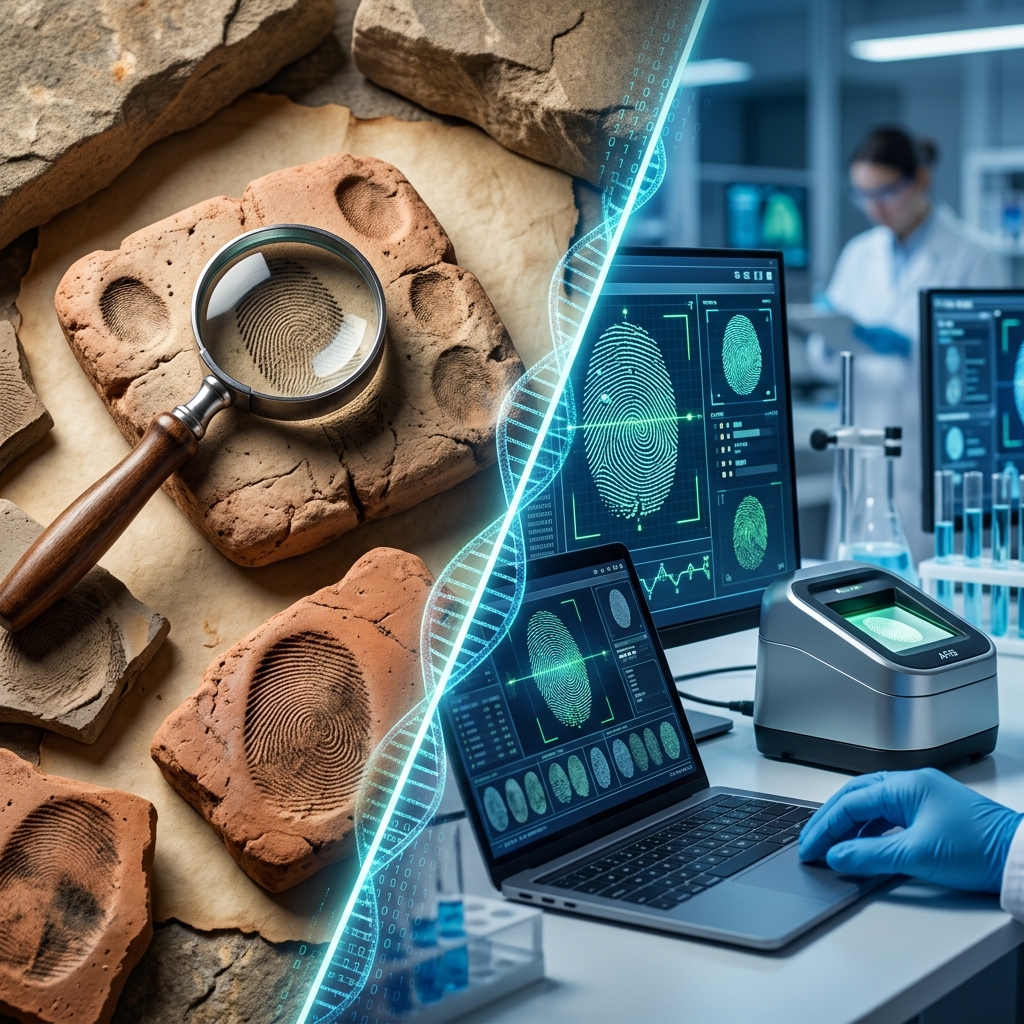
Fingerprints have become one of the most recognizable symbols of modern criminal investigation. Police dust doorknobs, weapons, and windows for latent prints, while courts routinely rely on fingerprint evidence to confirm a suspect’s identity. Yet this practice is the product of centuries of scientific development and legal refinement, not a simple detective trick.
This article explains how fingerprints moved from ancient commercial use into the heart of criminal procedure, why they are considered uniquely reliable, how they are collected and stored, and what their use means for privacy and individual rights.
Why Fingerprints Matter in Criminal Identification
Fingerprints are the intricate ridge patterns on the tips of our fingers. For criminal justice professionals, they serve two critical purposes: identifying people and linking individuals to specific events or locations.
- Uniqueness: Scientific and forensic practice treats fingerprints as unique to each individual, even among identical twins.
- Permanence: Ridge patterns form before birth and, barring significant scarring or injury, remain stable throughout life.
- Reproducibility: Fingerprints can be collected repeatedly and compared against stored records, allowing authorities to confirm identity over time.
Because fingerprints combine uniqueness, permanence, and ease of capture, they became the first widely adopted biometric identifier in criminal procedure and remain a cornerstone of identification today.
From Clay Tablets to Criminal Records: A Brief Historical Timeline
The use of fingerprints predates modern criminal law by thousands of years. Early societies exploited their distinctive patterns long before anyone thought of crime scene investigations.
Early Uses Outside Criminal Law
- Ancient Babylonia: Merchants and officials pressed fingertip impressions into clay to validate business transactions.
- Ancient China: Officials and citizens used fingerprints to authenticate documents and agreements, effectively as signatures.
These early uses showed that people recognized the identification value of fingerprints, even though there was no systematic scientific framework behind the practice.
Nineteenth-Century Scientific Foundations
The shift from informal practice to scientific identification began in the 1800s:
- Mid-19th century administrative use: British colonial administrators in India, including Sir William Herschel, used fingerprints on contracts and for local identification, noting their apparent stability over time.
- Scientific study and classification: In the late 19th century, scholars such as Francis Galton in England and Juan Vucetich in Argentina developed classification systems and statistical analyses of fingerprints, demonstrating their uniqueness and reliability.
These developments transformed fingerprints from a practical tool into a scientifically grounded method of personal identification, paving the way for their adoption in criminal justice.
Into Criminal Procedure and Police Practice
By the end of the 19th century and early 20th century, fingerprints became formally integrated into policing and court processes.
| Approximate Year | Milestone | Jurisdiction |
|---|---|---|
| 1892 | Publication of scientific fingerprint classification work (e.g., Galton) | United Kingdom |
| 1897 | Formal adoption of fingerprint identification for criminals in British India | British India |
| 1900–1901 | Official recommendation and creation of fingerprint bureaus for criminal records | England / Scotland Yard |
| 1903 | Systematic fingerprinting of criminal records begins in New York prisons | United States (New York) |
| Early 20th century | Fingerprints introduced as evidence in court and used in major investigations | UK, US and other countries |
| Late 20th century | Automated fingerprint identification systems deploy nationwide | Various, including FBI AFIS in the US |
By the mid-20th century, fingerprinting of arrested individuals was routine in many countries, and large centralized repositories allowed law enforcement agencies to conduct cross-jurisdictional checks.
How Fingerprint Identification Works in Criminal Investigations
Fingerprints play two major roles in criminal procedure: identifying people who come into contact with the justice system and linking individuals to crime scenes or physical evidence.
Collection of Fingerprints
Law enforcement agencies collect fingerprints in several ways:
- Ink and paper: Traditional methods involve pressing fingers coated with ink onto cards, capturing rolled and flat impressions of each finger.
- Digital scanners: Modern booking stations use electronic fingerprint scanners that record high-resolution images for immediate database comparison.
- Latent prints at scenes: Investigators dust surfaces with powder, use chemical reagents, or apply specialized lighting to make invisible or faint fingerprints visible on objects such as weapons, windows, or door handles.
All of these images can then be compared against known prints in local, state, or national databases.
Comparison and Matching
Fingerprint comparison focuses on distinctive features known as minutiae—small points where ridges end, bifurcate, or form unique patterns.
- Manual comparison: Historically, trained examiners visually compared an unknown print with a known record, looking for a sufficient number of corresponding minutiae.
- Automated systems: Modern Automated Fingerprint Identification Systems (AFIS) generate candidate matches by comparing an unknown print against millions of stored records.
- Expert verification: Even with automation, human examiners typically review and confirm any match that may be used as evidence in court.
When a match is confirmed, prosecutors can use the fingerprint evidence to establish that a particular person handled an object or was present at a scene, subject to interpretation and other contextual evidence.
Fingerprint Databases and the Role of AFIS
As fingerprinting expanded, law enforcement agencies faced a practical problem: how to store and access millions of records efficiently. Classification systems and, later, computerized databases addressed this challenge.
Early Classification Systems
Before computers, large fingerprint repositories relied on classification schemes based on broad pattern types, such as loops, whorls, and arches. Systems developed in India, England, and the United States allowed authorities to file and retrieve records, but searching still required significant manual effort.
Rise of Automated Identification
Beginning in the late 20th century, automated fingerprint identification systems revolutionized criminal identification.
- National AFIS deployments: Countries introduced centralized automated databases that could compare new prints against millions of existing records within minutes.
- FBI systems in the US: The Federal Bureau of Investigation built one of the largest fingerprint repositories in the world, transitioning from manual card files to digital systems, culminating in the Integrated Automated Fingerprint Identification System (IAFIS) and later Next Generation Identification (NGI).
- Benefits for criminal procedure: Automated systems improved the speed of suspect identification, helped resolve unsolved cases, and facilitated cross-jurisdictional checks for wanted individuals and repeat offenders.
These technologies made fingerprints the backbone of criminal history record systems, enhancing both investigations and background checks.
Legal Significance of Fingerprint Evidence
Fingerprints are not merely investigative clues; they carry legal weight in criminal proceedings and shape how courts handle questions of identity.
Admissibility in Court
Courts generally accept fingerprint evidence if certain conditions are met:
- Reliable scientific basis: Fingerprint comparison is widely recognized as a valid forensic technique when conducted by qualified experts.
- Proper collection and chain of custody: Prints must be collected lawfully, documented carefully, and preserved to avoid contamination or loss.
- Expert testimony: Forensic examiners explain their methods, the features compared, and the basis for concluding that prints match.
Historically, appellate decisions have affirmed convictions based on fingerprint evidence, including cases where fingerprints were the primary proof of identity or presence at a crime scene.
Fingerprints in Criminal Records and Repeat Offender Cases
Fingerprint records also play a critical role in proving prior convictions when prosecutors pursue enhanced penalties for repeat offenders. Instead of relying on witnesses from previous cases, authorities can present certified fingerprint records showing that the defendant is the same person who was convicted earlier, simplifying the process of establishing criminal history.
Privacy, Rights, and Modern Concerns
While fingerprints serve important public safety and justice functions, their collection and storage raise significant questions about privacy and individual rights.
- Scope of collection: Many jurisdictions fingerprint all individuals who are arrested, regardless of whether they are ultimately convicted.
- Retention and expungement: Laws vary on how long fingerprint records may be kept and whether they can be removed from databases following acquittal or record sealing.
- Access and sharing: Fingerprint data may be shared among local, state, and national agencies, and sometimes with immigration or security authorities, raising concerns over broad surveillance.
- Data security: Large biometric databases must guard against unauthorized access, data breaches, and misuse of sensitive personal information.
Individuals who are concerned about how their fingerprint data is used may need to consult applicable laws or a legal professional to understand their rights, including possibilities for challenging unlawful collection or seeking expungement in appropriate circumstances.
Practical Uses Beyond Traditional Crime
Fingerprint technology now extends well beyond classic police work, influencing everyday life and other legal contexts.
- Background checks: Many licensing processes, security clearances, and employment screenings rely on fingerprint-based checks of criminal history.
- Disaster victim identification: Authorities use fingerprints to identify deceased individuals in mass casualty incidents, allowing faster confirmation of identity when dental or DNA records are not immediately available.
- Consumer devices: Smartphones, laptops, and locks use fingerprint sensors to control access, familiarizing the public with biometric authentication.
These broader uses demonstrate how a technique born in ancient administrative practice and refined by criminal procedure has become a general tool for identity management.
Key Advantages and Limitations of Fingerprint Evidence
Although fingerprints are powerful, they are not infallible. Understanding their strengths and weaknesses helps place them in the proper legal and investigative context.
Advantages
- High identification value: When quality prints are available, they can strongly support conclusions about identity.
- Established methodology: Fingerprint analysis benefits from decades of standardization, training, and judicial scrutiny.
- Quick search capabilities: Automated systems enable rapid comparison against large databases, improving investigatory efficiency.
Limitations and Challenges
- Print quality: Smudged, partial, or distorted prints may be difficult to interpret and can lead to inconclusive results.
- Human judgment: Even with automation, final decisions rely on expert interpretation, which must follow robust standards to avoid error.
- Context: A fingerprint on an object does not always establish when or how it was left there; courts must consider surrounding evidence and plausible alternative explanations.
These limitations underscore why fingerprint evidence is typically evaluated alongside other investigative and forensic information.
Frequently Asked Questions (FAQs)
Are fingerprints truly unique for every person?
Forensic science and decades of practice support the view that no two individuals, including identical twins, share the same complete fingerprint pattern. Studies and classification work dating back to the 19th century, combined with modern database experience, underpin this assumption.
Can my fingerprints change over time?
Fingerprint ridge patterns generally remain stable throughout life. Minor injuries usually do not change the underlying pattern, though deep scarring or certain medical conditions can alter the appearance of prints.
When can police take my fingerprints?
In many jurisdictions, police may collect fingerprints when a person is formally arrested and booked. Specific rules are set by national and local law; some places also permit fingerprinting for certain civil background checks or licensing processes.
How long are my fingerprints kept in criminal databases?
Retention periods differ by country and region. Some systems keep prints indefinitely once they are associated with a criminal record, while others allow removal if charges are dropped or records are expunged. Legal advice is often necessary to understand options in a particular jurisdiction.
Can fingerprint evidence alone lead to a conviction?
Courts have upheld convictions where fingerprint evidence played a central role, especially when the prints were clearly linked to a crime scene or critical object. However, judges and juries normally consider fingerprints alongside other evidence, and prosecutors must still prove guilt beyond a reasonable doubt.
References
- The Fingerprint System — New York State Division of Criminal Justice Services. 2010-01-01. https://www.criminaljustice.ny.gov/ojis/history/fp_sys.htm
- The Fingerprint Sourcebook — National Institute of Justice, U.S. Department of Justice. 2011-01-01. https://www.ojp.gov/pdffiles1/nij/225321.pdf
- History of Fingerprinting — Science HowStuffWorks. 2006-05-19. https://science.howstuffworks.com/fingerprinting3.htm
- History of Fingerprinting — CPI OpenFox. 2017-03-15. https://www.openfox.com/news/history-of-fingerprinting/
- Forensic Fingerprinting Analysis and History — Investigating Detectives. 2019-08-01. https://detectives.theworduk.org/forensic-fingerprinting-analysis-and-history/
- FBI Marks 100 Years of Fingerprints and Criminal History Records — Federal Bureau of Investigation. 2004-07-08. https://www.fbi.gov/news/stories/fbi-marks-100-years-of-fingerprints-and-criminal-history-records
Similar Articles








Read full bio of Sneha Tete




