
Filing for Divorce in Tennessee: A Practical Step‑By‑Step Guide
Learn the key legal rules, forms, timelines, and practical steps to successfully file and finalize a divorce in Tennessee.
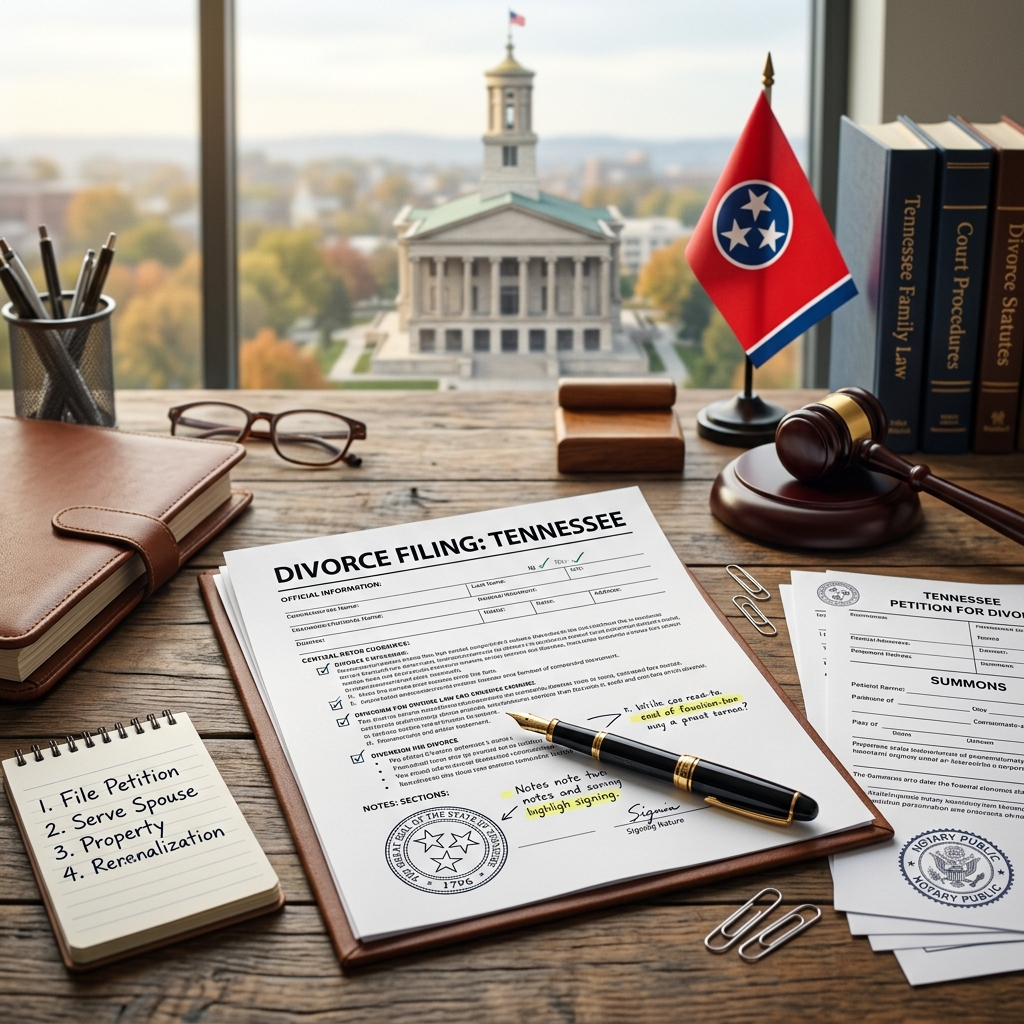
Ending a marriage is emotionally difficult, and the legal process can feel overwhelming. This guide walks you through how divorce works in Tennessee, from the basic requirements to the court forms, waiting periods, and final hearing. It is designed to help you understand the process so you can better plan your next steps, whether you are pursuing an uncontested or contested divorce.
This article is for general information only and is not legal advice. For guidance on your specific situation, speak with a Tennessee family law attorney.
Overview: How Divorce Works in Tennessee
In Tennessee, a divorce is a civil lawsuit that formally ends a marriage. One spouse starts the case by filing a document called a Complaint for Divorce with the appropriate court. The other spouse is then officially notified (“served”) and has a chance to respond.
Tennessee recognizes both no‑fault and fault‑based grounds for divorce. Many couples use the no‑fault ground of “irreconcilable differences” and resolve their case by agreement, which is known as an uncontested divorce.
- Uncontested divorce: Spouses agree on all major issues and typically use irreconcilable differences as the ground.
- Contested divorce: Spouses disagree about one or more issues (such as property or child custody), or one spouse alleges fault such as adultery or abuse.
Key Legal Requirements Before You File
Before you prepare divorce papers, make sure you meet Tennessee’s basic legal requirements. Courts will look at residency, grounds, and compliance with mandatory waiting periods.
Residency Rules
To file for divorce in Tennessee, at least one spouse must have a sufficient connection to the state. In many cases, this means living in Tennessee for a certain amount of time before filing.
- Tennessee generally requires that the ground for divorce occurred in the state or that one spouse has lived in Tennessee for at least six months before filing.
- Residency ensures the court has authority over the marriage and divorce issues, such as property and children.
If you recently moved to Tennessee or your spouse lives in another state, it is wise to confirm residency rules with an attorney or your local court clerk.
Grounds for Divorce
You must state a legally recognized reason—called “grounds”—to end your marriage. Tennessee law allows:
- No‑fault grounds: Typically irreconcilable differences, meaning the marriage cannot be repaired.
- Fault‑based grounds: Such as adultery, cruelty, abandonment, or other misconduct listed in Tennessee statutes.
No‑fault grounds are often used in uncontested divorces because they avoid proving blame and can make settlement negotiations smoother.
Mandatory Waiting Periods
Tennessee does not finalize divorces immediately. There is a required waiting period between filing the Complaint and receiving a Final Decree of Divorce.
| Type of Case | Minimum Waiting Period |
|---|---|
| No‑fault divorce with no minor children | 60 days from the date the Complaint is filed |
| Divorce involving minor children | 90 days from the date the Complaint is filed |
These waiting periods apply even if you and your spouse agree on everything. They are intended to provide time for reflection and negotiation.
Essential Tennessee Divorce Forms
The paperwork you must complete depends on whether your divorce is contested or uncontested, and whether you have minor children. Some forms are required in almost every case.
Core Forms Commonly Used
- Complaint for Divorce – Opens the case, identifies the parties, states grounds, and requests relief such as property division and support.
- Summons – Issued by the clerk after the Complaint is filed; directs the other spouse to respond within a set time.
- Certificate of Divorce or Annulment – A statistical form processed by the state, often filed with the Complaint.
Forms for Uncontested Divorce
In an uncontested case, additional documents help the court confirm that all issues are resolved and that the agreement is complete.
- Marital Dissolution Agreement – Sets out the agreed division of property, debts, and sometimes spousal support.
- Agreed Permanent Parenting Plan – Required where minor children are involved, describing custody, visitation, and parenting responsibilities.
- Final Decree of Divorce – The order the judge signs to formally end the marriage once all conditions are met.
The Tennessee Administrative Office of the Courts provides court‑approved divorce forms that are legally sufficient and accepted in all Tennessee courts, which can be particularly useful for simple agreed divorces.
Step‑By‑Step: Filing for Divorce in Tennessee
While details can vary by county and case type, most Tennessee divorces follow a similar sequence. The steps below describe a typical process from start to finish.
1. Prepare for Filing
Before filing, gather information and think through your goals. Planning ahead can reduce surprises and streamline the case.
- Collect financial documents: pay stubs, tax returns, bank statements, mortgage records, retirement account details.
- List marital assets and debts, including real estate, vehicles, credit cards, and loans.
- Consider your preferred outcomes for property division, parenting arrangements, and support.
- Confirm residency and grounds, and determine whether your case is likely to be uncontested or contested.
2. File the Complaint and Required Forms
The spouse who starts the case is often called the plaintiff. Filing is usually done in the circuit or chancery court in the county where either spouse lives.
- Complete and sign the Complaint for Divorce, including your grounds and requested relief.
- Prepare the Certificate of Divorce or Annulment, if required by the court.
- Submit the paperwork to the clerk of court and pay the filing fee (or request a fee waiver if eligible).
- The clerk issues a Summons once the Complaint is filed.
3. Serve Your Spouse
The Summons and Complaint must be formally delivered to the other spouse, known as the defendant. Proper service is critical; if service rules are not followed, the court may not grant the divorce.
Common methods of service include:
- Personal service by a sheriff or private process server.
- Certified mail with return receipt requested.
- Publication in a newspaper if the spouse’s location is unknown, following court rules.
After service, the defendant typically has around 30 days to file a response or countercomplaint.
4. Response and Countercomplaint
Your spouse may respond in several ways:
- File an Answer admitting or denying the statements in the Complaint.
- File a Countercomplaint seeking different relief or stating different grounds.
- Do nothing, in which case you may be able to request a default judgment if service was proper and deadlines passed.
If both parties agree to the divorce and its terms, the case may quickly move toward settlement and a final hearing.
5. Discovery and Settlement Negotiations
In contested cases, the parties often engage in discovery—formal information‑gathering—before settlement discussions or trial. Discovery can include written questions (interrogatories) and document requests.
During this phase, spouses and their attorneys typically:
- Exchange financial information and other relevant documents.
- Negotiate division of property, debt allocation, and alimony.
- Work on parenting plans covering custody, visitation, and decision‑making for children.
Many cases settle during or after discovery. Once a full agreement is reached, it can be written into a Marital Dissolution Agreement and, if applicable, an Agreed Permanent Parenting Plan.
6. Parenting Class (If You Have Children)
Tennessee often requires parents involved in divorce to complete a parenting education class, especially when custody or parenting time is at issue.
- The class focuses on how separation affects children and how to co‑parent effectively.
- Courts typically require proof of completion before finalizing the divorce.
7. Trial or Final Hearing
If you reach a full agreement, the court will usually hold a brief final hearing to confirm the settlement and enter the Final Decree of Divorce. In contested cases, the judge may hold a more extensive trial to resolve disputed issues.
- At trial, each side presents evidence and testimony about property, support, and children.
- The judge issues rulings on contested matters and ultimately signs the Final Decree of Divorce, officially ending the marriage.
Divorce trials can range from a short hearing to several days of testimony, depending on the complexity of the case.
Contested vs. Uncontested Divorce in Tennessee
Understanding the difference between contested and uncontested divorce helps you anticipate the time, cost, and emotional investment involved.
| Aspect | Uncontested Divorce | Contested Divorce |
|---|---|---|
| Main characteristic | Spouses agree on all key issues | Spouses disagree on one or more key issues |
| Common grounds | No‑fault (irreconcilable differences) | Fault or no‑fault, depending on allegations |
| Timeframe | Can be resolved soon after waiting period if paperwork is complete | May take months or longer, often involving discovery and trial |
| Cost | Lower, fewer court appearances and attorney hours | Higher, due to preparation, negotiations, and trial |
| Emotional strain | Generally less conflict | Often more stressful and adversarial |
After the Final Decree: Practical Follow‑Up Steps
Once the judge signs the Final Decree of Divorce, your marriage is legally over, but you may still need to take some practical steps.
- Obtain certified copies of the Final Decree from the clerk.
- Transfer property titles and update financial accounts as ordered (e.g., deeds, vehicle titles, bank accounts).
- Change beneficiaries on life insurance and retirement accounts, as appropriate.
- Comply with any orders related to benefits; for example, state employees may need to submit the final decree to adjust health coverage.
Failing to follow through on these details can cause financial or legal problems later, so it is important to review the decree carefully.
Frequently Asked Questions about Tennessee Divorce
Do I need a lawyer to file for divorce in Tennessee?
No, you are not legally required to have a lawyer, and Tennessee provides court‑approved forms for self‑represented parties. However, divorce affects important rights related to property, support, and children. Consulting an attorney is strongly recommended, especially in contested or complex cases.
How long will my divorce take?
The minimum waiting period is 60 or 90 days, depending on whether you have minor children. An uncontested case might finish soon after that, while a contested case with discovery and trial can take several months or longer.
Can we both file together?
One spouse must technically file the Complaint, but in an agreed divorce, spouses can work on the paperwork together and present a joint settlement to the court. The case still needs a final hearing and a judge’s approval.
What if my spouse refuses to cooperate?
You can still proceed with the case if you meet residency and grounds requirements and properly serve your spouse. If the spouse does not respond, you may seek a default judgment, subject to court rules and proof of service.
Where can I find official Tennessee divorce forms?
The Tennessee Administrative Office of the Courts publishes court‑approved divorce forms that are accepted statewide. These forms help ensure you meet basic legal requirements, but you must still complete them accurately and follow local court procedures.
References
- Tennessee Divorce Laws — FindLaw. 2023-05-10. https://www.findlaw.com/state/tennessee-law/tennessee-legal-requirements-for-divorce.html
- Agreed Divorce Instructions (Without Children) — Circuit Court Clerk, Davidson County. 2022-01-01. https://circuitclerk.nashville.gov/wp-content/uploads/forms/cir/Agreed%20Divorce%20Instructions_WOC.pdf
- Understanding the Tennessee Divorce Process from Start to Finish — LaFevor & Slaughter. 2021-11-15. https://lalawknoxville.com/blog/understanding-tennessee-divorce-process/
- The Tennessee Divorce Process: How Divorces Work Start to Finish — MemphisDivorce.com. 2020-06-01. https://memphisdivorce.com/divorce/the-divorce-process/
- How Does the Divorce Process Work, and What Can You Expect? — Steven C. Frazier, Attorney at Law. 2022-09-20. https://stevencfrazierlaw.com/blog/how-does-the-divorce-process-work-and-what-can-you-expect/
- Tennessee Divorce Laws & FAQ — Cordell & Cordell. 2023-03-10. https://cordellcordell.com/resources/tennessee/tennessee-divorce-questions/
- Tennessee Divorce — WomensLaw.org. 2021-08-05. https://www.womenslaw.org/laws/tn/divorce
- Court-Approved Divorce Forms — Tennessee Administrative Office of the Courts. 2022-04-01. https://www.tncourts.gov/help-center/court-approved-divorce-forms
- Divorce FAQs — State of Tennessee Benefits Administration. 2020-02-01. https://benefitssupport.tn.gov/hc/en-us/articles/17573140046355-Divorce-FAQs
Similar Articles








Read full bio of Sneha Tete


