
Does the 5th Amendment Protect Your Phone Passcode?
Law enforcement wants your password. Does the Constitution protect it?
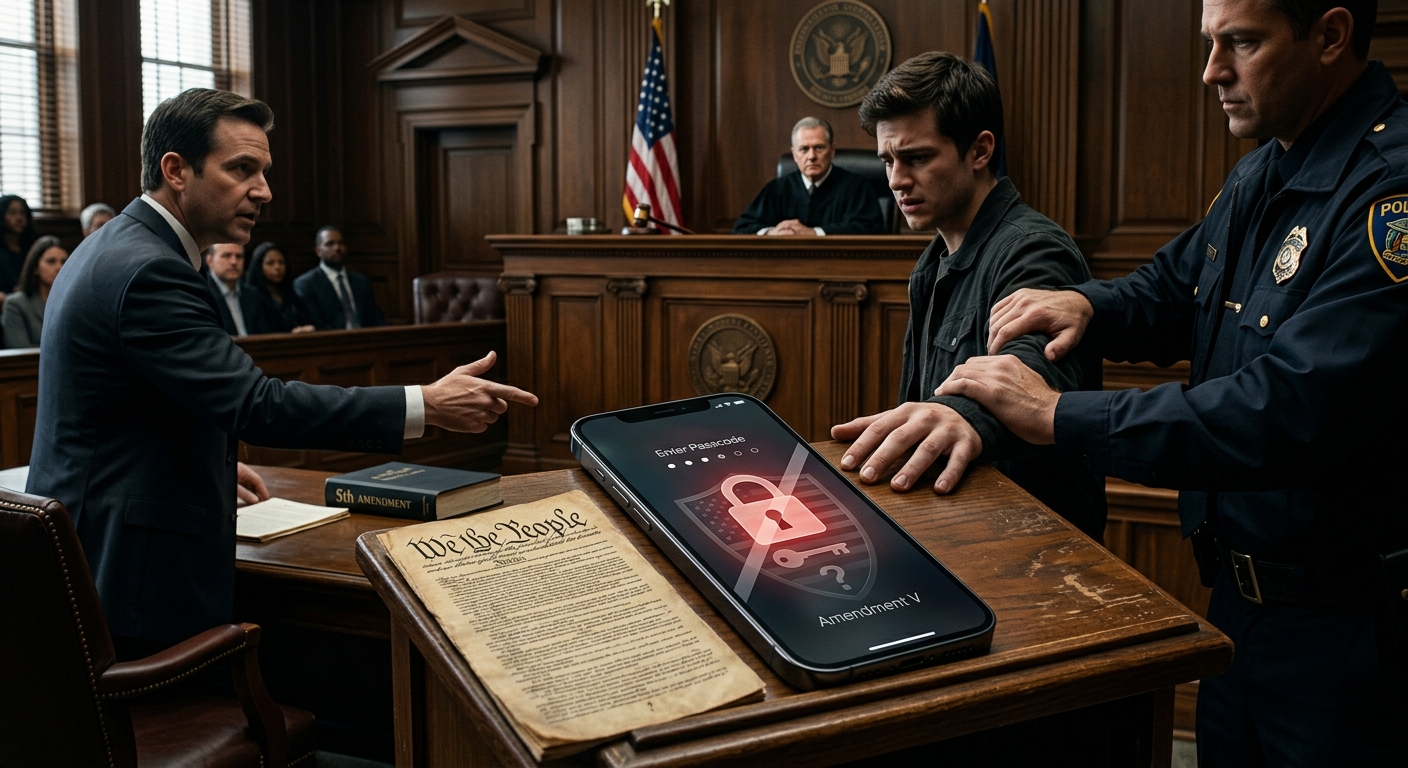
In the modern era, a smartphone is no longer just a communication device; it is a digital extension of the human brain. It holds our most intimate conversations, our financial realities, our medical inquiries, and our real-time locations. Recognizing this profound shift, the United States Supreme Court fundamentally altered the digital privacy landscape in 2014 with Riley v. California , ruling that law enforcement generally must obtain a warrant to search a suspect’s cell phone incident to an arrest. The Court recognized that searching a smartphone is akin to searching a person’s entire home—perhaps even more invasive.
However, securing a warrant is only the first step for modern law enforcement. Because today’s devices are secured by robust encryption, police are increasingly confronting a seemingly impenetrable digital wall. To bypass this, prosecutors and investigators are turning to a controversial tactic: legally compelling individuals to hand over their passcodes. This practice, known as “compelled decryption,” has sparked a fierce legal debate over where our digital lives end and our constitutional rights begin, specifically regarding the Fifth Amendment.
The Fifth Amendment and the “Testimonial” Standard
The Fifth Amendment to the U.S. Constitution guarantees that no person “shall be compelled in any criminal case to be a witness against himself.” Traditionally, this right has protected individuals from being forced to confess to a crime on the witness stand or during a police interrogation. But how does this apply to a string of numbers or a swiping pattern on a digital screen?
For the Fifth Amendment to apply, the government’s compulsion must result in evidence that is both incriminating and testimonial. Evidence is considered testimonial if it reveals the “contents of an individual’s mind.” In a famous legal analogy, forcing a suspect to hand over a physical key to a safe is not testimonial because it is merely a physical act of surrendering an object. However, forcing a suspect to reveal the combination to that safe is testimonial, because it requires the suspect to communicate information stored in their memory.
Legal scholars and privacy advocates argue that a smartphone passcode is the modern equivalent of the safe combination. When the state forces you to write down or speak your alphanumeric password, it is compelling you to extract information from your mind and hand it to the government, thereby testifying against yourself .
Passcodes vs. Biometrics: The Digital Divide
The distinction between a physical key and a memorized combination has created a bizarre paradox in how courts treat different unlocking mechanisms. With the advent of biometric security—such as Apple’s Face ID or Touch ID—the legal analysis becomes remarkably convoluted.
- Alphanumeric Passcodes: Most privacy advocates and a significant number of judges agree that a memorized PIN or password relies on the contents of the mind. Therefore, it generally triggers Fifth Amendment scrutiny.
- Biometric Unlocking: Conversely, some courts view biometric features—like your face or your thumbprint—as physical characteristics, much like a blood sample, a DNA swab, or a traditional physical key. Because handing over your physical thumb requires no cognitive revelation, several jurisdictions allow police to forcibly place a suspect’s finger on their phone or hold the device to their face to unlock it.
This creates a glaring gap in privacy protection. The exact same data, secured on the exact same device, might be constitutionally protected if secured by a six-digit PIN, but entirely vulnerable if secured by a fingerprint. As technology rapidly evolves, this “key versus combination” framework struggles to meaningfully address the realities of consumer cryptography .
The “Foregone Conclusion” Loophole
Even if courts agree that providing a passcode is testimonial, the government has another legal weapon at its disposal: the “foregone conclusion” doctrine. This doctrine is the primary battleground in compelled decryption cases today.
The foregone conclusion exception originated in the 1976 Supreme Court case Fisher v. United States . In that case, the IRS subpoenaed physical tax documents from a taxpayer’s attorney. The Court ruled that while the act of producing the documents might implicitly communicate that the documents existed and were authentic, this “testimony” was irrelevant. The government already knew the tax documents existed, knew who had them, and knew they were authentic. Thus, the act of producing them added so little to the government’s knowledge that it was a “foregone conclusion.”
Today, prosecutors argue that if they can prove a suspect owns a specific smartphone, they already know the suspect knows the password. Therefore, forcing the suspect to enter the password is merely a foregone conclusion. But privacy advocates fiercely counter this application. They argue that the government doesn’t just want the password; it wants the vast, unknown oceans of data hidden behind the password .
Contrasting the Analog and Digital Worlds
Applying a 1970s tax document doctrine to a modern 1TB smartphone illustrates the friction between outdated legal theories and modern technology. Here is why the comparison falters:
| Feature | Analog Safe / File Cabinet | Modern Smartphone |
|---|---|---|
| Storage Capacity | Limited by physical dimensions (a few dozen folders). | Effectively infinite (millions of pages, photos, videos, logs). |
| Knowledge of Contents | Government often knows exactly what files they are looking for. | Government frequently conducts fishing expeditions for unknown data. |
| Intimacy Level | Contains mostly formal or administrative documents. | Contains real-time location, health data, and spontaneous thoughts. |
The Fractured Legal Landscape
Because the U.S. Supreme Court has not yet issued a definitive ruling on compelled decryption and the Fifth Amendment, lower courts are sharply divided. The United States is currently a patchwork of conflicting constitutional interpretations.
In states like New Jersey, courts have leaned heavily in favor of law enforcement. In State v. Andrews (2020) , the New Jersey Supreme Court ruled that a former sheriff’s officer could be forced to surrender his iPhone passcodes. The court relied on the foregone conclusion doctrine, asserting that the state’s knowledge of the defendant’s ownership of the phone and his ability to access it was sufficient to bypass his self-incrimination protections.
Conversely, other state supreme courts—such as Pennsylvania and Indiana—have vehemently rejected this logic. These courts have ruled that the foregone conclusion doctrine was never meant to force a human being to decrypt a device that acts as a comprehensive repository of their personal life. They argue that until the government knows precisely what specific files are on the phone, they cannot claim the contents of the device are a foregone conclusion .
This judicial chaos means that a citizen’s constitutional rights currently depend entirely on their geographic location. A suspect in Pennsylvania may have their digital privacy securely protected under the Fifth Amendment, while a suspect a short drive away in New Jersey could be jailed for contempt of court for refusing to reveal their passcode.
The Broader Stakes for Civil Liberties
The implications of compelled decryption stretch far beyond individual criminal trials; they touch the very foundations of civil liberty, press freedom, and political dissent. If law enforcement is permitted to routinely compel phone passcodes, the chilling effect on society could be profound.
Journalists, for instance, rely on encrypted communications to protect confidential sources and whistleblowers. If an investigative reporter can be legally forced to unlock their device, the safety of their sources is immediately compromised. Similarly, political activists organizing protests or advocating for marginalized groups often utilize smartphones to coordinate securely. Allowing police to compel decryption transforms the smartphone from a tool of empowerment into a highly efficient surveillance trap.
Ultimately, encryption is one of the few reliable tools everyday citizens have to protect themselves from cybercriminals, corporate data harvesting, and unwarranted state intrusion. Undermining that security by establishing a legal framework for forced decryption fundamentally weakens the privacy ecosystem for everyone.
Frequently Asked Questions (FAQs)
Can the police force me to use Face ID or Touch ID to unlock my phone?
In many jurisdictions, yes. Because courts often view biometrics as physical evidence rather than “testimonial” evidence, police may be legally permitted to hold your phone to your face or press your finger against the sensor to unlock it, provided they have a valid search warrant or exigent circumstances exist.
Is it safer to use a passcode instead of biometrics?
From a purely legal standpoint, an alphanumeric passcode currently offers stronger Fifth Amendment protections than biometric unlocking. Because a passcode must be recalled from your memory, it triggers constitutional arguments against self-incrimination that fingerprints and face scans generally do not.
What should I do if law enforcement asks to search my phone?
You have the right to politely refuse to consent to a search of your device and the right to remain silent. If officers have a warrant, they can seize the device, but you are not obligated to voluntarily provide your passcode without consulting legal counsel. Always ask for an attorney if you are being detained or questioned.
Conclusion
The smartphone has fundamentally reshaped how human beings store and transmit information, and our constitutional doctrines must adapt accordingly. Attempting to shoehorn the realities of digital cryptography into 20th-century legal frameworks concerning physical keys and tax documents is an exercise in judicial gymnastics. The Fifth Amendment was designed to protect the innermost sanctum of the human mind from state compulsion. As our minds increasingly bleed into our digital devices, safeguarding the passcodes that protect that data is not just a matter of criminal defense—it is a critical imperative for preserving human privacy in the digital age.
References
Note: The foundational Supreme Court rulings (Riley and Fisher) are included due to their status as the universally recognized, authoritative precedents governing current compelled decryption litigation.
- Riley v. California, 573 U.S. 373 — Supreme Court of the United States. 2014-06-25. https://supreme.justia.com/cases/federal/us/573/373/
- Fisher v. United States, 425 U.S. 391 — Supreme Court of the United States. 1976-04-21. https://supreme.justia.com/cases/federal/us/425/391/
- State v. Andrews, 243 N.J. 447 (A-72-18) — Supreme Court of New Jersey. 2020-08-10. https://www.njcourts.gov/system/files/court-opinions/2020/a_72_18.pdf
- Compelled Decryption and the Fifth Amendment: Exploring the Technical Boundaries — Harvard Journal of Law & Technology (Vol. 32). 2018. https://jolt.law.harvard.edu/assets/articlePDFs/v32/32HarvJLTech169.pdf
- Compelled Decryption & State Constitutional Protection Against Self-Incrimination — American Criminal Law Review. 2021. https://www.law.georgetown.edu/american-criminal-law-review/wp-content/uploads/sites/15/2021/04/58-2-Compelled-Decryption-State-Constitutional-Protection-Against-Self-Incrimination.pdf
Similar Articles








Read full bio of Sneha Tete


