
Federal Roadmap for Advancing Gender Equity
A comprehensive federal blueprint for advancing gender equity.
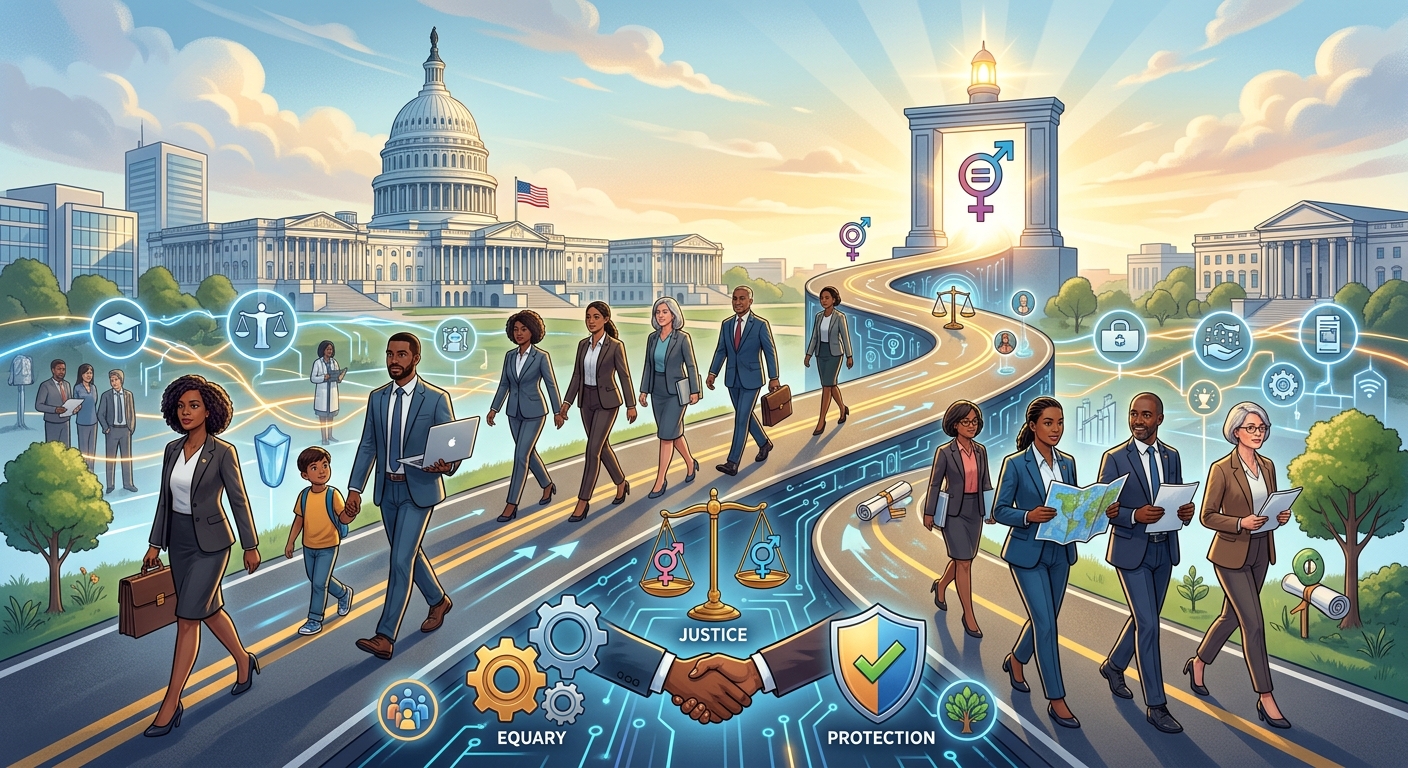
Introduction: The Imperative for Federal Action
In the continuous pursuit of systemic equality, the executive branch of the United States government wields unparalleled authority to enact sweeping, transformative changes for women’s rights. While major legislative milestones frequently dominate public discourse, the meticulous implementation, robust enforcement, and strategic rulemaking by federal agencies are what truly translate statutory promises into lived realities. Crafting a comprehensive federal roadmap for advancing gender equity requires a multifaceted approach. It is not enough to address isolated issues; policymakers must confront the interconnected barriers women face across the workplace, within the housing market, throughout educational institutions, and in public service.
Historically, federal policy has often treated women’s rights as a peripheral concern rather than a central tenet of economic and social stability. A modernized executive agenda demands a paradigm shift—one that recognizes issues like maternal accommodations, eviction disparities, and educational safety as foundational civil rights imperatives. By leveraging the authority of agencies such as the Department of Labor, the Equal Employment Opportunity Commission (EEOC), the Department of Education, and the Department of Housing and Urban Development, the federal government can systematically dismantle the archaic structures that perpetuate gender-based discrimination. This comprehensive blueprint explores how targeted executive action and rigorous enforcement of newly enacted laws can forge a more equitable future.
Economic Security: Redefining Workplace Fairness
For decades, the American workplace was governed by policies that largely ignored the physiological and caregiving realities of women. Economic security is fundamentally tied to a worker’s ability to remain in the labor force without sacrificing their health or family responsibilities. Closing the gender wage gap and ensuring upward mobility requires aggressive federal intervention to eliminate occupational segregation and pregnancy-related discrimination.
Implementing the Pregnant Workers Fairness Act (PWFA)
One of the most significant leaps forward in workplace equity is the enforcement of the Pregnant Workers Fairness Act (PWFA). For too long, pregnant employees were forced into an impossible choice: endure unsafe working conditions that could jeopardize their health, or take unpaid leave and risk economic ruin. On April 15, 2024, the U.S. Equal Employment Opportunity Commission (EEOC) issued a final rule to implement the PWFA, providing critical clarity for both employers and workers.
The PWFA mandates that covered employers provide reasonable accommodations for a worker’s known limitations related to pregnancy, childbirth, or related medical conditions, provided those accommodations do not cause an undue hardship on the business operations. This regulatory framework represents a monumental shift from previous standards, which often required workers to prove that non-pregnant employees with similar limitations were granted accommodations. By clarifying the types of limitations covered and outlining straightforward processes for requesting modifications—such as additional bathroom breaks, light duty, or flexible scheduling—the federal government has established a proactive shield against pregnancy discrimination. Robust enforcement of this rule by the EEOC is paramount to ensuring that these protections materialize on the factory floor and in the corporate boardroom alike.
Expanding Protections with the PUMP Act
Parallel to pregnancy accommodations, the ability to safely and privately express breast milk during the workday is a critical component of maternal economic security. The Providing Urgent Maternal Protections for Nursing Mothers Act (PUMP Act) expanded essential rights to millions of workers previously excluded from federal protections, including agricultural workers, teachers, and care workers. To ensure compliance, the U.S. Department of Labor launched nationwide awareness initiatives, such as the ‘Power to Pump’ campaign, aiming to educate both employers and vulnerable workers about these expanded rights.
Under the PUMP Act, employers are legally obligated to provide reasonable break time and a private, functional space—that is explicitly not a bathroom—for nursing employees to pump breast milk for up to one year after a child’s birth. The executive branch’s role extends beyond mere awareness; it requires rigorous auditing and strict penalization of non-compliant enterprises. When agencies aggressively pursue violations, they send a clear mandate that maternal health is non-negotiable in the modern economy.
Summary of Core Workplace Protections
The table below outlines the primary federal frameworks currently protecting women’s economic and physical well-being in the workforce, highlighting the recent expansions in federal law.
| Legislation / Rule | Enforcing Agency | Core Protections Provided |
|---|---|---|
| Pregnant Workers Fairness Act (PWFA) | EEOC | Requires reasonable workplace accommodations for pregnancy, childbirth, and related medical conditions. |
| PUMP for Nursing Mothers Act | Department of Labor (WHD) | Mandates break time and a private, non-bathroom space for expressing breast milk for up to one year post-birth. |
| Title VII of the Civil Rights Act | EEOC | Prohibits employment discrimination based on race, color, religion, sex (including pregnancy), and national origin. |
Housing Justice: Confronting the Eviction Crisis
Housing instability is profoundly intertwined with gender and racial inequality. The eviction crisis in the United States does not impact all demographics equally; it disproportionately displaces women, particularly women of color. Foundational demographic research highlights this severe disparity: data indicates that women—especially Black and Latinx women—face significantly higher eviction filing and execution rates than their male counterparts. While this data was cemented during the height of the pandemic eviction tracking, it remains a uniquely authoritative baseline for understanding the structural gender disparities inherent in the American housing market.
The trauma of eviction extends far beyond the immediate loss of shelter. An eviction record can shadow a woman for years, severely restricting her ability to secure future housing, obtain credit, and maintain stable employment. This creates a cyclical trap of poverty that federal policy must address directly. Executive agencies must prioritize housing justice as a core element of gender equity. This includes directing the Department of Housing and Urban Development (HUD) to enforce fair housing laws rigorously against landlords who exploit vulnerable female tenants, particularly those facing sexual harassment in exchange for rent leniency.
Furthermore, the federal government should incentivize local jurisdictions to adopt “Right to Counsel” programs for eviction proceedings. By providing federal grant preferences to states that guarantee legal representation for tenants, executive agencies can help level the heavily skewed legal playing field. Addressing how prior eviction filings are weaponized against housing applicants is another critical regulatory step needed to ensure long-term stability for women and their families.
Educational Equity: Reclaiming and Strengthening Title IX
The promise of equal educational opportunity is hollow if students are subjected to environments hostile to their gender, sexual orientation, or pregnancy status. Title IX of the Education Amendments of 1972 is the bedrock of gender equity in education, but its efficacy relies entirely on the vigor with which the Department of Education enforces it. In recent years, the interpretation and application of Title IX have been subject to severe political whiplash, underscoring the need for a steadfast, comprehensive executive approach.
On August 1, 2024, the U.S. Department of Education implemented comprehensive updates to its Title IX regulations, aimed at clarifying and expanding protections against sex-based discrimination. These regulations explicitly codify protections against discrimination based on pregnancy or related conditions, as well as parental, family, or marital status. The updated framework requires federally funded institutions to take proactive steps to prevent sex discrimination and ensure equal access, such as providing reasonable modifications for pregnant students and dedicated lactation spaces.
Moreover, modernizing Title IX enforcement means holding educational institutions strictly accountable for how they handle reports of sexual harassment and assault. The executive mandate must prioritize swift investigations by the Office for Civil Rights (OCR) and ensure that schools are offering free, individualized supportive measures to complainants. Schools must not be allowed to sweep gender-based violence under the rug. By utilizing the full weight of federal funding restrictions as leverage, the executive branch can compel systemic compliance, ensuring that all students have the freedom to learn in safe, equitable environments.
Modernizing Public Service and Military Integration
The federal government is the nation’s largest employer, and as such, it must set the gold standard for workplace equity. This is particularly crucial within the Department of Defense and other uniformed services, where archaic, sex-segregated policies have historically hampered women’s career advancement and operational integration. Achieving true gender equity in the military requires more than just opening combat roles on paper; it demands the systemic dismantling of biased institutional cultures.
Executive leadership must direct military branches to eliminate outdated practices, such as sex-segregated basic training facilities, which foster division and reinforce antiquated gender norms from day one of a service member’s career. Additionally, policies that restrict junior female soldiers from being assigned to certain units unless senior female officers are already present create artificial bottlenecks that stall career progression. The administration must mandate transparent, merit-based promotion metrics that actively root out implicit bias. Ensuring that women who choose to serve their country can do so free from harassment and systemic disadvantage is a vital component of a comprehensive federal women’s rights agenda.
Conclusion
Advancing gender equity is not a passive endeavor; it requires an aggressive, coordinated executive strategy that touches every facet of American life. By enforcing critical workplace protections like the PWFA and the PUMP Act, confronting the racialized and gendered eviction crisis, strengthening Title IX safeguards, and modernizing military integration, the federal government can fundamentally alter the landscape of opportunity. This roadmap provides a clear directive: equality must be actively engineered through relentless policy enforcement, regulatory clarity, and an unwavering commitment to civil rights.
Frequently Asked Questions (FAQs)
- What is the Pregnant Workers Fairness Act (PWFA)?
The PWFA is a federal law that requires covered employers to provide reasonable accommodations to employees experiencing limitations related to pregnancy, childbirth, or related medical conditions, ensuring they can continue working safely without facing discrimination. - How does the PUMP Act protect nursing mothers?
The PUMP Act requires employers to provide reasonable break times and a private, non-bathroom space for most nursing employees to express breast milk for up to one year after the birth of a child. - Why are evictions considered a gender equity issue?
Statistical data demonstrates that women, particularly Black and Latinx women, face disproportionately higher rates of eviction filings and removals compared to men, making housing displacement a critical intersection of gender and racial injustice. - What recent changes were made to Title IX regarding pregnancy?
Recent Title IX regulatory updates explicitly prohibit discrimination based on pregnancy, parental, or marital status, and require schools to provide reasonable modifications and lactation spaces to ensure equal access to education.
References
- EEOC Issues Final Regulation on Pregnant Workers Fairness Act — U.S. Equal Employment Opportunity Commission. 2024-04-15. https://www.eeoc.gov/newsroom/eeoc-issues-final-regulation-pregnant-workers-fairness-act
- Racial and Gender Disparities among Evicted Americans — The Eviction Lab. 2020-12-16. https://evictionlab.org/demographics-of-eviction/
- US Department of Labor launches ‘Power to Pump’ campaign — U.S. Department of Labor. 2023-08-01. https://www.dol.gov/newsroom/releases/whd/whd20230801
- Nondiscrimination Based on Pregnancy or Related Conditions & Parental, Family, or Marital Status — U.S. Department of Education. 2024-08-01. https://www2.ed.gov/about/offices/list/ocr/docs/titleix-info-preg.pdf
Similar Articles








Read full bio of medha deb


