
Federal Crime Victims’ Rights: What Victims Need To Know Now
Understand the core protections, notices, participation rights, and restitution remedies available to federal crime victims.
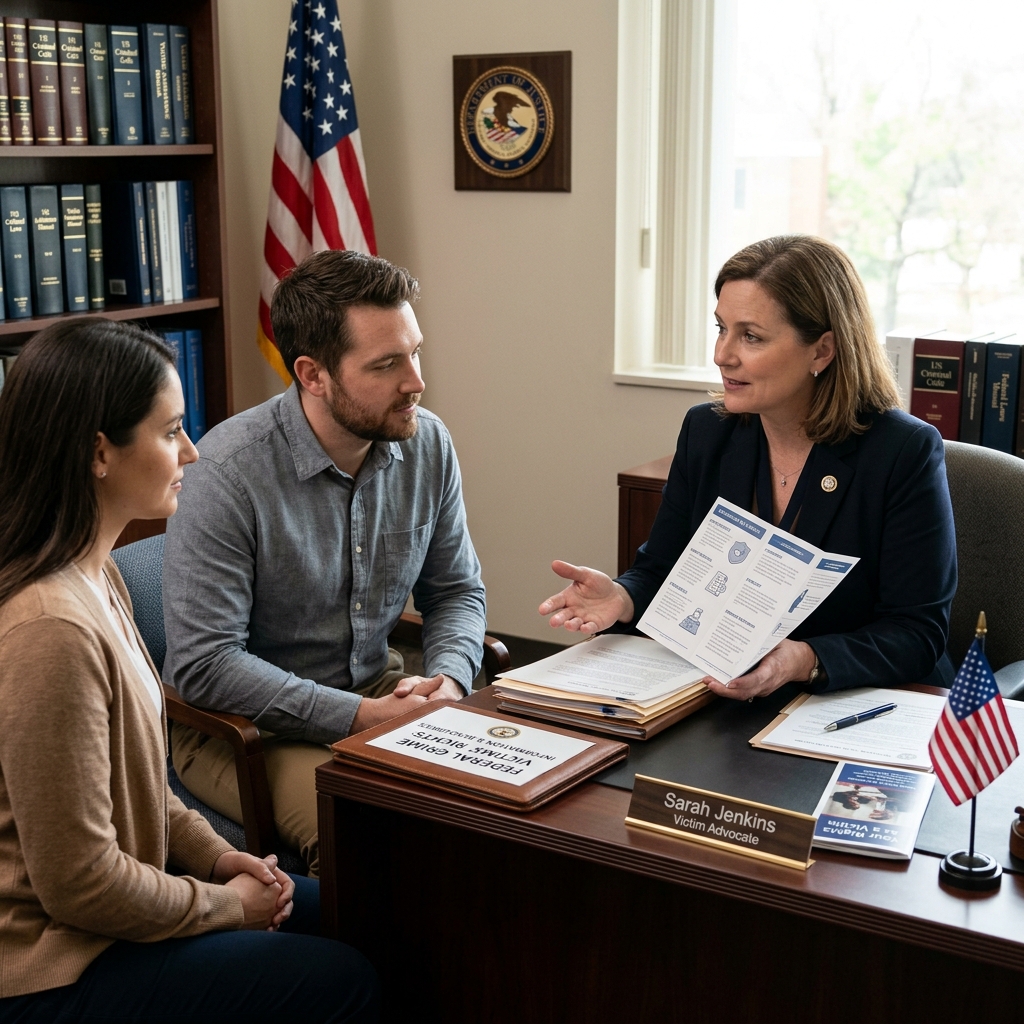
When a federal crime occurs, the justice system does not focus only on the accused and the government. Federal law also recognizes that victims have legal rights that can shape how a case moves forward, how they are kept informed, and how they are treated throughout the process.
Those protections are designed to give victims a meaningful role without turning them into parties to the prosecution. In practice, the system aims to provide notice, safety, respect, and a path to restitution while still allowing investigators and prosecutors to do their work.
What federal victims’ rights are meant to do
Federal victims’ rights serve several connected purposes. First, they help make sure victims are not left in the dark about important developments. Second, they create a baseline of dignity and privacy in an often stressful criminal process. Third, they give victims opportunities to participate in key stages of a case, especially where release, plea, sentencing, or restitution are involved.
These rights are mainly associated with two federal statutes: the Victims’ Rights and Restitution Act and the Crime Victims’ Rights Act. Together, they cover both early-stage support and court-process protections.
The core rights available to victims
The most important federal protections can be grouped into a few practical categories. The table below gives a clear snapshot of what each right is intended to accomplish.
| Right | What it means in practice |
|---|---|
| Protection | Reasonable protection from the accused and, in some contexts, from persons acting with the accused. |
| Notice | Timely information about hearings, releases, escapes, plea deals, and other important developments. |
| Participation | The chance to attend proceedings and be reasonably heard at key moments such as release, plea, and sentencing. |
| Conferral | A reasonable opportunity to speak with the prosecutor handling the case. |
| Restitution | The right to full and timely restitution where allowed by law. |
| Fair treatment | Respect for the victim’s dignity and privacy throughout the process. |
Protection from harm and intimidation
One of the first concerns after a federal crime is safety. Federal law recognizes a victim’s right to be reasonably protected from the accused.
This protection can matter in many ways. It may affect how contact is handled, how information is shared, and how the case is managed if there is a risk of intimidation, retaliation, or other threats. In some situations, protection also extends to preserving the victim’s personal property and maintaining that property in good condition when it is held as evidence.
- Safety planning may be important early in the case.
- Prosecutors and victim-witness staff may help explain available protections.
- Courts may consider victim safety when handling proceedings and release issues.
Notice about hearings, releases, and case changes
Federal victims are entitled to reasonable, accurate, and timely notice of major events in the case. That includes public court proceedings, parole-related proceedings where applicable, and developments such as release or escape of the accused.
Notice is one of the most practical rights because it gives victims time to prepare, decide whether to attend, and understand how the case is moving. The federal framework also requires victims to be informed of any plea bargain or deferred prosecution agreement in a timely manner.
Under the Victims’ Rights and Restitution Act, victims are also entitled to be told that they have been the victim of a federal crime and to receive information about medical, social, counseling, and other support services.
Attendance and the right to be heard
Federal victims generally have the right not to be excluded from public court proceedings involving the crime, unless a narrow legal exception applies. They also have the right to be reasonably heard at public proceedings involving release, plea, sentencing, or parole-related matters.
That right to be heard does not mean a victim controls the result. Instead, it ensures the court can receive the victim’s perspective before making decisions that may affect safety, accountability, or fairness. The right is especially important at sentencing, where the victim’s account of harm may help the court understand the full impact of the offense.
- Victims may attend many public proceedings connected to the case.
- Victims may speak at selected hearings where the law allows participation.
- Courts may limit attendance only in specific circumstances recognized by law.
Working with the prosecutor
Another important protection is the reasonable right to confer with the attorney for the Government. This does not give the victim authority to direct the prosecution, but it does create a formal expectation of communication.
Conferencing can help victims understand charging decisions, plea discussions, scheduling issues, and sentencing preparation. It can also make it easier to raise concerns about safety, property, restitution, and privacy before decisions are made.
Restitution and financial harm
Federal law recognizes that crime can cause measurable financial loss. For that reason, victims may be entitled to full and timely restitution as provided by law.
Restitution is designed to compensate victims for eligible losses caused by the offense. Depending on the case, this can involve medical bills, counseling expenses, lost property, or other covered harms. The Sentencing Commission’s primer notes that restitution is one of the CVRA’s central substantive goals.
It is important to distinguish restitution from a general civil damage award. Restitution is tied to the criminal case and is limited by the governing statutes and the facts proved in that proceeding.
Privacy, dignity, and respectful treatment
Federal victims are entitled to be treated with fairness and with respect for their dignity and privacy. This right matters throughout the process, especially when cases involve sensitive facts, personal records, or public court filings.
Respect for privacy may influence how information is shared, how victims are identified in court documents, and how public proceedings are managed. The goal is not to hide the case from the public record, but to avoid unnecessary harm and prevent additional victimization through the process itself.
Support services and practical assistance
Federal law goes beyond courtroom rights by requiring that victims be informed about available services. Those services may include medical care, counseling, treatment, and other forms of support.
For many victims, the most useful assistance comes from victim-witness staff and related support programs that explain the system in plain language, help track case developments, and connect victims to community resources. The Office for Victims of Crime plays a broader federal role in supporting service providers and professionals who assist crime victims.
How federal rights are enforced
Legal rights only matter if they can be raised when something goes wrong. Under the federal framework, victims may seek enforcement through the courts and may also rely on the Department of Justice’s Office of the Victims’ Rights Ombuds for help if they believe DOJ staff failed to provide rights under the Crime Victims’ Rights Act.
The U.S. Courts also tracks CVRA litigation in which rights were asserted and relief was denied, showing that enforcement is an active part of the federal system rather than a symbolic promise.[10]
What victims should keep in mind during a federal case
Federal criminal cases can move quickly and can involve multiple hearings, filings, and deadlines. Victims benefit from staying organized and from keeping contact information current with the relevant federal agency or victim-witness personnel so notices are not missed.
- Keep copies of any letters, emails, or notices from federal officials.
- Write down losses, expenses, and questions early for possible restitution or discussion with the prosecutor.
- Ask about safety concerns as soon as they arise.
- Request plain-language explanations of hearings and deadlines.
Common questions about federal crime victims’ rights
Do these rights apply in every criminal matter? The federal rights described here apply in federal cases, and some rights depend on whether federal charges have been filed and whether the statute applies to the specific proceeding.
Can a victim force a particular outcome? No. These rights allow participation, notice, and protection, but they do not give the victim control over prosecutorial strategy or the court’s final judgment.
Is restitution automatic? Not always. Restitution is available as provided by law and depends on the offense, the losses, and the applicable statute.
What if a notice is missed? Victims should contact the assigned victim-witness staff, the prosecutor’s office, or the Office of the Victims’ Rights Ombuds if they believe a required right was not honored.
Why these rights matter
Federal victims’ rights make the criminal process more transparent, more humane, and more responsive to the people directly affected by crime. They help ensure that victims are informed, protected, heard, and treated with respect while the government carries out its law-enforcement responsibilities.
Although these rights do not erase the harm caused by the crime, they give victims a stronger and more visible place in a process that can otherwise feel distant and impersonal. That is why notice, participation, restitution, and privacy remain central themes of federal victim law.
FAQs
What are the main federal crime victims’ rights?
The main rights include protection from the accused, timely notice of key proceedings, the ability to attend and be heard at certain hearings, the right to confer with the prosecutor, restitution, and fair treatment with respect for dignity and privacy.
Who helps victims understand these rights?
Victim-witness personnel, federal prosecutors, and related support offices can explain rights, hearing dates, and available services.
Can victims speak at sentencing?
Yes, federal law gives victims the right to be reasonably heard at public proceedings involving sentencing, subject to the rules of the case and the court.
Where can victims turn if rights are ignored?
Victims may raise concerns with the prosecutor’s office, the court, or the Department of Justice’s Office of the Victims’ Rights Ombuds if DOJ staff failed to provide required rights.
References
- Rights of Federal Crime Victims — FBI. n.d. https://www.fbi.gov/how-we-can-help-you/victim-services/rights-of-federal-crime-victims
- Crime Victims’ Rights Act – Department of Justice — U.S. Department of Justice. n.d. https://www.justice.gov/usao/resources/crime-victims-rights-ombudsman/victims-rights-act
- 18 U.S. Code § 3771 – Crime victims’ rights — Cornell Law School, Legal Information Institute. n.d. https://www.law.cornell.edu/uscode/text/18/3771
- Crime Victims’ Rights Primer — United States Sentencing Commission. 2023. https://www.ussc.gov/sites/default/files/pdf/training/primers/2023_Primer_Crime_Victims.pdf
- Office for Victims of Crime: Home — Office for Victims of Crime, U.S. Department of Justice. n.d. https://ovc.ojp.gov/%3Cfront%3E
- Crime Victims’ Rights Report — United States Courts. n.d. https://www.uscourts.gov/data-news/reports/statistical-reports/crime-victims-rights-report
Similar Articles








Read full bio of medha deb




