
Essential Documents for Family Immigrant Visas at U.S. Consulates
Comprehensive guide to required forms, proofs, and procedures for family-based immigrant visas at U.S. embassies worldwide.
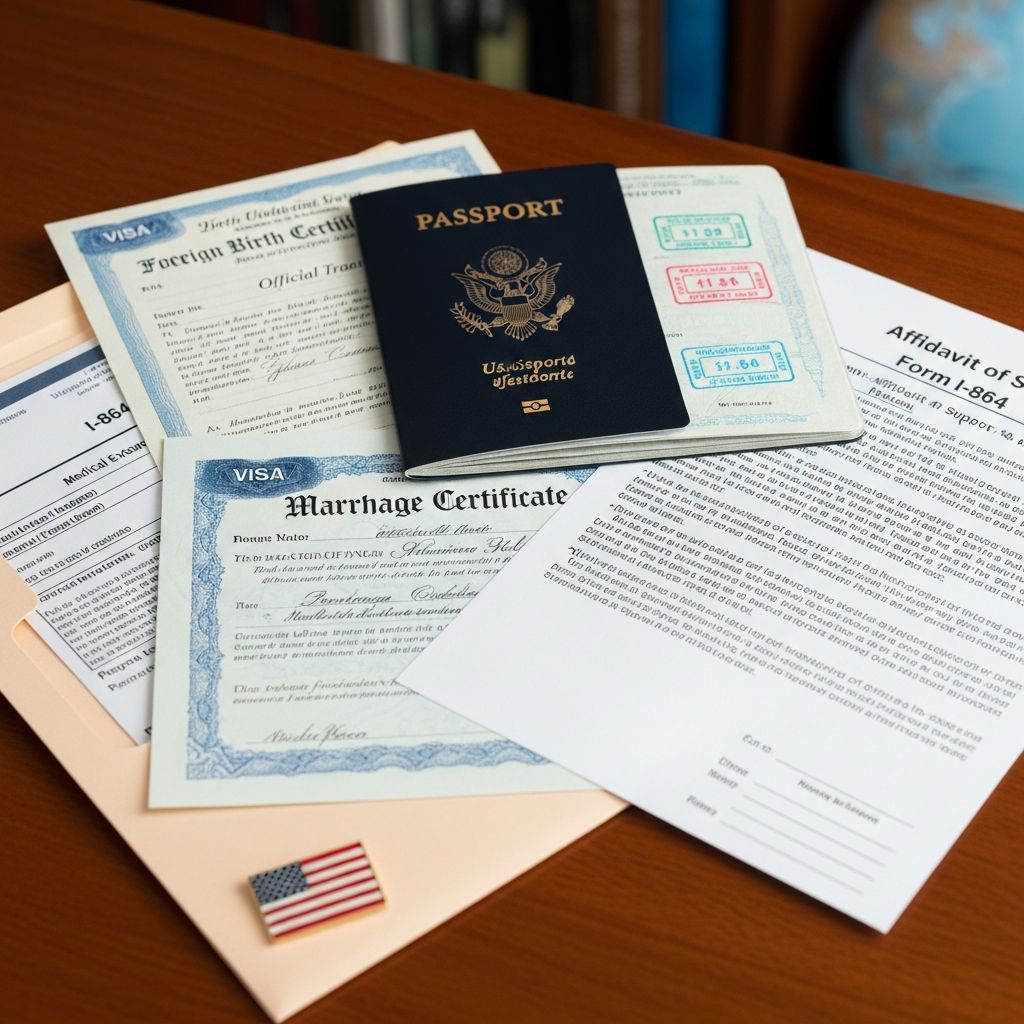
Obtaining a family immigrant visa through a U.S. consulate involves meticulous preparation of specific forms and supporting evidence to prove eligibility and relationships. This process allows approved petitioners in the U.S. to bring immediate relatives or family preference beneficiaries abroad for permanent residency.
Understanding the Family-Based Visa Pathway
Family immigrant visas enable U.S. citizens and lawful permanent residents (LPRs) to sponsor spouses, children, parents, siblings, and other relatives for green cards. The journey typically starts with filing Form I-130, Petition for Alien Relative, with U.S. Citizenship and Immigration Services (USCIS). Once approved, the case transfers to the National Visa Center (NVC) for document submission and fee payments, culminating in a consular interview.
Recent developments, including the February 2026 Visa Bulletin, outline priority dates for family-sponsored categories like F1 (unmarried sons/daughters of citizens), F2A (spouses/children of LPRs), and F2B (unmarried adult children of LPRs). Worldwide limits stand at 226,000 for family preferences, with per-country caps at 7%. Note that as of January 21, 2026, immigrant visa processing is suspended for nationals of 75 countries, potentially delaying cases from regions like Afghanistan and Albania. Exceptions may apply for certain family-based categories, but applicants should monitor State Department updates.
Core Application Forms Required
Applicants must complete and submit several standardized forms during the consular processing phase. These establish identity, intent, and compliance with U.S. immigration laws.
- DS-260 Online Immigrant Visa Application: The primary form filed electronically via the Consular Electronic Application Center (CEAC). It collects personal details, travel history, and background information. All applicants, including derivatives, must submit this.
- DS-260 Confirmation Page: Print the barcode page after submission as proof for the interview.
- Affidavit of Support (Form I-864): Proves the sponsor meets 125% of the Federal Poverty Guidelines income threshold. Multiple forms may be needed for joint sponsors or household members.
- Form I-864A (Contract Between Sponsor and Household Member): Used when household income contributes to the support requirement.
- DS-2054 (Medical Exam Addendum): Accompanies the required medical examination results.
Fees include a $325 immigrant visa processing fee and a $120 Affidavit of Support fee per applicant, payable to the NVC before interview scheduling.
Proving Family Relationships with Civil Documents
Consular officers scrutinize evidence of bona fide family ties, especially amid heightened 2026 reviews for genuine relationships. Originals or certified copies are mandatory; translations must be certified if not in English.
| Relationship Type | Required Documents |
|---|---|
| Marriage (Spouse) | Marriage certificate, proof of termination of prior marriages (divorce/death certificates), evidence of ongoing relationship (photos, joint accounts, correspondence) |
| Parent-Child | Child’s birth certificate listing both parents, adoption decree if applicable |
| Sibling | Birth certificates of both siblings showing same parents, parents’ marriage/birth records |
| Other (e.g., Fiancé Derivatives) | Supporting affidavits, DNA test results if requested |
For marriage cases, include joint financial records, travel itineraries, and photos spanning the relationship’s duration to counter fraud concerns. Sibling petitions often require extended family records due to backlog complexities.
Identity and Passport Requirements
A valid passport is non-negotiable, valid for at least six months beyond the intended U.S. entry date. Two passport-style photos (2×2 inches, white background) must match DS-260 specifications.
- Police certificates from every country lived in for six months or more after age 16.
- Military records if applicable.
- Court/certification of no criminal record for countries without formal police certificates.
Failure to provide these can result in administrative processing delays or refusals.
Medical Examination and Vaccination Proof
All applicants undergo a panel physician-approved medical exam, including vaccinations for MMR, polio, tetanus, and COVID-19 (as per current CDC guidelines). Sealed results in an envelope are presented at the interview; do not open them.
Vaccination waivers are rare and require compelling humanitarian reasons. Recent USCIS expansions in digital processing may streamline medical uploads.
Financial Support Documentation
The I-864 demands detailed income proof: recent tax returns (IRS Form 1040), W-2s, pay stubs, and employer letters. Assets like property or savings can supplement if income falls short.
- Public assistance history must be disclosed; 2026 public charge reviews emphasize self-sufficiency.
- Joint sponsors submit identical packages if primary fails thresholds.
Calculate requirements using the 2026 HHS Poverty Guidelines; for a household of four, it’s approximately $39,000 annually (125% level).
Navigating the Consular Interview Process
After NVC document approval (via checklist status), the embassy schedules the interview. Arrive early with all originals, copies, and fees receipt.
Officers assess admissibility, asking about relationship history, U.S. plans, and health. Derivatives (children under 14) may not need to attend. Post-interview, visas are typically issued within days if approved, valid for six months.
Common pitfalls: Incomplete I-864s or mismatched documents, leading to Requests for Evidence (RFEs).
Recent 2026 Policy Impacts on Processing
The U.S. State Department froze immigrant visa issuance for 75 countries effective January 21, 2026, amid public charge policy reviews under executive directives. This affects family categories but may exempt immediate relatives; check country-specific lists.
Visa Bulletin updates show F2A current for many, but F4 (siblings) retrogressed. USCIS backlogs persist, with digital tools offering hope for faster resolutions. Bond requirements for nonimmigrant visas expanded to 38 countries, indirectly signaling stricter compliance.
Tips for a Smooth Application
- Organize documents in labeled folders matching the welcome letter.
- Monitor CEAC and embassy websites weekly.
- Prepare for interview with practice questions on relationship authenticity.
- Consult an immigration attorney for complex cases, especially under suspensions.
DNA testing, if requested, is at applicant’s expense and conducted post-interview.
Frequently Asked Questions
What if my priority date is not current?
Wait for Visa Bulletin advancement; file DS-260 anytime after I-130 approval, but interview requires current date.
Can I expedite for medical emergencies?
Yes, submit evidence via embassy; approvals are discretionary.
What happens if documents are refused?
Address issues within response windows to avoid case closure.
Are children aging out an issue?
Yes, maintain under 21 via Child Status Protection Act; seek waivers if needed.
How long after visa issuance to enter U.S.?
Six months; pay USCIS Immigrant Fee online for green card production.
Conclusion: Preparation is Key to Family Reunification
Thorough documentation and awareness of updates like the 75-country suspension position applicants for success. Families separated by borders deserve efficient paths home; stay proactive amid evolving rules.
References
- WR Immigration News Digest — Wolfsdorf Rosenthal LLP. 2026-01-15. https://wolfsdorf.com/wr-immigration-news-digest-20260115/
- State Department Freezes Immigrant Visa Processing for 75 Countries — VisaHQ. 2026-01-17. https://www.visahq.com/news/2026-01-17/us/state-department-freezes-immigrant-visa-processing-for-75-countries/
- Visa Bulletin For February 2026 — U.S. Department of State. 2026. https://travel.state.gov/content/travel/en/legal/visa-law0/visa-bulletin/2026/visa-bulletin-for-february-2026.html
- What’s Changing for Family-Based Immigration in 2026 — Altius Immigration Law. 2026. https://altius.law/whats-changing-for-family-based-immigration-in-2026-and-how-it-could-affect-your-case/
- The Visa Bulletin — U.S. Department of State. 2026. https://travel.state.gov/content/travel/en/legal/visa-law0/visa-bulletin.html
- U.S. State Department Suspends Immigrant Visa Issuance — Kutak Rock LLP. 2026-01. https://www.kutakrock.com/newspublications/publications/2026/january/state-dept-suspends-immigrant-visa-75-countries
- BREAKING: The U.S. Just Announced a new 75-Country Immigrant Visa Suspension — Thomas M. Lee, Esq. 2026-01-14. https://www.thomasmlee.com/blog/breaking-the-u-s-just-announced-a-new-75-country-immigrant-visa-suspension-on-january-14-2026-what-does-it-means-for-immigrants/
Similar Articles








Read full bio of Sneha Tete


