The Illusion of Objective Surveillance
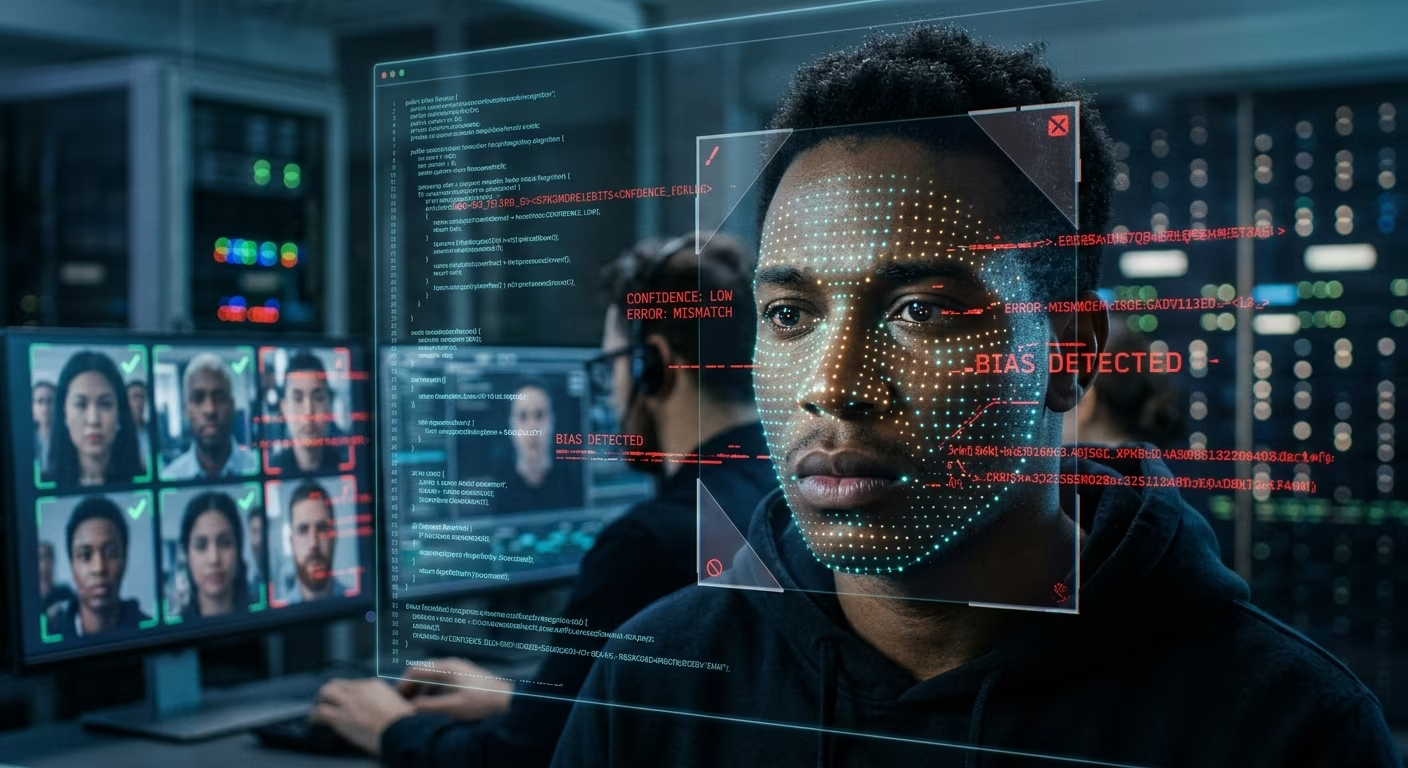
The digital age has ushered in a wave of technological advancements that promise unparalleled efficiency and security, with facial recognition technology (FRT) at the forefront of this revolution. Marketed as an objective, infallible tool for identifying individuals, this technology is rapidly permeating every facet of modern life, from unlocking smartphones to securing borders and aiding law enforcement investigations. However, beneath the veneer of mathematical precision lies a deeply troubling reality: artificial intelligence and algorithmic systems are not inherently neutral. They are constructed by humans, trained on human-generated data, and, consequently, they inherit and amplify human prejudices.
When applied to surveillance and policing, the systemic bias embedded in facial recognition technology transforms it from a tool of public safety into an instrument of systemic oppression. The intersection of algorithmic inaccuracy and historical over-policing creates a dangerous paradigm where marginalized communities—particularly Black, Indigenous, and People of Color (BIPOC)—bear the brunt of technological failures. The reliance on these flawed systems perpetuates a cycle of racial injustice, disguised as objective law enforcement, making it one of the most pressing civil rights crises of the twenty-first century.
The Mathematics of Prejudice: How Algorithms Fail Demographics
To understand why facial recognition technology is fundamentally biased, one must first examine how it is built. Machine learning algorithms, which power these systems, learn to identify faces by analyzing massive datasets containing millions of images. If these datasets are overwhelmingly composed of white, male faces—a phenomenon often referred to as the “pale male” data problem—the algorithm becomes highly proficient at distinguishing between white men but struggles significantly with other demographics. This is not a theoretical concern; it is a mathematically proven flaw documented by some of the world’s most authoritative institutions.
A landmark 2018 peer-reviewed study, known as “Gender Shades,” conducted by researchers at the Massachusetts Institute of Technology (MIT), systematically evaluated commercial gender classification systems. The researchers found that while the algorithms performed with near-perfect accuracy on lighter-skinned men, they suffered from alarming error rates when analyzing darker-skinned women, misidentifying them at rates exceeding one in three. The algorithm’s inability to read the faces of marginalized people is a direct consequence of who is included in the training data and who is left out.
This demographic disparity was further validated by the National Institute of Standards and Technology (NIST), the premier federal laboratory for technology evaluation. In a comprehensive 2019 report analyzing demographic effects across 189 facial recognition algorithms, NIST discovered widespread, empirical evidence of racial bias. The study found that false positive rates—situations where the algorithm incorrectly matches a person’s face with a different person’s photo in a database—were heavily skewed across various populations.
- Geographic Disparities: False positive rates were highest among faces from West African, East African, and East Asian demographics compared to Eastern European demographics.
- Gender and Age Factors: The technology exhibited elevated false positive rates for women across the board, as well as for the elderly and young children.
- Magnitude of Error: In some algorithms, the difference in false positive rates across demographic groups was a factor of 10 to 100, indicating catastrophic failure rates for non-white individuals.
The Dangers of False Positives versus False Negatives
Understanding the types of errors facial recognition makes is critical to grasping its civil rights impact. Algorithms generally make two distinct types of errors: false negatives and false positives.
| Error Type | Technical Definition | Real-World Consequence in Law Enforcement |
|---|---|---|
| False Negative | The system fails to match two photos of the exact same individual. | A suspect goes unidentified, or an individual is wrongly denied access to a secure facility or digital account. |
| False Positive | The system incorrectly matches two photos of totally different individuals. | An innocent person is identified as a criminal suspect, leading to wrongful interrogation, arrest, or incarceration. |
While false negatives pose an inconvenience or a missed opportunity for investigators, false positives represent a direct and immediate threat to personal liberty. Because algorithms struggle to differentiate between the facial structures of people of color due to inadequate training data, innocent Black and Brown individuals are far more likely to be falsely flagged as criminals.
Weaponizing Flawed Tech: The Policing Pipeline
The inherent biases within facial recognition algorithms are dangerous on their own, but they become weaponized when integrated into the criminal justice system without proper safeguards. Across the United States, federal, state, and local law enforcement agencies have rapidly adopted facial recognition services, often utilizing massive, unregulated databases that compile driver’s license photos, mugshots, and images scraped indiscriminately from social media platforms.
Despite the profound risks of misidentification, a 2023 report by the Government Accountability Office (GAO) exposed a disturbing lack of oversight in the federal use of these technologies. The GAO reviewed several law enforcement agencies within the Department of Homeland Security (DHS) and the Department of Justice (DOJ) and found that many officers using facial recognition had received zero mandatory training on how the technology works, its demographic limitations, or how to interpret its results. In many cases, officers treated the algorithm’s numerical “confidence score” as unassailable proof, bypassing traditional and necessary investigative protocols.
Furthermore, facial recognition is not deployed evenly across society. Surveillance cameras, from which many facial recognition queries originate, are disproportionately located in low-income neighborhoods and communities of color. This geographic targeting creates a dangerous feedback loop: heavily policed communities are subjected to more digital surveillance, which generates more facial recognition searches, which in turn leads to more police encounters. The technology effectively automates and supercharges the historical over-policing of marginalized groups.
The Human Toll: False Arrests and Ruined Lives
The abstract mathematics of algorithmic bias translate into devastating human tragedies. In recent years, multiple high-profile cases have emerged in which innocent Black men were falsely arrested, jailed, and prosecuted based entirely on erroneous facial recognition matches. The narrative is chillingly consistent across these cases: a crime is caught on grainy surveillance footage, the low-quality image is fed into a facial recognition database, the algorithm spits out a false match of an innocent person, and police proceed to make an arrest without gathering corroborating physical evidence.
For the victims, the consequences are severe and life-altering. They are torn from their families, publicly humiliated in front of their communities, and forced into holding cells—sometimes for days or weeks—for crimes they absolutely did not commit. The burden of proof is unjustly shifted onto the accused, who must somehow prove that an opaque, proprietary machine learning algorithm made a mathematical mistake. Even after the charges are inevitably dropped, the trauma, crushing legal fees, and permanent digital footprint of a wrongful arrest can haunt victims for years. These incidents highlight a severe violation of civil liberties, as an algorithmic guess is erroneously elevated to the legal standard of probable cause.
Chilling Effects on Civil Liberties
Beyond the immediate, visceral threat of false arrest, the ubiquitous deployment of facial recognition technology casts a long shadow over fundamental civil liberties, particularly the First Amendment rights to free speech and peaceful assembly. History shows that surveillance technologies are frequently turned against activists, political dissidents, and social justice movements, and facial recognition is no exception.
During large-scale protests, law enforcement agencies have been documented using facial recognition to scan crowds, identify participants, and catalog their presence at political events. This creates a profound chilling effect on democracy. Knowing that attending a rally could result in one’s face being scanned, stored indefinitely in a government database, and potentially misidentified as a criminal suspect deters citizens from exercising their constitutional rights. For communities of color, who have historically been the targets of extensive state surveillance programs, the digital panopticon represents a modern, automated evolution of an old and oppressive tactic.
The invasion of privacy is absolute. Our faces are our most public and permanent identifiers; unlike a password or an ID card, a face cannot be left at home, changed, or hidden easily. When public spaces are blanketed with biometric surveillance, anonymity ceases to exist, fundamentally altering the relationship and power dynamic between the citizen and the state.
Regulatory Voids and The Urgent Call for Legislation
Despite the well-documented biases and civil liberties violations associated with facial recognition technology, the United States currently lacks a comprehensive federal framework regulating its use. The current legal landscape is a chaotic patchwork of local ordinances and state laws. Several progressive cities and municipalities have recognized the profound dangers and enacted outright bans on government use of facial recognition, citing its unreliability and demonstrably racist outcomes. However, in most jurisdictions, law enforcement operates in a regulatory void, purchasing and deploying powerful surveillance tools with little transparency, oversight, or public consent.
Advocacy groups and civil rights organizations are urgently calling for sweeping legislative action. At a minimum, proponents of civil liberties demand a federal moratorium on law enforcement use of facial recognition until the technology can be proven undeniably accurate across all demographic groups and rigorous, enforceable guardrails are established. Others argue that the technology is fundamentally incompatible with a free democratic society and should be banned outright in all public spaces. The path forward requires shifting the paradigm from unchecked, rapid technological adoption to one that prioritizes human rights, algorithmic transparency, and strict accountability for the developers and deployers of biased artificial intelligence.
Frequently Asked Questions (FAQs)
Why is facial recognition technology considered racially biased?
Facial recognition technology is considered racially biased because it consistently demonstrates significantly higher error rates when analyzing the faces of Black, Indigenous, and People of Color (BIPOC) compared to white individuals. This occurs primarily because the algorithms are trained on datasets that heavily over-represent white faces. Consequently, the technology struggles to accurately map and differentiate the facial features of darker-skinned individuals, leading to a much higher likelihood of misidentification.
What is a false positive in facial recognition?
A false positive occurs when a facial recognition system incorrectly matches an image of an unknown person (such as a suspect captured on a security camera) with a completely different person in an existing database. In the context of law enforcement, a false positive means an innocent person is wrongly identified as a criminal suspect, which has directly led to wrongful arrests and unlawful incarcerations.
Can police use facial recognition alone to arrest someone?
Legally and procedurally, a facial recognition match is supposed to be treated only as an “investigative lead,” not as probable cause for an arrest. Law enforcement is expected to find physical corroborating evidence. However, in practice, multiple high-profile cases have revealed that police officers have used unverified facial recognition matches as the sole basis for securing arrest warrants, completely bypassing necessary investigative work and leading to the false arrest of completely innocent individuals.
Are there laws banning the use of facial recognition in the US?
Currently, there is no overarching federal law banning the use of facial recognition technology in the United States. However, a growing number of cities, including San Francisco, Boston, and Portland, have passed local ordinances banning municipal agencies and police departments from using the technology. The legal landscape varies drastically depending on your specific state and local jurisdiction.
How can the bias in artificial intelligence be fixed?
Fixing bias in AI requires a multifaceted, structural approach. First, the datasets used to train these algorithms must be drastically diversified to accurately and equitably reflect the entire human population. Second, there must be independent, third-party audits of AI systems to ensure they meet strict accuracy standards across all demographics before they can be sold to governments. Finally, there must be robust legal frameworks that hold both tech companies and end-users accountable when algorithmic bias causes tangible harm.
References
- Face Recognition Vendor Test (FRVT) Part 3: Demographic Effects — National Institute of Standards and Technology (NIST). 2019-12-19. https://nvlpubs.nist.gov/nistpubs/ir/2019/NIST.IR.8280.pdf
- Facial Recognition Services: Federal Law Enforcement Agencies Should Take Actions to Implement Training, and Policies for Civil Liberties — U.S. Government Accountability Office (GAO). 2023-09-12. https://www.gao.gov/products/gao-23-105607
- Gender Shades: Intersectional Accuracy Disparities in Commercial Gender Classification — Joy Buolamwini, Timnit Gebru / Proceedings of Machine Learning Research. 2018-02-24. http://proceedings.mlr.press/v81/buolamwini18a/buolamwini18a.pdf
- Facial recognition technology jailed a man for days. His lawsuit joins others from Black plaintiffs — Associated Press (AP News). 2023-09-24. https://apnews.com/article/facial-recognition-wrongful-arrest-lawsuit-black-men-21727c9d92415174fba4a5a54cc981d3