When Photo Apps Analyze Faces: What the Law Sees
Photo organization tools that identify faces are now common in consumer apps, especially on mobile platforms. These systems can group pictures by person, suggest albums, and make large libraries easier to search, but they also raise questions about whether a company is collecting biometric information and whether users have really agreed to it. The legal answer depends on both the technical design of the feature and the privacy statute being applied, which is why similar products can trigger lawsuits yet still survive in court.
At the center of the debate is a simple tension: a system may scan a face without using that information in a dramatic way, but the scanning itself can still feel invasive. Courts often separate that feeling from the narrower question of whether the plaintiff can prove a concrete legal injury. In the dispute involving Google Photos, the court treated the alleged face-template collection as potentially sensitive, but it still found the plaintiffs had not shown the type of harm needed for federal standing.
Why Face Templates Matter in Privacy Disputes
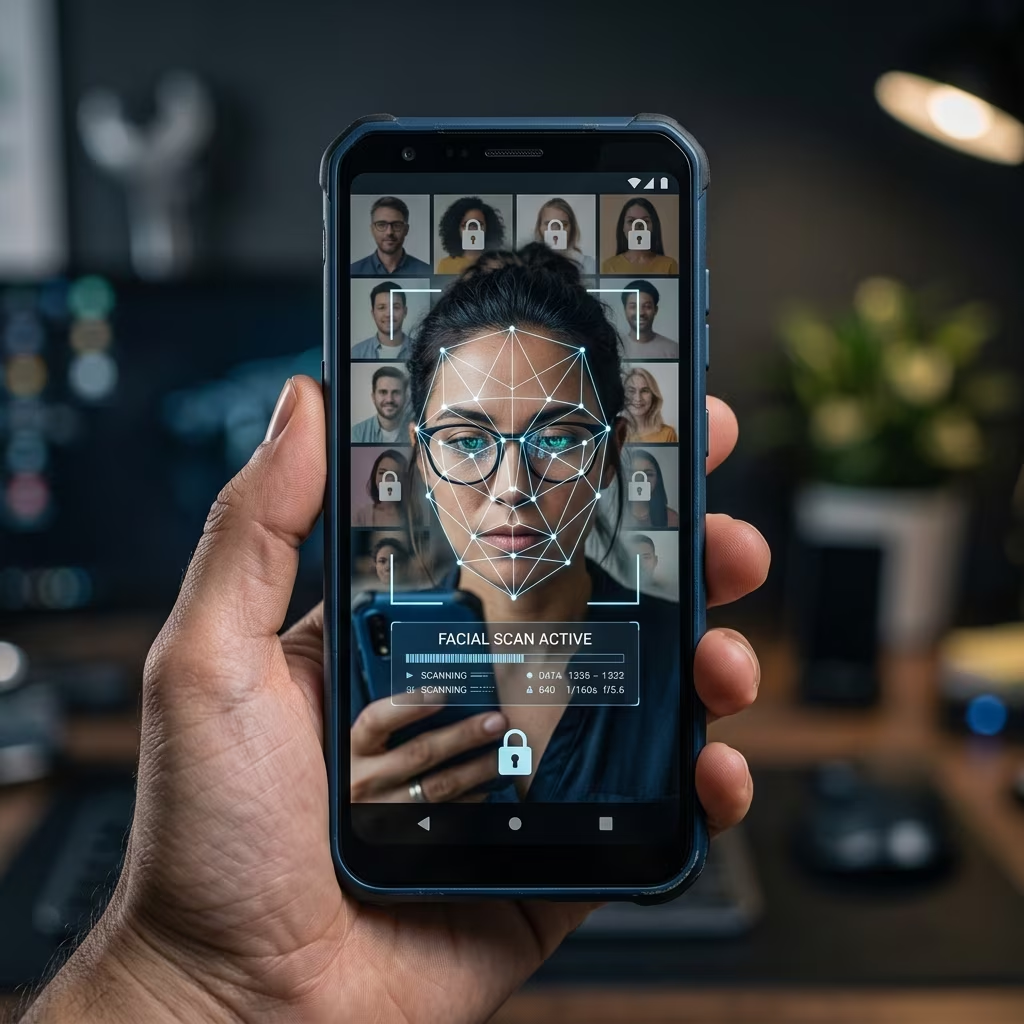
Face-recognition tools do not all work the same way. Some systems unlock a phone locally, some identify people in cloud-stored images, and some create mathematical representations of facial features so a program can compare and sort pictures. Those representations are often called face templates or faceprints, and privacy laws may treat them as biometric data when they are tied to a person’s identity.
The legal concern is not only that a face is visible in a photograph. Instead, the issue is whether software extracts measurable information from that face and stores or uses it in a way that can be linked back to an individual. That distinction matters because courts and regulators tend to focus on whether the company is creating a persistent biometric profile, not merely handling an ordinary image file.
In Illinois, the Biometric Information Privacy Act is especially important because it limits how private entities collect and use biometric identifiers. That statute has become one of the most influential privacy laws in the United States because it allows private lawsuits and has produced major litigation over face scans, fingerprints, and similar technologies.
Consent Is Important, But It Is Not the Whole Case
One of the first questions in these cases is whether the company got proper consent. If a service scans faces without clearly informing users and obtaining permission, plaintiffs may argue that the company violated a biometric privacy law. In the Google Photos litigation, the court assumed for purposes of the ruling that the face templates could qualify as biometric information and that affected people had not consented, yet the case still failed on standing grounds.
That result shows how privacy litigation often turns on more than just the consent question. A plaintiff must usually show not only that the law was violated, but also that the violation caused a concrete injury recognized by the court. Under Article III of the U.S. Constitution, federal courts cannot decide abstract disputes; they need an actual case or controversy. This requirement can be a major obstacle in privacy suits where the harm is difficult to quantify.
As a practical matter, companies often respond to this risk by adding opt-out settings, disclosure language, or limited-use assurances. Those design choices do not automatically eliminate legal exposure, but they may help support arguments that the feature is narrow, expected, and not used for broad surveillance or commercial profiling.
Why One Court Was Not Persuaded by the Harm Claim
The Google Photos decision is notable because the court did not deny that the feature involved face scanning. Instead, it focused on whether the plaintiffs had shown a concrete injury like identity theft, financial loss, emotional distress, or a similar real-world consequence. The court found no substantial risk that the use of face templates would lead to identity theft, and it also noted that the plaintiffs had not alleged additional harm beyond feeling offended by the collection itself.
That reasoning reflects a broader trend in federal courts after the Supreme Court’s standing decisions: a statutory violation alone does not always create a case that can be heard in federal court. Plaintiffs must connect the alleged legal violation to a tangible injury or a harm closely related to traditional privacy torts. In the Google case, the court concluded that the alleged injury was not sufficiently concrete to meet that standard.
For technology companies, this distinction is critical. A feature may still be controversial, but controversy is not automatically the same as justiciable harm. For users and privacy advocates, the decision can feel unsatisfying because it suggests that a system may scan faces without permission and yet still avoid liability if the plaintiffs cannot prove more than discomfort or generalized concern.
How Other Courts and Advocates View Face Recognition
Not all courts have viewed face-recognition privacy claims the same way. In a later Ninth Circuit decision discussed by the ACLU, the court recognized that developing a face template without consent can invade private affairs and concrete interests, signaling a more receptive view of biometric privacy harm. That does not mean every case will succeed, but it shows that the law is still developing and that outcomes can depend heavily on the circuit, the statute, and the specific facts.
Advocacy groups argue that face recognition is uniquely sensitive because a face cannot be changed the way a password can. They also emphasize that biometric systems can be used repeatedly, quietly, and at scale, which makes them more privacy-invasive than a one-time data collection event. These concerns are part of why biometric statutes exist and why lawmakers have treated facial data differently from ordinary account information.
Technology defenders, by contrast, often stress that face grouping in photo libraries can be user-facing convenience rather than surveillance. When the software simply helps a person sort private pictures on their own account, companies argue that the risk profile is much lower than a system that shares biometric data with third parties or uses it for advertising.
What Makes a Face-Scanning Feature Less Legally Risky?
Several design choices can reduce the legal risk of a photo app that analyzes faces. These choices do not guarantee immunity, but they often matter in litigation and regulatory review.
- Limiting the feature to private organization rather than public identification.
- Avoiding disclosure of face templates to third parties.
- Separating biometric data from advertising or profiling systems.
- Providing notice and a meaningful opt-out option.
- Storing the data only as long as needed for the feature’s operation.
These measures matter because they help show that the company is not using biometric data for broad secondary purposes. In the Google Photos case, the absence of allegations that Google disclosed the templates, mined them for ads, or linked them to other datasets helped support the view that the alleged harm was limited to a private sorting function.
A Practical Comparison of Privacy Risks
| Feature type | Typical function | Privacy concern |
|---|---|---|
| Local phone unlock | Verifies identity on the device | Usually lower concern if data stays on-device |
| Photo library face grouping | Sorts images by person | Moderate concern because templates may be created |
| Cross-platform facial profiling | Identifies people across services | Higher concern because of broader tracking potential |
This comparison is not a legal rule, but it captures how courts and regulators often think about the issue. The more a system resembles private convenience and the less it resembles persistent identification or sharing, the easier it becomes for a company to argue that the risk of real harm is limited.
What Consumers Should Watch For
Users often assume that if a feature is built into a familiar app, it must be harmless. That assumption is risky. People should check whether the app explains how facial data is used, whether the feature is optional, and whether the service says the analysis happens locally or in the cloud. The difference can affect both privacy protection and legal rights.
It is also worth remembering that consent language can be easy to overlook. A settings menu or terms-of-service notice may satisfy a company’s paperwork needs even if many users never read it. That is why biometric privacy debates often focus on transparency, clarity, and the ability to refuse the feature without losing core service functionality.
Frequently Asked Questions
Does face-scanning in a photo app always violate privacy law?
No. Whether it violates the law depends on the statute, the way the feature works, whether consent was obtained, and whether the plaintiff can show a legally recognized injury.
Is a face template the same as a photograph?
No. A photograph is an image, while a face template is typically a numerical or algorithmic representation used to compare or classify faces. That difference is one reason biometric laws treat the issue separately from ordinary photo storage.
Why did the Google Photos case fail?
The court assumed the face templates might be biometric data and assumed consent may have been missing, but it still dismissed the claim because the plaintiffs did not show a concrete injury for federal standing purposes.
Can biometric privacy claims still succeed in other courts?
Yes. Other courts have recognized that face-template creation can invade concrete privacy interests, so outcomes may differ depending on the jurisdiction and the facts.
What is the biggest legal risk for app developers?
The biggest risk is collecting or using biometric data without clear notice, proper consent, and a limited purpose. Broad reuse, sharing, or profiling can increase exposure substantially.
Why This Issue Still Matters
Face scanning in consumer apps sits at the intersection of convenience and surveillance concerns. A feature designed to help users find childhood photos or group family images can also trigger serious questions about how biometric data is created, stored, and used. The law has not settled every aspect of this debate, which is why similar features can be defended as useful one day and attacked as invasive the next.
For now, the most important lesson is that privacy law does not stop at the question of whether a face was scanned. Courts also ask how the data was used, who could access it, whether consent existed, and whether the plaintiff suffered a concrete harm. That framework explains why some face-scanning claims survive while others do not.
References
- Google, Facebook, and the Legal Mess Over Face Scanning — Yahoo Finance. 2019-01-02. https://finance.yahoo.com/news/google-facebook-legal-mess-over-221721882.html
- Google Photos Defeats Privacy Lawsuit Over Face Scans-Rivera v. Google — Eric Goldman’s Technology & Marketing Law Blog. 2018-12-13. https://blog.ericgoldman.org/archives/2018/12/google-photos-defeats-privacy-lawsuit-over-face-scans-rivera-v-google.htm
- A Federal Court Sounds the Alarm on the Privacy Harms of Face Recognition — American Civil Liberties Union. 2019-08-23. https://www.aclu.org/news/privacy-technology/federal-court-sounds-alarm-privacy-harms-face