
Eyewitness ID: How Lineups and Showups Work
Understanding how police lineups, photo arrays, and showups affect criminal cases and due process rights.
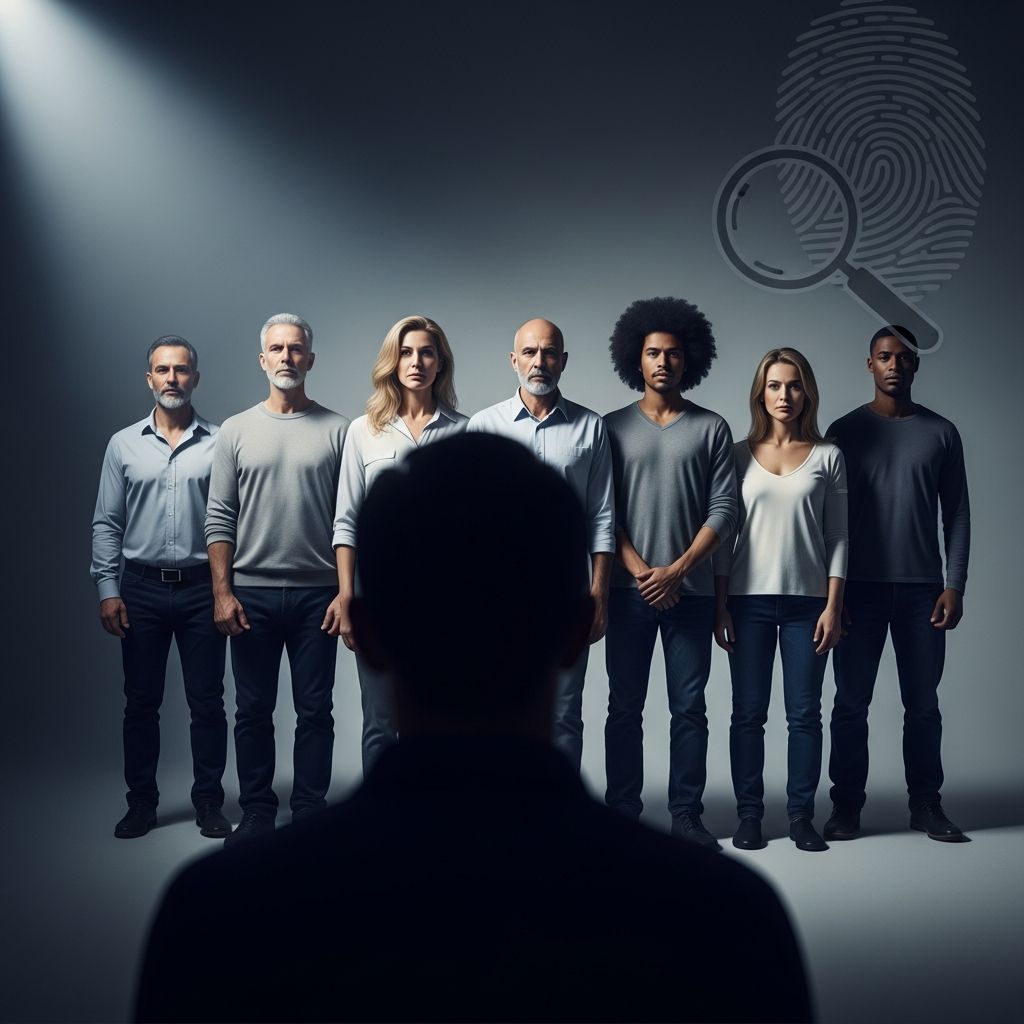
How Police Identify Suspects Through Eyewitnesses
When a crime occurs and there is no clear video or forensic evidence, police often rely on eyewitnesses to help identify the person responsible. This process typically involves some form of identification procedure: a live lineup, a photo array, or a showup where a single suspect is presented. These tools are powerful, but they also carry serious risks. If not conducted carefully, they can lead to mistaken identifications and, in the worst cases, wrongful convictions. Understanding how these procedures work, what safeguards exist, and what can go wrong is essential for anyone involved in or affected by the criminal justice system.
Common Types of Identification Procedures
Law enforcement agencies use several structured methods to obtain eyewitness identifications. Each has its own strengths and weaknesses, and courts evaluate them differently under constitutional law.
Live Lineups (Physical Lineups)
A live lineup, sometimes called a physical lineup, brings together the suspect and several other people, known as fillers or foils, who resemble the suspect in key ways. The witness is brought into a room (often with a one-way mirror) and asked whether they recognize anyone from the crime.
- The suspect stands among at least four or five fillers.
- Fillers are chosen to match the suspect’s description: age, height, build, race, hair color, and other distinguishing features.
- The lineup may be conducted simultaneously (all people shown at once) or sequentially (one at a time).
- Procedures are usually recorded, and the witness is instructed that the perpetrator may or may not be present.
Photo Arrays (Photo Lineups)
A photo array, often referred to as a photo lineup or “six-pack,” is a set of photographs shown to a witness. It typically includes the suspect’s photo and several others of people who resemble the suspect.
- Photos are usually presented one at a time (sequential) or all together (simultaneous).
- They should be of similar quality, size, and background, with no markings that suggest which one is the suspect.
- Only one suspect should appear per array, and if multiple suspects are involved, separate arrays are used.
Showups (Single-Suspect Identifications)
A showup occurs when police bring a single suspect to a witness, often shortly after the crime, and ask if that person is the perpetrator. This is common when a suspect is arrested near the scene or soon after the incident.
- It is inherently more suggestive than a lineup because the witness knows police have focused on this one person.
- Courts allow showups when they are necessary and reliable, such as when a suspect is caught in the act or very close in time and place to the crime.
- Because of the risk of suggestion, showups are scrutinized closely if challenged later in court.
Why Identification Procedures Matter in Criminal Cases
Identifications made during lineups, photo arrays, or showups can become central evidence at trial. A confident eyewitness saying, “That’s the person who did it,” can be extremely persuasive to a jury. But research and experience show that eyewitness memory is far from perfect.
- Stress, lighting, distance, and the presence of weapons can all distort what a witness remembers.
- Memory can be influenced by how the identification procedure is conducted.
- Once a witness makes an identification, they often become more confident over time, even if they were initially uncertain.
Because of these risks, courts and legal standards place strict limits on how identifications can be used, especially if the procedure was unfair or suggestive.
Constitutional Protections in Identification Procedures
The U.S. Constitution, particularly the Due Process Clause of the Fourteenth Amendment, protects suspects from identification procedures that are so unfair they create a substantial risk of misidentification.
When a Procedure Violates Due Process
A lineup or showup can be challenged if it was unduly suggestive and created a serious risk that the witness would mistakenly identify an innocent person. Courts look at the “totality of the circumstances” to decide whether an identification should be allowed in court.
Examples of procedures that may violate due process include:
- Fillers who look nothing like the suspect, making the suspect stand out.
- Only the suspect is asked to repeat something the perpetrator said or to wear clothing described in the crime.
- Police hinting that the suspect is the one they believe committed the crime.
- Showing the suspect alone to the witness after telling them they have “caught the guy.”
- Allowing the suspect to be pointed out before or during the procedure.
If a court finds that the procedure was so suggestive that it violated due process, any later in-court identification by that witness may be excluded from trial.
The Role of the “Totality of the Circumstances” Test
Courts do not automatically throw out an identification just because the procedure had some suggestive elements. Instead, they apply a balancing test that considers:
- How suggestive the procedure was.
- How reliable the identification itself appears to be, based on factors like:
- The witness’s opportunity to observe the perpetrator.
- The witness’s degree of attention at the time.
- The accuracy of the witness’s prior description of the perpetrator.
- The level of certainty expressed at the time of identification.
- The time between the crime and the identification.
If the reliability of the identification outweighs the suggestiveness of the procedure, the court may still allow it to be presented to the jury.
Best Practices for Fair and Reliable Identifications
To reduce the risk of mistaken identifications and protect both public safety and defendants’ rights, many jurisdictions have adopted evidence-based guidelines for conducting identification procedures.
Key Elements of a Fair Lineup or Photo Array
- Double-blind administration: The officer showing the lineup or photos should not know who the suspect is, so they cannot unintentionally influence the witness.
- Fillers who match the description: Fillers should resemble the suspect in age, race, height, build, hair, and other features so no one stands out unfairly.
- Neutral instructions: The witness should be told that the perpetrator may or may not be in the lineup and that they should not feel pressured to pick anyone.
- Sequential presentation: Showing photos or people one at a time reduces the chance that a witness will simply pick the person who looks most like the perpetrator compared to the others.
- Recording the procedure: Audio or video recording helps ensure transparency and provides a clear record of what happened.
- One suspect per lineup: Only one suspect should appear in each lineup or photo array, with different fillers used if multiple suspects are involved.
Proper Instructions to Witnesses
What the witness is told before viewing a lineup or photo array can have a major impact on the outcome. Recommended instructions include:
- “The person who committed the crime may or may not be in this lineup.”
- “You should not feel that you have to pick anyone.”
- “It is just as important to clear innocent people as it is to identify the guilty.”
- “If you do not see the person, it is okay to say so.”
These instructions help reduce pressure on the witness and encourage honest, careful decisions.
How Courts Evaluate Identification Evidence
When a defendant challenges an eyewitness identification, the court must decide whether the identification is reliable enough to be presented to the jury. This often happens in a pretrial hearing, sometimes called a Manson hearing after the Supreme Court case Manson v. Brathwaite.
Factors Courts Consider
In deciding whether an identification is admissible, courts look at several factors:
| Factor | What It Means |
|---|---|
| Opportunity to Observe | How clearly and for how long the witness saw the perpetrator (lighting, distance, duration). |
| Attention | Whether the witness was focused on the perpetrator (e.g., not distracted by a weapon). |
| Accuracy of Prior Description | How well the witness’s earlier description matches the suspect. |
| Level of Certainty | The witness’s confidence at the time of the first identification, not later at trial. |
| Time Between Crime and Identification | Shorter time generally supports reliability; longer delays increase risk of error. |
When Identifications Are Excluded
If the court finds that the identification procedure was so suggestive that it created a substantial risk of misidentification, and that risk is not outweighed by the reliability of the identification, the court may:
- Exclude the out-of-court identification (e.g., the lineup or photo array result).
- Exclude any later in-court identification by that witness, unless the prosecution can show it has an independent basis (for example, if the witness had multiple prior contacts with the suspect).
This is a high bar, but it is meant to protect against convictions based on unreliable eyewitness testimony.
Practical Implications for Defendants and Attorneys
For anyone accused of a crime, the way an eyewitness identification was conducted can be a critical part of the defense. Knowing what to look for can make a real difference in the outcome of a case.
What to Ask About an Identification
- When and where was the identification made?
- Was it a live lineup, photo array, or showup?
- Were the fillers similar in appearance to the suspect?
- Was the procedure recorded?
- Did the officer know who the suspect was?
- What instructions were given to the witness?
- Was the witness told the perpetrator might not be present?
- How much time passed between the crime and the identification?
When to Challenge the Identification
A defense attorney may challenge an identification if:
- The procedure was highly suggestive (e.g., only the suspect matched the description).
- The witness was pressured or given misleading information.
- The witness’s description of the perpetrator does not match the suspect.
- The identification was made long after the crime, with no intervening contact.
Successfully challenging an identification can weaken the prosecution’s case or, in some cases, lead to dismissal of charges.
Frequently Asked Questions
Can police force a suspect to participate in a lineup?
No, police cannot force a suspect to participate in a lineup over their objection, but they can use other evidence to support the case. In some cases, a refusal to participate may be noted, but it cannot be used as direct evidence of guilt.
What happens if a witness picks the wrong person in a lineup?
If a witness mistakenly identifies an innocent person, that person may be investigated or even charged. Later evidence (alibis, video, DNA) can help correct the error, but the initial misidentification can still cause serious harm. This is why fair procedures are so important.
Can a witness be shown the same suspect in multiple lineups?
Generally, no. Showing the same suspect in multiple lineups with the same fillers can be highly suggestive. If multiple suspects are involved, each should be in a separate lineup with different fillers.
Are photo arrays as reliable as live lineups?
Both can be reliable if conducted properly. Photo arrays are more convenient and easier to standardize, while live lineups allow the witness to see movement and hear the suspect’s voice. The key is how the procedure is structured, not just the format.
What if the police only show one photo to a witness?
Showing only one photo is essentially a showup and is considered highly suggestive. It may be allowed if done soon after the crime and under emergency circumstances, but it will be closely examined if challenged in court.
Can a defendant testify about how the lineup was conducted?
Yes. A defendant can testify about their experience in the lineup, including how they were treated, what they were told, and whether the procedure seemed fair. This testimony can support a motion to suppress the identification.
References
- Colorado Eyewitness Identification Procedures — Colorado Department of Revenue. Accessed 2025. https://cdor.colorado.gov/eyewitness-identification
- U.S. Attorney’s Manual: Lineup—Due Process — U.S. Department of Justice. https://www.justice.gov/archives/jm/criminal-resource-manual-241-lineup-due-process
- Police Lineup – Wikipedia — Wikimedia Foundation. https://en.wikipedia.org/wiki/Police_lineup
- Eyewitness Identification Model Procedures — Police Chiefs’ Eyewitness Identification Task Force. https://pceinc.org/wp-content/uploads/2015/06/Eyewitness-Identification-Model-Photo-Array-and-Lineup-ID-Procedures.pdf
- National Academies Report: Eyewitness Identification Procedures — National Academies of Sciences, Engineering, and Medicine. https://www.nationalacademies.org/read/18891/chapter/4
Similar Articles








Read full bio of medha deb


