
Exploring Patent Categories: Utility, Design, and Plant
Unlock the secrets of utility, design, and plant patents to safeguard your innovations effectively in a competitive market.
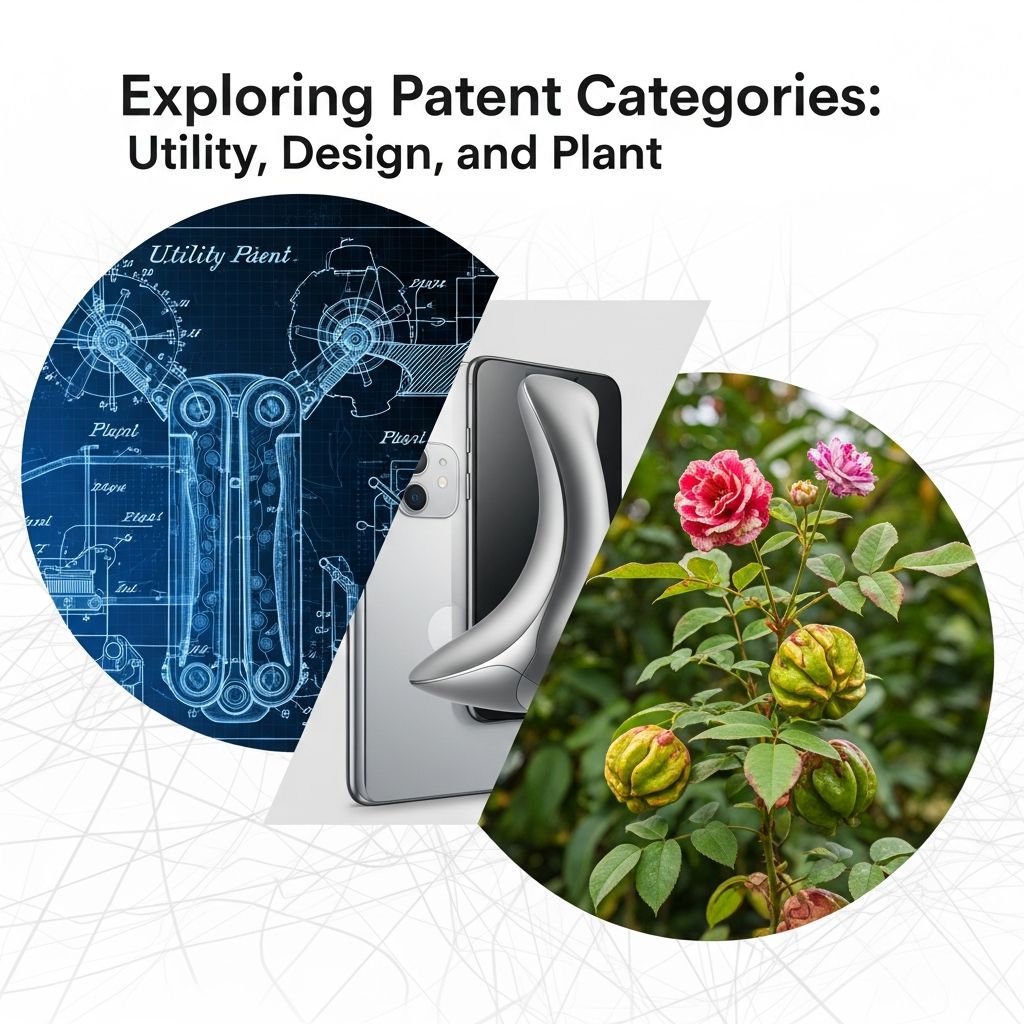
Patents serve as vital tools for inventors, granting exclusive rights to their creations and fostering innovation across industries. In the United States, the U.S. Patent and Trademark Office (USPTO) recognizes three fundamental categories: utility, design, and plant patents. Each type addresses distinct aspects of inventiveness, from functional mechanisms to aesthetic appearances and biological discoveries. Understanding these distinctions is crucial for selecting the appropriate protection strategy, ensuring inventions remain secure from unauthorized use for defined periods.
Core Foundations of Patent Protection
At their essence, patents reward originality by preventing others from making, using, selling, or importing the protected invention without permission. This monopoly typically lasts 20 years for utility and plant patents from the filing date, while design patents offer 15 years from the grant date, with no maintenance fees required. Eligibility hinges on novelty, non-obviousness, and utility, though specifics vary by category. Over 90% of USPTO-issued patents fall under utility, underscoring their dominance in technological advancement.
Inventors must navigate application processes, including provisional filings for utility and plant patents to secure early priority dates without full examination. These temporary placeholders allow one year to refine non-provisional submissions. Global considerations, such as Patent Cooperation Treaty (PCT) applications, enable streamlined international filings, though protection remains territorial.
Utility Patents: Safeguarding Functional Innovations
Utility patents, often called “patents for invention,” protect the operational heart of new or improved devices, methods, compositions, or manufactures. They cover anything from machinery and chemical formulas to software algorithms and business processes, provided the invention demonstrates practical usefulness, novelty, and non-obvious improvement over prior art.
These patents encompass four primary subcategories:
- Process Patents: Methods or procedures for achieving specific outcomes, such as manufacturing techniques for advanced batteries or pharmaceutical synthesis.
- Machine Patents: Tangible devices capable of motion or operation, like enhanced electric motors or robotic arms.
- Manufacture Patents: Articles without moving parts but with technical upgrades, exemplified by an optimized automotive component.
- Composition Patents: Novel material blends, including drugs, alloys, or polymers.
Protection endures for 20 years from filing, requiring maintenance fees at 3.5, 7.5, and 11.5 years to avoid lapse. Business method patents, a utility subset, shield innovative processes in finance or e-commerce, such as Amazon’s one-click purchasing system. Filing demands detailed specifications, claims defining the invention’s scope, drawings, and oaths from inventors.
| Utility Patent Subcategory | Description | Example |
|---|---|---|
| Process | Method to produce or transform | Battery production technique |
| Machine | Operational device | Improved engine |
| Manufacture | Static improved article | Enhanced glove box lid |
| Composition | New material mix | Novel drug formula |
Strategic licensing options include exclusive agreements for sole use in markets or non-exclusive for broader dissemination, aligning with business objectives.
Design Patents: Shielding Visual Appeal
Design patents focus exclusively on the ornamental, non-functional appearance of a product, protecting unique shapes, patterns, or surface ornamentation that enhance aesthetic value. Unlike utility patents, they ignore structural or operational features, targeting how an item looks to the eye.
Eligibility requires the design to be novel, original, and non-obvious, typically illustrated through drawings or photographs. Common in consumer goods, electronics, and furniture, examples include the iconic Apple Watch face or zippered earphone cords (US D652407). Duration is 15 years from issuance, with no renewal fees, making them cost-effective for short-term visual exclusivity.
Applications emphasize clear visual representations, often using solid black lines for outlines and shading for depth. They prevent competitors from copying the exact look, boosting brand distinctiveness without claiming functionality. Internationally, equivalents like European Community Designs offer similar but varying protections.
Plant Patents: Innovating in Botany
Plant patents reward discoveries or inventions of new, distinct, asexually reproduced plant varieties, excluding those naturally occurring or sexually reproduced via tubers. Asexual reproduction—via cuttings, grafting, or layering—ensures genetic uniformity, qualifying hybrids, mutants, or seedlings like the ‘Legacy’ sugar maple tree (US PP04979).
Granted for 20 years from filing, these patents cover the plant itself, not seeds or sexual offspring, promoting agricultural innovation in ornamentals, fruits, and ornamentals. Requirements include detailed botanical descriptions, origin narratives, and specimen deposits with authorized repositories. They represent a niche but vital category, encouraging biodiversity and crop improvement.
Navigating Patent Application Pathways
Beyond core types, inventors encounter varied application formats to optimize protection:
- Provisional Applications: Low-cost placeholders establishing priority for utility/plant inventions, valid for 12 months.
- Non-Provisional Applications: Full examinations leading to grants.
- Continuation Applications: Refine claims without new matter (U.S.-specific).
- Divisional Applications: Split claims for distinct inventions.
- Continuation-in-Part (CIP): Add new details to ongoing applications.
- Convention/PCT Applications: Claim foreign priorities or pursue multi-country filings.
Reissue applications correct errors, while patents of addition build on granted ones. Each suits evolving inventions, with examiners issuing search reports citing prior art.
Strategic Considerations for Inventors
Choosing the right patent type—or combination—maximizes value. A smartphone might secure utility for software/hardware and design for its chassis. Costs vary: utility filings average higher due to complexity, while designs are simpler. International strategies via PCT defer national phases, aiding global portfolios.
Licensing amplifies revenue: exclusive deals dominate niches, non-exclusive scale distribution. Enforcement involves litigation, but strong patents deter infringement proactively.
Frequently Asked Questions (FAQs)
What distinguishes utility from design patents?
Utility patents protect functional aspects like how something works, lasting 20 years; design patents cover ornamental appearances, lasting 15 years.
Can plant patents cover sexually reproduced plants?
No, only asexually reproduced varieties qualify, such as those via grafting.
How long do utility patents last?
20 years from filing date, subject to maintenance fees.
What is a provisional patent application?
A temporary filing for utility/plant inventions to secure an early priority date without full claims.
Are business methods patentable?
Yes, as utility patents if novel and non-obvious, like e-commerce processes.
Conclusion: Empowering Innovation Through Knowledge
Mastering utility, design, and plant patents equips inventors to fortify their intellectual assets. By aligning protection with invention type, duration needs, and market goals, creators unlock commercial potential while advancing society.
References
- Understanding The Different Types of Patents and Why It Matters — Thompson Patent Law. 2023. https://thompsonpatentlaw.com/different-types-of-patents/
- What are the Different Types of Patents? — TT Consultants. 2024-05-15. https://ttconsultants.com/what-are-different-types-of-patents/
- Different Types of Patents — Lens Support. 2023-11-20. https://support.lens.org/knowledge-base/different-types-of-patents/
- Patents, Trademarks, and Copyright — University of Texas Libraries (.edu). 2024. https://guides.lib.utexas.edu/c.php?g=532337&p=3642135
- Patents and Patentability — University of Minnesota (.edu). 2025. https://z.umn.edu/patents
- Applying for Patents — USPTO (.gov). 2025-12-01. https://www.uspto.gov/patents/basics/apply
- Description of Patent Types — USPTO (.gov). 2024-08-10. https://www.uspto.gov/web/offices/ac/ido/oeip/taf/data/patdesc.htm
Similar Articles








Read full bio of medha deb


