
Exempt Vs Nonexempt Employees: A Practical Guide For Employers
A clear guide to employee classification, overtime rules, and pay protection.
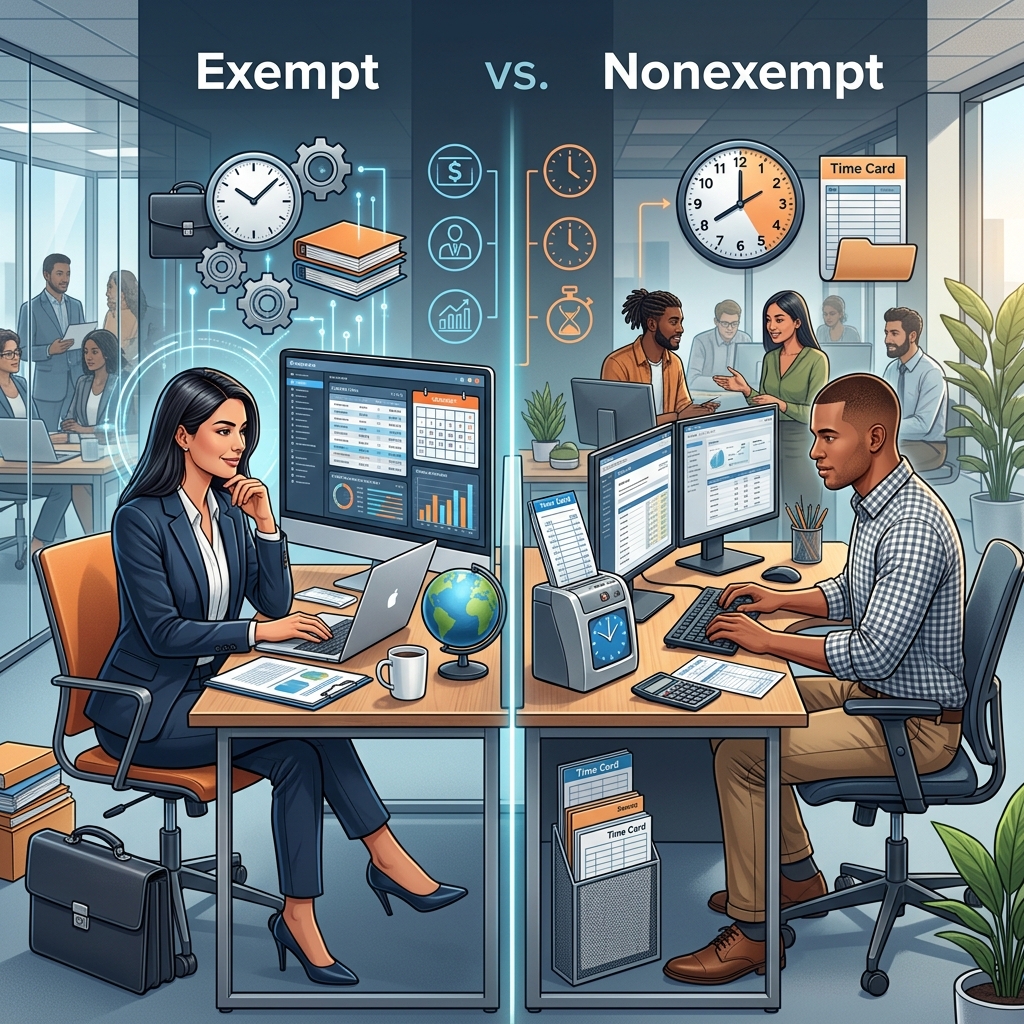
Whether a worker is classified as exempt or nonexempt affects how they are paid, whether they qualify for overtime, and how employers must track their hours. Under federal wage law, the label is not based on job title alone; it depends on salary rules and the actual duties performed.
This distinction matters for businesses of every size because payroll errors can lead to back wages, penalties, and disputes over employee status.
What the two classifications mean
An exempt worker is generally paid on a fixed salary and is not entitled to overtime pay under the Fair Labor Standards Act when the classification is proper. A nonexempt worker is covered by minimum wage and overtime protections and is usually paid by the hour, although salary alone does not automatically make a role exempt or nonexempt.
The practical difference is simple: nonexempt employees must be paid extra when they work more than 40 hours in a workweek, while properly classified exempt employees do not receive that overtime premium under federal law.
How classification is determined
Employers cannot decide exempt status based only on a job title such as manager, analyst, or specialist. Federal guidance focuses on whether the worker meets the salary basis rule, the salary level rule, and the duties test.
That means two employees with similar titles may be treated differently if their actual responsibilities, pay structure, or level of independence differ.
| Factor | Exempt status generally requires | Nonexempt status generally means |
|---|---|---|
| Pay structure | Fixed salary not reduced by hours worked | Hourly pay or pay that does not satisfy exemption rules |
| Salary threshold | At least the minimum required under federal rules | Below the applicable threshold or not salary-based |
| Job duties | Primarily qualifying executive, administrative, professional, computer, or outside sales duties | Does not meet one or more exemption duty requirements |
The salary basis rule
The salary basis rule means an exempt employee receives a predetermined amount on a regular schedule, and that amount is not reduced because the employee worked fewer hours than expected or because the quality or quantity of work varied.
This rule is important because it distinguishes salaried exemption from ordinary salary arrangements. A person can be salaried and still be nonexempt if the pay structure or duties do not satisfy the legal test.
The salary level requirement
Federal guidance states that certain employees must earn at least $684 per week, which equals $35,568 per year, to qualify for the white-collar exemptions discussed in current federal materials. If an employee does not meet the required salary threshold, the exemption usually does not apply even if the role sounds managerial or professional.
This threshold is only one part of the analysis. Meeting the salary requirement without satisfying the duties test is not enough to make a worker exempt.
The duties test and why it matters most
The duties test asks what the employee actually does on the job. Federal materials describe exemption categories that commonly include executive, administrative, professional, computer-related, and outside sales roles.
For example, an executive exemption generally involves leading an enterprise or a recognized department, directing the work of other employees, and having input into hiring, firing, or staffing decisions. Administrative roles usually involve office or nonmanual work tied to business operations and the exercise of independent judgment on important matters. Professional roles often require advanced knowledge in a field of science, learning, or specialized expertise.
Because duties are so important, employers should review real responsibilities rather than relying on written descriptions alone. A title may suggest exemption, but day-to-day work controls the legal analysis.
Common pay differences between the two groups
Exempt employees typically receive a steady salary and may not have every minute of their time tracked for wage purposes, although employers may still monitor attendance or productivity for business reasons. Nonexempt employees are usually paid hourly and must have their hours recorded so overtime can be calculated correctly.
Nonexempt workers are generally entitled to at least the minimum wage for all hours worked and one and one-half times their regular rate for hours over 40 in a workweek under federal law. Employers may choose to offer bonuses, incentives, or paid time off to exempt staff, but those extras do not replace the legal framework used to classify the role.
Why misclassification is risky
Misclassifying a worker can create liability for unpaid overtime, unpaid minimum wages, and related damages. It can also trigger recordkeeping problems because employers must keep accurate time records for nonexempt staff.
In practice, mistakes often happen when employers assume that a salaried worker is automatically exempt or when a role changes over time but the classification is never revisited. A job that began as exempt may drift into nonexempt territory if the employee spends more time on routine tasks than on qualifying duties.
Signs a role may need a second look
- The employee is paid a salary but regularly works long hours and performs mostly routine tasks.
- The person has a managerial title but does not supervise employees or influence staffing decisions.
- The position has changed after reorganization, growth, or automation.
- The company does not track hours for a worker who may not satisfy exemption tests.
- The employee’s pay falls below the applicable threshold for exemption.
How employers can reduce classification errors
Good classification practices begin with a written review of each position’s actual duties, compensation structure, and decision-making authority. Employers should compare the role against the exemption categories recognized by federal wage law rather than using internal assumptions.
It also helps to revisit job classifications whenever responsibilities change, staff are reassigned, or a department is reorganized. Regular audits can identify positions that need to move from exempt to nonexempt or vice versa before the issue becomes a wage claim.
Training managers is equally important. Supervisors often assign work, approve schedules, and make staffing decisions that affect whether employees are working overtime or performing exempt-level duties.
What employees should understand about their status
Workers should know how they are paid, whether time records are kept, and whether the tasks they perform match the label attached to their job. If a worker is classified as exempt but spends most of the week on hourly-style tasks or does not meet the salary threshold, the classification may deserve a review.
Employees can also ask for clarification about how their employer evaluates overtime, schedules, and compensation changes. Clear communication helps reduce confusion, especially in workplaces where roles blend supervisory, technical, and administrative work.
Frequently asked questions
Is every salaried worker exempt?
No. Salary alone does not determine exempt status. The worker must also meet the salary level and duties requirements for a recognized exemption category.
Do exempt employees ever receive overtime?
Federal law does not require overtime pay for properly classified exempt employees. Some employers may choose to offer extra compensation, but that is a policy choice, not a legal mandate.
Are nonexempt employees always hourly?
Not always. Some nonexempt employees may receive a salary, but they still remain entitled to minimum wage and overtime if they do not satisfy the exemption tests.
Does the job title control classification?
No. Classification depends on actual duties, salary basis, and salary level, not merely the title printed on a business card or organizational chart.
Why do employers keep time records for nonexempt staff?
Because overtime pay depends on the number of hours worked, employers need accurate timekeeping to calculate wages correctly and comply with federal wage rules.
When legal or HR review is worthwhile
If a role has mixed duties, unusual pay arrangements, or a history of overtime disputes, it is wise to review the classification carefully. That is especially true for jobs that combine management, technical work, and administrative decision-making, since those categories are often the hardest to analyze correctly.
A structured review can help employers align payroll practices with the law and help workers understand whether they are receiving the protections they are owed.
References
- Fact Sheet #17A: Exemption for Executive, Administrative, Professional, Computer and Outside Sales Employees Under the Fair Labor Standards Act — U.S. Department of Labor, Wage and Hour Division. 2024-05-13. https://www.dol.gov/agencies/whd/fact-sheets/17a-overtime
- Exempt vs. Non-Exempt Employees — Indeed. 2025-01-01. https://www.indeed.com/hire/c/info/exempt-vs-non-exempt-employee
- Exempt vs. Non-Exempt Employees: Differences Explained — Paycor. 2025-01-01. https://www.paycor.com/resource-center/articles/exempt-vs-non-exempt/
- Exempt vs Non-Exempt Employee — ADP. 2025-01-01. https://www.adp.com/resources/articles-and-insights/articles/t/the-difference-between-exempt-and-non-exempt-employees.aspx
- Exempt vs. Nonexempt Employees — Paychex. 2025-01-01. https://www.paychex.com/articles/payroll-taxes/whats-the-difference-between-exempt-and-non-exempt-employees
- Understanding Exempt vs. Non-Exempt Jobs at MIT — Massachusetts Institute of Technology. 2025-01-01. https://hr.mit.edu/managers/exempt
Similar Articles








Read full bio of medha deb




