Exceptions to Trademark Infringement Claims
Discover key legal defenses and exceptions that protect unauthorized trademark use from infringement lawsuits.
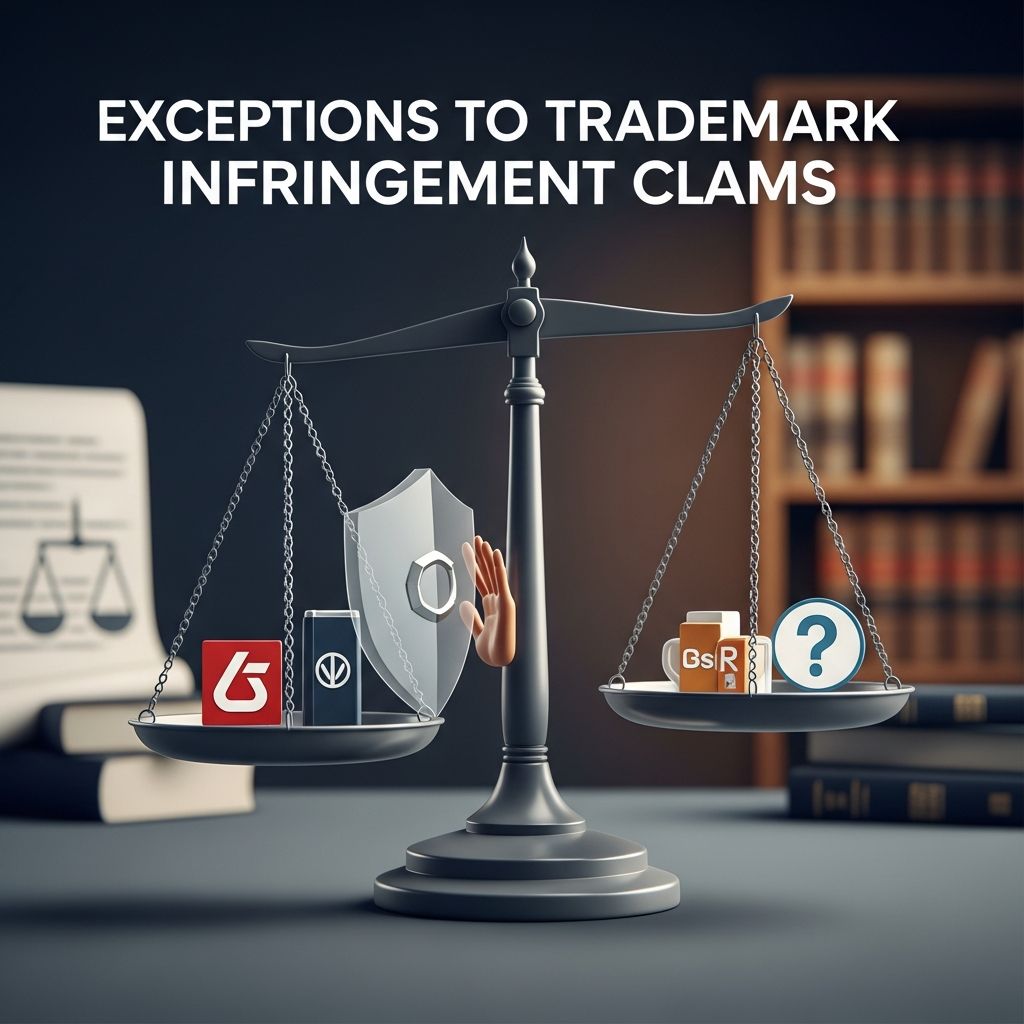
Trademark infringement occurs when someone uses a registered mark without permission in a way likely to confuse consumers about the source of goods or services. However, not every unauthorized use triggers liability; several legal exceptions exist to balance trademark protection with free speech and fair competition.
Core Elements of a Trademark Infringement Case
To claim infringement under the Lanham Act, a plaintiff must prove ownership of a valid, protectable mark and that the defendant’s use creates a likelihood of confusion. Without these, no infringement exists. Courts assess factors like mark similarity, goods proximity, and marketing channels to determine confusion risk.
- Valid Mark Ownership: Registration presumes validity, but challengers can contest it if under five years old or prove fraud/abandonment.
- Unauthorized Use in Commerce: Must involve sale, distribution, or advertising of related goods/services.
- Consumer Confusion: Key test; no confusion means no infringement.
Defenses That Nullify Infringement Allegations
Even if elements seem met, defendants can invoke defenses showing no violation occurred. These include estoppel, unclean hands, and registration challenges.
| Defense | Description | Example |
|---|---|---|
| Estoppel/Acquiescence | Plaintiff impliedly permitted use through delay or encouragement. | Long-term inaction on known use bars claims. |
| Unclean Hands | Plaintiff’s misconduct taints their suit. | Filing false claims or prior violations. |
| Contesting Validity | Prove mark unprotectable (generic/descriptive without secondary meaning). | New registrations under 5 years. |
Fair Use: Nominative and Descriptive Protections
Fair use allows trademark terms in non-confusing contexts. Nominative fair use permits referencing a mark to identify the owner’s goods, if no suggestion of endorsement. Descriptive fair use uses terms in their ordinary dictionary sense, not as source identifiers.
- Nominative Fair Use Factors: Need for mark to identify goods; minimal use; no consumer confusion implied.
- Descriptive Example: Selling ‘WD-40 inhibitor’ products truthfully describes function without implying affiliation.
Courts protect this to avoid monopolizing common language.
Parody and First Amendment Safeguards
Parodies mock trademarks without confusing consumers about source or endorsement. They transform the mark for commentary or humor, qualifying as expressive speech. Success hinges on no commercial exploitation of goodwill and clear satirical intent.
Key test: Does it function as criticism rather than competitor? Famous cases uphold parodies like ‘Chewy Vuiton’ dog toys satirizing Louis Vuitton.
Abandonment and Genericide: When Marks Lose Protection
Trademarks abandoned through non-use for three+ years or genericide (becoming generic, e.g., ‘Aspirin’) cease protection. Plaintiffs must prove continuous commercial use; defendants can counter with abandonment evidence.
- Intent irrelevant if non-use proven.
- Genericide defenses succeed if public perceives mark as product category.
Functional Use and Other Non-Infringing Applications
Product features dictated by function can’t be trademarked; copying them isn’t infringement. Also, comparative advertising truthfully comparing products using competitor marks is allowed if no misleading claims.
Practical Strategies to Avoid Infringement Risks
Conduct clearance searches, use distinct marks, and monitor for infringers. If accused, gather evidence of no confusion or fair use applicability.
Frequently Asked Questions
What constitutes trademark infringement?
Unauthorized use of a mark likely causing consumer confusion about goods/services origin.
Does intent matter in infringement cases?
Not for liability, but willful infringement affects damages.
Can I use a trademark in advertising?
Yes, for truthful comparisons or nominative fair use without implying endorsement.
How to prove no likelihood of confusion?
Consumer surveys, expert testimony on market differences, and lack of actual confusion evidence.
What remedies for infringement?
Injunctions, damages, profits disgorgement; treble for willful cases.
References
- What is the definition of Trademark Infringement? | Law Glossary — Winston & Strawn. 2023. https://www.winston.com/en/legal-glossary/trademark-infringement
- Trademark Infringement Elements Explained — Trestle Law. 2024-05-15. https://www.trestlelaw.com/blog/trademark-infringement-elements
- infringement (of trademark) — Cornell Law School Legal Information Institute. 2025-01-10. https://www.law.cornell.edu/wex/infringement_(of_trademark)
- What is Trademark Infringement and How to Protect Against It — BrandShield. 2024. https://www.brandshield.com/blog/trademark-infringement/
- What Is Trademark Infringement? — Romano Law. 2023-11-20. https://www.romanolaw.com/what-is-trademark-infringement/
- Trademark Violation | Examples, Cases, Penalties — Mandour Law. 2024. https://www.mandourlaw.com/trademark-violation/
- Trademark Infringement – Foundations of Law: Module 5 — LawShelf. 2022-06-01. https://www.lawshelf.com/videocoursesmoduleview/trademark-infringement-module-5-of-5/
Similar Articles







Read full bio of Sneha Tete