
Essential Traits Law Firms Seek in Junior Attorneys
Discover the core qualities that top law firms prioritize when hiring young lawyers to build high-performing teams.
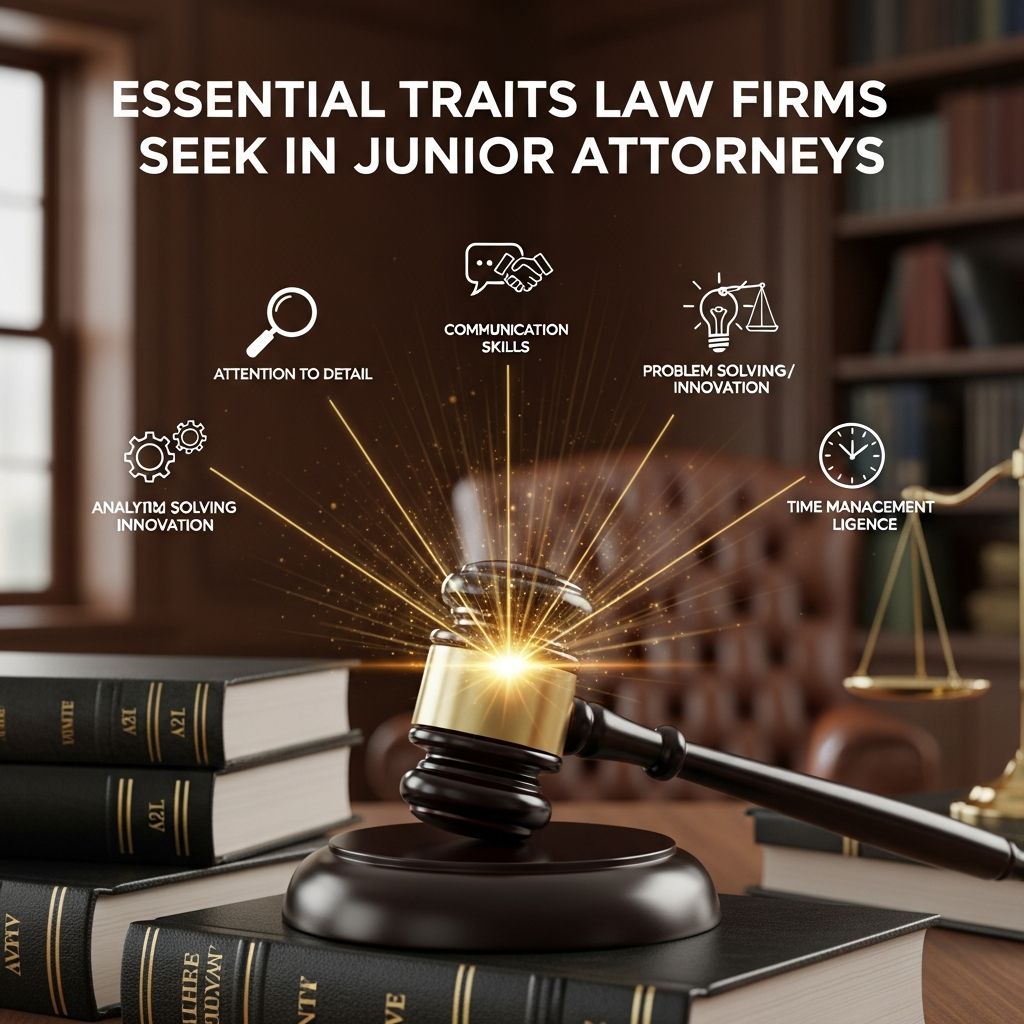
Entering the legal profession demands more than just a law degree; law firms rigorously evaluate candidates on a set of core competencies that predict success in high-stakes environments. These traits enable young lawyers to handle complex cases, collaborate effectively, and deliver value to clients from day one. Drawing from industry insights, this article explores the standout qualities that recruiters prioritize, offering actionable advice for aspiring attorneys to cultivate and demonstrate them.
Mastering Analytical Precision and Problem-Solving
The foundation of legal excellence lies in the ability to dissect intricate problems and devise logical solutions. Law firms seek junior attorneys who excel in analytical thinking, breaking down multifaceted legal issues into actionable components. This skill is crucial for researching precedents, evaluating evidence, and crafting persuasive arguments that withstand scrutiny.
Candidates demonstrate this through academic achievements, such as strong performances in rigorous coursework or moot court competitions, where they must anticipate counterarguments and adapt strategies on the fly. Firms assess this during interviews by presenting hypothetical scenarios, observing how applicants identify key facts, apply relevant laws, and propose innovative resolutions.
- Break down complex cases: Focus on core elements like jurisdiction, liability, and remedies.
- Apply logic rigorously: Use precedents and statutes to build airtight reasoning.
- Innovate creatively: Propose novel approaches when standard solutions fall short.
Developing this trait involves practicing with real-world case studies and seeking feedback from mentors to refine your approach.
Excelling in Clear and Persuasive Communication
Effective communication bridges the gap between legal jargon and client understanding, making it a non-negotiable for hires. Firms look for attorneys who can articulate sophisticated concepts verbally and in writing, whether drafting briefs, negotiating settlements, or advising clients. Precision in language prevents misunderstandings that could derail cases.
Recruiters evaluate this via writing samples, resumes free of errors, and interview responses that are concise yet comprehensive. Strong communicators listen actively, tailoring explanations to diverse audiences—from judges to non-legal stakeholders.
| Communication Type | Key Skills Demonstrated | Interview Assessment |
|---|---|---|
| Written | Clarity, structure, error-free prose | Review cover letters, memos |
| Verbal | Articulation, active listening | Role-play client consultations |
| Persuasive | Argument construction, adaptability | Moot court-style questions |
Hone these skills through public speaking clubs, writing workshops, and mock negotiations to stand out.
Fostering Teamwork and Collaborative Spirit
Law practice thrives on collaboration, from large deals requiring cross-practice input to litigation teams pooling expertise. Firms prioritize candidates who build rapport, contribute ideas, and support colleagues, creating cohesive units that outperform siloed efforts.
Evidence of this appears in extracurricular leadership, group projects, or internships where applicants coordinated with diverse teams. Interviews probe past experiences: ‘Describe a time you resolved team conflict’ reveals empathy and leadership.
- Active listening: Value others’ input to enhance collective outcomes.
- Idea sharing: Offer constructive feedback without dominating discussions.
- Support role: Step up during crunch times to aid teammates.
Cultivate this by volunteering for team assignments and reflecting on group dynamics in your professional narrative.
Demonstrating Unwavering Work Ethic and Time Mastery
High-pressure deadlines define legal work, so firms seek driven individuals with superior time management and resilience. Top candidates show dedication through consistent output, prioritizing tasks amid competing demands, and maintaining quality under stress.
This trait shines in references citing reliability and in interviews via examples of juggling multiple responsibilities, like balancing exams with clinic work. Firms value those who go beyond expectations, embodying a proactive mindset.
Embracing Adaptability in a Dynamic Field
The legal world evolves with new regulations, technologies, and case law, demanding attorneys who adapt swiftly. Recruiters favor those open to learning AI tools, remote workflows, or emerging practice areas like cybersecurity law.
Showcase this with stories of pivoting during internships or embracing unfamiliar challenges. A growth mindset—viewing obstacles as opportunities—sets candidates apart in interviews.
Upholding Integrity and Ethical Fortitude
Trust is the currency of law; firms hire those with impeccable ethics, good judgment, and commitment to professional standards. Integrity means honest representation, confidentiality, and avoiding conflicts, even under pressure.
Demonstrate via clean records, references attesting to character, and responses to ethical dilemmas in interviews. Firms like those valuing collegiality assess cultural fit through office interactions.
Sharpening Attention to Detail
Microscopic precision prevents costly errors in filings, contracts, or discovery. Firms test this with flawless applications and probe experiences managing detailed workloads.
- Proofreading rigor: Catch nuances others miss.
- Multi-task accuracy: Handle volume without lapses.
- Verification habits: Double-check facts and citations.
Prioritizing Client-Centric Orientation
Ultimate success hinges on understanding client needs, delivering practical advice, and building lasting relationships. Firms seek empathetic advisors who translate legal wins into business value.
Highlight clinic or pro bono work showing client advocacy. Interviews reveal this through passion for service over billable hours alone.
Building a Well-Rounded Profile
Beyond skills, firms value leadership, creativity, and community engagement. Captaining teams, leading societies, or innovating in journals signals potential. Quality trumps quantity—deep involvement beats superficial listings.
Recruiters seek maturity and self-motivation, assessing via behavioral questions on independence and initiative.
Strategies to Showcase Your Strengths
To impress, tailor resumes to highlight these traits with quantifiable impacts. Prepare STAR stories (Situation, Task, Action, Result) for interviews. Network at firm events to gauge culture fit.
| Trait | Resume Example | Interview Prep |
|---|---|---|
| Analytical | Moot court win | Case hypotheticals |
| Communication | Published article | Client role-play |
| Teamwork | Clinic team lead | Conflict resolution story |
Frequently Asked Questions (FAQs)
What is the most important quality for junior lawyers?
Analytical thinking tops lists, as it underpins all legal work, but strong communication and integrity are equally vital for firm success.
How can I prove teamwork in applications?
Detail leadership in group projects or extracurriculars, using metrics like ‘Led 10-member team to national moot court quarterfinals’.
Do firms prioritize grades over soft skills?
Grades open doors, but soft skills like adaptability and ethics determine hires, especially in competitive markets.
Is work ethic testable in interviews?
Yes, through questions on handling deadlines and references confirming reliability under pressure.
How does cultural fit factor in?
Firms assess collegiality and values alignment via callbacks and casual chats, ensuring long-term retention.
References
- Unlocking Success: The Key Attributes Law Firms Seek in New Talent — Leaders in Law. 2023-05-15. https://www.leaders-in-law.com/unlocking-success-the-key-attributes-law-firms-seek-in-new-talent/
- How to Identify the Best Legal Talent: Qualities and Characteristics to Look For in a Candidate — BCG Attorney Search. 2024-02-10. https://www.bcgsearch.com/article/900054133/How-to-Identify-the-Best-Legal-Talent-Qualities-and-Characteristics-to-Look-For-in-a-Candidate/
- What Do Firms Look For When Hiring New Lawyers? — Associates Mind. 2014-04-21. https://associatesmind.com/2014/04/21/what-do-firms-look-for-when-hiring-new-lawyers/
- What Recruiters Are Looking For — Chambers Associate. 2025-01-08. https://www.chambers-associate.com/where-to-start/getting-hired/what-recruiters-are-looking-for/
- Assessing Law Firms: Culture, Clients, Compensation and Beyond — Yale Law School. 2024-09-12. https://law.yale.edu/student-life/career-development/students/career-pathways/law-firms/assessing-law-firms-culture-clients-compensation-and-beyond
Similar Articles








Read full bio of Sneha Tete




