
Essential New Jersey Employment Law Facts
Key New Jersey employment law rules workers and employers overlook, from at‑will limits to discrimination, pay and hiring protections.
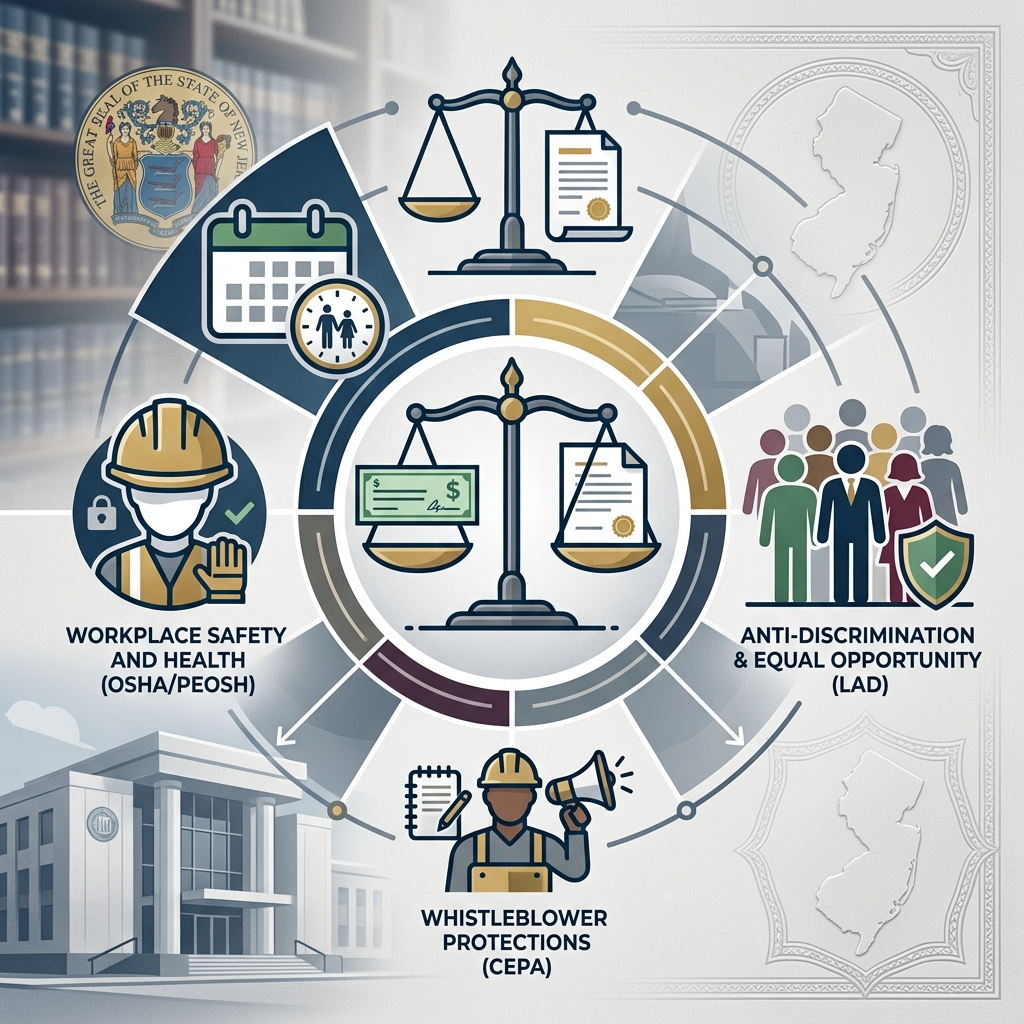
New Jersey has a detailed network of employment laws that go far beyond basic rules about hiring and firing. While many employees and employers have heard of concepts like at-will employment or “equal opportunity,” they often misunderstand the real limits and protections built into New Jersey law. This overview highlights several important but often overlooked rules that shape workplace rights and responsibilities in the state.
This article is designed for both workers and businesses. It explains key New Jersey employment law principles in plain language, while pointing you toward official rules and regulations for deeper guidance.
1. At-Will Employment Has Real Limits in New Jersey
New Jersey is generally an at-will employment state. That means, in basic terms, that an employer can end an employment relationship at any time, for almost any reason, and without prior notice, and employees can also quit at any time. However, the phrase “for any reason” is misleading if taken literally. There are important exceptions and restrictions.
Key features of at-will employment
- Employer flexibility: Employers may terminate workers with or without cause and with or without advance notice, unless a contract says otherwise.
- Employee freedom: Employees are not usually required to give a specific amount of notice before resigning.
- No automatic explanation required: Employers generally are not legally obligated to give a detailed explanation for a termination.
Important exceptions to at-will rules
- Written employment contracts: If an employment contract or collective bargaining agreement promises job security or defines when termination is allowed, those terms can override at-will rules.
- Discrimination laws: Employers cannot fire, demote, or otherwise disadvantage workers for reasons that violate the New Jersey Law Against Discrimination (NJLAD) or federal anti-discrimination law.
- Public policy protections: Employers may not terminate workers for engaging in legally protected activities, such as filing wage complaints, reporting discrimination, or serving on a jury.
In practice, at-will employment offers flexibility, but it is not a blank check. Employers still must respect anti-discrimination statutes, wage and hour laws, and other worker protections.
2. New Jersey’s Strong Anti-Discrimination Protections
New Jersey’s Law Against Discrimination (NJLAD) is one of the most robust state civil rights laws in the country. It protects employees from being treated less favorably because of certain personal characteristics, known as protected traits or protected classes.
Protected traits under NJLAD
According to state guidance, employers may not discriminate against workers based on characteristics such as:
- Race, color, or national origin
- Religion or creed
- Sex, gender identity or expression, and sexual orientation
- Age
- Disability
- Marital status or civil union status
- Ancestry and genetic information
NJLAD applies to a wide range of employment situations, including hiring, firing, promotions, pay, training opportunities, and workplace harassment. It also protects employees from retaliation when they complain about discrimination, assist in investigations, or participate in legal proceedings related to discrimination.
Harassment and hostile work environments
Discrimination is not limited to overt decisions like refusing to promote someone. New Jersey law also recognizes harassment and hostile work environments as unlawful discrimination when behavior is severe or pervasive and is based on a protected trait. Examples can include:
- Repeated offensive comments about a worker’s race or religion
- Sexual jokes or unwanted physical contact
- Persistent teasing about a disability or pregnancy
Employers are expected to take reasonable steps to prevent and address harassment, including responding promptly to complaints and enforcing clear policies.
3. Equal Pay and Wage Protections Extend Beyond Gender
Equal pay laws in New Jersey do more than require equal pay for men and women doing the same job. The state’s Diane B. Allen Equal Pay Act ties wage fairness to the broader set of protected traits recognized under NJLAD.
Equal pay for substantially similar work
- Substantially similar work: Employers must pay employees in protected classes at least the same as employees outside those classes when they perform work that is substantially similar in skill, effort, and responsibility.
- Beyond gender: The law applies to protected classes such as race, age, disability, religion, and more, not only sex.
- Objective differences allowed: Employers can justify pay differences if they are based on legitimate factors, such as seniority, merit, or quantity/quality of production, rather than prejudice.
Minimum wage and overtime rules
New Jersey’s wage and hour laws set baseline standards for pay and hours. The state minimum wage for most workers is periodically adjusted, and state law also establishes overtime requirements.
| Topic | Basic Rule |
|---|---|
| Minimum wage | State law sets a minimum hourly wage for most workers; specific rates are updated regularly. |
| Small employers and certain sectors | Some categories, such as small employers or farm work, may have different minimum wage levels. |
| Overtime | Covered employees must generally be paid 1.5 times their regular rate for hours worked beyond 40 per week. |
| Pay frequency | Most hourly workers must be paid at least twice per month on regular paydays; salaried workers at least monthly. |
Workers who suspect they are not being paid correctly—in terms of minimum wage, overtime, or equal pay—may have the right to file complaints with the state and are generally protected from retaliation for doing so.
4. Hiring, Criminal Records, and Job Advertising Rules
New Jersey’s employment laws do not just regulate the treatment of existing employees; they also shape how employers recruit and evaluate job applicants. Several rules limit what employers can ask and how they present job opportunities.
“Ban the Box” and criminal history inquiries
Under New Jersey’s Opportunity to Compete Act, many employers are restricted from asking about an applicant’s criminal record too early in the hiring process. Specifically:
- Employers with a certain number of employees may not ask about criminal history on initial job applications.
- Verbal or written questions about arrests or convictions are generally deferred until after the first interview.
- Job advertisements cannot state that people with criminal records will not be considered at all.
These rules aim to give applicants an opportunity to be evaluated on their qualifications before criminal history is considered.
Advertising and treatment of unemployed applicants
New Jersey law also places limits on how employers advertise jobs with respect to unemployed individuals. For example, job postings may not:
- Require that candidates already have a job as a condition of applying.
- State that applications from unemployed people will not be considered.
- Indicate that only currently employed applicants will be reviewed.
These rules reduce barriers for unemployed job seekers and help ensure that hiring decisions remain focused on skills and fit rather than current employment status.
5. Special Protections: Pregnancy, Jury Duty, and Retaliation
Beyond general anti-discrimination and wage rules, New Jersey provides targeted protections for certain situations that commonly lead to conflicts at work.
Pregnancy and breastfeeding accommodations
New Jersey’s Pregnant Worker’s Fairness Act requires employers to protect pregnant workers from discrimination and to make reasonable accommodations for pregnancy-related needs. Additionally, employers cannot treat leave related to pregnancy or breastfeeding less favorably than leave for other temporary conditions that affect a worker’s ability to perform their job.
Reasonable accommodations might include:
- Providing more frequent breaks
- Offering a temporary change in work duties
- Allowing time and a private space for breastfeeding or pumping
Jury duty and civic responsibilities
Employees who are required to serve on juries are protected from employer retaliation. Employers may not penalize, threaten, or coerce workers because they must attend court for jury service. While employers typically must allow time off for jury duty, whether that leave is paid or unpaid can depend on company policy and applicable law.
Protection against retaliation
Retaliation occurs when an employer punishes an employee for engaging in a legally protected activity, such as filing a complaint or participating in an investigation. New Jersey law prohibits employers from retaliating against workers for:
- Reporting discrimination or harassment under NJLAD
- Filing complaints about wage and hour violations
- Seeking accommodations for pregnancy or disability
Retaliation can take many forms, including firing, demotion, cutting pay, or making working conditions intolerable. Workers who experience retaliation may have legal claims separate from their original complaint.
6. Practical Steps for Employees and Employers
Understanding New Jersey employment law is not just a theoretical exercise. Both employees and employers benefit from putting this knowledge into practice.
Tips for employees
- Keep written records: Document key events such as performance reviews, disciplinary actions, and any incidents of harassment or discrimination.
- Review policies: Read your employer’s handbook or HR policies to understand internal procedures for complaints and accommodations.
- Use official channels: When making a complaint, follow the steps provided by your employer and consider contacting state agencies if issues persist.
- Know your pay rights: Monitor pay stubs for accuracy, including overtime and any deductions.
Tips for employers
- Train supervisors: Ensure managers understand basic employment law principles, especially anti-discrimination and wage rules.
- Audit job ads and applications: Confirm that hiring materials comply with restrictions on criminal history inquiries and unemployment status.
- Update policies regularly: State laws change over time; review and revise handbooks and procedures as minimum wage and other requirements are updated.
- Encourage reporting: Create safe, confidential ways for employees to report concerns without fear of retaliation.
7. Quick FAQ on New Jersey Employment Law
Is my job always at-will in New Jersey?
Most jobs are at-will, meaning you or your employer can end the relationship at any time. However, written contracts, collective bargaining agreements, and laws against discrimination and retaliation limit when and how an employer may terminate employment.
Can I be fired for filing a wage complaint?
No. State and federal laws protect employees from retaliation for filing or discussing wage and hour complaints. Punishing workers for asserting their rights can itself be a legal violation.
Do equal pay rules only apply to men and women?
No. New Jersey’s equal pay law covers a wide range of protected traits under NJLAD, such as race, age, disability, and sexual orientation, not just gender.
When can an employer ask about my criminal record?
Under the Opportunity to Compete Act, covered employers generally may not ask about criminal history on initial job applications or before the first interview. After that point, certain inquiries may be allowed, subject to other laws and policies.
Are pregnant workers entitled to accommodations?
Yes. New Jersey law requires reasonable accommodations for pregnant workers and prohibits unfavorable treatment of pregnancy-related leave compared to other temporary conditions affecting work ability.
References
- Wage and hour compliance: laws and regulations — New Jersey Department of Labor and Workforce Development. 2024-01-01. https://www.nj.gov/labor/myworkrights/wages/wages.shtml
- Wage & Hour Compliance | Laws and Regulations — New Jersey Department of Labor and Workforce Development. 2024-01-01. https://www.nj.gov/labor/wageandhour/tools-resources/laws/
- Workers’ Rights and Protections — Legal Services of New Jersey. 2024-01-01. https://www.lsnjlaw.org/legal-topics/jobs-employment/other-topics/pages/workers-rights-protections
- New Jersey Employment Law Desk Reference — New Jersey Business & Industry Association. 2016-01-01. https://njbia.org/wp-content/uploads/2017/03/New-Jersey-Employment-Law-Desk-Reference-2016.pdf
- Guide to HR Laws in New Jersey — PeopleKeep. 2023-06-01. https://www.peoplekeep.com/resources/new-jersey-hr-compliance
- Quick and Easy Guide to Labor & Employment Law: New Jersey — Baker Donelson. 2024-01-01. https://www.bakerdonelson.com/easy-guide-new-jersey
Similar Articles








Read full bio of medha deb




