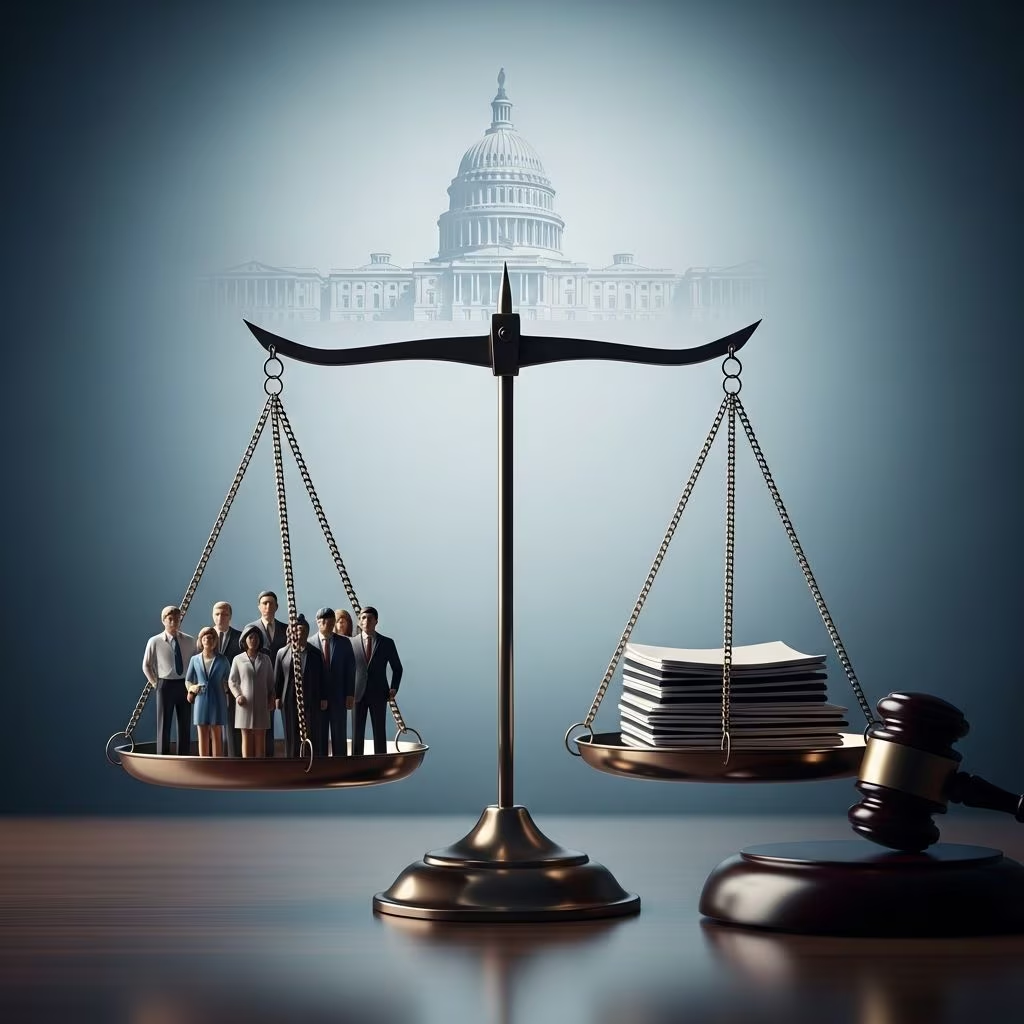
Understanding your rights as an employee is crucial for maintaining fair treatment in the workplace. Federal laws establish baseline protections that apply across most U.S. employers, covering everything from compensation and leave to discrimination prevention and safety standards. These regulations ensure workers can advocate for themselves without fear of retaliation.
Foundational Wage and Hour Protections
The cornerstone of employee compensation rights is the **Fair Labor Standards Act (FLSA)** of 1938, which mandates minimum wage and overtime pay for most non-exempt workers. Employers must pay at least $7.25 per hour for all hours worked, with overtime at 1.5 times the regular rate for hours exceeding 40 in a workweek. Exemptions apply to certain executive, administrative, or professional roles, but misclassification is common and challengeable.
Under FLSA, ‘enterprise coverage’ includes businesses with annual gross sales over $500,000 or engaged in interstate commerce, while individual coverage applies to workers directly involved in such activities. Family-owned businesses employing only close relatives may be exempt, as are specific categories like agricultural laborers or independent contractors. The Equal Pay Act (EPA), amending FLSA, prohibits sex-based wage discrimination for substantially equal work requiring similar skill, effort, and responsibility.
| Employee Category | FLSA Minimum Wage | Overtime Eligibility |
|---|---|---|
| Non-Exempt Hourly | $7.25/hour | Yes, over 40 hours |
| Exempt Salaried (e.g., Executives) | N/A (Salary Threshold Applies) | No |
| Tipped Employees | $2.13/hour + Tips (if reaching $7.25 total) | Yes |
Violations can lead to back wages, liquidated damages, and attorney fees recovered through Department of Labor (DOL) complaints or lawsuits. States often set higher minimums, which preempt federal floors.
Family and Medical Leave Entitlements
The **Family and Medical Leave Act (FMLA)** of 1993 provides eligible employees up to 12 weeks of unpaid, job-protected leave per 12-month period for serious health conditions, family care, or newborn/adoption bonding. Military family leave extends to 26 weeks for servicemember care. Covered employers have 50+ employees within 75 miles; employees need 12 months tenure and 1,250 hours worked.
- Qualifying Reasons: Birth/adoption, serious personal/family health issues, military exigency, or servicemember care.
- Protections: Same job or equivalent upon return; continued health benefits.
- Exceptions: Highest-paid 10% if causing ‘substantial economic injury’; short-service reporting rules (e.g., 8-hour rest post-deployment).
Claims have a 2-3 year statute, with damages for lost wages or benefits. Employers cannot interfere or retaliate. Recent additions like the Pregnant Workers Fairness Act (PWFA) of 2023 mandate reasonable accommodations for pregnancy-related limitations, akin to ADA standards, for employers with 15+ workers.
Protections Against Workplace Discrimination
Federal anti-discrimination laws form a robust shield against bias. The **Civil Rights Act of 1964** (Title VII) bans discrimination based on race, color, religion, sex, or national origin by employers with 15+ employees. Expanded by the **Age Discrimination in Employment Act (ADEA)** of 1967 for those 40+, **Americans with Disabilities Act (ADA)** of 1990 for qualified disabled individuals, and others.
ADA requires reasonable accommodations (e.g., modified schedules) unless causing undue hardship, covering hiring, promotion, and terms of employment. ADEA prohibits age bias in benefits via the Older Workers Benefit Protection Act (OWBPA), mandating informed waivers for releases. Retaliation against complainants is illegal across statutes.
- Race/Color/National Origin: No disparate treatment or impact.
- Sex/Pregnancy: Equal pay (EPA), harassment-free environment.
- Age: No forced retirement or benefit cuts.
- Disability: Accessible workplaces, interactive accommodation process.
Enforcement via EEOC charges within 180-300 days, followed by lawsuits. Successful claims yield back pay, reinstatement, and punitive damages.
Safe and Healthy Work Environments
The **Occupational Safety and Health Act (OSHA)** of 1970 guarantees a hazard-free workplace. Employers must comply with standards, maintain records, and allow inspections. Workers have the right to report violations anonymously, request inspections, and refuse unsafe work without retaliation.
OSHA covers most private sector employers and some public; states administer plans in 22 states with equal or stricter rules. Common protections include machine guarding, hazard communication, and PPE provision. Violations trigger citations, fines up to $161,323 per willful breach (2024 rates), and criminal penalties.
Collective Bargaining and Concerted Activities
The **National Labor Relations Act (NLRA)** protects private sector employees’ rights to form/join unions, bargain collectively, and engage in protected concerted activities—even without a union. Concerted activity includes group complaints over wages, hours, or conditions; solo actions count if advancing group interests.
Exclusions: Supervisors, agricultural/domestic workers, government employees, family businesses. NLRB enforces via unfair labor practice charges; remedies include back pay and union certification elections.
Background Checks and Privacy Rights
The **Fair Credit Reporting Act (FCRA)** regulates employer use of consumer reports for hiring, promotions, or terminations. Employers must provide disclosures, obtain consent, and issue adverse action notices with report copies. Applies to credit, criminal, and background checks.
Enforcing Your Rights: Practical Steps
To assert rights:
- Document Everything: Dates, witnesses, communications.
- Report Internally: Use HR policies first.
- File Agency Complaints: DOL (wages), EEOC (discrimination), OSHA (safety), NLRB (union issues).
- Seek Legal Aid: Free consultations via legal aid or unions.
- Statute Awareness: Most claims have 180-300 day filing windows.
Handbooks or verbal promises can create enforceable rights beyond statutes, overriding ‘at-will’ presumptions. States enhance federal minima (e.g., higher wages, paid leave).
Frequently Asked Questions (FAQs)
Am I entitled to overtime if salaried?
Only if non-exempt under FLSA duties/salary tests; many misclassified salaried workers qualify.
Does FMLA apply to small businesses?
No, requires 50+ employees within 75 miles; check state mini-FMLA laws.
Can my employer discriminate based on disability?
No, ADA mandates accommodations unless undue hardship for 15+ employee firms.
What if I’m fired for complaining about safety?
Protected under OSHA/NLRA; file with OSHA or NLRB for reinstatement/back pay.
Are union rights only for union members?
No, NLRA protects all non-exempt concerted activities.
State Variations and Emerging Protections
Federal laws set floors; states like California offer paid family leave, higher wages, and broader anti-discrimination (e.g., sexual orientation). Recent federal updates include PWFA for pregnancy accommodations. Track DOL/OSHA for recency, as penalties adjust annually.
Workers in exempt categories (e.g., farm, domestic) have limited federal recourse but may access state laws. Gig economy challenges persist, with DOL clarifying independent contractor status under FLSA.
References
- United States labor law — Wikipedia (summarizing statutes). 2023. https://en.wikipedia.org/wiki/United_States_labor_law
- Quick and Easy Guide to Labor & Employment Law: Federal — Baker Donelson. 2023. https://www.bakerdonelson.com/easy-guide-federal
- Employee Rights — National Labor Relations Board (NLRB). 2024-02-09. https://www.nlrb.gov/about-nlrb/rights-we-protect/your-rights/employee-rights
- Worker Rights — U.S. Department of Labor (DOL). 2024. https://www.dol.gov/agencies/whd/workers
- Labor laws and worker protection — USAGov. 2024. https://www.usa.gov/labor-laws
- OSHA Worker Rights and Protections — Occupational Safety and Health Administration (OSHA). 2024. http://www.osha.gov/workers
- Summary of the Major Laws of the Department of Labor — U.S. Department of Labor (DOL). 2024. https://www.dol.gov/general/aboutdol/majorlaws