
Essential Checklist for What to Do After a Car Accident
Learn the critical safety, legal, and insurance steps to take immediately after a car accident so you protect your health and your rights.
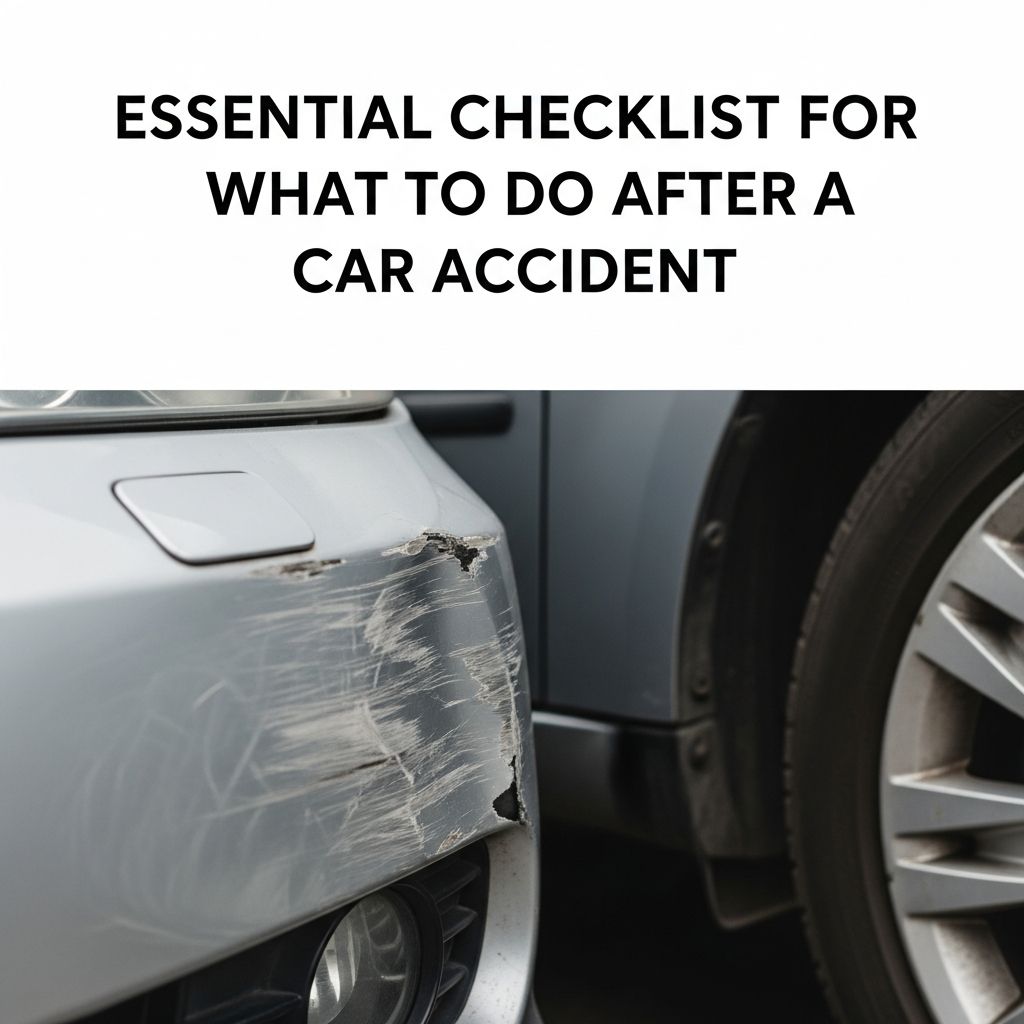
A car crash can leave you shaken, confused, and unsure what to do next. Having a clear plan before an accident happens can help you stay calm, protect your health, and avoid costly mistakes. This guide walks you through each phase after a collision, from the first seconds at the scene to dealing with insurers and considering legal help.
1. Put Safety First and Prevent Further Harm
Your first responsibility after any collision is to protect yourself and others from additional injury or damage. Safety steps should come before discussions about fault, money, or repairs.
- Check for immediate injuries to yourself and your passengers. If anyone is seriously hurt, call 911 right away and describe the injuries and location as clearly as possible.
- Move to a safer area if the vehicles are drivable and it is safe to do so, such as the shoulder of the road or a nearby parking lot.
- Turn on hazard lights so other drivers can see that there is an incident ahead.
- Set out cones or warning triangles if you have them and can place them safely.
- Do not stand in traffic lanes or between vehicles that could still be moved or hit.
Official guidance from police and insurance regulators consistently emphasizes staying at the scene, staying calm, and securing the area as your top priorities.
2. Call Emergency Services and Law Enforcement
Even if a crash seems minor, it is often wise to involve emergency responders and the police. Their reports and observations can be important later.
- Dial 911 if anyone is injured, traffic is blocked, there is a fire risk, or you suspect impairment or hit-and-run.
- Tell the dispatcher:
- Where you are (nearest intersection, mile marker, or landmark)
- How many vehicles are involved
- Whether anyone appears injured and if there are hazards like leaking fuel
- Request the police for any collision with injuries, significant property damage, or disputes about what happened.
- When officers arrive, answer questions truthfully but stick to the facts. Avoid guessing about speed or fault.
- Ask how to get a copy of the police accident report, which many insurance companies and courts rely on.
Many state insurance departments advise drivers to report accidents promptly and note that a police report may be required for certain types of claims or for crashes above a damage threshold.
3. Exchange Information With Other Drivers
Most states require drivers involved in a crash to stop and share specific information. Failing to do so can result in fines or criminal charges.
Collect the following from every other driver involved:
- Full name and contact information (phone and, if possible, email)
- Driver’s license number and state
- License plate number
- Vehicle make, model, year, and color
- Insurance company name
- Policy number and claims phone number
Also note:
- Number and apparent age of passengers in other vehicles
- Whether the other driver states they are driving for work or as a rideshare driver
Keep your conversations polite and limited. Do not argue or discuss who is at fault. Many insurers warn policyholders not to admit responsibility at the scene, since fault can be complex and is often determined later by evidence and state law.
4. Identify and Speak With Witnesses
Neutral witnesses can play a powerful role in clarifying what happened, especially when drivers give conflicting accounts.
- Look for bystanders who saw the crash, including pedestrians, bicyclists, or nearby workers.
- Ask politely if they are willing to share their contact information for a future statement.
- Request that they wait to speak with police, if possible.
- Make a quick note of where they were standing and what they say they observed.
If no witnesses are available, detailed photos, notes, and any nearby security or traffic camera footage may still support your version of events.
5. Thoroughly Document the Scene
Accident scenes change quickly as vehicles are moved and debris is cleared. Use your phone or a camera to capture as much as you safely can right away.
5.1 Photos and Video
- Take wide shots showing all vehicles and the surrounding area.
- Capture close-ups of damage to each vehicle from multiple angles.
- Photograph skid marks, broken glass, debris, and road conditions such as potholes or ice.
- Include pictures of traffic signs, signals, and lane markings near the crash.
- If appropriate, photograph visible injuries (such as bruises or cuts) over time, starting at the scene.
5.2 Written Notes
Right after a stressful event, your memory may be sharper than it will be later. Take a few minutes to write down:
- Date and approximate time of the accident
- Exact location (street names, direction of travel, mile marker)
- Weather and lighting conditions
- Speed limit and approximate speeds before the crash
- Sequence of events as you remember them (for example, “stopped at red light, rear-ended by vehicle behind”)
5.3 Key Details to Capture (Quick Table)
| Category | Examples of Helpful Information |
|---|---|
| Location | Intersection, lane number, nearby businesses, mile markers |
| Environment | Rain, fog, ice, glare from sun, nighttime lighting, construction |
| Roadway | Skid marks, potholes, standing water, missing signs, closed lanes |
| Vehicles | Damage locations, airbag deployment, broken lights or windows |
| People | Apparent injuries, use of seat belts, statements made at the scene |
6. Seek Medical Evaluation Promptly
Some serious injuries do not cause immediate pain. Conditions such as whiplash, concussion, and internal bleeding may take hours or days to become obvious. Health agencies and trauma specialists recommend medical evaluation after significant collisions even if you feel fine initially.
- Accept medical attention from paramedics if offered at the scene.
- Visit an emergency room, urgent care, or your primary doctor as soon as possible after the crash.
- Describe all symptoms, even mild ones, including headache, dizziness, stiffness, or confusion.
- Follow the treatment plan and attend follow-up appointments.
- Keep copies of all medical records, bills, prescriptions, and therapy referrals.
Prompt care helps protect your health and creates documentation of any accident-related injuries, which can be crucial for insurance claims or legal actions.
7. Notify Your Insurance Company
Most auto policies require you to report accidents within a reasonable time. Delays may complicate or even jeopardize your coverage.
- Call the claims number printed on your insurance card or listed in your policy.
- Provide basic facts: time, place, people involved, and whether a police report was filed.
- Give your insurer the claim numbers and contact information for any other involved insurers, if available.
- Ask what documentation they need, such as photos, repair estimates, and medical records.
- Take notes on each conversation, including date, time, and the name of the representative.
State insurance regulators advise drivers to cooperate with their own insurer’s investigation, but you generally are not required to give a recorded statement to the other driver’s insurance company without advice from your own insurer or an attorney.
8. Track Costs and Keep an Organized File
Your out-of-pocket costs may accumulate over weeks or months. Maintaining an organized record can prevent missed reimbursements and supports any legal claim.
- Save all medical bills, including hospital, doctor, physical therapy, and medication receipts.
- Keep proof of lost wages, such as pay stubs and employer letters documenting time off work.
- Document transportation costs for medical visits (rideshares, parking, public transit).
- Retain repair estimates, invoices, and receipts for vehicle towing and storage.
- Note any expenses for child care, household help, or adaptive equipment needed because of injuries.
9. Understand Common Insurance and Legal Issues
Even a straightforward collision can raise complex questions about fault, coverage, and compensation. Knowing the basic concepts helps you ask better questions and protect your rights.
9.1 At-Fault vs. No-Fault Systems
- In at-fault (tort) states, the driver who caused the crash (and their insurer) generally pays for injuries and damage, subject to state negligence rules.
- In no-fault states, your own insurance pays certain medical and wage-loss benefits regardless of who caused the crash, up to your policy limits. You may only sue the other driver if your injuries meet state-specific severity thresholds (such as a certain dollar amount in medical expenses).
9.2 Comparative and Contributory Negligence
States use different rules to decide how compensation is affected when more than one person shares fault.
- Pure comparative negligence: each party’s compensation is reduced by their percentage of fault.
- Modified comparative negligence: you may recover only if your share of fault is below a set limit (often 50% or 51%).
- Contributory negligence (in a few states): any fault by the injured person may bar recovery entirely.
These doctrines are typically defined in state statutes or case law and applied by courts or claims adjusters.
9.3 When to Consider Speaking With a Lawyer
You might benefit from legal advice if:
- You suffered serious or long-term injuries.
- Fault is disputed or multiple vehicles were involved.
- The other driver is uninsured or underinsured.
- You are being pressured to accept a quick settlement that seems too low.
- You receive a lawsuit or legal notice.
Personal injury attorneys commonly evaluate car accident cases and can explain how your state’s laws apply to your situation.
10. Mistakes to Avoid After a Car Accident
Certain missteps can harm your health, weaken your claim, or even violate the law. Try to avoid the following:
- Leaving the scene before exchanging information and, when required, contacting police.
- Admitting fault or apologizing in a way that might be interpreted as accepting legal responsibility.
- Skipping medical care or delaying evaluation despite symptoms.
- Posting about the accident on social media in ways that could be interpreted against you later.
- Ignoring policy deadlines for reporting the crash or submitting documentation.
Frequently Asked Questions (FAQs)
Q: Should I always call the police after a minor fender-bender?
A: Laws vary, but many states require reporting crashes that involve injury, death, or damage above a certain amount. Even when not required, a police report can provide neutral documentation that may help resolve later disputes with insurers or in court.
Q: Do I have to see a doctor if I feel fine after the accident?
A: It is strongly recommended, especially after moderate or high-speed collisions. Some injuries, including internal trauma and concussions, may not show symptoms immediately. Early diagnosis helps protect your health and connects any later symptoms to the crash for insurance or legal purposes.
Q: Can the other driver’s insurance company demand a recorded statement?
A: You are generally required to cooperate with your own insurer, but you are not usually obligated to give a recorded statement to the other driver’s insurer without guidance from your insurer or an attorney. Talking to a lawyer first can help you avoid misstatements that might be used against you.
Q: How long do I have to file an insurance claim or lawsuit?
A: Insurance policies often require prompt notice, sometimes within days or weeks. Lawsuits must be filed within your state’s statute of limitations for personal injury or property damage, which can range from one to several years. Checking both your policy and your state’s laws—or consulting a lawyer—can clarify the deadlines that apply to you.
Q: What if the at-fault driver does not have insurance?
A: If you carry uninsured or underinsured motorist coverage, your own policy may help pay for injuries or property damage caused by an uninsured driver. Coverage details vary by state and policy, so review your declarations page and speak with your insurer to understand your options.
References
- What to Do After a Car Accident: A Step-by-Step Guide — Allstate Insurance Company. 2023-05-01. https://www.allstate.com/resources/car-insurance/in-case-of-a-car-accident
- After an Accident — North Carolina Department of Insurance. 2022-06-15. https://www.ncdoi.gov/consumers/auto-and-vehicle-insurance/after-accident
- Car Accident Checklist — UCI Police Department. 2019-01-10. https://www.police.uci.edu/how-do-i/_brochures/automobile_accident_checklist.pdf
- What to Do After a Car Accident — Progressive Casualty Insurance Company. 2023-03-20. https://www.progressive.com/answers/what-to-do-after-car-accident/
- A Comprehensive Checklist on How to Document Your Car Accident — The Cochran Firm. 2022-04-05. https://www.cochranfirm.com/philadelphia/practice-areas/philadelphia-car-accident-lawyer/checklist-how-to-document-car-accident/
Similar Articles








Read full bio of Sneha Tete


