
The Erosion of Genetic Privacy: Arrests and DNA Databases
Arrests now fuel massive DNA databases, threatening our basic genetic privacy.
The Shifting Paradigm of Biological Surveillance
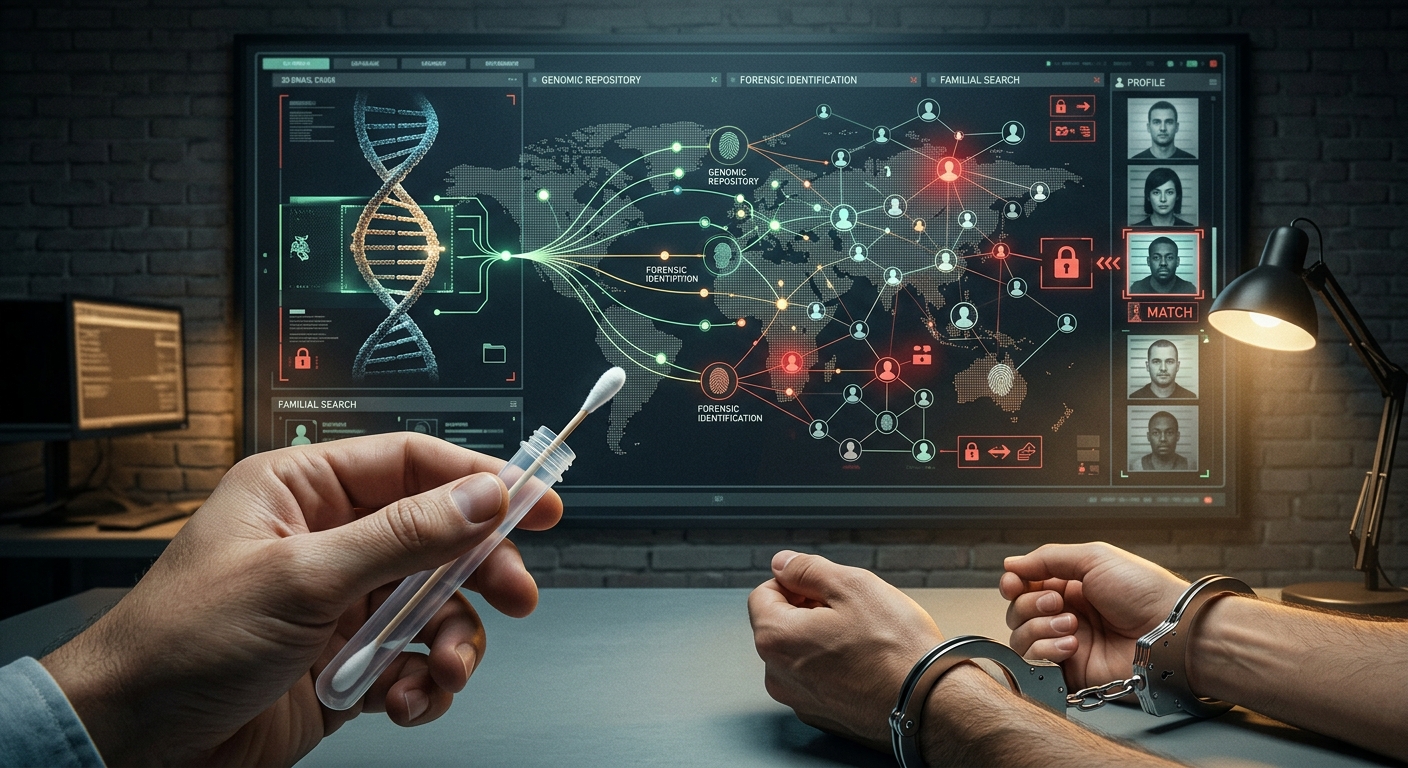
The human genome is the most intimate blueprint of an individual’s existence, containing highly sensitive medical data and familial connections. Traditionally, law enforcement agencies relied on biological data collection only after a criminal conviction, serving as a registry specifically reserved for proven offenders. However, over the past decade, a profound and concerning shift has occurred within the American criminal justice system. Authorities at both the state and federal levels are increasingly treating biometric swabbing as a standard, mandatory booking procedure for individuals who have merely been arrested, long before any formal trial or conviction. This practice has triggered immense alarm among civil rights advocates, legal scholars, and privacy experts. If an arrest—which requires a significantly lower evidentiary burden than a conviction—is all it takes for the government to permanently log your genetic sequence in federal databases, the foundational presumption of innocence is called into severe question. Today, safeguarding one’s biological privacy seems to demand a daunting, practically impossible strategy: absolutely avoiding any interaction with law enforcement entirely. The normalization of this practice is effectively transforming local police stations into collection hubs for a universal biological registry.
The False Equivalency: Fingerprints vs. DNA
At the heart of the current legal landscape is the assertion that collecting biological samples is no more intrusive than rolling a suspect’s fingers in ink. For over a century, fingerprinting has been the standard method for identifying individuals taken into custody. Proponents of expanded biometric databases argue that a cheek swab serves the exact same purpose: verifying the identity of the person in custody. However, this comparison relies on a fundamental false equivalency. A fingerprint is a purely structural identifier; it reveals nothing about a person’s health, their physical traits, or their lineage. In stark contrast, a genetic profile, even the non-coding regions historically targeted by law enforcement, holds a treasure trove of deeply personal biological secrets. When law enforcement officers collect a swab based merely on an arrest, they bypass the traditional requirement of a warrant backed by probable cause related to a specific crime involving biological evidence. Instead, the collection becomes a systemic, dragnet-style operation aimed at building a massive repository of biometric data. This conflation of basic identification with comprehensive biological mapping represents a significant overreach into the personal lives of citizens.
The Legal Precedent: Maryland v. King
The pivotal moment that fundamentally altered the trajectory of biological privacy in the United States was the 2013 Supreme Court decision in the landmark case Maryland v. King . By a narrow 5-4 majority, the Court ruled that swabbing the inside of an arrestee’s cheek is a reasonable search under the Fourth Amendment, explicitly likening the procedure to traditional booking practices like fingerprinting or photographing. The Court’s rationale was heavily rooted in the state’s interest in accurately identifying individuals taken into custody and ensuring safe facility operations. However, the dissenting voices, most notably Justice Antonin Scalia, vehemently argued against this expansion of state power. The dissent highlighted that the Fourth Amendment strictly forbids dragnet searches conducted without specific suspicion. Scalia warned that the ruling swung open the doors for the state to mandate biological collection at the point of booking for virtually any offense, drastically expanding the scope of state surveillance without judicial oversight. Since this ruling, the legal barrier to preemptive biological collection has been all but obliterated, empowering jurisdictions across the country to harvest the DNA of the legally innocent under the guise of administrative identification.
The Expansion of Federal and State DNA Databases
Following the Supreme Court’s green light, the landscape of forensic databases expanded dramatically. The FBI’s Combined DNA Index System (CODIS), and specifically its National DNA Index System (NDIS), has ballooned to unprecedented proportions. As of recent metrics, the system contains more than 19 million offender profiles and well over 6 million arrestee profiles . This massive influx of data is driven by sweeping legislation at both the state and federal levels. The Department of Justice (DOJ) has continuously pushed the boundaries of these collections, expanding mandates to include not just citizens arrested for felonies, but also non-citizens detained at the border for immigration violations. For citizens and non-citizens alike, the system operates on a ‘collect first, ask questions later’ methodology. Once a biological sample is processed and digitized into the federal index, extracting it becomes a labyrinthine bureaucratic challenge. Below is a breakdown of how collection and retention operate across different levels of government.
| Jurisdiction Level | Collection Trigger | Expungement Process |
|---|---|---|
| Federal Level (DOJ) | Arrest or Immigration Detention | Petitions required for removal; notoriously difficult to execute. |
| State Level (Varies) | Typically upon felony arrest | Requires the citizen to proactively initiate legal expungement. |
| Proposed Legal Reforms | Post-Conviction Only | Automatic deletion if charges are dropped or acquitted. |
This framework ensures that millions of profiles belonging to legally innocent individuals remain perpetually indexed in criminal databases.
Familial Searching: The Unwitting Informant
The privacy implications of massive arrestee databases extend far beyond the specific individuals who are swabbed during the booking process. Due to the inherent, shared nature of our biological code, an individual’s profile acts as a genetic beacon for their entire family tree. To capitalize on this, law enforcement agencies increasingly utilize ‘familial searching’—a controversial technique that involves scanning the national index for partial genetic matches to identify close relatives of an unknown suspect. While proponents praise familial searching for its ability to generate leads in cold cases, civil liberties advocates warn that it effectively turns biometric databases into population-wide surveillance nets. If your sibling, parent, or child is arrested and their biological data is legally retained, you are by proxy placed on the government’s radar. This creates a deeply concerning dynamic where individuals who have never interacted with the criminal justice system are subjected to a form of biological ‘stop-and-frisk’ based solely on their family ties. Critics strongly argue that this practice circumvents the Fourth Amendment by turning citizens into non-consenting informants against their own kin, vastly amplifying the privacy infringement initiated by a single, unconvicted arrest.
The Advent of Rapid DNA Technology
Compounding the legal and ethical concerns surrounding genetic privacy is the rapid advancement and widespread deployment of Rapid DNA technology . Historically, analyzing a biological sample required sending the swab to an accredited forensic laboratory, a meticulous process that could take several weeks or even months to complete. Today, the FBI is actively authorizing the rollout of Rapid DNA devices capable of producing a fully compatible index profile in under two hours, directly inside police booking stations. These automated, desktop-sized machines are operated by standard law enforcement officers rather than trained forensic scientists. Beyond the obvious concerns regarding quality control and potential sample contamination, the sheer immediacy of this technology fundamentally alters the power dynamic during detention. It allows police to instantaneously check an arrestee against a nationwide database of unsolved crimes before the individual even has the opportunity to see a judge, post bail, or contact an attorney. This speed incentivizes ‘pretextual arrests’—situations where an individual is detained for a minor, unrelated infraction simply to legally harvest their biology and run a speculative, warrantless database search.
Disproportionate Impacts on Marginalized Communities
The expansion of biometric collection at the arrest level cannot be adequately analyzed in a vacuum; it must be understood within the context of the systemic biases inherent in the American criminal justice system. Extensive statistical documentation demonstrates that marginalized communities—particularly Black and Hispanic populations—are disproportionately targeted for police stops, searches, and arrests. Because arrest rates are skewed by these systemic biases, the demographic composition of arrestee databases is equally skewed. When systems like CODIS are heavily populated by profiles from specific racial groups, any subsequent investigative techniques, including the aforementioned familial searching, will inherently target those same minority groups at exponentially higher rates. This creates a self-perpetuating, vicious loop of state surveillance. Marginalized individuals are more likely to be arrested, their biological blueprints are more likely to be logged, and therefore, their entire extended families are more likely to be swept up in dragnet investigations. The erosion of biological privacy is not a burden distributed equally across the populace; rather, it exacerbates existing racial disparities, transforming data collection into an automated engine of systemic inequality.
The Bureaucratic Nightmare of Expungement
For individuals whose charges are dropped, or who are acquitted, retaining their biological data represents a lingering violation of civil liberties. In theory, the justification for collecting an arrestee’s biology is tied to the administrative need for identification during the active criminal process. If a person is cleared, there is no logical basis for the state to retain this data. Unfortunately, the reality of removing one’s profile from the national index is a bureaucratic nightmare. While many jurisdictions technically possess laws that allow for the expungement of arrestee profiles, the burden of initiating this process falls entirely on the innocent citizen. Automatic expungement is exceedingly rare. Instead, individuals must navigate complex, costly, and time-consuming legal procedures, often requiring the hiring of an attorney to formally petition the state for the return of their biological privacy. Because many citizens lack the resources or legal knowledge to pursue these petitions, countless innocent people remain permanently registered in government systems, their DNA treated as state property simply because they were in the wrong place at the wrong time.
Conclusion
Transforming biological data from a post-conviction tool to a mandatory prerequisite of arrest marks a perilous shift. By conflating the arrested with the guilty, authorities are slowly building a universal biometric registry that permanently compromises the privacy of millions. The presumption of innocence, a bedrock principle of democratic justice, is structurally undermined when the state treats every arrested individual as a perpetual suspect awaiting a future crime. Until sweeping legislative reforms are implemented to mandate automatic expungements for the innocent and place strict limitations on familial searching algorithms, our most intimate biological information remains precariously exposed. Currently, the most reliable defense against this overarching surveillance is an impossible one: navigating life without ever crossing paths with law enforcement.
Frequently Asked Questions
What is the National DNA Index System (NDIS)?
The National DNA Index System is the federal level of the FBI’s Combined DNA Index System (CODIS). It serves as a centralized repository where federal, state, and local law enforcement agencies share and compare biometric profiles to generate investigative leads. It contains tens of millions of profiles from both convicted offenders and mere arrestees.
Can my biometric data be used against my family members?
Yes. Through a practice known as familial searching, law enforcement can use your stored profile to find partial genetic matches. This technique allows them to identify and investigate your close biological relatives, even if those relatives have never committed a crime or been arrested.
How can I remove my profile if my charges were dropped?
The process varies heavily by jurisdiction. While some states have moved toward automatic expungement for dropped charges, the vast majority require the individual to file a formal legal petition. This process can be complicated, lengthy, and may require the assistance of a legal professional to successfully compel the government to delete your data.
References
- Maryland v. King, 569 U.S. 435 — Supreme Court of the United States. 2013-06-03. https://supreme.justia.com/cases/federal/us/569/435/
- CODIS-NDIS Statistics — Federal Bureau of Investigation. 2025-11-01. https://www.fbi.gov/services/laboratory/biometric-analysis/codis/ndis-statistics
- Rapid DNA — Federal Bureau of Investigation. 2024-01-01. https://www.fbi.gov/services/laboratory/biometric-analysis/codis/rapid-dna
Similar Articles








Read full bio of Sneha Tete


