Introduction: A Persistent Threat to Representative Government
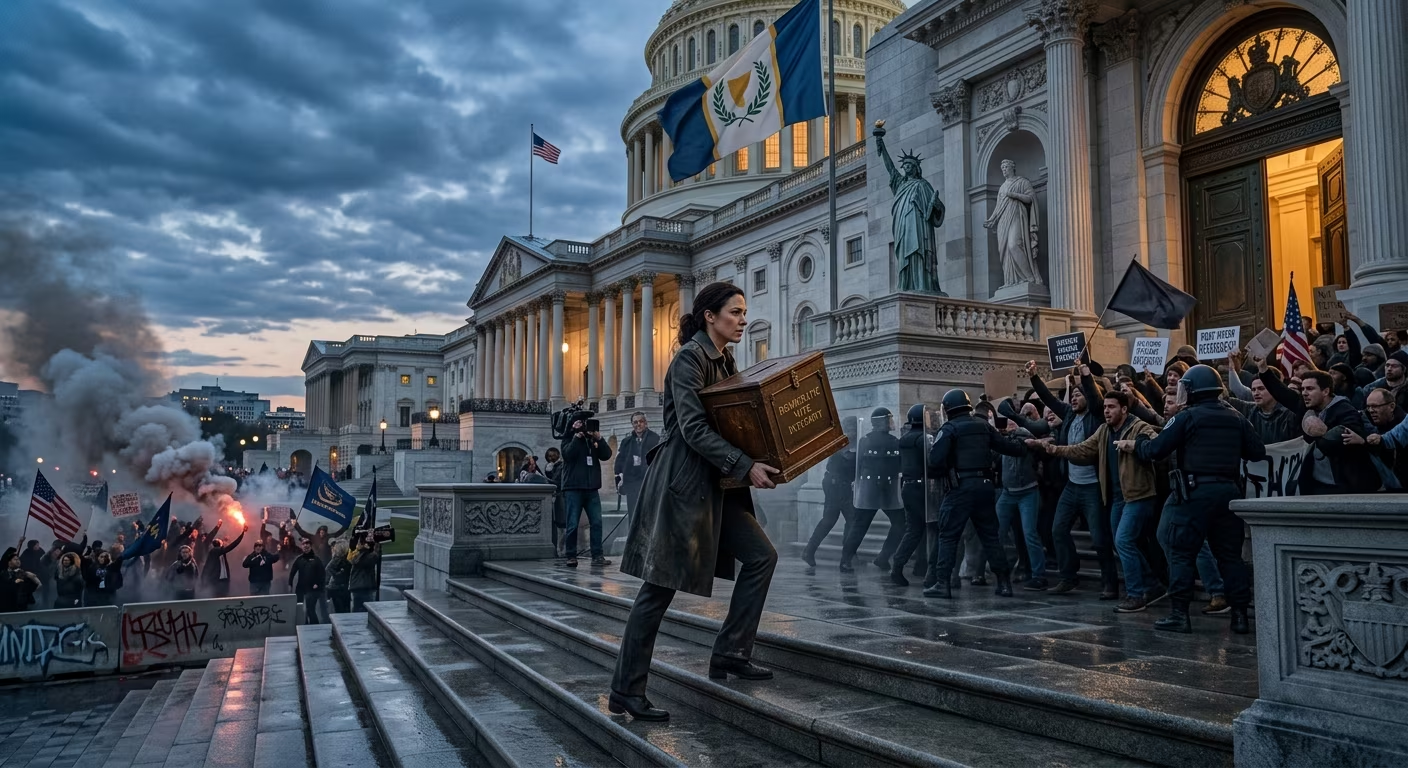
The foundation of any healthy republic is the unshakable guarantee of free, fair, and accessible elections. However, the American democratic experiment is currently navigating a period of profound vulnerability. While physical attacks on democratic institutions capture global attention, a quieter, more systemic erosion of representative government has been taking place in legislative chambers across the nation. The crisis facing democracy did not begin or end with a single day of unrest; rather, it has metastasized into a sustained, calculated effort to restrict ballot access and alter the mechanics of election administration. Understanding the true scope of this ongoing emergency requires looking past the overt disruptions and focusing on the intricate legal maneuvers designed to suppress voter participation. The integrity of the electoral process is being challenged not by outside adversaries, but by internal legislative shifts that threaten to disenfranchise millions of eligible citizens. As we reflect on the state of the nation, it becomes increasingly clear that the defense of democracy must transition from reactive measures to proactive, structural reforms aimed at protecting the fundamental right to vote.
Beyond the Physical Breach: The Shift to Legislative Battlegrounds
In the aftermath of the 2020 election, the assault on democratic norms shifted from chaotic post-election challenges to highly organized legislative campaigns. Lawmakers in dozens of states began drafting and passing bills that fundamentally alter how elections are conducted. Proponents of these measures frequently cite “election integrity” and “voter security” as the primary motivations, despite comprehensive audits and reviews confirming the security of recent national elections. This rhetorical strategy has provided a pretext for enacting laws that deliberately complicate the voting process.
The shift to the legislative arena represents a more insidious threat to democracy because it cloaks voter suppression in the legitimacy of the law. By tweaking the administrative rules of elections—such as shortening voter registration windows or reducing the number of polling locations—partisan actors can effectively shape the electorate to their advantage. This strategy does not rely on preventing voters from casting ballots through intimidation, but rather on making the process so burdensome that turnout inevitably declines. This ongoing legislative push highlights a dangerous paradigm where the rules of democracy are continually rewritten to consolidate political power rather than expand civic participation.
State-Level Restrictive Voting Laws: A Coordinated Effort
The sheer volume of restrictive voting legislation introduced since 2020 is unprecedented in modern American history. According to the Brennan Center for Justice, by late 2021, 19 states had enacted 33 laws that make it demonstrably harder for Americans to vote. This legislative wave has not dissipated; it has instead become a persistent feature of state-level politics. These laws systematically target the methods of voting that saw massive expansion and success during previous election cycles, particularly early in-person voting and mail-in balloting.
Disproportionate Impact on Communities of Color
The burden of these restrictive laws does not fall equally across the population. Historical data and contemporary civil rights analyses consistently demonstrate that voter suppression tactics disproportionately impact Black, Indigenous, and Hispanic voters, as well as voters with disabilities and low-income citizens. For instance, the reduction of polling locations in densely populated urban centers predictably leads to unacceptably long wait times—a barrier that is far less prevalent in predominantly white, suburban districts.
Furthermore, strict voter identification requirements often disadvantage minority voters who are statistically less likely to possess the specific forms of government-issued ID mandated by these new laws. The U.S. Commission on Civil Rights has extensively documented how such procedures, compounded by systemic socio-economic disparities, function as modern-day barriers to the ballot box, echoing the discriminatory practices that necessitated the civil rights movements of the mid-20th century.
Mechanisms of Disenfranchisement
The specific mechanisms used to restrict access are diverse but share a common goal of increasing the friction associated with voting. Common tactics include:
- Voter Roll Purges: Aggressive and often inaccurate removal of eligible voters from registration lists under the guise of list maintenance.
- Mail-in Ballot Restrictions: Imposing strict signature matching requirements, reducing the timeframe for requesting ballots, and severely limiting the availability of secure ballot drop boxes.
- Criminalization of Assistance: Enacting severe penalties for individuals and organizations that assist voters in returning their absentee ballots or provide food and water to citizens waiting in long polling lines.
- Polling Place Consolidations: Closing voting locations in specific precincts, thereby increasing travel distance and wait times for targeted demographics.
Data Snapshot: Analyzing the Surge in Restrictive Voting Laws
The table below provides a conceptual overview of the primary categories of restrictive voting laws enacted recently and their intended impact on the electorate.
| Category of Legislation | Common Provisions | Primary Impact on Electorate |
|---|---|---|
| Absentee/Mail-in Voting | Bans on unsolicited ballot applications; strict ID requirements for mail voting. | Reduces participation among elderly, disabled, and remote voters. |
| Early In-Person Voting | Elimination of Sunday voting; reduced daily operating hours. | Disproportionately affects wage workers and “Souls to the Polls” initiatives. |
| Election Administration | Shifting authority from nonpartisan election boards to partisan legislatures. | Increases the risk of partisan interference in ballot counting and certification. |
The Role of the Department of Justice in Safeguarding Access
In response to the proliferation of state-level restrictions, federal entities like the U.S. Department of Justice (DOJ) have been forced to intervene to protect the constitutional rights of voters. The DOJ has utilized the remaining provisions of the Voting Rights Act of 1965 to challenge discriminatory state laws. For example, the Justice Department has filed lawsuits against states that enact redistricting plans that dilute the voting strength of minority communities or pass legislation that improperly restricts assistance in the polling booth.
In 2021, the DOJ issued comprehensive guidance regarding federal statutes affecting methods of voting, reminding states that changes to election procedures must comply with federal civil rights laws. Despite these efforts, the DOJ’s ability to preemptively stop discriminatory voting laws was severely handicapped by the Supreme Court’s 2013 decision in Shelby County v. Holder, which effectively dismantled the preclearance requirement. Without preclearance, the Justice Department is relegated to reactive litigation—suing states after harmful laws have already been enacted and, in many cases, after elections have already taken place under restricted access. This dynamic underscores the urgent need for federal legislative action to restore robust civil rights protections.
Federal Impasse: The Stalled Push for Comprehensive Reform
The ongoing crisis at the state level has amplified calls for sweeping federal intervention to establish baseline national standards for voting access. Civil rights advocates and pro-democracy coalitions have championed comprehensive legislative packages designed to override state-level suppression tactics. The most prominent of these efforts has been the John Lewis Voting Rights Advancement Act, which seeks to modernize and restore the preclearance formula struck down by the Supreme Court.
Additionally, legislation aimed at standardizing early voting, implementing automatic voter registration, and banning partisan gerrymandering has been introduced to fortify the democratic process. However, the push for comprehensive federal reform has repeatedly collided with institutional roadblocks in the United States Senate. The filibuster rule, which requires a 60-vote supermajority to advance most legislation, has proven to be an insurmountable hurdle for voting rights advocates.
This federal legislative impasse leaves voters vulnerable to the patchwork of state laws that increasingly dictate the ease or difficulty of casting a ballot based purely on geographic location. The inability of Congress to pass protective measures signals a profound dysfunction within the federal government, highlighting a dangerous gap between the urgent need to protect democratic institutions and the political mechanisms required to enact such protections. As long as federal reform remains stalled, the burden of defending democracy will continue to fall disproportionately on local organizers and civil rights litigators.
Charting a Path Forward for Democratic Resilience
Despite the formidable challenges facing the American electoral system, pathways to democratic resilience remain. The defense of voting rights requires a multifaceted approach that combines relentless legal advocacy, robust civic education, and widespread grassroots mobilization. Civil rights organizations continue to mount aggressive legal challenges against discriminatory laws, securing vital injunctions that protect vulnerable voters in the short term.
At the community level, voter registration drives and educational campaigns are critical in helping citizens navigate the increasingly complex web of new voting regulations. Ensuring that voters know their rights, understand ID requirements, and are aware of polling place changes is essential for mitigating the impact of suppressive legislation. Furthermore, protecting the nonpartisan officials who administer elections from harassment and political interference is paramount to maintaining the integrity of the vote count. The crisis of democracy is an ongoing struggle that demands sustained vigilance. By recognizing the evolving nature of voter suppression and committing to both local engagement and the pursuit of structural federal reform, advocates can begin to reinforce the foundations of representative government against continuous assault.
Frequently Asked Questions (FAQs)
What is voter suppression?
Voter suppression refers to any strategy, tactic, or legislation designed to prevent eligible citizens from registering to vote or casting a ballot. Modern suppression often takes the form of complex administrative rules, such as strict ID requirements, limited early voting, and polling place closures, rather than outright bans.
How did the Shelby County v. Holder decision affect voting rights?
In 2013, the Supreme Court ruled in Shelby County v. Holder that the formula used to determine which jurisdictions required federal preclearance before changing voting laws was unconstitutional. This essentially removed the federal government’s ability to preemptively block discriminatory voting laws in states with a history of racial discrimination.
What would the John Lewis Voting Rights Advancement Act achieve?
The proposed legislation aims to restore and strengthen the Voting Rights Act of 1965 by creating a new, updated formula to determine which states and local governments must seek federal approval (preclearance) before implementing changes to their voting practices and election procedures.
Why are voting laws different in every state?
The U.S. Constitution grants individual states the primary authority to manage and administer elections. While Congress can establish national standards for federal elections, the lack of comprehensive federal legislation has resulted in a wide disparity in voting accessibility depending on where a citizen lives.
References
- Voting Laws Roundup: October 2021 — Brennan Center for Justice. 2021-10-04. https://www.brennancenter.org/our-work/research-reports/voting-laws-roundup-october-2021
- Guidance Concerning Federal Statutes Affecting Methods of Voting — U.S. Department of Justice. 2021-07-28. https://www.justice.gov/opa/pr/justice-department-issues-guidance-concerning-federal-statutes-affecting-methods-voting
- An Assessment of Minority Voting Rights Access in the United States — U.S. Commission on Civil Rights. 2018-09-12. https://www.usccr.gov/files/pubs/2018/Minority_Voting_Access_2018.pdf
- The State of State Election Law Since 2020 — Voting Rights Lab. 2022-12-14. https://votingrightslab.org/the-state-of-state-election-law-since-2020/